Published August 5, 2026
How to read Qi Baishi's signatures and seals, know his shrimp and insect subjects, and spot the workshop fakes that crowd the market for his name.
In the summers of his last years, visitors to a small courtyard house in Beijing would find a man in his nineties working by the window: ink ground fresh that morning, a sheet of xuan paper weighted flat, and a shrimp taking shape out of two loaded strokes of grey. Qi Baishi had been painting his subjects from memory for decades — the ponds, insects and field corners of a Hunan childhood — and by then the memory was surer than most painters' eyesight.
Qi Baishi (1864–1957) is the most widely loved of China's twentieth-century masters, and for a collector he is also the most dangerous name in the market: enormously prolific, endlessly imitated, and faked at every price level. This guide walks through the shape of the career, the subjects and what they signal, the seals and inscriptions, and how to think about authenticity before you think about price.
From carpenter to painter
Qi Baishi was born in 1864 into a farming family near Xiangtan, in Hunan province. There was no artistic pedigree and no money; as a teenager he was apprenticed to a carpenter and spent his twenties as a woodworker, carving decorative panels and furniture for local households. The name the world knows him by came later — Baishi, "white stone," taken from Baishipu, a place near his home village — but the carpentry never quite left. He kept "Muren," wood man, among his seals for the rest of his life.
Local scholars noticed his talent, lent him painting manuals, and pulled him into the orbit of poetry, calligraphy and seal carving. Between roughly 1902 and 1909 he made five long journeys across China, filling sketchbooks with real mountains and rivers at a time when most literati painters recycled formulas. In 1919, in his mid-fifties, he settled permanently in Beijing and made a discouraging discovery: his cool, spare manner in the tradition of Bada Shanren did not sell.
The turn came on the advice of the painter Chen Shizeng, who urged him to stop imitating and paint something warmer and more his own. Through his sixties Qi rebuilt his art — the change he called his "reform in old age" — arriving at the manner that made him famous: bright red blossoms against wet black-ink leaves, a palette owing much to Wu Changshuo's flower painting, joined to subjects no one else thought worth painting. A 1922 exhibition in Tokyo, organised with Chen Shizeng's help, sold strongly and made his reputation. By the 1930s he was the most celebrated painter in Beijing; in 1953 the new government honoured him as "People's Artist"; he worked almost to his death in 1957, at ninety-three.
The subjects, and what they signal
Qi Baishi painted the things he had known as a farm boy, and he painted them thousands of times. For a collector, subject matter is the first sorting tool — both for judging a picture and for understanding its price.
| Subject | What to know || --- | --- || Shrimp | The signature subject, refined over decades until each body was built from a few translucent strokes || Insects and grasses | Meticulously fine-lined insects, often paired with loose freehand plants || Flowers and fruit | Lotus, wisteria, plum, peony; peaches and gourds carrying wishes for long life || Small creatures | Crabs, frogs and tadpoles, chicks, mice, water buffalo || Landscapes and figures | The rarest categories, and the most valuable when genuine |
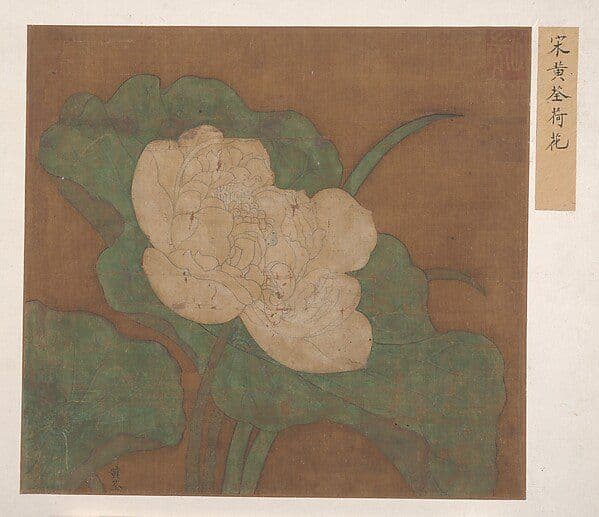
The shrimp paintings show his method at its clearest: over decades the shrimp grew simpler and more alive — fewer walking legs, a body that reads as translucent, whiskers with a live spring in them. The insect works run the opposite direction: grasshoppers and dragonflies rendered wing-vein by wing-vein, sometimes so finely that he painted stocks of them while his eyes were young and added the plants and inscriptions in old age. That pairing of precise insect and loose plant, covered in our guide to his insect-and-grass works, is one of the most distinctive inventions in modern Chinese painting. The late lotus subjects distil the same economy — broad wet leaves, a dry-brush stem, one touch of colour — and the manner carries even in reproduction, as in the Lotus and Dragonfly print in our collection.
Landscapes and figures sit at the top of the market because he painted comparatively few. In December 2017 his Twelve Landscape Screens, a set painted in 1925, sold at Poly Beijing for RMB 931.5 million — at the time the highest price ever paid for a work of Chinese art at auction.
Seals, signatures and inscriptions
Qi Baishi was a master seal carver before he was a famous painter, and his own seals — cut in a blunt, decisive single-knife manner — are part of every picture's evidence. Among the seals seen most often are Baishi, Qi Da ("Qi the elder"), Muren ("wood man"), and the wry "rich man of three hundred stone seals." A genuine impression has the same qualities as his painting: strong, plain cutting with no fuss.
Signatures are usually short — Baishi, Baishi laoren ("old man White Stone"), or Qi Huang, the formal name he took as a young man. Late works are often inscribed with his age rather than a date, and the count follows traditional reckoning, so converting an inscribed age to a Western year is not always straightforward arithmetic. The calligraphy itself is a tell: his hand was trained on seal-script models and stays blunt and upright, without the fluent sweetness imitators tend to fall into.
None of these features settles authenticity on its own. Seals outlive their owners and can be re-cut or re-used; a correct signature can sit on a wrong picture. They are checkpoints, not verdicts.
The authentication problem
By common consent Qi Baishi is the most faked painter in Chinese art. The reasons stack up neatly: a seventy-year working life and an output plausibly counted in five figures, meaning no complete catalogue exists; a manner that looks simple to copy; and a market that has paid serious money for his name for a century. Copies were being made while he was alive, members of his own circle and family painted convincingly in his manner, and modern workshop fakes range from crude to genuinely skilled.
Specialists approaching a Qi Baishi weigh the whole object, the way experts authenticate Chinese paintings generally: the behaviour of ink on the paper, the confidence of individual strokes, seal impressions compared against reference impressions from documented works, the inscription's calligraphy and internal logic, and above all provenance — where the picture has been since the 1950s, and whether that story can be checked. Warning signs repeat: compositions that assemble his greatest hits too conveniently, lines that describe a shrimp without any live force in them, inscriptions with hesitant strokes, publication histories that begin suspiciously recently.
For a buyer the practical rule is blunt. Assume a work attributed to Qi Baishi is not by him until the evidence, and ideally a specialist, argues otherwise.
What the market looks like
The Qi Baishi market is a pyramid. At the top sit the landscapes, figure paintings and important early or documented works — museum-grade objects that appear rarely and command headline prices, as the record for Chinese paintings at auction shows. The broad middle is fine flower-and-bird, shrimp and insect works with credible provenance, a market measured in hundreds of thousands to millions of dollars at the major houses. Below that spreads the base of the pyramid: attributed works, "school of" pictures, honest period copies and outright fakes, which together vastly outnumber the genuine article.
Two habits protect a collector here. First, buy the picture, not the story — a modest but plainly genuine album leaf is a better object than an ambitious painting with an unverifiable tale attached. Second, be clear about what category you are buying in: an original painting, a period copy, or a modern reproduction are three different objects with three different prices, and each is only a problem when sold as something it is not.
Common questions
How many works did Qi Baishi paint?
No one knows precisely, and that is part of the authentication problem. He worked for some seventy years, often daily, and estimates of his output run well into the tens of thousands of works. There is no complete catalogue raisonné, so absence from the literature proves little, and presence in a recent publication proves less than buyers hope. This is why provenance and expert opinion carry more weight for Qi Baishi than for almost any other modern Chinese painter.
Why are his shrimp so famous?
Because they compress his whole art into one subject. He worked on the shrimp for decades, gradually dropping legs, simplifying the head, and adjusting ink-water balance until the body reads as translucent — a live creature made of five or six strokes. They became his signature in his lifetime, which is also why they are the most copied of all his subjects: a shrimp painting should be examined more sceptically, not less.
Did Qi Baishi paint landscapes?
Yes, and they are among his rarest and most valuable works. His early landscapes drew on the five long journeys he made across China in the first decade of the twentieth century, and the late ones reinvent the genre with the same blunt economy he brought to flowers and insects. Because the market sees so few, genuine examples — like the Twelve Landscape Screens sold in 2017 — sit at the very top of his price structure.
How do I check a signature or seal on a Qi Baishi?
Compare, don't admire. Set the seal impression beside documented impressions of the same seal from museum collections and scholarly publications, and read the inscription against his known calligraphy — blunt, upright, seal-script-informed. Check that any inscribed age is consistent with the claimed date under traditional reckoning. Then treat a pass as necessary rather than sufficient, and put the real weight on provenance and specialist opinion.
Further reading
- How to Identify Chinese Artist Signatures — the general method for reading signatures on Chinese paintings.
- Reading Chinese Painting Seals — what artist, collector and studio seals tell you.
- Wu Changshuo: Flower Painter and Seal Carver — the Shanghai master whose heavy-flower manner fed Qi's late style.
- Zhang Daqian: A Collector's Guide — the other giant of the modern market, with the other great fake problem.
Browse the collection
Qi Baishi's subjects were made to be lived with, and that is the spirit of what Kiln & Ink sells: limited-edition archival giclée reproductions of the twentieth-century Chinese ink masters, printed on xuan paper or museum-grade cotton rag, hand-numbered, and issued with a Certificate of Authenticity — from about $300 to $1,200.
Explore Further