Published February 28, 2026
Chinese painting has quietly risen to dominate the upper tiers of the global auction market. From Qi Baishi's monumental Eagles and Pine to Zhang Daqian's luminous splashed-ink landscapes, these ten record-breaking sales reveal what the world's wealthiest collectors value most — and where the market is headed next.
In 2017, a single painting by Qi Baishi — twelve panels of landscapes — sold at Beijing Poly Auction for 931.5 million yuan (approximately $140 million), making it the most expensive Chinese artwork ever sold and placing it among the ten most expensive paintings in world history. The buyer's paddle dropped in a room that had gone completely silent. Even the auctioneer paused before bringing down the hammer.
Chinese painting has, in the space of two decades, gone from a niche market dominated by a handful of Hong Kong and Taipei dealers to a global force that regularly produces nine-figure results. Understanding which paintings command the highest prices — and why — offers a window into what the market values most: historical significance, provenance, rarity, and the ineffable quality the Chinese call “qi yun” — spirit resonance.
1. Qi Baishi — Twelve Landscape Screens (¥931.5M / ~$140M, 2017)
This monumental work, painted in 1925, consists of twelve large-format panels depicting landscapes from Qi Baishi's memory of his travels across China. What makes it extraordinary is not merely its scale but its rarity: Qi Baishi almost never worked at this size, and the complete set had remained in a single private collection for over sixty years. It is the only work by Qi Baishi that approaches the ambition of the great Song Dynasty landscape tradition while retaining his signature folk-art immediacy.
2. Wang Ximeng — A Thousand Li of Rivers and Mountains (never offered at auction)
This twelve-metre Song Dynasty handscroll was painted by Wang Ximeng at the age of eighteen — and he died shortly after completing it. It has never been sold at auction (it remains in the Palace Museum, Beijing), and no published valuation for it exists — nothing remotely comparable has ever come to market. Its 2017 exhibition in Beijing drew queues of over six hours.
3–5. Zhang Daqian's Market Dominance
Zhang Daqian holds a unique position: he has appeared more frequently in the top-ten annual auction results than any other Chinese artist. His splashed-ink landscape Peach Blossom Spring sold for HK$270 million ($34.9M) in 2016, and his Mist at Dawn (晓云图) fetched HK$214.6 million at Sotheby's Hong Kong in 2021. Zhang Daqian's market strength rests on his extraordinary versatility — he mastered every classical Chinese style and then invented entirely new techniques in his final decades.
6–10. The Second Tier: Xu Beihong, Wu Guanzhong, Pan Tianshou
Xu Beihong's oil painting Put Down Your Whip sold for HK$72 million in 2007 — a record for a Chinese oil painting that stood for years. Wu Guanzhong, whose abstract ink landscapes bridged Eastern and Western modernism, regularly achieves eight-figure results. Pan Tianshou, the great traditionalist, holds records in the flower-and-bird genre.
What connects all these record-setting works is a common thread: each represents a moment where an individual artist transcended the conventions of their time and created something that could not have existed before — or since. The market, for all its speculation, still rewards genuine artistic innovation above all else.
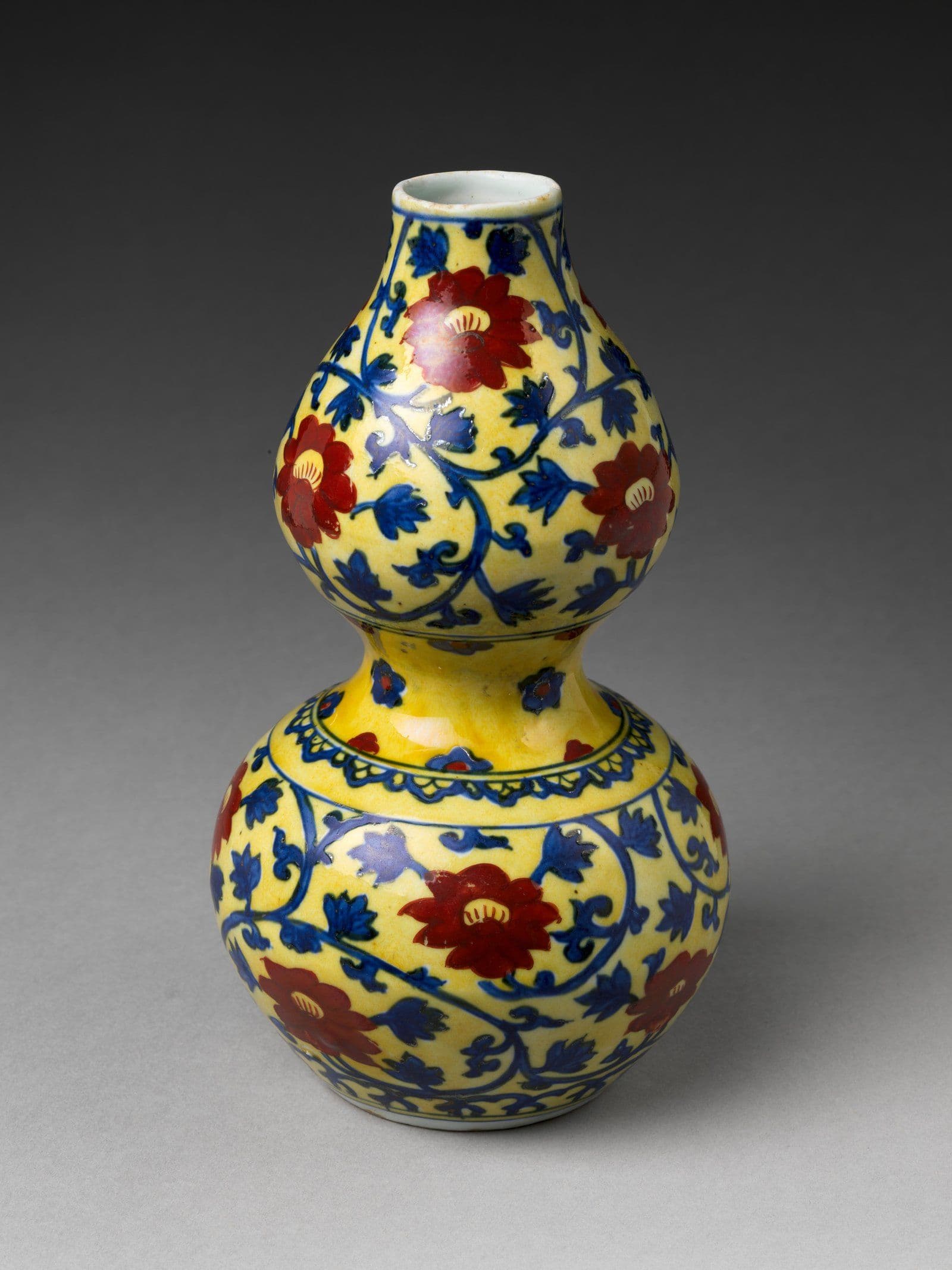
From the Kiln & Ink collection: Gourd, an archival giclée edition after Qi Baishi, hand-numbered on xuan paper with a certificate of authenticity.
Explore Further