Published September 8, 2026
Qi Baishi's peaches and gourds decoded: the longevity myth, the fulu pun in the gourd, birthday inscriptions, pigments, and what to check before buying.
Hold a Qi Baishi peach scroll at arm's length and the first thing you notice is that the fruit is too big. Three peaches sit on the paper like a small harvest, each broader than a hand, the carmine of the blush bleeding into gamboge yellow where the two colours met wet on raw paper. The leaves are black, brushed in one or two strokes of heavy ink, the veins added while the wash was still damp. Above them, in his blunt, square-shouldered script, the old man has written two characters, da shou, "great longevity", and pressed a red seal beneath.
This guide walks you through what that painting is saying: the longevity myth behind the peach, the pun inside a gourd, the rest of Qi Baishi's auspicious vocabulary, how the inscriptions, ages and seals place a work in time, and what to look at before you buy one.
Why Qi Baishi painted so many peaches
Qi Baishi settled in Beijing in 1919, a former carpenter from Xiangtan in Hunan who had learned to paint from the Mustard Seed Garden manual and from local teachers. His early work in the capital did not sell. The painter Chen Shizeng told him to trust his own eye rather than the cool, sparse manner of the Ming and Qing individualists, and over the next decade Qi reworked his whole approach. He called it shuainian bianfa, "changing method in old age".
What came out of that reform is the style the market now recognises on sight: big, wet, saturated fruit and flowers in imported red against leaves and stems of pure ink. The guide to Qi Baishi's red flowers and ink leaves covers the technique. Peaches suited it better than almost any other subject.
They also paid. A painter in the capital lived on commissions, and the largest single category was the birthday gift. A scroll of peaches with a dedication was the correct present for a sixtieth, seventieth or eightieth birthday, and Qi produced them by the hundred.
The peach of immortality
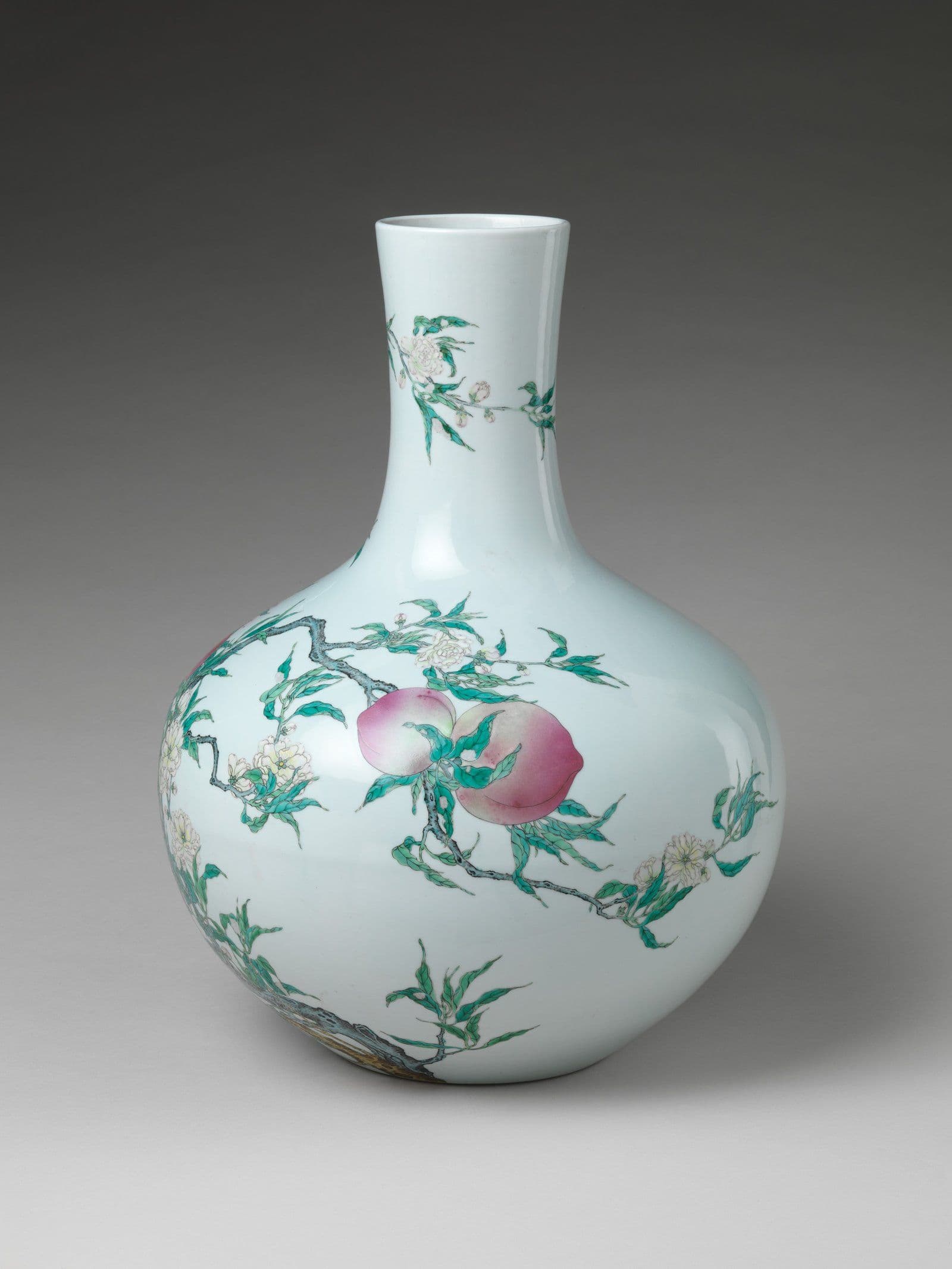
The peach is the longevity symbol of Chinese art because of a story about the Queen Mother of the West, Xiwangmu, whose orchard in the Kunlun mountains bears fruit once in three thousand years. Whoever eats it does not die. The immortals gather for her peach banquet, and the Han court wit Dongfang Shuo is said to have stolen from the orchard three times, which is why he appears in birthday paintings grinning and clutching a peach.
From that story came the shoutao, the "longevity peach". Real peaches are a summer fruit; the painted peach is a wish. The god of longevity, Shoulao, holds one in his hand. A Qi Baishi scroll of peaches alone, without a figure, compresses the whole banquet into the fruit.
The size matters. Qi's peaches are not botanically observed; they are as large as the paper allows, because the wish is large. He usually paints three or five, sometimes a basketful, with stems and leaves attached to say they were picked that morning. The bird-and-flower symbolism decoder sets out how such emblems work across the tradition. The peach is the one that needs no decoding, which is why it was the safest gift.
Reading the gourd
The gourd is the other great longevity subject of Qi's late work, and its meaning is built from sound rather than story. Hulu, the bottle gourd, is close in sound to fulu, "fortune and emolument". A gourd is packed with seeds, so it also stands for many descendants. The word for its trailing vine, man, echoes wan, "ten thousand", so a gourd on its vine reads as wandai, "ten thousand generations". There is a Daoist layer too: the immortal Li Tieguai carries a gourd holding the elixir of life, and "to hang the gourd" still means to practise medicine.
His gourds are painted in two colours only: a dense gamboge for the fruit, laid on in a few loaded strokes so that the wet edges pool darker, and ink for the vine, leaves and tendrils. The tendrils are the test of the painter. Qi drew them with a dry, twisting brush that thins and thickens without hesitation; copyists draw them slowly and the line goes dead. He often inscribed these paintings with just two characters, yiyang, "after the pattern", a joke at his own expense: the proverb about painting a gourd by copying the pattern means doing something mechanically, and Qi, who painted gourds all his life, was admitting the repetition with a grin.
The rest of the auspicious vocabulary
Once you can read peaches and gourds, the rest of Qi's fruit and flowers fall into place, because nearly all of them are puns or emblems for the same handful of wishes. This is the vocabulary he inherited from Wu Changshuo and the Shanghai school.
- Lychee. The name li echoes li, "profit", so a branch of red lychees inscribed dali, "great profit", is a gift for a merchant.
- Persimmon. Shi sounds like shi, "affair", and a heap of persimmons wishes that everything goes as you would have it.
- Buddha's hand citron. Foshou puns on fushou, "fortune and long life"; Qi liked it beside peaches because the two together say the whole blessing.
- Pine, crane and lingzhi. The older longevity emblems. In Qi's work the lingzhi turns up beside peaches, while the pine appears more often under his eagles than beside a crane.
Pairings add meaning. Peaches with peonies say "wealth and long life". Two peaches, or peaches with a second longevity emblem, are read as shuangshou, "double longevity", which is also the term for a married couple's joint birthday, so a painting under that title was very often made for a husband and wife celebrating together.
How he painted them
Three materials do most of the work. The red is yanghong, "Western red", an imported carmine that Wu Changshuo had already used for peonies and that Qi pushed to full saturation. It is an organic dye, not a mineral pigment, which is why it sinks so beautifully into the paper and why it fades if a painting hangs in direct sun for years. The yellow is gamboge, a tree resin, also organic and also fugitive. The paper is raw xuan, unsized, which drinks colour the moment it touches.
He painted the fruit without outlines, the method called mogu, "boneless": a large brush loaded with yellow, its tip dipped in red, turned once on the paper so that the body of the peach and its blush appear in a single motion. The leaves follow in ink so black it has almost no water in it, and the veins go in with the darkest ink while the leaf is still wet, so that they spread a hair's breadth into the wash. There is no going back over anything. A peach with a corrected edge, or a leaf whose veins sit neatly on top of dry ink, was not painted this way.
Inscriptions, ages and seals as dating tools
Qi's inscriptions on auspicious subjects are short and useful. The commonest are a single shou, "long life", the two-character da shou or duo shou, "great" or "much" longevity, and dedications of the form "painted for the birthday of Mr So-and-so". A named recipient is provenance; if the name can be traced, the painting can be placed. The guide to reading a Chinese painting inscription walks through the grammar of these lines.
He also signed with his age, which needs one correction. Qi counted his years in the Chinese manner, one at birth and one more at each New Year, and from 1937, on a fortune-teller's advice, he added two further years to escape a predicted calamity. So a work signed "Baishi at ninety-seven" was painted in 1957, the last year of his life, and one signed "at eighty-eight" belongs to 1948. The final works carry ages in the nineties and a slower, larger hand.
The seals confirm the reading. Ren chang shou, "may the person live long", is the seal he pressed on birthday paintings; Baishi weng, "old man Baishi", is the usual signature seal of the late period. Compare impressions with published ones rather than judging by eye, because Qi cut hundreds of seals himself and the fakers copy the famous ones first.
What the market pays for and what it fakes
Peaches are among the most copied Qi Baishi subjects, with shrimps, and for the same reasons that made them popular: the composition is simple, the meaning is universal and the demand is bottomless. The collector's guide to Qi Baishi sets out the categories of doubtful work. For auspicious subjects, three matter most.
- Studio and pupil versions. Qi's sons and pupils painted in his manner, and in his last years family members are known to have produced paintings that he then inscribed and sealed. Period works of real interest, but not by his hand.
- Later copies. Painted from reproductions, they get the composition right and the brush wrong: the tendrils are slow, the ink leaves grey rather than black, the red sitting on the paper instead of sinking into it.
- Reproductions sold as originals. Rongbaozhai woodblock-watercolour prints and modern giclée copies on xuan-type paper can pass at a glance. Under a raking light, a printed peach has no ridge of pigment along the wet edge.
In dollar terms, an authenticated peach or gourd painting of ordinary hanging-scroll size with a traceable dedication is a six-figure purchase at the major auction houses, the large birthday scrolls of the 1940s and 1950s go for multiples of that, and small album leaves and fans sit in the five figures.
Buying and living with one
A peach scroll is still the correct gift for a parent's or grandparent's milestone birthday, and a gourd for a wedding or a new house. Hang it where the household gathers; the tradition of placing Chinese paintings at home puts longevity subjects in the living room or in the room of the eldest person. Keep it out of direct sunlight, because the carmine that makes these paintings glow is the pigment most vulnerable to light. An archival reproduction at the right scale gives you the composition and the colour without the worry; the difference between the two is the subject of the guide to giclée prints and original ink works.
Common questions
What do peaches mean in Qi Baishi's paintings?
Long life. The peach is the fruit of immortality from the orchard of the Queen Mother of the West, which ripens once in three thousand years, and a painting of peaches is a birthday wish in visual form. Qi Baishi's inscriptions make it explicit: shou, da shou or duo shou, meaning "long life", "great longevity" and "much longevity", often with a dedication to the person whose birthday the scroll marked.
Why did Qi Baishi paint gourds?
Because the gourd carries four blessings in one object. Its name, hulu, sounds like fulu, "fortune and salary"; its seeds mean descendants; its vine puns on "ten thousand generations"; and the gourd of the immortal Li Tieguai holds the elixir of life. Qi painted it for birthdays and weddings, and often inscribed it yiyang, "after the pattern", a joke about painting the same subject yet again.
How can I date a Qi Baishi peach painting?
Start with the inscribed age, remembering that Qi counted in the Chinese manner and added two years to his stated age from 1937 onward, so "ninety-seven" means 1957. Then read the dedication for a recipient who can be traced, compare the seals with published impressions, and look at the hand: the late works have a slower, larger script. Paper, mounting and the tone of the carmine are supporting evidence only.
What does Double Longevity mean in a painting title?
Shuangshou is the joint birthday of a married couple, and a painting with that title was made or bought to mark it. In Qi Baishi's work the subject is usually two large peaches, or peaches paired with a second longevity emblem such as lingzhi, so that the two wishes sit side by side. The term describes the occasion rather than a fixed composition.
Further reading
- Qi Baishi's insects and grasses — the fine-brush side of his work, and the pairing of meticulous insects with broad-brush plants.
- Reading Chinese painting seals — how to compare an impression against a reference and what a seal can and cannot prove.
- How experts authenticate Chinese paintings — the order of evidence a specialist works through before an attribution.
Browse the collection
Kiln & Ink stocks limited-edition archival giclée reproductions of the twentieth-century Chinese ink masters, hand-numbered and issued with a Certificate of Authenticity. Qi Baishi's longevity subjects are among them: see the Qi Baishi artist page for the peach and gourd compositions currently in the edition, or browse the full collection.
Explore Further