Published May 1, 2026
Giclée is the most important technology in fine-art collecting since lithography, and the least well understood. This is what it actually is, why a hand-numbered giclée by an authorised estate is a real collectible, and how to tell a fine-art giclée from a glorified poster.
Giclée is the most important technology in fine-art collecting since lithography, and the least well understood. The word is French — it means "sprayed" — and refers to a high-resolution archival inkjet printing process developed in the late 1980s. This is what it actually is, why a hand-numbered giclée by an authorised estate is a real collectible, and how to tell a fine-art giclée from a glorified poster.
What giclée actually is
A giclée is made on a wide-format inkjet printer, but everything else about it is industrial-grade. The pigments are archival — typically twelve to eighteen pigment-based inks (not dyes), tested by independent labs to last 100 to 200 years without visible fading under museum lighting. The substrate is cotton-rag paper, often Hahnemühle or Canson, made the same way fine-art watercolour paper has been made for two centuries. The resolution is 1440 to 2880 dots per inch — finer than any litho stone or screen-printing mesh can resolve.
The result is a print indistinguishable from the original at viewing distance, on a substrate that will outlast most of the original oil paintings hanging in major museums today.
The problem giclée solves
Twentieth-century Chinese masters present a specific problem for international collectors. The originals — a Qi Baishi shrimp scroll, a Xu Beihong galloping horse, a Zhang Daqian splashed-ink landscape — sell at auction for $5 million to $50 million. They live in museums, in vaults, in the hands of a few hundred families worldwide. They are functionally inaccessible to anyone outside that ecosystem.
Before giclée, the only alternative was a poster — a four-colour offset litho print, often on coated paper, with no edition control, indifferent colour fidelity, and an archival lifespan measured in decades, not centuries. A Qi Baishi poster on your wall in 1985 would be visibly faded by 2010. The market for serious reproductions of Chinese masters basically did not exist.
Giclée changed this. A high-resolution scan of the original, printed on rice paper or cotton rag with archival pigment, can reproduce the brushwork, the ink granulation, the bleed at the edges, and the exact colour temperature of the original — to within a few percent of human visual discrimination.
What "hand-numbered" and "limited edition" actually mean
A hand-numbered limited-edition giclée is a closed run. The artist's authorised estate decides on a fixed number of prints — say 200 — and that number is reserved exclusively for that work. Each print is hand-numbered (e.g. 47/200), signed off by the estate, and accompanied by a Certificate of Authenticity that records its number, the work it reproduces, the printer, the paper, and the inks.
Once the edition is closed, no more are produced. Ever. The plates and digital files are escrowed or destroyed. This is the same model used by twentieth-century lithography editions of Chagall, Picasso, and Miró — works that today sell for anywhere from a few hundred dollars to $50,000 each, depending on artist, image and edition size, and which were originally published as authorised reproductions during the artists' lifetimes.
Giclées of Chinese masters work the same way. The economics are similar in shape, not in scale: a giclée of a major Qi Baishi work sits at a small fraction of the original's price — our own editions run from about $300 to $1,200. No secondary market for Chinese-master giclée editions has formed yet, so treat any appreciation claim, ours included, as speculation rather than forecast.
How to spot a real fine-art giclée
Three diagnostics:
First, the paper. Run your finger along the edge — fine-art giclée paper is heavy (300 to 400 gsm), with a deckled or torn-and-mounted edge, and has visible fibre. A poster on coated paper will have a sharp machine edge and a glossy or matte coating that feels slick.
Second, the surface under raking light. A real giclée has dot variation visible at 20cm — almost imperceptibly fine, but present. A litho poster has a regular four-colour rosette pattern visible to the naked eye. A digital print on coated stock will look uniformly flat.
Third, the documentation. A serious edition comes with a Certificate of Authenticity that lists the edition size, the print number, the source work, the paper, the inks, and the issuing party. No certificate, or a generic certificate that doesn't list the specific print number, means it is not a real edition.
What giclée is not
A giclée is not the original painting. It is a reproduction. Anyone who tells you otherwise is either confused or selling something. A Qi Baishi giclée is a record of a Qi Baishi painting; the painting itself remains in whatever collection holds it.
But a hand-numbered, archival, limited-edition giclée from an authorised estate is a real fine-art object — one that will hang on a wall for a hundred years without visible change, that has its own market and provenance, and that lets a collector live with the work of a major painter at a price that is not eight figures. That is a meaningful thing to buy. The poster is not.
Every print at Kiln & Ink is a hand-numbered limited-edition giclée on archival rice paper, sourced through authorised estates and accompanied by a Certificate of Authenticity recording the edition, paper, and inks.
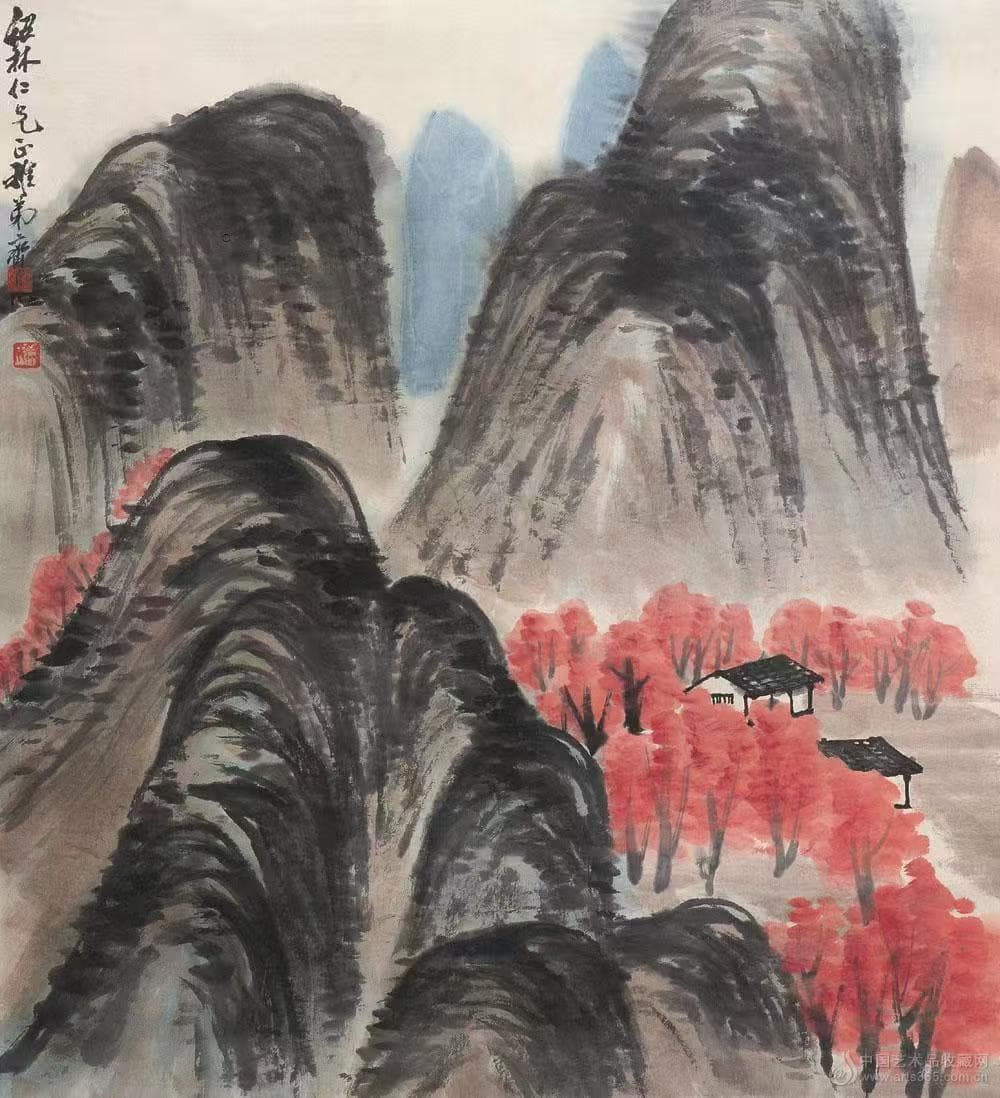
From the Kiln & Ink collection: Fine Autumn Scenery, an archival giclée edition after Qi Baishi, hand-numbered on xuan paper with a certificate of authenticity.
Explore Further