Published September 7, 2026
Feng shui placement for Chinese paintings: where horses, lotus and shanshui mountains go, which way they should face, and the rooms to avoid for paper.
Hold a galloping-horse print against the wall of a hallway and turn it round once. With the horse running toward the front door the picture reads as an exit; with the horse running into the house it reads as an arrival. Nothing about the ink has changed, but every feng shui manual of the last century would tell you the second hanging is the correct one. That small turn is what feng shui placement mostly comes down to: which way a subject moves, what it stands for, and which wall it faces.
This guide walks you through the conventions as practitioners apply them to the three subjects collectors of twentieth-century Chinese ink ask about most: Xu Beihong's horses, the lotus paintings of Zhang Daqian and Qi Baishi, and the mountain-and-water landscape. You will be able to read the direction of a picture, match it to a room and a wall, tell the two schools of feng shui apart when their advice conflicts, and recognise the placements a paper conservator would veto whatever the compass says.
What feng shui asks of a painting
Feng shui (fengshui, "wind and water") is a set of conventions for arranging a space so that qi, the animating breath, moves through it without stagnating or rushing out. Applied to pictures, that becomes three questions. First, what the subject represents in the symbolic vocabulary Chinese painting has carried for a thousand years. Second, which of the five elements it belongs to: wood, fire, earth, metal or water. Third, which way it moves, because a painting with movement in it is treated as a current, not as a wall covering.
Two schools give different answers. The classical compass and form schools orient the house by its actual facing direction and place subjects by the real compass sector they suit. The bagua-map method popularised in the West lays a nine-square grid over the floor plan from the front door, with career at the entrance wall, wealth in the far left corner and relationships in the far right, regardless of compass bearings. A horse that belongs in the south under one system belongs in the fame sector under the other, and the two only coincide when the front door faces north.
Treat all of this as convention rather than physics. Its practical value is that the rules make you think about sightlines, light and the first thing a visitor sees, which is what a good hang is anyway. The design side is covered in the styling guide listed under further reading; this article covers the symbolic side, and points out where the two agree.
Horses: direction, room and number
The horse is the yang subject par excellence, and the blessing that comes with it is ma dao cheng gong, "success the moment the horse arrives". Xu Beihong's galloping horses are the version almost everyone means when they say "a horse painting", and the reasons they became a national symbol are traced in Xu Beihong's Horses: A Painter, a Nation, a Symbol. For placement, three conventions matter.
- The horse runs into the house. Hang it so the animal moves toward the interior, or toward the seat of the person who owns the room, never toward the door or a window. A horse heading out is read as fortune leaving.
- South, or the working room. Horses belong to fire, so the compass school sends them to the south wall and the bagua map to the fame sector, the wall opposite the front door. In practice most practitioners settle for the study or the office, behind or beside the desk.
- Not in the bedroom. Too much movement in a room meant for rest. The same logic keeps eagles, tigers and anything with teeth out of the bedroom.
Number carries meaning as well. A single horse is drive; a pair is companionship; the group of eight, the ba jun tu, "eight steeds", is the auspicious set, because eight is the number of prosperity and the eight horses of King Mu of Zhou are among the oldest horse legends in Chinese literature. A group running one way reads as momentum; a group scattered across the sheet reads as freedom rather than arrival, and belongs where the family gathers rather than where anyone works.
Lotus: the water subject for living rooms and entrances
The lotus carries more homophones than any other flower in the language, which is why it appears in so many houses. He, "lotus", sounds like the word for harmony; lian, its other name, sounds like "continuous" and like "integrity". Since Zhou Dunyi's Song-dynasty essay on loving the lotus, the flower that rises from the mud unstained has stood for the upright person. Painted with fish it says lian nian you yu, "surplus year after year"; painted as a pair of blooms on one stalk it is the matrimonial subject.
Placement follows the meaning. Lotus belongs to water, so the compass school gives it the north, the career wall, and the bagua map does the same. Practitioners agree on the living room, the dining room and the wall facing the front door, where a calm subject is wanted in the first sightline. A pair of lotuses goes in the bedroom, one of the few painted subjects that does, because the meaning is union rather than movement. A lotus pond with fish goes where money is discussed.
Which lotus you hang changes the effect. Zhang Daqian's lotuses, from ink monochrome to the splashed-colour late works discussed in Zhang Daqian Lotus Paintings: Periods, Styles and How to Judge, are large, upright and formal, and read well over a sofa or in a hall. Qi Baishi's lotuses, red flowers over ink leaves with a dragonfly or a few fish for scale, are smaller and warmer and suit the dining room. The wider vocabulary of these pairings is decoded in Chinese painting symbols: what magpies, cranes and peonies mean.
Mountains and water: the backing wall
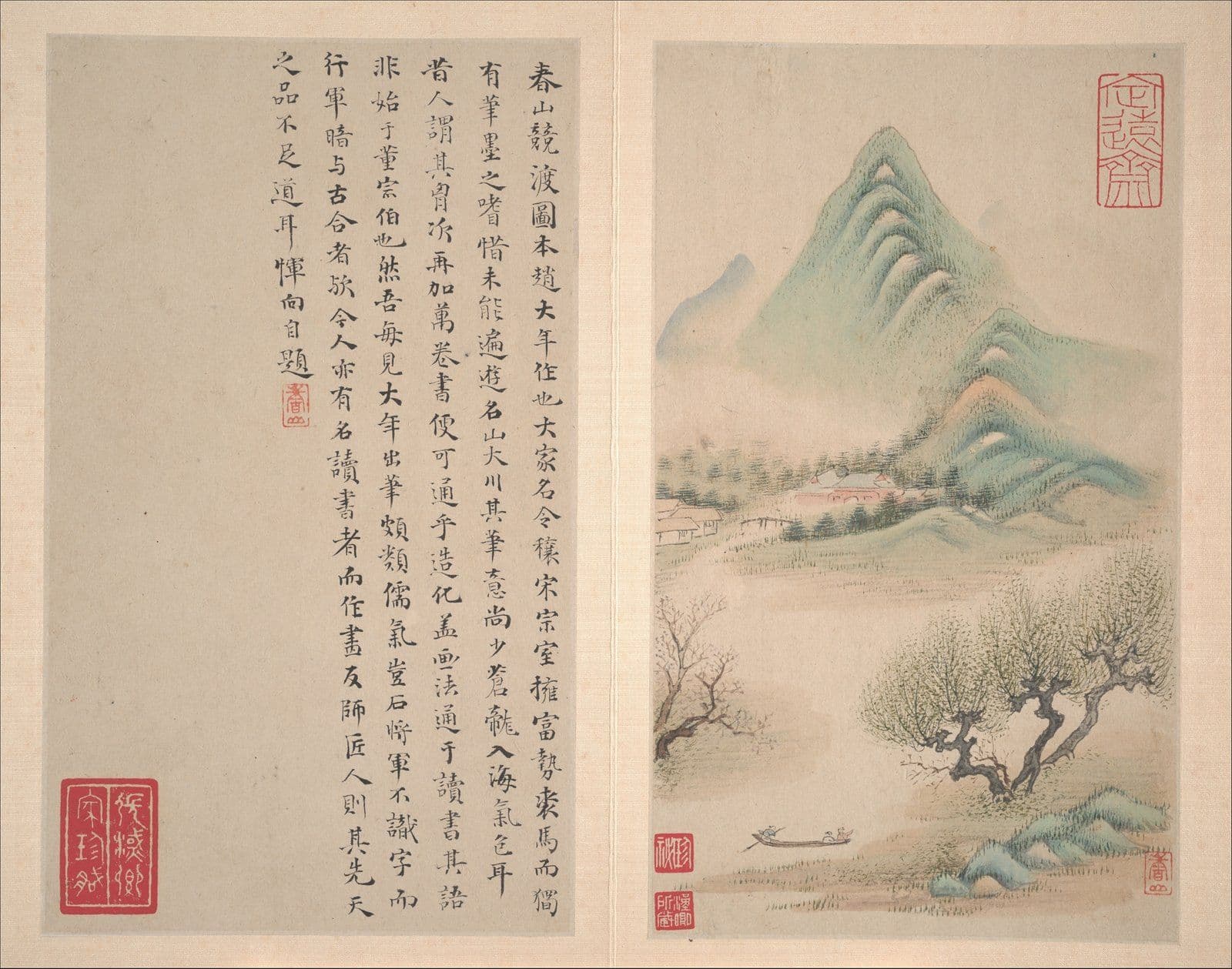
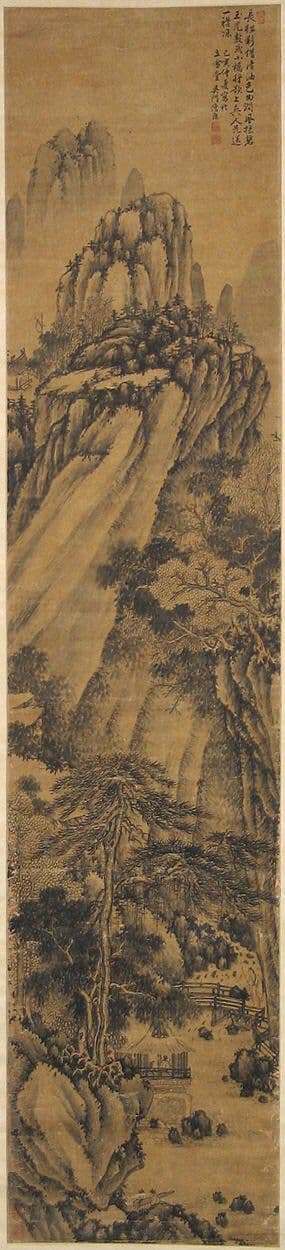
The mountain has the clearest placement rule in the whole tradition, because the rule is built into everyday Chinese. Kao shan, "a mountain to lean on", means a backer, a patron, a solid support. A landscape hangs behind you, on the wall at your back when you sit at the desk or on the sofa, so that the mountain is the support and the room in front of you is the open ground. Hang the same scroll on the wall you face and the mountain becomes an obstacle.
Water is the second half of the picture and has its own rule: shan guan rending, shui guan cai, "mountains govern people, water governs wealth". A river or waterfall should flow into the room and toward the seat, never toward the door. Rapids, waterfalls and storm seas are kept out of bedrooms and out of the wealth corner, where calm water is wanted; a still lake or a slow river with a boat is the safe version.
Practitioners also read the season and the mood. A spring or autumn landscape with a path leading into the mountains and a house at the end of it is the classic auspicious composition; a winter scene, a bare crag or a landscape with no path and no dwelling is admired in the study and kept away from the room where guests are received. To read those elements in the picture itself, see Chinese landscape painting: how to read a shanshui scroll.
Reading the direction of any picture
Most of the placement rules reduce to reading movement, and you can do that for any subject.
- Movement. Animals, birds, boats and running water all have a direction. Point it into the room, toward the seat of the room's owner, or toward the centre of the house. Never toward the door, a window or a staircase.
- Gaze. A bird or a figure looking out of the picture edge is read as leaving. Choose a composition whose gaze meets the room.
- Weight. Heavy ink, dark rocks and the mass of a mountain go low and behind; light, open, blank paper goes high and in front. A top-heavy landscape over a bed is the placement every manual forbids.
- Season and state. Blossom, fruit and full leaf are welcomed; dead trees, fallen petals and bare branches are for the scholar's study, where melancholy is a virtue.
- Pairs. Couplets and paired scrolls hang as pairs, flanking a door or a window, never split across rooms.
Rooms to avoid, whatever the school says
Here the feng shui manual and the paper conservator say the same thing for different reasons. Both keep ink paintings out of the bathroom and the kitchen: the manual because water and fire are the wrong elements for paper, the conservator because steam, grease and swings in humidity destroy xuan paper and lift the mounting. Both keep a painting off the wall above a radiator or a fireplace and out of direct sun.
The care rules are not negotiable, so be sure of them before the compass comes out. Works on paper want a stable room, indirect light, UV-filtering glazing and a mount that lets the paper move; the details are in how to care for Chinese ink paintings and works on paper. If a feng shui placement and a conservation rule conflict, the conservation rule wins, because a faded horse brings nobody luck.
Height, scale and the bagua on a real wall
Height is the mistake most people make before any question of direction. Hang the centre of the picture at eye level for a standing person, about 145 to 150 centimetres from the floor, which is the museum convention; over a sofa, drop it so the bottom edge sits a hand's width above the back. A hanging scroll is the exception, because it is tall and read from a seated position, and there is a separate note on displaying a Chinese scroll painting at home.
Scale follows the wall. A painting should cover between half and two thirds of the width of the furniture beneath it; a small print floating on a large wall reads as an afterthought under both systems. Lay the grid from the front door, find the sector you want to strengthen, and only then ask which of your subjects belongs there: horses to fame, lotus to career or relationships, mountains to the wall at your back.
Common questions
Which direction should a horse painting face in feng shui?
Into the room. The convention is that the horse runs toward the interior of the house or toward the seat of the room's owner, so that it reads as arriving with success rather than leaving with it. Avoid a horse running toward the front door, a window or a staircase. If the print shows several horses running in different directions, hang it where the family gathers rather than in an office.
Where should a lotus painting be placed at home?
In the living room, the dining room or on the wall that faces the front door, and on a north wall if you follow the compass school, because lotus is a water subject. A pair of lotus blooms on one stalk is the one lotus composition that belongs in the bedroom, since its meaning is marital harmony. Lotus with fish, meaning surplus year after year, goes where household finances are discussed.
Can you hang a mountain landscape in the bedroom?
Yes, with two conditions. Keep the mountain behind the bed, not on the wall the bed faces, and choose a calm composition, with still water or none, a path and a dwelling rather than a waterfall or a storm. Practitioners also warn against a heavy, top-weighted landscape directly above the pillows; a small horizontal scene on a side wall is the placement most recommend.
Does feng shui placement matter for a giclée print as much as for an original?
Under feng shui, yes: the conventions read the subject, the direction and the wall, not the medium, so a well-placed archival print of a Xu Beihong horse follows the same rules as the painting it reproduces. Under conservation, an archival giclée on cotton rag is more forgiving of light than a painting on xuan paper, but the same rooms are still to be avoided.
Further reading
- How to Display Chinese Art in Your Home: A Complete Styling Guide — the design side of the same decisions, from wall colour to grouping.
- Chinese Hanging Scrolls: Format, Mounting and Display — why a scroll hangs differently from a framed print.
- Xu Beihong: A Collector's Guide to the Horses and Beyond — the horses themselves, periods and what is faked.
Browse the collection
Every subject in this article is one Kiln & Ink stocks. The collection carries limited-edition archival giclée reproductions of Xu Beihong's galloping horses, Zhang Daqian's and Qi Baishi's lotus paintings and the mountain landscapes of Li Keran, Lu Yanshao and Huang Binhong, each hand-numbered and issued with a Certificate of Authenticity. The Xu Beihong artist page is the place to start if the hallway wall is the one you need to fill.
Explore Further