Published September 6, 2026
Chinese painting symbols decoded: what magpies, cranes, peonies, lotus and plum mean, how homophone rebuses pair them, and how to read the occasion of a gift.
Hold a bird-and-flower painting at arm's length and count before you admire. Two magpies, not one, on a plum branch with three open blossoms; a red seal low in the corner; four characters running down the margin. None of it is decoration. The pair of birds is a wish, the plum is a pun, and the four characters say the wish aloud for anyone who can read them. A painting like this was made to be sent — to a wedding, a sixtieth birthday, a new house — and it carries its message the way a card carries a printed verse.
This guide walks you through how the rebus system behind Chinese painting symbols works, what the birds, flowers, fruits and animals that recur in bird-and-flower painting each stand for, how pairings and numbers compound the meaning, how to separate an auspicious commission from a scholar's statement, and how to read the occasion of the painting in front of you.
How a Chinese painting says what it means
Chinese has a small stock of syllables and a very large stock of words, so almost every painted object sounds like something else. A bat is fu (蝠) and fortune is fu (福); a fish is yu (鱼) and surplus is yu (余). Paint the bat and you have written the blessing. The device is called xieyin (谐音), "matching sound", and it is the engine of the whole system. A subject that looks like natural history is very often a sentence.
Sound is only the first layer. The second is the observed character of the thing: the crane lives long, the pine stays green through winter, the lotus rises clean out of mud. The third is literature, which fixed particular plants to particular men — Tao Yuanming's chrysanthemums by the eastern fence, Zhou Dunyi's essay on the lotus, Lin Bu's plum trees at West Lake. The fourth is rank. Qing civil officials wore birds on their rank badges, with the crane for the first rank. So a crane on a scroll can be a birthday wish, an immortal's mount or the top of the civil service, and the inscription is what settles it.
Birds: magpie, crane, mandarin duck, rooster, egret
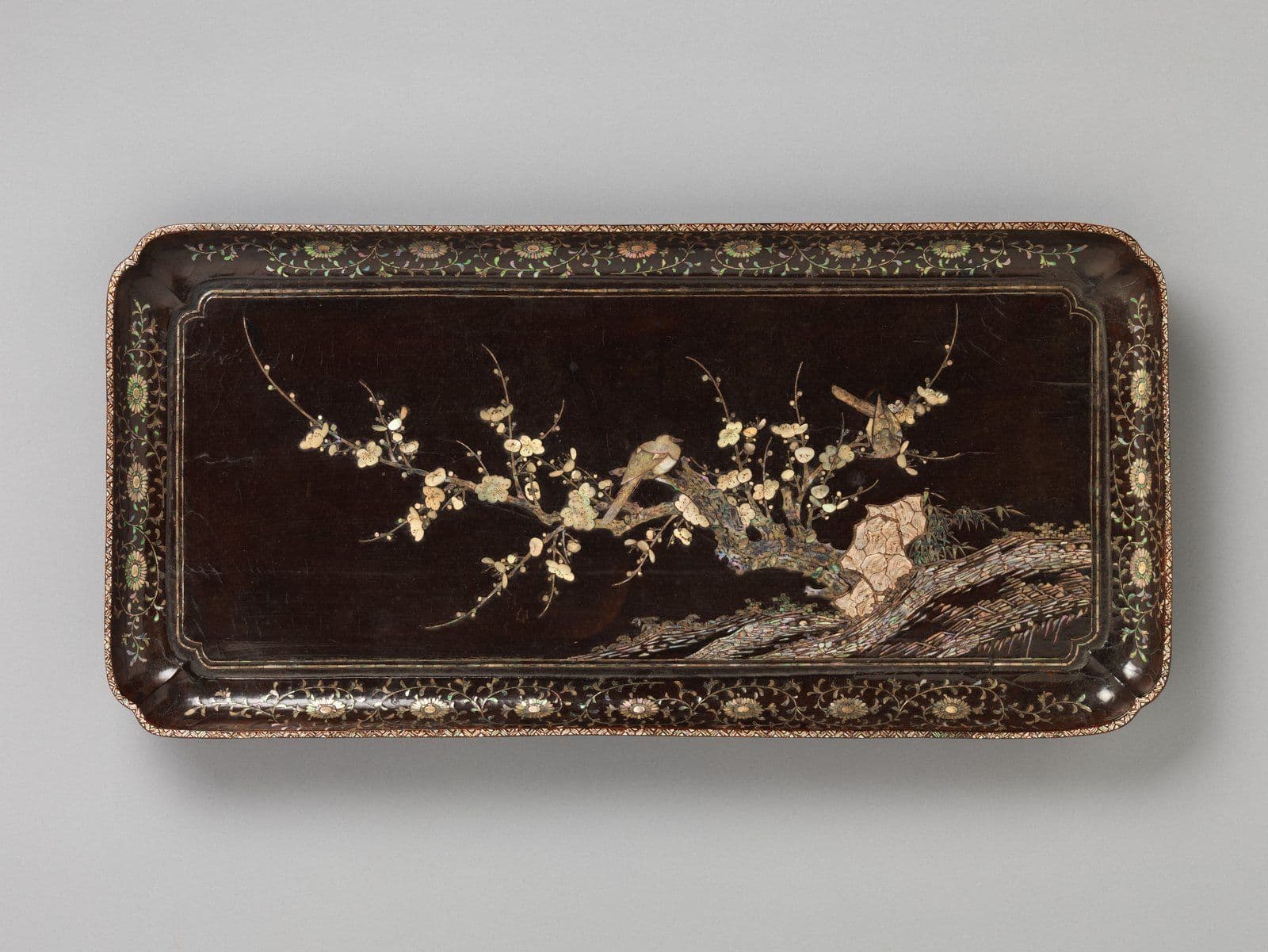
- Magpie (xique, 喜鹊). The name contains xi, joy. One magpie is good news arriving; two are shuangxi, "double joy", the wedding wish. A magpie on a plum branch is xi shang mei shao, "joy up to the tips of the eyebrows", because mei the plum sounds like mei the eyebrow.
- Crane (he, 鹤). Long life, and the bird the immortals ride. With a pine it becomes songhe yannian, "pine and crane extend the years", the standard birthday scroll. Standing among waves with the sun in the corner, it borrows the first-rank badge and wishes for office instead.
- Mandarin ducks (yuanyang, 鸳鸯). Always a pair, always fidelity. They swim among lotus so that lian the lotus also reads as lian, "joined", and the whole picture says a marriage that holds.
- Rooster (gongji). A crowing cock is gong ming, "merit and fame", from gong the cock and ming the crow. Beside a cockscomb flower (jiguanhua) it becomes guan shang jia guan, "office upon office", because guan the comb sounds like guan the official.
- Egret (lu, 鹭). One egret walking through lotus and reeds is yi lu lian ke, "may your road through the examinations be unbroken".
- Eagle (ying, 鹰). Ying is also "hero". Qi Baishi inscribed an eagle on a pine "the hero stands alone", and Li Kuchan built his late style on the bird. In twentieth-century painting the eagle is a national mood rather than a pun.
Flowers: peony, lotus, plum and the rest of the calendar
- Peony (mudan, 牡丹). The fugui hua, "flower of wealth and rank", and the most-painted flower in the language. A peony with a cat and a butterfly is a birthday picture, because mao the cat and die the butterfly together sound like maodie, the word for a great old age.
- Lotus (lian, 莲, or he, 荷). Purity, from the plant that rises unstained from the mud. Lian also sounds like "continuous" and he like "harmony", so lotus with fish is lian nian you yu, "abundance year after year", and a lotus given at a wedding wishes the couple harmony. The seed pod, lianzi, sounds like "sons in succession". Zhang Daqian's lotus paintings carry all of this while being, first, exercises in the wet brush.
- Plum (mei, 梅). Blossom on bare wood in the cold: endurance, and the scholar's spine. The five petals stand for the wufu, the five blessings of long life, wealth, health, love of virtue and a peaceful end. With pine and bamboo it forms the suihan sanyou, the Three Friends of Winter. Guan Shanyue's red plum turned the scholar's sparse ink plum into a crowded, optimistic subject, and the change of colour is itself the message.
- Chrysanthemum (ju, 菊). Autumn, retirement and the long life of a plant that flowers after frost.
- Bamboo (zhu, 竹). Hollow at the heart and straight at the joint, so humility and principle together. Zhu also sounds like "to wish", which is why bamboo turns up in so many birthday pictures. Plum, orchid, bamboo and chrysanthemum together are the Four Gentlemen.
Fruits and animals that finish the sentence
- Peach. The fruit of the Queen Mother of the West, ripening once in three thousand years: long life, and the birthday fruit above all others.
- Pomegranate. Painted split, with the seeds showing, it is liu kai bai zi, "the pomegranate opens on a hundred sons".
- Buddha's hand citron (foshou, 佛手). Fo sounds like fu, fortune, and shou is longevity. Peach, pomegranate and citron together are the sanduo, the Three Abundances: long life, many sons, much blessing.
- Persimmon (shi, 柿) and lychee (li, 荔). Shi sounds like "matters", so persimmons with a ruyi sceptre are shi shi ruyi, "everything as you wish". Li sounds like "profit", which is why Qi Baishi could title a plate of lychees Great Profit without irony.
- Fish (yu, 鱼). Surplus. Nine carp are lasting abundance because jiu, nine, sounds like jiu, enduring; goldfish, jinyu, sound like "gold and jade". A carp leaping the dragon gate is examination success.
Pairings, numbers and colour: how meaning compounds
Meaning in this system is additive. Crane plus pine is long life; add a peach and it is a birthday; add the character shou (寿) in the inscription and the painter has stopped hinting. Magpie plus plum is joy; make the plum red and the picture is for the New Year; put two magpies in it and it can go to a wedding as well. Numbers work the same way: five bats are the five blessings, nine carp last, and a hundred of anything, bai, is the number of plenty.
Colour completes the reading. Red is joy, the wedding and the New Year, and a red peony or red plum is a warmer wish than an ink one. Ink monochrome is the scholar's register, and the same plum painted in ink alone leans towards character rather than celebration.
Reading the occasion — and what it tells you about the object
Once the vocabulary is in place, the subject tells you what the painting was for, and that in turn tells you what to expect from it.
- Birthday. Peach, crane, pine, lingzhi, the God of Longevity with his high forehead, the cat and butterfly, the shou character.
- Wedding. Mandarin ducks, lotus, paired magpies, red peony, the doubled xi character.
- Examination or promotion. Rooster with cockscomb, egret among lotus, carp at the gate.
- New Year. Magpie and plum, narcissus, persimmon, bats, and the whole repertoire of the popular woodblock print.
A gift painting was usually made quickly, to a formula, and sometimes by a studio hand. The dedication, however, is a gift to the collector: a named recipient and a date in the upper inscription are provenance in the painter's own hand. Dealers knew that an obscure recipient made a painting harder to sell, and often trimmed the dedication away, so an inscription that begins abruptly, or a top margin that sits tight against the text, deserves a second look.
Auspicious commission or scholar's statement
The same plant can belong to two different traditions. The Four Gentlemen and the Three Friends of Winter are self-portraits: a scholar painting bamboo in ink is describing the man he intends to be, and his inscription is a poem, not a wish. The peony, the crane and the paired ducks belong to the professional and the court painter, executed in colour, often in the fine-line gongbi manner, for a client and an occasion. Xieyi and gongbi were never simply two techniques; they were two markets with two vocabularies.
The twentieth-century masters straddled the line. Qi Baishi sold peonies inscribed Wealth and Honour and lychees inscribed Great Profit to the Beijing market with no embarrassment, in a brush that came straight from the literati tradition, while Pan Tianshou's birds sit on rocks that are about structure, not blessing. Knowing which register a painter is in tells you how to weigh the subject: as a message, or as a pretext for brushwork.
What symbolism cannot tell you
It cannot authenticate. A rebus is as available to a copyist as to a master, and the auspicious subjects are precisely the ones that studios reproduced in quantity. A Nine Carp or a Hundred Cranes is a decorative subject before it is anything else. Nor does it date: the vocabulary was in place by the Ming and has not changed since, so paper, mounting, seals and the brush itself date a painting and the subject does not.
It can also be over-read. Not every quail is a pun. English titles supplied by dealers, Prosperity, Longevity, Harmony, are often added afterwards to a picture whose inscription says something else. Read the inscription first and the symbols second.
Common questions
What do birds and flowers mean in Chinese painting?
Each bird, flower, fruit or animal stands for a word, a quality or a story. Most meanings come from homophones: the bat sounds like fortune, the fish like surplus, the magpie's name contains the word for joy. Others come from the nature of the thing, so crane and pine mean long life and the lotus means purity. Combined, they form a sentence, usually a wish for the person who received the painting.
What does a magpie symbolise in Chinese art?
Joy. The magpie's name, xique, contains xi, the word for happiness, so a single magpie announces good news and a pair means double joy, the wedding wish. On a plum branch the picture reads xi shang mei shao, "joy up to the eyebrows", because plum and eyebrow are both mei. Magpies and plum are also a New Year subject, since plum is the first flower of the year.
What does the crane mean in Chinese painting?
Long life first: the crane was believed to live for centuries and to carry the immortals. Paired with an evergreen pine it is the standard birthday scroll, songhe yannian, "pine and crane extend the years". The crane was also the badge of the first civil rank under the Qing, so it can wish for high office as well as old age.
What does the peony symbolise in Chinese painting?
Wealth and rank. The peony is the fugui hua, the flower of riches and honour, which is why it appears on wedding gifts and in New Year pictures. With a cat and a butterfly it becomes a birthday wish for a long old age, because the animals' names together sound like the word for one's eighties. Red peonies are the warmest version of the wish.
Further reading
- Bird-and-Flower Painting: A Collector's Guide to Huaniao — the tradition, the two techniques and what to check before buying.
- The Four Gentlemen: Plum, Orchid, Bamboo and Chrysanthemum — the four moral emblems that are not rebuses.
- How to Read a Chinese Painting Inscription and Signature — where the wish is written out, and the dedication with it.
- Nianhua: Chinese New Year Prints and How to Date Them — the same vocabulary in the popular print.
Browse the collection
Most of what Kiln & Ink stocks speaks this language. Qi Baishi's peonies, gourds, lychees and lotus pods and Xu Beihong's magpies, cranes and roosters are the rebus tradition carried into the twentieth century by two of its best brushes, and our limited-edition archival giclée reproductions of them, hand-numbered and issued with a Certificate of Authenticity, are in the collection. Choose by the wish as well as the picture.
Explore Further