Published September 20, 2026
How to read the colophons on Chinese scrolls: what a tiba proves about a painting, how to date the hand and seals, and the four ways they are faked.
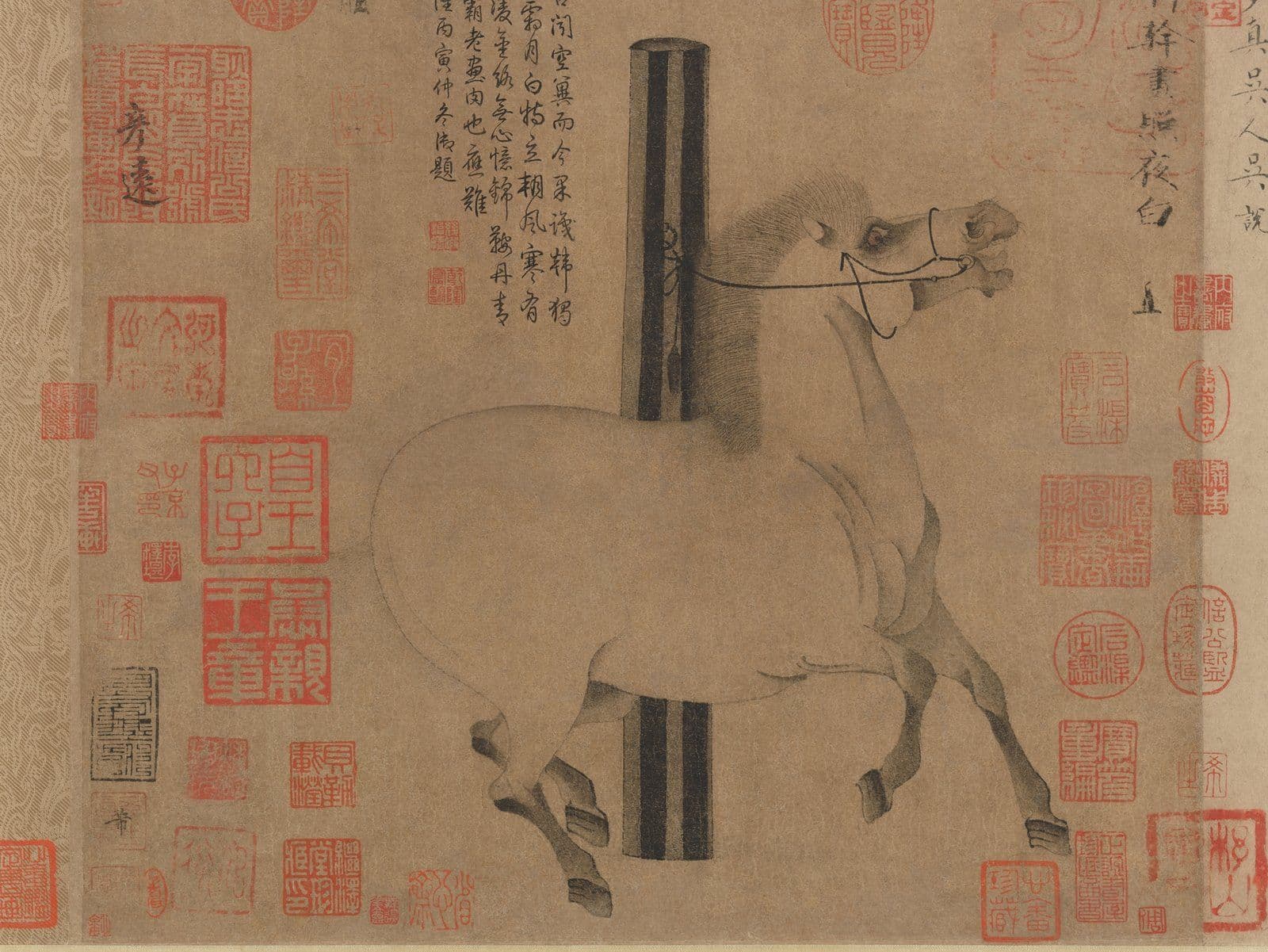
Hold a handscroll open at arm's length and you will see that the painting is rarely the longest thing on the paper. Past the final brushstroke the mounting keeps going, and on that continuation other people have written: an owner three centuries after the artist, a scholar who borrowed the scroll for a fortnight, an emperor who could not leave a good silk alone. The columns run right to left, stamped over in vermilion, sometimes so crowded that the painting reads as the quiet opening to a long argument. Those texts are colophons, tiba, and they are the part of a Chinese scroll most buyers skim and most specialists read first.
This guide walks you through what a colophon is and where it sits on each format, the five jobs a tiba usually performs, how to read the hand and the date, what an inscription proves about a painting and what it cannot, the ways colophons are forged or transplanted between scrolls, and the checks to run before you let one raise your estimate of a picture.
What a colophon is, and what it is not
The word tiba is a compound of two habits. Ti is writing placed before or above the work, on the frontispiece or in the empty sky of a painting. Ba is the postscript that follows it, written after the image ends. Together they cover every text added to a scroll by a hand that is not making the picture.
That last clause matters. The artist's own inscription, the line of characters ending in a signature and a seal, is not a colophon but a kuanti, a signed inscription, and it is judged by different evidence: brush habits shared with the painting, ink that sank into the paper at the same time. A colophon is by definition later. It may be later by a week, when the painter's friend adds a poem over supper, or by six hundred years, when a Qing collector records what he paid and whom he doubted.
Confusing the two is the commonest beginner's error, and it runs in one direction: a good colophon is read as though the artist had endorsed it. If you are still learning to separate the hands, the conventions of artist signatures are the place to start, since the signature anchors every later date.
Where colophons sit on each format
Format governs how much room a later hand has, and so how much testimony a scroll can accumulate.
- Handscroll. The most hospitable. A scroll has a frontispiece for a large title in seal or clerical script, and after the painting a length of paper or silk, the tail, joined specifically to receive writing. Owners add sections to it. A handscroll that has passed through five serious collections can carry more text than image. The reading order and the way the scroll is opened section by section are covered in the handscroll viewing guide.
- Hanging scroll. Constrained. There is the sky above the image and narrow strips of mounting silk, so inscriptions stay short, and a long colophon ends up on a slip kept in the box.
- Album leaves and fans. Colophons occupy facing leaves. An album of eight paintings may be bound with eight leaves of commentary opposite them, written decades apart by different people.
Every one of those positions is created by the mounter, not the painter, which is why remounting history and colophon history are the same subject; the mounting practice known as zhuangbiao determines what survives of both.
The five jobs a tiba does
- Praise and placement. The writer names the tradition the painting belongs to, usually through two or three earlier masters. Common, and the least useful as evidence.
- Attribution. The writer states who painted it, and occasionally states that the previous colophon was wrong. Disagreement between colophons on one scroll is normal and is more informative than agreement.
- Circumstance. Where the scroll was seen, who brought it, which studio it was unrolled in. Such passages date the scroll's movements even when the painting cannot be dated.
- Transaction. Ownership, inheritance, sometimes the sum paid, sometimes the refusal to sell. This is the provenance chain in its original form.
- Poem. A matching verse, often rhyming with an earlier colophon on the same scroll. Poems are conventional and copied easily, so they carry the least weight.
Reading the hand, the date and the seals
Three things in a colophon can be checked against the outside world, and you check them in this order.
- The script. Colophons are usually running or cursive script, the writer's private hand rather than a formal one. Frontispieces run the other way, big seal or clerical characters meant to be seen from a distance. A colophon in careful regular script, evenly spaced as though copied, is a warning: fluent people writing on someone else's scroll do not write neatly, and a forger tracing a model does.
- The date. Almost always a cyclical date in the sixty-year ganzhi cycle plus a reign period, sometimes only the cycle. A cyclical date recurs every sixty years, so it fixes the year only once you know which lifetime you are in; the method is set out in the guide to ganzhi dates. Check that the reign period and the cycle can coexist, and that the writer was alive in that year. Mismatches here have unmasked whole careers of forgery.
- The seals. A colophon is normally signed and then stamped with one to three seals: a name seal, a style-name seal, sometimes a studio or leisure seal. Collectors stamped their own seals elsewhere, at the joins of the paper and across the mounting seams, deliberately, so that a section cannot be removed without cutting a seal in half. Learning to read those marks is a discipline of its own, set out in the guide to seals and collector marks.
Seals placed across a seam are the single most useful physical feature on a colophoned scroll. If a seal impression continues from the painting onto the mounting paper and lines up exactly, the two have been together since the stamp was made. If it does not line up, something has been cut.
What a colophon proves, and what it does not
A colophon proves that on a certain date, a certain person saw a certain object and wrote about it. That is all it proves, and it is a great deal.
It does not prove the attribution the writer makes. Scholars praised what their hosts owned, and a polite man asked to inscribe a friend's newly bought scroll was not conducting an examination. The Ming critic Dong Qichang (1555 to 1636), whose colophons are among the most sought after on any scroll, wrote confident attributions that specialists now read as opinion rather than fact, and his name is also one of the most forged signatures in Chinese art.
Imperial inscriptions are the extreme case. The Qianlong emperor, who reigned from 1736 to 1795, wrote on hundreds of the paintings in his collection and stamped them heavily. His inscriptions are evidence that a scroll was in the imperial collection by a given date, which is strong provenance. They are not evidence that the painting is by the master he names.
The honest reading is layered: the painting is one document, each colophon a second, the mounting a third. They can contradict each other, and a scroll whose colophons have been pruned to remove a dissenting voice is a scroll with something to hide.
How colophons are faked
Four methods, in rising order of difficulty.
- Invented colophon on a genuine painting. A later hand writes an attribution to raise the value of an unsigned work. Common, and usually detectable by the writing: ink that sits on the surface, characters too even, a signature copied from a printed reproduction.
- Transplant. Genuine colophons cut from a damaged or modest scroll and mounted after a better painting. Look at the joins. The paper of a genuine colophon has aged in the same room as its original painting, not this one, so tone, thickness and foxing rarely match across the seam.
- Genuine colophon, replaced painting. The reverse and the more dangerous trade: the testimony is authentic, the picture in front of it is not. This is why the measurements in the colophon are worth reading, since writers often describe the subject, and a description that does not match the painting ends the discussion.
- Whole scroll fabricated. Painting, colophons and seals made together, sometimes by a skilled workshop. The tell is consistency itself: several hands sharing one set of brush habits, several inks behaving identically under raking light.
The trade in skilful copying was never simply criminal; copying was a legitimate way of learning and of preserving compositions, and the boundary is explored in the article on the Chinese tradition of copying.
Four checks before you pay for a colophon
- Match the light. Under raking light, genuine old writing and old painting show the same surface, and a transplanted section catches the light differently.
- Follow the seals across the seams. Any seal broken by a join should continue exactly on the other side.
- Test the biography. The writer must have been alive on the date given, and the studio name must be one he used in that decade, not one he adopted later.
- Read what the text describes. If the colophon praises a river landscape and the painting is a bird on a branch, the pair was made in a workshop, not a lifetime.
What the market pays for
Colophons move prices in two directions. A scroll inscribed by well-documented figures sells above a comparable scroll without them, because the chain of custody is legible. A scroll carrying suspect colophons sells below a plain one: the buyer now has two problems instead of one, and specialists are wary of anything that argues too hard for itself.
Auction catalogues transcribe colophons in full for that reason. Where a catalogue gives a name without a date, or says an inscription is merely attributed, it is signalling that the house has not verified it.
Common questions
What is the difference between a colophon and an inscription?
An inscription, kuanti, is written by the artist as part of finishing the work, usually ending in a signature and seal, and its brushwork should match the painting. A colophon, tiba, is added afterwards by someone else, on the frontispiece, the tail of a handscroll or a facing album leaf. In practice the two are distinguished by position, by hand and by date, and the artist can also add a colophon to his own work years later, which is a third case again.
Do colophons increase the value of a Chinese painting?
Genuine colophons by documented writers usually do, because they establish where the scroll has been and who examined it. The effect is largest on works whose attribution is otherwise thin. Doubtful colophons reduce value, and heavy later inscription on a fine early painting is sometimes treated as damage by collectors who would rather see the silk. Value follows the credibility of the chain, not the number of inscriptions.
Can colophons be removed from a scroll?
Yes, and they routinely are. Remounting is a normal part of the life of a scroll, and every remounting is an opportunity to add, reorder or discard sections. Removed colophons survive as loose sheets and are traded separately. This is why a scroll that has been remounted recently deserves more scrutiny than one in tired original mounting, not less.
How do I read a colophon if I cannot read classical Chinese?
Start with the structure rather than the sense. Find the date at the end, the signature after it and the seals after that; those three carry most of the verifiable information. Museum records and good auction catalogues transcribe colophons, so a scroll with exhibition history often has published readings. For anything you intend to buy, a specialist transcription is a small cost against the sum at stake.
Further reading
- Chinese Painting Seals and Collector Marks — how to identify the vermilion stamps that accompany every colophon.
- Chinese Art Provenance Documents — the modern paperwork that continues the job colophons once did.
- Cursive Script — the hand most colophons are written in, and how to begin reading it.
- The Chinese Tradition of Copying — why faithful copies were made openly, and where copying turns into forgery.
Browse the collection
Colophons are a subject we write about rather than one we stock: the scrolls that carry them sit in museums and in long-established collections. What Kiln and Ink offers is the work of the twentieth-century ink masters in limited-edition archival giclee reproductions, hand-numbered and supplied with a Certificate of Authenticity. If reading colophons has left you wanting the painting rather than the argument about it, browse the collections.
Explore Further