Published October 27, 2026
Oracle bone and bronze script explained: how divination bones were prepared, why cast bronze strokes look brushed, and how to spot re-cut and facsimile pieces.
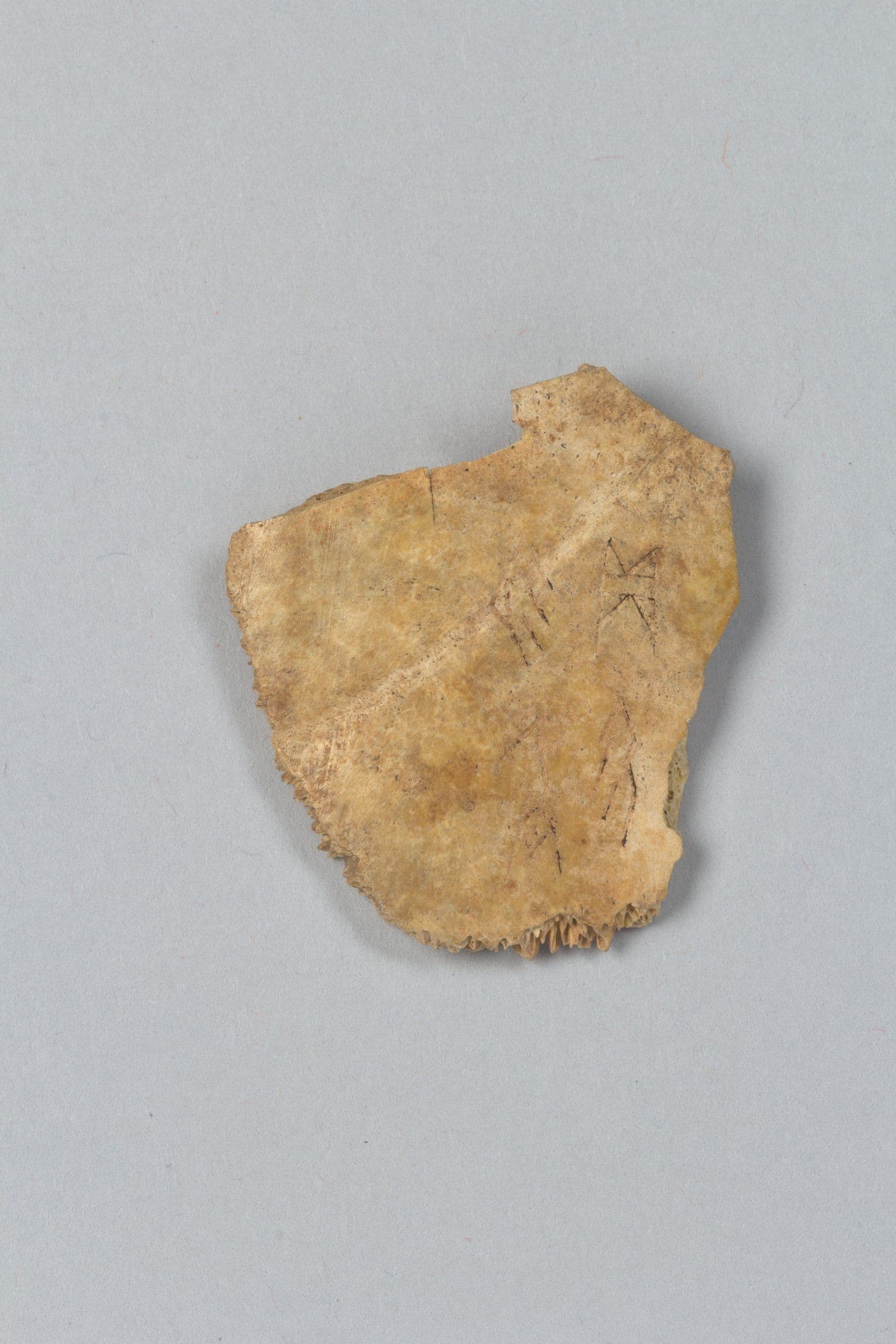
An ox scapula the size of a hand, sawn flat and smoothed, sits on a table with its rough side up. There the diviner's preparation is still visible: pairs of hollows, one round and one oval, chiselled in a neat column down the middle. Turn it over and the front carries a line of graphs cut so thinly that they disappear when the light comes from the wrong side. Between two of them runs a crack shaped like the character bu, a vertical stroke with a branch — the mark of heat applied to the hollow behind, and the reason the whole archive exists.
These are the earliest substantial texts in Chinese, and they were not written to be read as literature. They were written to ask questions of ancestors and to record whether the answers came true.
This guide walks you through what oracle bone script is and where it comes from, how a divination bone was prepared and inscribed, what the inscriptions actually record, how bronze script was cast rather than carved, why the knife and the brush produced two different stroke vocabularies, how the scripts were deciphered after 1899, and what to check before buying a bone or a rubbing.
What the Shang carved, and on what
The script is jiaguwen, "shell-and-bone writing", and it belongs to the last centuries of the Shang state, whose capital stood at Yin near modern Anyang in Henan. The overwhelming majority of surviving pieces come from that site. The materials are almost always two: the plastron of a turtle, and the shoulder blade of an ox. Sheep bone appears, and so does human bone in a handful of pieces, but the two staples are plastron and scapula because both are broad, flat and can be smoothed to a surface a knife can travel across.
The corpus is large. Something in the order of one hundred thousand inscribed pieces is recorded, scattered across collections in China, Japan, Europe and North America, with new fragments still being published from old excavations. The graphs number several thousand distinct forms.
How a divination bone was made
Preparation was a craft in itself, and the sequence is legible on any complete piece.
- Cleaning and smoothing. The bone was boiled or soaked, the flesh removed, the surface scraped and polished. On scapulae the spine was sawn away to leave a flat plate.
- Cutting the hollows. On the back, a round hollow was drilled and an oval one chiselled beside it, in pairs, in rows. The pair is the mechanism: the thin wall between them is what fails when heated.
- The charge. The question was put, and usually inscribed on the front beside the hollow it belonged to — the day, the diviner, the subject.
- The heat. A hot bronze rod was pressed into the hollow. The wall cracked, and the crack appeared on the front as a vertical line with a branch, read as an answer.
- The record. Sometimes the prognostication was added, and sometimes, later, a note on whether it happened.
A bone with a clean column of paired hollows and a matching column of inscriptions is a complete document. Most surviving pieces are fragments of one.
What the inscriptions record
The subjects are narrower than the corpus suggests, and more human. Sacrifices to named ancestors, and how many victims. War, and whether the border would hold. Harvest, rain, the birth of a prince, a toothache, a dream, the king's hunt. The date is given in the sexagenary cycle of stems and branches, which is why the archive can be sequenced at all.
Two consequences follow for anyone who collects or reads them.
First, they are administrative rather than literary. There is no narrative, no argument, no ornament. A line reads: on such a day the king divined, whether it would rain; on the eighth day it rained. The interest is in the accumulation, not the sentence.
Second, they are the only contemporary check on the traditional king list. The sequence of royal names recovered from the bones corresponds closely to the list given centuries later in Sima Qian's Records of the Grand Historian — a correspondence that did more than any other single result to establish the corpus as history rather than curiosity.
Bronze script: writing cast in metal
The second great early script is jinwen, "metal writing", also called zhongdingwen after the bells and cauldrons that carry it. It is not carved. The text was brushed onto the clay model from which the mould was made, so the founder's mould took a negative of a brushstroke and the finished vessel carries a positive of it.
That single fact explains almost everything about how bronze script looks. The strokes have rounded ends and a swelling middle, because a brush leaves them. The columns are even and the characters are squared to an invisible grid, because they were laid out on a flat model before casting. Curves are smooth where the knife made polygons.
The content is different too. Bronze inscriptions are commemorative and legal: a dedication to a dead ancestor, a record of a royal gift of cowries or horses, a boundary dispute settled, a campaign summarised. Western Zhou vessels carry the longest and most formal examples. The vessels themselves are treated in how to collect Chinese bronze; read the inscription before you read the patina.
The knife and the brush
Put a bone inscription and a bronze inscription side by side and the difference is not one of date but of tool.
The knife cuts a line of constant width. It cannot swell, and it turns a corner reluctantly, so a curve becomes a series of short straight segments — which is why oracle bone graphs look angular and slightly dry. The brush can swell, taper and turn in one movement, and the bronze graphs show it.
The important point for the history of calligraphy is that the underlying logic is already there. A bone graph is built from a small set of strokes in a fixed order, with a left-to-right, top-to-bottom discipline, and with the same distinction between a horizontal that closes and a vertical that descends. The vocabulary of the later scripts is present in outline. Some bones even carry characters written in ink or vermilion rather than cut, which settles the question of priority: the brush existed, and the knife was a choice.
From here the line runs through the seal script of the Qin reform and into the five scripts still taught today, traced in the five scripts of Chinese calligraphy.
How the scripts were read again
For most of two thousand years nobody could read a single graph. Bones came out of the ground at Anyang, were sold in drug shops as "dragon bones" for grinding into medicine, and were ground. The script survived in scholarly memory only as a rumour.
The standard account dates the recognition to 1899, when the scholar-official Wang Yirong noticed graphs on fragments offered as medicine and identified them as ancient writing. Antiquarians began buying, and from 1928 the site itself was excavated scientifically, which gave the corpus a stratigraphy and a context that looted pieces never have.
Decipherment proceeded by three routes, and all three are still in use.
- Formal descent. A graph is matched against its later seal and clerical descendants, and the reading follows if the shape and the sense both hold.
- Context. A graph in a fixed formula — a date, a king's name, a sacrifice — can be pinned by the formula even when its shape is ambiguous.
- Cross-check. The same graph in several hundred inscriptions must yield a reading consistent with all of them.
Roughly a third of the known graphs can be read with general agreement. The rest are disputed, and a proposed reading that has not been tested across the corpus is worth very little. For the mechanics of how inscriptions reach paper, see Chinese rubbings of stone inscriptions — the same ink-and-paper method was used on bones.
Collecting bones and rubbings
The market is small, scholarly and slow, and it is not a market in which a beginner should buy a bone.
Inscribed bones are cultural relics in China and cannot be freely exported; most of what circulates internationally left before the restrictions tightened, which means provenance is the whole game. A fragment with a published inscription and a documented line of ownership is a different object from an identical fragment without one.
Rubbings are the more sensible entry. A good rubbing of a bone or a bronze records the surface at a moment in time, including damage that has since progressed, and pre-1949 rubbings of major pieces are collected in their own right as examples of the technique. They are also cheap enough to learn on.
What to look for, in order: legibility of the inscription rather than size of the object; a complete column rather than a scatter of graphs; and a publication reference you can check.
Condition, facsimile and the common fake
Forgery in this field is old, well documented and mostly aimed at the middle of the market rather than the top.
- The joined fragment. Two or three genuine pieces assembled into one impressive bone, with filler at the joins. Look for a change in the colour and porosity of the bone across a crack, and for inscription columns that do not align.
- The re-cut text. A genuine blank bone with a modern inscription cut into it. Fresh cuts are V-shaped, bright inside the groove, and the bone around them is unstained. Period cuts are worn and the groove is U-shaped.
- The aged modern bone. Fresh bone buried in lime or acid to mimic burial staining. The colour is too even, and it sits on the surface rather than following the grain.
- The facsimile rubbing. Collotype and lithograph reproductions of famous rubbings, made in the early twentieth century and now sometimes offered as originals. Under magnification the ink is a uniform dot pattern rather than the uneven transfer of a hand rubbing.
A cast bronze with an added inscription belongs in the same list, and is the easiest of all to miss: the vessel is right, the patina is right, and the text was engraved into the finished surface rather than cast with it. Look for cut edges inside the strokes.
Common questions
Is oracle bone script the oldest Chinese writing?
It is the oldest substantial body of Chinese writing, but not necessarily the oldest writing. A handful of earlier signs on Neolithic pottery and jade are known and remain undeciphered. Oracle bone script is the earliest form that can be read as connected language.
How much of oracle bone script has been deciphered?
Roughly a third of the several thousand known graphs have readings that scholars broadly accept. The remainder are rare forms, names, or graphs whose meaning is contested. New readings appear steadily but the pace is slow.
Can you buy oracle bones legally?
Inscribed bones are treated as cultural relics in China and their export is restricted. Pieces circulating elsewhere generally left before those controls, so documented provenance matters more than condition. Buy from a dealer who can show a publication history.
What is the difference between oracle bone script and bronze script?
Oracle bone script was cut with a knife into bone and shell, which gives thin, angular strokes. Bronze script was brushed onto a clay model and cast in metal, which gives rounded, swelling strokes and even columns. The second is closer to later calligraphy because the brush, not the knife, made it.
Further reading
- Wu Changshuo and the Stone Drums — the script that bridges bronze writing and seal script.
- Seal Script: The Qin Standard — where the lineage arrives after the first unification.
- Detecting Calligraphy Fakes and Tracing Copies — the methods that apply to early material too.
- Collecting Chinese Calligraphy — how the later market is organised, and what it rewards.
Browse the collection
Oracle bone and bronze script are subjects we write about rather than objects we stock. What Kiln & Ink publishes is the twentieth-century ink tradition in archival giclée — limited editions, hand-numbered, with a Certificate of Authenticity — including the calligraphers and seal-carvers who worked self-consciously at the end of a line that begins on these bones. Browse the collection to see what is currently available.
Explore Further