Published October 25, 2026
Peking glass explained: how overlay is gathered and cut, the imperial workshop of 1696, snuff bottles and scholars' objects, dating clues and the fakes.
Hold a good overlay snuff bottle up to a window and the first thing you notice is the edge. A pale green layer has been carved back to a deep blue ground, and where the carving stops, the two colours meet in a line as sharp as a knife cut, with no blending and no hesitation. The carving itself is shallow, a couple of millimetres at most, and the design follows the layer rather than the other way round: a branch stops where the green runs out, a rock is cut down until the blue shows through as shadow. Turn the bottle over and the foot is polished flat, the glass clear enough at the rim to read the light through it.
That constraint, carving a picture out of a skin of colour, is the whole art of Peking glass, and it is also the best way to judge it.
This guide walks you through the ware as a collector meets it: what the material actually is, how the imperial workshop began and why a European priest was involved, how overlay is gathered and cut, the other Beijing techniques that get sold alongside it, what to examine in the hand, why so much of it is later than its mark suggests, and how to keep it alive.
What Peking glass actually is
Peking glass is a market term rather than a scientific one. The Chinese word is liàoqì, "material ware", and in Beijing it covers the low-fired lead glass made in small urban workshops for snuff bottles, beads, archer's rings, small vessels and imitations of precious stone.
The chemistry matters, because it explains the look. Chinese glassmaking developed along a different line from the Mediterranean tradition: instead of soda-lime, Chinese furnaces worked a lead-barium recipe that melts at a lower temperature, takes colour strongly, and cools to something soft, bright and slightly greasy in the hand. It reads as jade-adjacent rather than crystal-clear, which is precisely why it was used to imitate jade, realgar, tourmaline and rock crystal for people who could not afford the stones.
Two consequences follow: lead-rich glass can crizzle as it ages, and because fuel and materials were expensive the objects are almost always small. A Peking glass vase of any size is unusual.
A Jesuit, a furnace and the year 1696
Glass had been made in China for two thousand years, but the court's taste for it was fed by imports. That changed under the Kangxi emperor, who set up a glass workshop inside the palace workshops in 1696 and staffed it partly with Europeans. The German Jesuit Kilian Stumpf, who had learned glassmaking in Europe, worked in the palace complex in those years, and the workshop's early output shows a European furnace practice applied to Chinese materials.
The sequence that followed is the standard one for Qing decorative arts. Monochrome glass came first, made to imitate jade and crystal for the court. Overlay followed, and reached its height under the Qianlong emperor, when carvers produced bottles and small vessels with landscape, figure and flower scenes cut through two, three and occasionally more layers. The imperial workshop declined after Qianlong's reign, and by the nineteenth century the craft had moved out of the palace into private Beijing workshops, where it survived as a commercial trade rather than a court manufacture.
For a collector, the useful lesson is that the tradition is continuous but the patronage is not. The same techniques were practised in 1780 and in 1900, by different hands, for different customers.
How overlay is made
Overlay, tàoliào, is a glass version of cameo carving, and it is made in two distinct stages separated by days.
The first stage is the gather. The glassmaker collects the base colour on the end of a blowpipe, shapes it, then dips the hot gather into a crucible of a contrasting colour, or picks up a second gather and marries the two. The operation is repeated for each additional layer. The blank is then annealed, cooled slowly in a warm oven over many hours, because glass that cools too fast stores stress and will crack months later in a collector's cabinet.
The second stage is cold work. The annealed blank goes to a lathe, where the carver holds it against revolving wheels fed with abrasive, grinding the outer layer away to leave the design standing in relief and the ground colour showing in the cut. Nothing about this is forgiving. The layer is thin, so the depth of every cut is set by the thickness of the skin, and a design that demands more depth than the blank allows cannot be carved at all.
That is why the quality of an overlay piece is legible from the outside: deep, confident cutting means a generous blank, which means a maker who could afford materials. Shallow, timid cutting usually means a thin layer and a cheaper workshop.
The other Beijing techniques
Overlay is the technique collectors chase, but it is not the only one you will be offered.
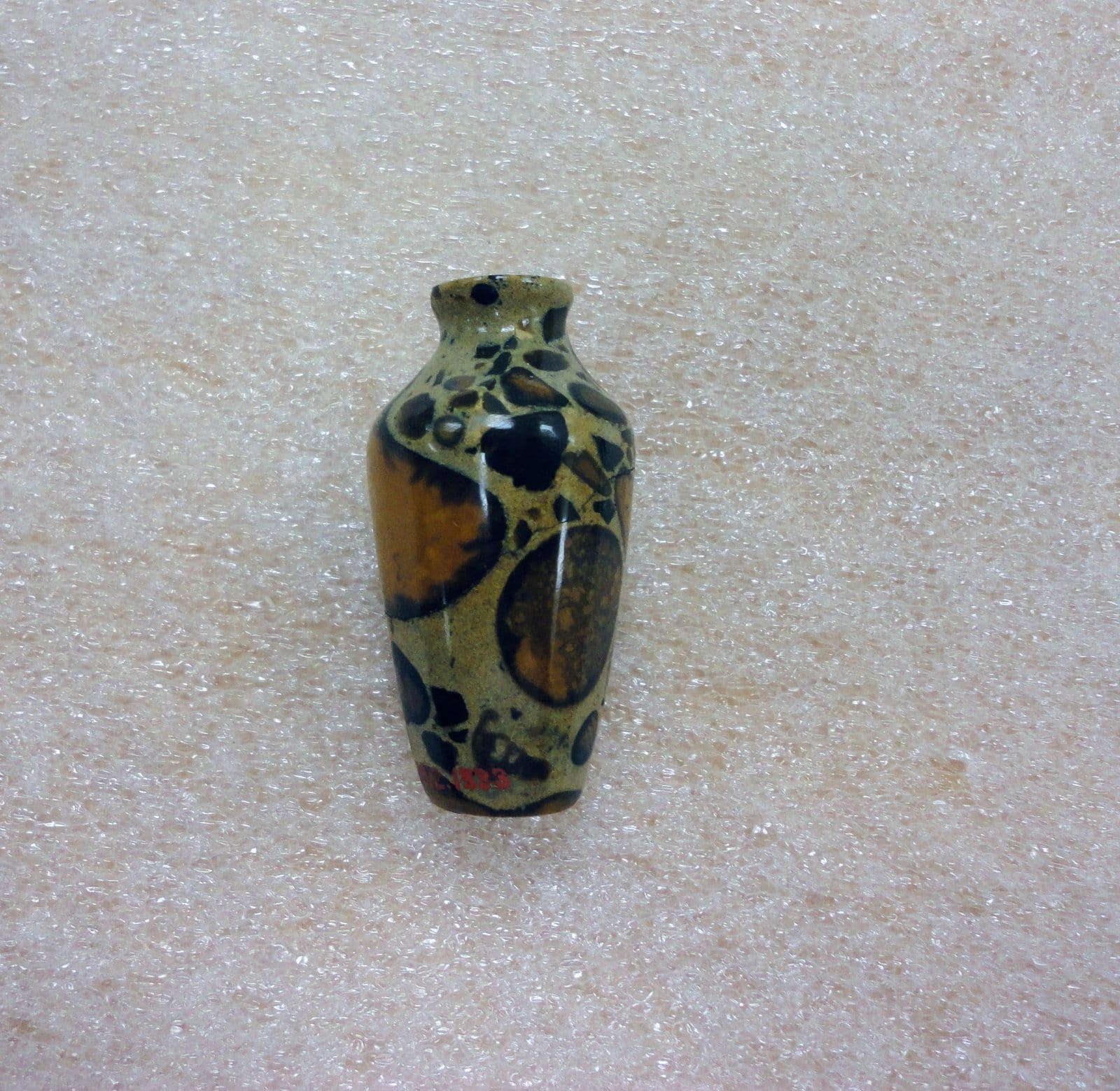
- Marbled glass, jiǎoliào. Two or more colours stirred together while molten, so the surface carries swirls that no two pieces share. The test is continuity: the pattern should run through the body, not sit on the surface.
- Aventurine glass, sǎ jīnxīng. Copper flecks suspended in the metal, flashing when the piece is turned. Genuine aventurine sparkles at depth; later material often has glitter applied to the surface.
- Painted enamel on glass. A Guangzhou and court speciality, where enamels are fired onto the glass body. The paint sits on the surface, so a raking light reveals a slight relief that overlay never has.
- Monochrome glass. Single-colour pieces made to imitate jade, realgar or turquoise, judged on the quality of the colour and the honesty of the imitation rather than on carving.
- Crackled glass. Deliberately fractured in the making, or naturally crizzled by age. These are different things and should not be priced the same.
Reading a piece: what to look at
Six checks, in the order that saves time.
- Where the layers meet. On a genuine overlay the boundary between colours is a clean optical line, and the carving cuts down to it without breaking through. Paint, applied colour or a laminated imitation will show a soft or doubled edge under a loupe.
- Tool marks in the carving. Wheel-cut glass carries fine parallel striations inside the cut, following the direction the abrasive travelled, and the intersections of cuts are crisp. Acid-etched decoration, common on twentieth-century production, leaves a uniformly dull, slightly pitted surface with soft intersections.
- The base and the pontil. Hand-made pieces show a polished or roughly ground pontil mark and a foot finished by hand, often slightly uneven. A perfectly flat, moulded base with a seam up the side is pressed glass, whatever the decoration.
- Bubbles. Hand-gathered glass contains bubbles of varied size, often stretched in the direction the gather was worked. Machine and moulded glass has either uniform fine seed or none at all.
- Wear in the right places. Two centuries of handling polish the high points of the carving and leave dirt in the recesses. Uniform brightness across a piece, with clean crevices, means it has been cleaned or made recently.
- Crizzling. A fine, dense web of surface cracks, usually at the neck or on thin sections. It is a condition of the material, not damage from use, and it is worth knowing how to read before you decide what to pay.
Why so much of it is later than it claims
The single most common surprise in this market is a piece with a Qianlong mark that was made a century or more later. Several mechanisms produce it, and they are worth separating.
Private Beijing workshops continued the overlay technique through the nineteenth century and into the twentieth, with the same four-character marks cut into the base as a convention rather than a claim. The mark indicates a style, not a date. Twentieth-century state workshops revived the craft for export, and their output, with its acid-etched decoration and even, bright colour, is now old enough to be mistaken for Qing. European cased glass of the nineteenth century, made by dipping clear glass into coloured metal and carving it back, is technically the same idea and turns up in Chinese sales rooms. And a certain amount of straightforward reproduction has been made for the tourist trade since the 1970s.
The practical rule is that the object must date itself. Layer quality, carving depth, tool marks, wear and crizzling together give a coherent answer; a mark on its own gives none. The same discipline applies to the porcelain glazes that were made in the same city in the same centuries, and the logic of condition and surface is closely related.
Care, and the one thing you cannot undo
Glass is chemically stable in the short term and fragile in the long term, and the two failure modes are different.
Thermal shock is the fast one. A cold bottle plunged into warm water, or a piece brought in from a freezing van into a heated room, can crack along a stress line that has been waiting two hundred years. Let objects come to room temperature slowly, and never wash them in hot water.
Crizzling is the slow one. A crizzled surface cannot be reversed; the network of cracks is in the glass, not on it. What you can do is slow it down by keeping relative humidity stable, avoiding detergents and ultrasonic cleaners that open the cracks further, and handling the piece by the body rather than the neck.
For storage and transport, the risks are mechanical: a padded, closed mount, no contact between pieces, and a box that does not allow the object to move. Shipping, insurance and storage covers the paperwork side of the same problem, which matters more for glass than for almost any other Chinese collectible, because a single drop ends the argument.
Common questions
Is Peking glass the same as glass made in Beijing?
Broadly yes, but the term is commercial. It covers the lead glass made in Beijing workshops from the Qing onwards, and dealers also use it for overlay glass made elsewhere in China in the same style. The material and the technique matter more than the city, and a good piece made in Guangzhou or Yangzhou should not be penalised for its postcode.
How can you tell overlay glass from painted glass?
Turn the piece under a raking light. Overlay is carved, so the design has physical depth and the cut edges catch light along their whole length. Painted enamel sits on the surface: the design is flat, the colours are opaque in a different way, and a loupe shows brush strokes rather than wheel marks.
Are Qianlong marks on glass reliable?
Not on their own. Four-character Qianlong marks were cut into the base as a convention by later workshops, so the mark tells you which tradition a piece belongs to, not when it was made. Date the object from the layers, the carving, the tool marks and the wear, then treat the mark as one more piece of evidence.
Is crizzling a reason not to buy?
It is a reason to pay less, not usually a reason to walk away. Crizzling is common in lead-rich Chinese glass, it is stable if the piece is kept in even conditions, and it does not affect the carving. What should stop you is active flaking, where the surface is shedding, or a crack that runs through the body.
What did Peking glass imitate?
Jade above all, then rock crystal, realgar, tourmaline and other semi-precious stones, and it did so for a court that wanted the colour without the cost. The imitation was understood as such and judged on its own terms, which is why a good monochrome bottle in a jade green is collected as glass rather than dismissed as a fake stone.
Further reading
- Chinese Snuff Bottles: A Collector's Guide — the form most Peking glass was made for, and the market where it is priced.
- Chinese Jade Carving: A Collector's Guide — the material that glass spent three centuries imitating, and the standard it was measured against.
- Chinese Cloisonné: A Collector's Guide — the other court metalwork of the Qing, with the same problem of later marks on earlier styles.
- Chinese Carved Lacquer: A Collector's Guide — another carving craft where layer depth determines what can be cut.
Browse the collection
Peking glass is a subject we write about rather than one we stock, and we would rather say that plainly than point you at something adjacent. What the collection does hold is the paper side of the same collecting world: archival giclée reproductions of twentieth-century Chinese ink masters, printed on cotton rag, hand-numbered and issued with a Certificate of Authenticity. If you are building a group of small objects and want something on the wall behind them, the collection is the place to start.
Explore Further