Published October 26, 2026
Chinese folding fans explained: ribs, the two-ply face, why the curve governs composition, how to spot a printed or married fan, and what to check.
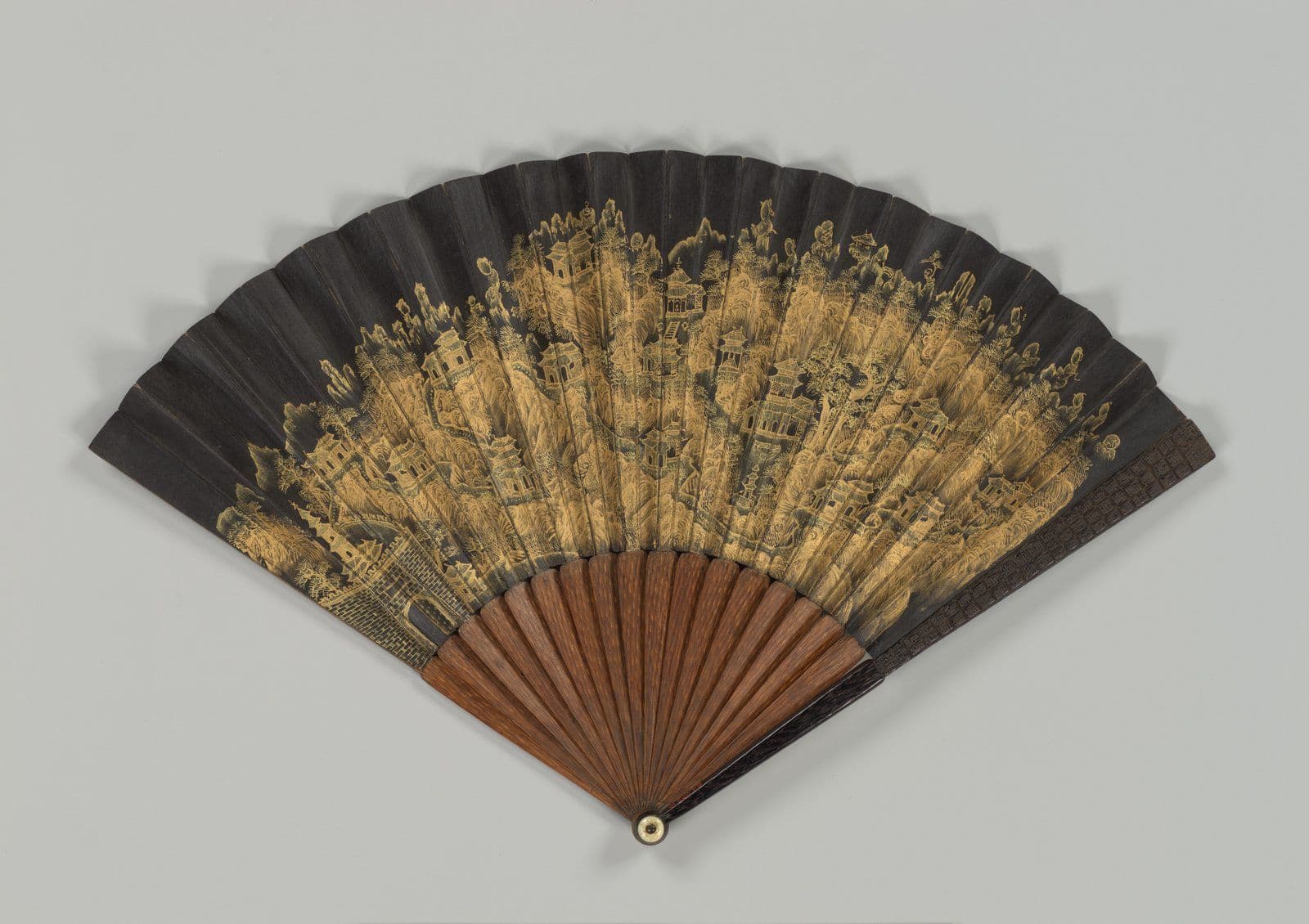
A closed fan sits in the hand like a folded knife: bamboo, paper, one rivet, a weight so slight you forget it is there until you open it. Do that badly and you will hear the sound that ends most fan sales — a dry crack along one of the creases, where sixty years of opening and closing have finally broken the grain of the paper. Do it properly, easing the guard sticks apart with both hands, and the face opens into a crescent that was never a rectangle, painted for a curve, and composed to be read at an angle no flat picture asks of you.
That crescent is the whole subject. A Chinese folding fan is not a small painting that happens to be pleated. It is a painting made for a shape, mounted on a mechanism, and judged as both.
This guide walks you through how the folding fan displaced the round fan, what the parts are called and which ones fail, why the curve governs the composition, how the two-ply face is built and why splitting it destroys value, four checks to run before you buy, what restoration can and cannot fix, and where the money actually sits.
From round fan to folding fan
The older Chinese fan is the tuanshan, the round or moon fan: a fixed leaf of silk or paper on a rigid handle, painted or embroidered, carried by women and scholars alike from the Han onward. It does not fold. It cannot go in a sleeve.
The folding fan, zheshan, came from Japan by way of Korea, and the conventional date for its arrival in China is the eleventh century. Acceptance was slow. A fan that folded was for a long time a foreign novelty with a whiff of the practical about it — something a merchant carried. The Ming changed that. By the sixteenth century the folding fan had become the default surface for a scholar's gift: painting on one side, calligraphy on the other, a poem and a dedication, made to be given away.
That social function explains almost everything about how these objects were made and why they survive as they do. A fan was a present, carried daily, used hard, and often kept for its association rather than its art. The album leaf and fan painting formats belong to the same world of small, giftable pictures.
The parts, and which ones fail
Vocabulary first, because a dealer will use it while turning the fan over.
- The face, shanmian. The painted leaf, traditionally two layers of paper pasted together at the edges, sometimes silk, sometimes gold-flecked.
- The ribs, shangu. The bamboo or wood strips the face is pleated around. A gentleman's fan typically has sixteen to twenty; larger fans more.
- The guard sticks, dagu. The two outer, thicker ribs, often carved, sometimes ivory, lacquer or zitan. These take the wear.
- The rivet. The pin at the pivot. Brass, sometimes bone. It is the only moving part and the first thing to check.
- The pleats. Not decoration: the structure that gives the face its spring.
Failures are predictable. Ribs crack at the shoulder, just below the rivet, where bending stress concentrates. Guard sticks split along the grain. The rivet works loose, the fan opens sloppily, and the slack then abrades the face at the pivot. Paper cracks along the creases, starting at the outer edge and running inward.
Why the curve governs the composition
A fan face is an annulus sector: two arcs and two radii, roughly 120 degrees of a circle. Nothing in European painting prepares a viewer for this, and nothing in Chinese painting either, which is why fan composition has its own rules.
The painter works from the pivot outward. The narrow end, near the rivet, is where the eye enters, and it is where the composition is most compressed. The wide upper arc is where the sky, the far bank or an inscription goes. A figure near the pivot is small; the same figure at the top edge is three times the size. Good fan painters use this deliberately, letting a path or a branch run diagonally from the narrow end to the wide one so the eye travels the way the fan opens.
It is also why a fan face removed and flattened looks wrong. The composition was built for a curve. Flattened, the perspective splays and the picture reads as something squashed.
The two-ply face, and why splitting destroys value
The painted layer is only the outer half of the face. Behind it sits a second sheet, pasted to it at the edges and along the pleats, which gives the leaf its body and takes the strain of folding. Those two layers are why a fan can be opened ten thousand times without the painting disintegrating.
When a fan is opened up — taken off its ribs to be framed or sold as a flat painting — a restorer must separate the layers. What comes away is a single sheet, thinner than before, with the crease set into it and the edges trimmed where the paste was. The object that results can be a fine painting. It is no longer a fan, and the market prices it accordingly: a split fan is worth a fraction of the same fan intact.
This is the most important thing to understand before buying. An intact fan with worn ribs is a better object than a pristine painting that used to be a fan. The mounting trade that produced these objects is the same trade that repairs them, and it has strong views on the difference.
How the fan was painted
Two routes. The common one is to paint on a blank face, sold ready-pleated on temporary ribs, which the painter removes, works on flat, and returns. The other is to paint directly on the mounted fan, holding it open in the left hand — faster, and far harder to do well.
The ground matters. Plain paper takes ink and wash the way a hanging scroll does. Gold-flecked paper, nijin, is gold leaf laid on the surface and sealed; ink sits on top rather than sinking in, so the line is crisper and the wash flatter, and the surface does not absorb a correction. Mica-flecked paper does something similar with a cooler glitter. Both are period markers: gold-fleck fans are common from the Ming onward and were made in quantity in the nineteenth century for the gift and export market.
Pigment behaves differently on a fan because the surface flexes. Mineral colours — azurite, malachite, cinnabar — are bound in glue and sit on the surface. Every fold flexes them and every flex eventually flakes them. That is why loss along the creases is normal, and why a fan with perfect colour on every crease deserves a closer look.
Four checks before you buy
- Open it slowly, and listen. Ease the guards apart with both hands, never one. Cracking at a crease is audible before it is visible. If the fan resists opening past 140 degrees, stop.
- Count and flex the ribs. Even number, no replacements in a different wood, no cracks at the shoulder. Hold the fan by the guard sticks and flex gently: a loose rivet shows as a wobble at the pivot.
- Look along the creases in raking light. Pigment loss and paper cracks concentrate on the fold lines. Light loss at the crests is normal wear; a dark line running the full length of a crease is a split.
- Check the edges and the reverse. The paste line at the edge should be even. The reverse is often blank, sometimes with a colophon; a reverse that has been re-papered is a repair. Seals near the narrow end should be interrupted by the pleats, not printed across them.
What restoration can and cannot fix
Re-ribbing is routine: new ribs, same face. It is acceptable when the ribs are honestly described and the rivet is correct, and it costs value without destroying the object. Re-gluing a lifting edge is routine too, and invisible done with the right paste. Consolidating flaking pigment is specialist work, reversible, and a good conservator will do it without adding colour.
What cannot be fixed: a face split from its backing, creases broken through the paper, and a fan whose face has been trimmed to fit shorter ribs. Trimming is the commonest destructive repair in the field, because a face that has lost its outer edge has lost the part of the composition that carried the inscription.
What the market pays for
Fan paintings sit in two markets that barely touch.
The first is the art market proper, where fans by major nineteenth and twentieth-century painters — Qi Baishi, Zhang Daqian, Wu Changshuo and their circle — are bought as paintings, at prices set by the name and the quality of the work rather than by the object. Condition still matters, but a fine fan with worn ribs will still find a buyer.
The second is the decorative and entry-level market: nineteenth-century fans, often export pieces, anonymous or minor, bought for the object. Here condition is everything and attribution almost nothing, and prices are modest.
The gap between the two is where most mistakes happen. A minor fan with a large name added to it, or a good fan given later carved guards, is priced as something it is not.
The common fake
- The printed fan. Collotype and halftone reproductions of fan paintings were produced in quantity, mounted on real ribs, and aged. The printed line is flat in raking light and the halftone screen is visible under magnification.
- The married fan. A face and a set of ribs from different fans. Check that the pleat count matches the rib count exactly, and that the paste at the edges is original.
- The cut-down scroll. A section of a hanging scroll trimmed to a crescent and pleated. The composition will not respect the pivot, and the paper will be too thick at the edges.
- The added seal. A seal impressed over the pleats after mounting, sitting on the fold ridges rather than being interrupted by them.
Common questions
Are antique Chinese folding fans worth collecting?
Yes, and they are one of the few entry points into genuine period painting. A nineteenth-century fan by a minor but competent painter costs less than a comparable hanging scroll, and teaches you more per pound: line, colour, mounting, condition and the market's habits, all in an object you can hold in one hand. Buy the integrity of the object first, names second.
How should a folding fan be stored?
Closed, in a fitted box, in the dark, and not compressed. Never store a fan open. Keep it away from radiators and from damp: paper and bamboo move at different rates, and a fan kept in a damp room will warp its ribs. Open it occasionally, gently, to let the pleats relax, and never leave it standing open on a shelf for months.
Can a fan painting be framed?
It can, and it costs you the object. Framing usually means opening the fan up, which means splitting the two-ply face and trimming the edges. If you want the image on a wall, buy a reproduction and leave the fan intact. A fan shown in a case, partly open on a mount, keeps both the object and the image.
What is a gold-flecked fan?
Nijin, "mud gold": gold leaf applied to the paper surface and sealed before painting. It was used from the Ming onward and heavily in the nineteenth century. The gold does not absorb ink, so lines sit crisper and washes stay flat, and the surface is unforgiving of correction. Gold-fleck fans are not automatically better than plain ones, but they are a useful dating signal.
Further reading
- How Chinese Hanging Scrolls Are Made and Mounted — the format a fan face is most often compared with.
- Framing Chinese Art Prints Without Damage — what to do instead of opening a fan up.
- Displaying Chinese Art at Home — light, humidity and the case that suits a small object.
- Archival Inks and Papers: How Long a Giclée Lasts — why the paper a picture is made on decides its life.
Browse the collection
Kiln & Ink sells reproductions, not fans, and we would rather you bought an intact fan from someone else than a split one from anyone. What we publish is the twentieth-century ink tradition in archival giclée — limited editions, hand-numbered, with a Certificate of Authenticity — including the flower-and-bird and figure subjects that were most often painted on fans in the first place. Browse the collection.
Explore Further