Published August 14, 2026
A collector's guide to Chinese bronze vessels: the main ritual types, reading cast inscriptions, spotting later copies, and the provenance questions to ask.
Turn a Chinese ritual bronze over and look at the underside of the foot. If the piece is early, you will usually find a faint raised line running across it — the seam where two halves of a ceramic mould met while the metal was poured. Western bronzes of comparable age were mostly made by melting out a wax model, which leaves no such seam. That one ridge is the beginning of almost every serious conversation about Chinese bronzes.
This guide covers the vessel types you will actually meet, how the inscriptions work, how these objects were made and copied, and the questions worth asking before money changes hands.
What these objects were for
The bronzes that define the field were not tableware and not decoration. They were vessels for ancestral sacrifice, made for the ruling lineages of the Shang and Zhou periods — roughly the second and first millennia BCE — and used to prepare, present and warm food and wine offered to the dead. Sets were buried with their owners. Almost everything now in circulation came out of the ground.
That origin explains two things that puzzle new collectors. It explains why the shapes are so specialised: each type had a job in a ritual sequence, which is why there are separate vessels for cooking grain, for serving it, for warming wine and for pouring water. And it explains why the field is legally complicated in a way that ceramics or paintings are not — the objects are, by definition, archaeological material.
Bronze shared the ritual stage with one other material. Jade was worked for ceremonial and burial use over an even longer span, and the two are often found together in the same tombs; our guide to Chinese jade carving covers the parallel tradition.
The main vessel types
Learning the shapes is the single most useful thing a newcomer can do in this field. Catalogue entries, auction descriptions and scholarly literature all use the Chinese type-names without translating them, and a buyer who cannot tell a gui from a you cannot follow a description.
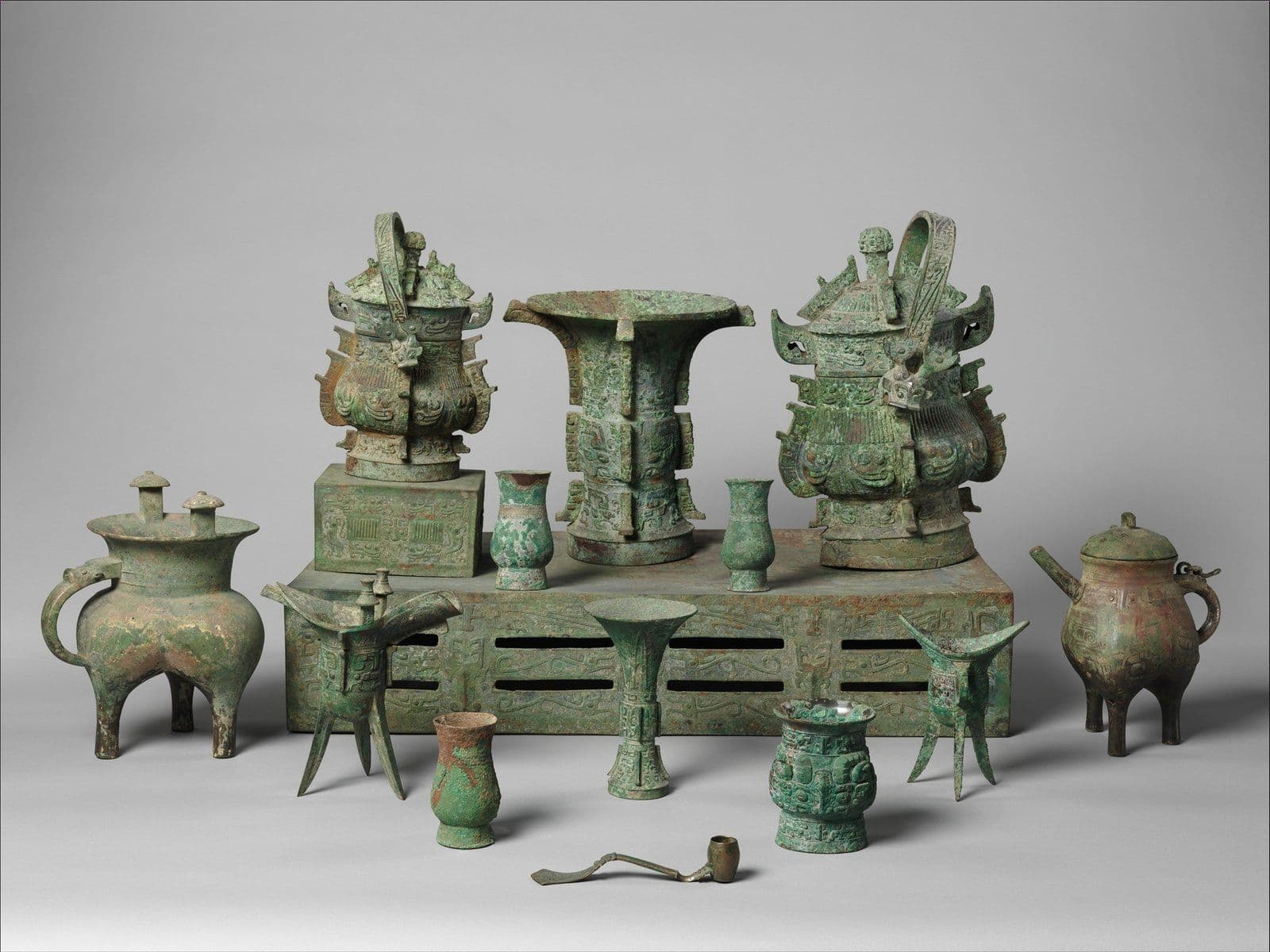
| Name | Function | What it looks like ||---|---|---|| Ding | Cooking and offering meat | Deep round basin on three legs, two upright handles on the rim; square four-legged versions exist || Li | Cooking grain | Tripod like a ding, but the legs are hollow and continuous with the bowl || Gui | Serving grain | Wide round bowl, usually two handles, often on a ring foot or square base || Jue | Warming and pouring wine | Small tripod cup with a long pouring spout, a pointed tail and two posts on the rim || Zun | Wine container | Tall vessel with a flaring mouth; some are shaped as animals || Hu | Wine or water storage | Large lidded jar, pear-shaped or flattened, often with ring handles || You | Wine container | Lidded bucket form with a swinging handle over the top || Pan | Water basin | Wide shallow dish on a ring foot |
The ding carries the most weight historically. Numbers of them signalled rank, and the phrase about "asking the weight of the cauldrons" — enquiring, that is, about the ruling house's authority — entered the language from that association.
Reading the decoration
Early bronze ornament is built from a small vocabulary used with enormous variation.
The dominant motif is the taotie, a frontal animal mask with prominent eyes, usually splayed symmetrically about a central ridge so that it can also be read as two profile creatures facing each other. Whether it depicted a specific creature was already disputed in antiquity, and the honest position is that no one knows.
Behind and around it sits leiwen, a dense ground of small squared spirals sometimes called thunder pattern. It fills the space the mask does not, and its crispness is one of the more reliable indicators of casting quality: on a good piece the spirals stay sharp where they run into the raised motif; on a poor cast or a late copy they soften and blur.
Vertical flanges — projecting fins running up the body — are common on Shang and early Zhou pieces. They began as a way of disguising the mould seams and became a decorative feature in their own right.
Inscriptions
Bronze inscriptions, jinwen, are the reason this material matters far beyond art history: they are among the earliest substantial Chinese texts, and they are contemporary documents rather than later transcriptions.
The critical technical point for a collector is that genuine early inscriptions were cast, not engraved. The characters were formed in the mould, so the metal flowed into them. Under magnification a cast character has soft, rounded interior surfaces and the same patina as the surrounding metal. An engraved character has tool marks, sharp edges, and often exposes brighter metal where the tool cut through the corrosion layer. Engraved inscriptions on ostensibly early vessels are one of the oldest tricks in the field — a plain authentic vessel is worth considerably less than an inscribed one, so inscriptions have been added to genuine bronzes for centuries.
Inscriptions are usually placed where they were protected: inside the bowl, under the lid, on the interior wall. Content ranges from a two-character clan sign to several hundred characters recording a royal appointment, a gift of land, or a military campaign, typically ending with a formula about the vessel being treasured by sons and grandsons for ten thousand years.
The script itself is the ancestor of the seal script still used on seals today; our guide to seal script and its archaic forms traces that line. And because inscriptions are recessed, they were traditionally studied through ink rubbings rather than from the object — a practice covered in our guide to Chinese rubbings and stone inscriptions.
Copies, and why not all of them are fakes
This field has an unusual problem: many of its "copies" are themselves antiques of real standing.
Serious antiquarian study of bronzes began in the Song period, when scholars and the court assembled collections and produced illustrated catalogues of them in the late eleventh and early twelfth centuries. Those catalogues did what catalogues do — they created a taste. Bronzes were then made in archaistic style for Song, Ming and Qing patrons who wanted the forms of high antiquity on their own altars and desks. Later archaistic bronzes were not made to deceive. They are legitimate objects of their own period, and a good Ming archaistic vessel is a desirable thing. The same pattern runs through other Chinese decorative arts, where later work in an earlier manner is collected on its own terms rather than dismissed — the situation described in our guide to Chinese carved lacquer.
The commercially motivated forgery is a separate category and became an industry in the late nineteenth and twentieth centuries, when Western museum demand arrived. Composite pieces — an authentic body with a replacement lid, or handles from another vessel — are common, as are genuine bronzes with added inscriptions.
Practical checks, in the order they are usually applied:
- Weight and wall thickness. Early vessels are thinner and lighter than most people expect. A piece that feels dense and heavy for its size deserves scepticism.
- Mould seams and casting flaws. Section-mould casting leaves seams, occasional misalignments and small repair patches. Their absence on an ostensibly early piece is a warning, not a virtue.
- Patina depth. Genuine burial corrosion grows into the metal in layers and varies with how the object lay in the ground. Applied patina sits on the surface, tends to be uniform, and often stops abruptly at edges.
- Inscription and vessel agreeing. The script style, vessel type and stated ceremonial context should belong to the same period. Mismatches are the commonest sign of a later addition.
Provenance and the law
No one should buy a Chinese bronze without addressing this, and it is the part of the field where a collector's own diligence matters most.
Because these objects are archaeological, they fall under both Chinese cultural property law and the import controls that a number of countries maintain on unlawfully exported archaeological material. The United States has for many years restricted the import of certain categories of Chinese archaeological material under a bilateral agreement, and comparable frameworks exist elsewhere. What this means in practice is that documented ownership history — ideally showing the object outside China well before those controls, with dated invoices, catalogue entries or photographs — is not a nicety. It determines whether a piece can be resold, lent, insured or exported at all.
Ask for the documents before you ask about the price, and treat a seller's reluctance to produce them as the answer to your question. Buying from a long-established dealer or a major auction house does not remove the obligation, but it does mean someone with a reputation at risk has looked first.
Common questions
Why are Chinese bronzes green, and should they be cleaned?
The colour comes from corrosion products formed over millennia in the ground — copper compounds that range from pale blue-green to a deep near-black, depending on soil chemistry and how the vessel lay. This layer is not dirt. It is part of the object's evidence and part of its value, and it is what a specialist reads when assessing authenticity. Cleaning it off destroys both. Loose soil can be removed by a conservator; the patina itself should be left alone. If a piece looks freshly bright, that is a question to ask, not a feature.
Are bronzes a realistic thing to start collecting?
They are a demanding entry point. The forgery problem is old and sophisticated, the legal requirements are strict, and the literature assumes you already know the vessel types. Collectors who do well here almost always begin by handling objects — at museum study rooms, at auction previews, in dealers' back rooms — for a long time before buying. Starting with later archaistic bronzes, which are cheaper and less legally fraught, is a reasonable way to build an eye.
What does an inscription add to a vessel's value?
A great deal, which is precisely why inscriptions are faked. A long historical inscription turns an object into a primary document, and vessels whose texts record datable events are studied far beyond the art market. But the premium only applies if the inscription is demonstrably original to the casting, which usually requires specialist examination rather than a naked-eye judgement.
Is a bronze with a replaced lid worth buying?
Sometimes, provided the replacement is disclosed and priced accordingly. Composite objects are a normal part of this field after three thousand years, and a good vessel with a later lid is more honest than a suspiciously perfect one. What matters is that the condition report says so plainly.
Further reading
- Chinese Jade Carving: A Collector's Guide — the other great material of the early ritual repertoire.
- Chinese Rubbings and Stone Inscriptions — how inscribed surfaces were recorded and studied.
- Chinese Carved Lacquer: A Collector's Guide — another field where later archaistic work is collected in its own right.
- Chinese Scholar's Rocks (Gongshi) — antiquarian taste applied to objects rather than texts.
Browse the collection
Bronzes are a subject we write about rather than one we stock. What Kiln & Ink sells is paper: limited-edition archival giclée reproductions of the twentieth-century Chinese ink masters, each one printed on rice paper or museum-grade cotton rag, hand-numbered, and issued with a Certificate of Authenticity.
Explore Further