Published September 20, 2026
How to tell fake Chinese calligraphy from a written hand: traced copies, rubbings, collotype and inkjet prints, and the six checks to run at the table.
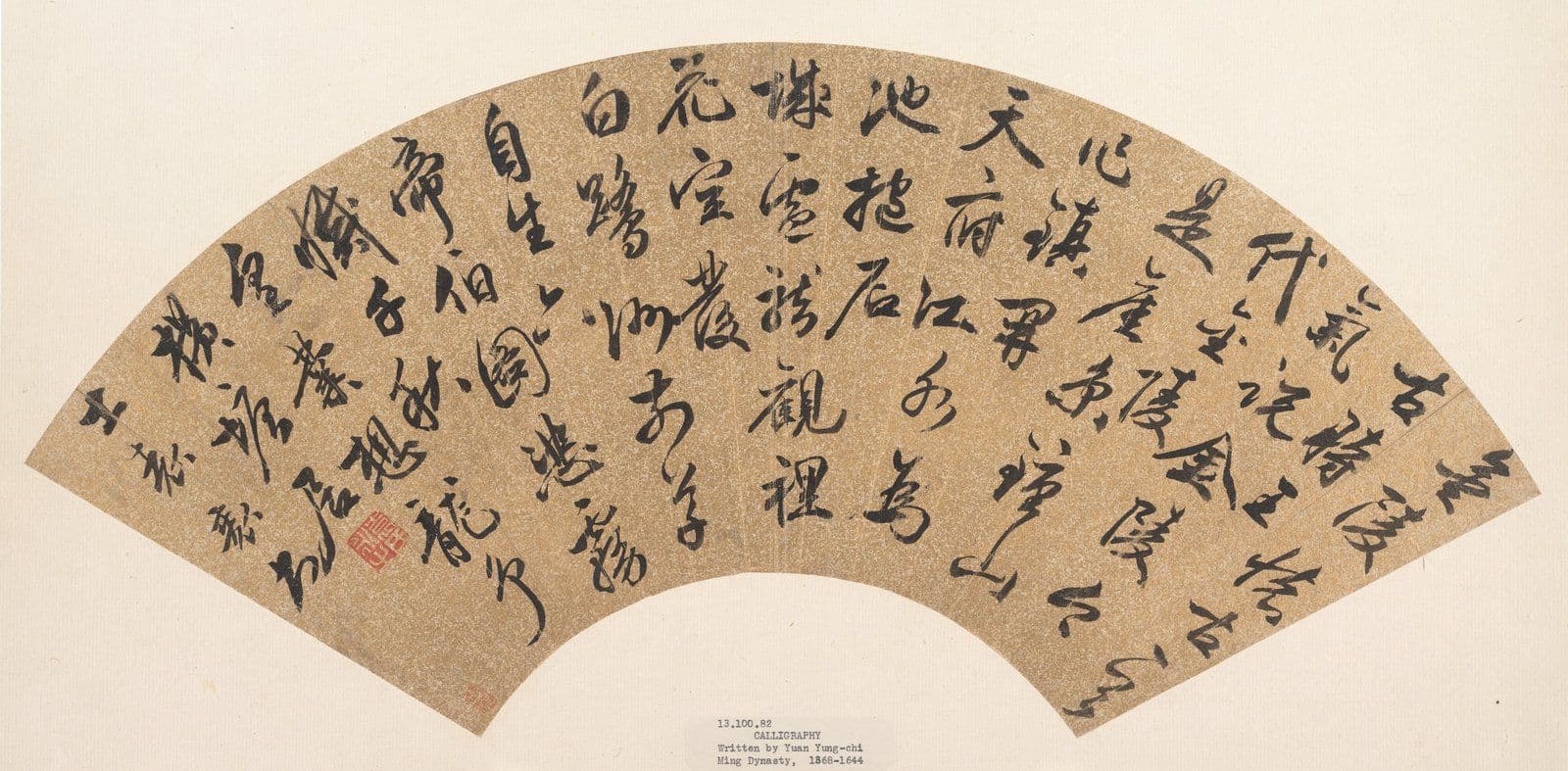
Take a piece of calligraphy to a window and look at the downstroke of a long vertical. In writing done at speed you will see the ink pool slightly where the brush paused, thin where it lifted, and the fibres of the paper will have drawn the wet edge outward in a soft, uneven bloom. In a traced copy the same stroke has tidy parallel edges, the ink density is even from top to bottom, and the bloom is the same on both sides. One line was written once. The other was drawn twice, an outline and then a fill, by a careful hand with the original in front of it.
This guide walks you through the four kinds of copy you will meet in the trade, what a traced line cannot disguise under raking light, how rubbings and model-books differ from forgeries, how to spot collotype and modern digital facsimiles, what paper and silk tell you about a date, and the sequence of checks to run before you buy a piece of Chinese calligraphy.
Four kinds of copy, only one of which is a fake
The Chinese tradition has names for the ways one hand follows another, and confusing them costs money in both directions.
- Mo, the traced copy. Thin paper laid over the original, the characters outlined and then filled, a technique known as shuanggou tianmo, "double outline, filled ink". It was court practice for preserving the letters of early masters, and the finest surviving witnesses to fourth-century writing are traced copies made centuries later. They are historical documents in their own right.
- Lin, the free copy. The student writes facing the model rather than over it, at the model's speed. A lin copy shares the composition and misses the small accidents. Great calligraphers made them all their lives.
- Fang, the imitation. Writing in the manner of an earlier master without following a specific text, usually signed by the imitator and stated as such in the inscription.
- Forgery. A copy of any of the above sold as the master's own hand, or a new composition given a false signature and seals. Only this last category is deception, and the physical evidence usually separates it from the other three within a few minutes.
The same distinctions govern painting, where copying was equally open and equally misread by later buyers; the article on the tradition of copying sets out how the practice worked in the studio.
What a traced line cannot hide
Speed is the thing that cannot be borrowed. Calligraphy is written in one pass, at a tempo the writer cannot slow without changing the line, and every technical feature you can check comes back to that.
- Edge quality. Hold the sheet at a low angle to a single light. A written stroke has one wet edge slightly heavier than the other, because the brush was travelling. A traced stroke is symmetrical, and where the fill met the outline you can sometimes see a faint seam inside the stroke.
- The joins. In running and cursive writing the brush leaves connecting threads between characters, thin trailing hairs made by the tip lifting. Tracers reproduce them as drawn lines of even width. Genuine connecting threads taper to nothing and often break.
- Flying white. Where a dry brush moves fast the ink splits into streaks with paper showing through, a feature called feibai, "flying white". Real flying white has ragged, irregular gaps that follow the brush hairs. Copied flying white has gaps of similar size, evenly spaced, because they were drawn.
- Pressure rhythm. Read a whole column, not a character. A genuine hand accelerates and slows in a pattern that repeats across the sheet. A copy is uniformly careful, and the last column is as tidy as the first, which no one writing at speed ever manages.
- Corrections. Genuine letters and drafts contain repairs, smudges and characters written over. Forgeries rarely do, because the forger is copying a finished object.
Reading these features demands some familiarity with how each script is meant to behave, and the five script types are the groundwork, cursive above all.
Rubbings and model-books are not forgeries
A great deal of what circulates as old calligraphy is not brushwork at all but ink taken from stone.
Texts were engraved on stele and on sets of stone or wooden blocks, and impressions were pulled by laying damp paper over the surface and tapping ink onto it. The result, a rubbing, shows white characters on a black ground. Compendia of such impressions, called fatie, model-letter albums, were how students learned the hands of masters whose originals had already been lost.
Rubbings are legitimate, collectable and often valuable, with early impressions from a stone worth far more than late ones, because stone wears. They are only a problem when a dealer cuts an album apart, mounts a page as a hanging scroll and sells it as writing. The test is simple: a rubbing has no brush modulation, the strokes are uniformly black with crisp white edges, the paper surface carries the texture of the stone, and there is usually a faint speckle across the ground where the ink pad struck the paper.
Printed facsimiles, old and new
Three printing technologies account for most of the honest reproductions now sold dishonestly.
- Collotype. A photographic process that reproduces continuous ink tone without a visible dot pattern, used for high-quality art facsimiles from the late nineteenth century onwards. It is the hardest reproduction to spot with the eye alone, but under a loupe the tonal areas break into a fine reticulated grain, like crazed varnish, which brushwork never shows.
- Lithograph and half-tone. Any regular dot pattern under magnification settles the question immediately.
- Digital inkjet. Modern giclee output on convincing paper. Under a loupe, look for a fine spray of isolated dots in the pale areas around the stroke edges, and for ink that sits in a film on the surface rather than sinking into the fibres. A wetted cotton swab on an unimportant margin is a last resort, not a first one.
Every printed facsimile shares one weakness: the seals are printed too. A genuine seal impression is vermilion paste sitting on top of the ink with a slightly raised, granular surface, and it will show the fine cracks and uneven coverage of a stamp pressed by hand.
Paper, silk and mounting
The support dates the object independently of the writing, and a forger has to find old material or accept a modern one.
- Paper. Old xuan paper is thin, soft-surfaced and translucent, and it ages to a warm tone unevenly, darker at the edges and around any old damp. Uniform tea-coloured staining across a whole sheet is artificial ageing, and it usually pools at the paper's edges where the liquid was applied.
- Silk. Old silk grows brittle and the weave opens slightly, so it breaks along the threads rather than tearing across them. New silk stiffened with sizing looks glassy under raking light.
- Machine signs. A perfectly straight, hard-cut edge, a uniform thickness and a bright even tone all point to modern manufacture.
- Mounting. Backing paper, silk borders and rollers are replaced every few generations, so recent mounting is not itself a warning. But the ink of a genuine old piece has usually struck through to the back sheet. If the mounter left the original backing visible and there is no strike-through at all, be careful.
Seals, signatures and dates
Three checks, quick and decisive when they fail.
- The seal. Compare the impression with published examples of the same seal. Seal stones chip with use, so a genuine impression of a late-career seal carries the same small defects as other late impressions. A seal that is sharper than its dated comparisons is a modern recutting.
- The signature. A calligrapher's signature is the most practised thing he writes and therefore the most consistent, which makes deviation meaningful. The guide to artist signatures covers how style names and studio names changed over a career.
- The date. Most pieces are dated by the sixty-year cycle, so check that the cyclical year, the reign period and the writer's life all agree; the method is in the guide to ganzhi dates. A studio name adopted late in life on a piece dated early is a closed case.
Collector seals stamped across the mounting seams are worth tracing as well, because a seal that does not continue across a join tells you the sheet has been cut, as explained in the guide to seals and collector marks.
Six checks, in order
- Loupe first. Any dot pattern, any reticulated grain, and you are finished in thirty seconds.
- Raking light. Look for the seam inside filled strokes and for ink sitting on the surface rather than in the fibres.
- Read a column for tempo. Acceleration, hesitation, dry passages. Uniform care is the warning.
- Turn it over. Strike-through on the back, consistent with the ink density on the front.
- Check the seal surface. Raised granular vermilion with hand-pressed unevenness, not flat printed red.
- Test the date against the life. Cycle, reign period, studio name, all in one decade.
What the market does about it
Forgery of calligraphy is old, organised and in places regional, with workshops historically specialising in particular masters, and the twentieth century added photographic copying to the toolkit. Auction houses respond by hedging: a lot described as "signed" or "attributed to" is a lot the house will not stand behind, while a full catalogue attribution with exhibition history and published references is a much stronger statement.
For a buyer, the practical rule is that certainty is bought with provenance, not connoisseurship alone. A modest piece with an unbroken record of ownership is a safer purchase than a spectacular one with none, and general practice for building a collection is covered in the collecting guide.
Common questions
How can you tell if Chinese calligraphy is real or printed?
Use a loupe on a dark stroke and on the red seal. Print gives itself away by pattern: regular dots in half-tone and lithography, a fine reticulated grain in collotype, a scatter of isolated dots at stroke edges in inkjet. A brush-written stroke has continuous ink that has sunk into the paper fibres, with one edge heavier than the other. The seal is the second tell, since a genuine impression is raised granular paste with uneven coverage, and a printed one is flat.
Are traced copies of famous calligraphy worthless?
No. Traced copies made close to the master's own period are often the only surviving witnesses to his hand, and the best of them are treated as major cultural objects. What matters is that the piece is sold as what it is. A Tang-period traced copy honestly described is valuable; the same object sold as an original is a fraud, and a modern traced copy is a study exercise.
Is a rubbing the same as a fake?
No. A rubbing is an ink impression taken from engraved stone or wood, and it is a legitimate class of object with its own scholarship and market, where early impressions taken before the stone wore are the prizes. It becomes a deception only when it is remounted and presented as brushwork. Rubbings are easy to recognise: white characters on a black ground, no brush modulation, and the texture of the stone across the surface.
Does a red seal mean the calligraphy is authentic?
It means very little on its own. Seals are the easiest element to reproduce, whether by recutting a stone from a published photograph or by printing the impression with the rest of the sheet. Seals become useful evidence only in comparison: the same seal, in other documented impressions from the same years, should show the same chips and the same wear. Multiple collector seals help more, because they describe a chain of ownership that can be checked.
Further reading
- Chinese Calligraphy: A Collector's Guide — how the market is structured and what to buy first.
- The Five Scripts Explained — the formal grammar each hand is judged against.
- Chinese Painting Seals and Collector Marks — reading the vermilion, and why placement matters.
- Cursive Script — the hand where tracing is easiest to detect, and hardest to read.
Browse the collection
Calligraphy is a subject we write about rather than one we stock. What Kiln and Ink offers is the work of the twentieth-century Chinese ink masters in limited-edition archival giclee reproductions, hand-numbered and supplied with a Certificate of Authenticity, and described as reproductions at every point of sale, which is precisely the distinction this article is about. If you would rather live with the image than adjudicate the object, browse the collections.
Explore Further