Published October 30, 2026
Suzhou embroidery explained: how Su xiu is stitched, the four tests that separate hand work from machine work, its history, market and how to keep silk safe.
Hold a Suzhou embroidery panel up to a window and the silk stops behaving like thread. A petal that looked flat on the wall turns out to be built from a dozen shades, each one a fraction finer than the last, laid in lines so close that the ground disappears. Turn it over and the reverse is a second picture, almost as finished, with no knots and nothing to hide. That reversibility is the whole argument of the craft, and it is the first thing an experienced buyer checks.
This guide walks you through what Suzhou embroidery is and where it sits among China's regional needle traditions, how the stitching actually works, the tests that separate hand work from machine work, the history that produced the finest pieces, what survives on the market, and how to keep silk from destroying itself in a frame.
What Suzhou embroidery is
Su xiu, "Suzhou embroidery", is the needle tradition of Suzhou and the towns around Lake Tai in Jiangsu. It is usually named as one of four regional schools, alongside the embroidery of Hunan, Guangdong and Sichuan, and it is the one that came to stand for refinement rather than display. Where Cantonese work piles silk and gold into dense relief, Suzhou work goes the other way: fewer threads, thinner threads, a surface meant to be read at close range.
The craft grew inside a silk city. Suzhou wove and finished silk for the court for centuries, and embroidery sat at the end of that supply chain, using the same floss the weavers used. Today the production centre is Zhenhu, a town on the lake's edge west of the city, where thousands of households still stitch, and where the distinction between a tourist piece and studio work is visible within a few metres of each other.
How a Suzhou picture is stitched
The material is mulberry silk floss, and the defining move is division. A strand of floss is twisted from many filaments, and the embroiderer splits it down, sometimes to a sixteenth, sometimes finer than a human hair, before threading a needle thin enough to pass through satin without leaving a hole. Split that far, silk loses most of its twist, and the light stops bouncing off it in a hard line. It begins to behave like pigment.
Four stitches do most of the work. Ping zhen, "flat stitch", lays parallel lines that fill a shape evenly. Tao zhen, "nesting stitch", is the Suzhou signature: successive rows of stitching interlock, each row entering the previous one, so that a colour can be graded from pale to saturated without a visible step. Da zi xiu, "seed stitch", builds a knotted texture for stamens, fur and moss. Pan jin, "coiled gold", couches metallic thread along an edge, and is used sparingly, because it stiffens what it touches.
The design is drawn on the ground first, usually in fine ink or a pale wash. On good pieces the drawing is a guide, not a colouring book, and the embroiderer departs from it wherever the silk demands. On cheap pieces the drawing is printed in colour and simply followed.
The reverse side is the argument
Suzhou finishing is defined by what happens underneath. Threads are carried as little as possible; where a colour must travel, it is tucked under existing stitches rather than run across the back. Knots are avoided altogether, since a knot creates a hard point that will abrade the silk around it for the next century.
The tradition pushes this to its logical end in shuang mian xiu, "double-sided embroidery", where both faces are finished pictures and neither is a backing. The virtuoso versions are double-sided with different colours, and a small number with a different image on each face, which requires the stitcher to work two compositions at once without ever seeing the second one.
For a collector, the reverse is the cheapest test available. A nineteenth-century sleeve band may have a plain back, because nobody was looking. A studio piece from the twentieth century rarely does.
Three tests for hand work
- The back. Lift the panel from its mount if the frame allows. Hand work shows a soft, slightly irregular back with the shadow of the design visible; machine work shows a dense, uniform lattice of bobbin thread and often a cut-away stabiliser.
- The gradient. Find a single petal or a bird's breast and count the shades. Hand work in the Suzhou manner runs through ten, twenty, sometimes thirty graded tones; machine work manages five to eight, and the transitions band visibly at arm's length.
- The outline. Run a finger along an edge. Hand-stitched contours undulate by a fraction of a millimetre and thicken where the stitcher doubled back. Machine satin stitch is mathematically even, and the thread has a uniform synthetic sheen under raking light.
Two further checks cost nothing. Hold the piece to a strong light: a printed underdrawing in colour will show as a shadow beneath thin stitching, which is the standard shortcut in low-cost workshop production. And look at the ground itself, since Suzhou work is usually stitched on satin, gauze or a fine tabby, never on the loose evenweave sold for counted-thread kits.
From Song needlework to Shen Shou
Embroidery in China was a religious and courtly craft long before it was a picture-making one. Tang and Song needlework survives mainly as Buddhist images and as fragments of costume, stitched to accumulate merit or to dress an image, not to hang on a wall. By the Ming and Qing, Suzhou had workshops, guilds and a market, and the city's embroiderers were producing the sleeves, collars, purses and badges that survive in the greatest numbers today.
The break with the old manner came at the end of the Qing. Shen Shou, who lived from 1874 to 1921, trained in the Suzhou tradition and then went looking for a way to render light and shadow. Her answer, which she called fang zhen xiu, "simulation embroidery", combined split-silk shading with the tonal logic of Western painting, and it allowed silk to imitate oil and photography. She taught in Beijing and later in Nantong, at the school established by the industrialist Zhang Jian, and her treatise on the craft was transcribed by him and published in 1919. Almost every ambitious piece of the twentieth century descends from that shift.
Rank badges, robes and what survives
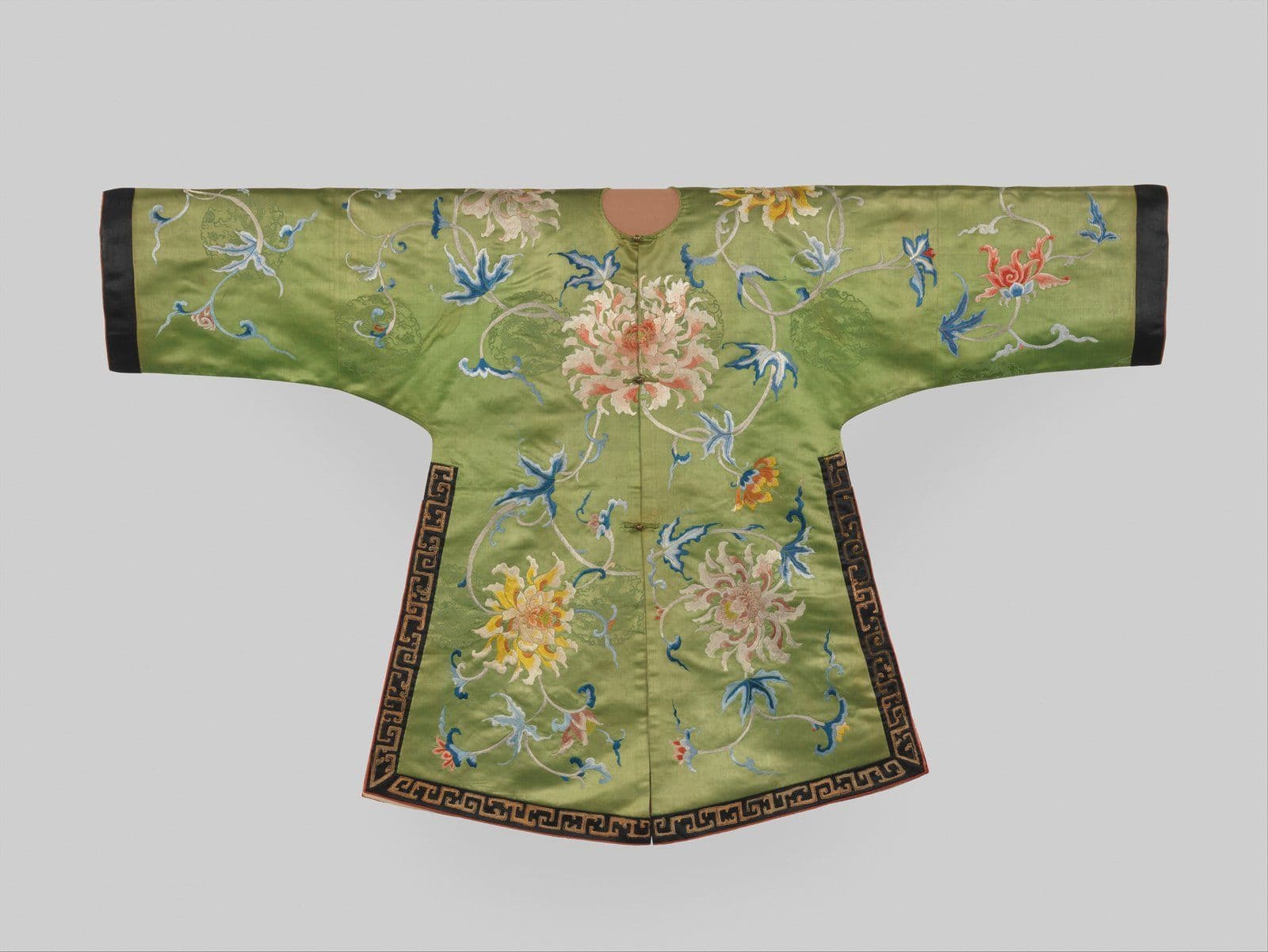
The pieces a collector actually meets are mostly ceremonial rather than pictorial. Ming and Qing rank badges, the square panels worn on the chest and back of an official's robe, were worked in both kesi silk tapestry and embroidery, and the embroidered ones are far more common. Dragon robes carry the same repertoire at larger scale: five-clawed dragons, waves, clouds and auspicious emblems, stitched in silk and couched gold.
Below that level sit sleeve bands, collars, mirror covers, fan cases and children's hats, the domestic work that survives in quantity and can still be bought for modest sums. Motifs repay study, since a great deal of the meaning is coded: bird and flower symbolism reads the same way in silk as in ink, and a peony with a pheasant is making a claim about rank and prosperity, not about botany.
Pictorial panels are the scarcest category. Most were made in the twentieth century for exhibition, export or state gift, and they are the pieces most often copied.
What the market looks like
Suzhou embroidery trades in two almost separate markets. The first is decorative: framed panels, screens and souvenir pieces sold by the square metre, where the price reflects the frame and the labour rate rather than the stitching. The second is the collector's market for signed studio work, late imperial badges and robes, and early twentieth-century panels with a documented maker or institute.
The gap between them is wide and mostly about authorship. An unsigned late Qing badge in good condition is an affordable object; a fine double-sided panel from a named Suzhou studio is not. Be sceptical of any pictorial piece sold without a maker, a date or an institute, since the workshop production of the 1970s and 1980s was large and is now routinely described as earlier.
Condition, light and the mistakes that ruin silk
Silk fails in ways that are easy to miss. The fibres embrittle before they discolour, so a panel can look sound and shatter along a fold when it is handled. Sunlight does the damage faster than anything else: ultraviolet light breaks the fibre and fades the dyes, and a piece hung opposite a window for a decade will lose its pale greens first.
Frames cause their own problems. Embroidery mounted against acidic board or glued to a backing will stain from the reverse, and the stain is irreversible. Ask for the mount to be described, and prefer a piece that is stitched to a linen stretcher or hinged with conservation tissue. Store flat or rolled on a tube padded with washed cotton, interleaved with acid-free tissue, and never in a plastic bag, which traps moisture against the silk. For the practical side of moving and insuring textiles, the guidance on shipping, insurance and storage applies unchanged.
Restoration is possible but limited. Holes can be couched and losses can be filled with dyed silk, and a good conservator will do both without repainting the image. What cannot be undone is a backing adhered with animal glue, or a panel trimmed to fit a frame.
Common questions
Is Suzhou embroidery always double-sided?
No. Double-sided work is the prestige form and the one most often photographed, but the great majority of Suzhou pieces are single-sided, with a plain back and a mount covering it. Genuine double-sided panels with two different images are rare and expensive, and they are the category most frequently faked by joining two single-sided panels back to back.
How can you tell Suzhou embroidery from Cantonese embroidery?
By the surface and the thread. Cantonese work uses thicker, heavily twisted silk and metallic thread to build a raised, glossy relief, and it often depicts birds and flowers in strong colour. Suzhou work is flatter, softer and closer in tone, built from split floss, and it reads as a painting rather than as a sculpture.
Does machine embroidery pass as hand work?
Only at a distance. Machine work is uniform in a way hands cannot be, and its colour transitions band. The reliable checks are the reverse, the gradient and the outline, all of which are visible without equipment. Sellers sometimes combine a machine ground with hand finishing on the faces, which shows up as a stiff, evenly stitched field beneath lively detail.
What is the difference between Su embroidery and Suzhou embroidery?
None. Su xiu is simply the Chinese term for the embroidery of Suzhou, and both names describe the same tradition. Auction catalogues and dealers use them interchangeably, along with "Suzhou work", so a search under either term will find the same objects.
Further reading
- Chinese art provenance documents — what a paper trail for a textile should contain, and why invoices matter more than labels.
- Certificate of authenticity — the fields a serious certificate carries, useful when a studio piece is sold with one.
- How to collect Chinese art — the general sequence of buying, from study pieces to the first serious acquisition.
Browse the collection
Kiln & Ink publishes limited-edition archival giclée reproductions of twentieth-century Chinese ink masters, hand-numbered and issued with a Certificate of Authenticity. Embroidery is a subject we write about rather than one we stock, but the same collectors buy both, and the collection is where the painting side of that conversation begins.
Explore Further