Published July 26, 2026
Ren Bonian, central master of the Shanghai School: his figure and bird-and-flower painting, and how collectors judge attributed works.
In the treaty-port Shanghai of the 1870s and 1880s, a painter could live or starve by the marketplace, and Ren Bonian lived very well. He painted fast, sold steadily, and gave a fast-growing merchant city exactly what it wanted: figures that told a story at a glance, and birds and flowers so fresh they looked caught mid-motion. He worked for money and made no apology for it — and in doing so he became one of the defining artists of modern Chinese painting.
This article looks at who Ren Bonian was, how his figure and bird-and-flower painting fused old lineage with new immediacy, why he sits at the centre of the Shanghai School, and what collectors weigh when they judge a work attributed to him.
An outsider who mastered the market
Ren Bonian (任伯年, 1840–1895), also known by his given name Ren Yi (任頤), came from Zhejiang, the son of a father who painted portraits and taught the boy to observe and record a likeness. He moved to Shanghai as a young man, in the years when the port was swelling into China's commercial capital, and he became a professional painter in the fullest sense — a maker of pictures for a paying urban public rather than a scholar-amateur painting for a circle of friends.
That professional footing is central to understanding him. Where the older literati tradition prized the unhurried, self-effacing brush of the gentleman-painter, Ren Bonian worked at the pace and appetite of a city. He was prolific, versatile, and commercially clear-eyed, and he raised the standing of the professional painter at a moment when the old scholar-amateur ideal was loosening its grip. He is grouped among the leading painters surnamed Ren active in the region — a lineage that shaped his figure style — and he learned as well from the bold, stylized figure painting of the seventeenth-century master Chen Hongshou, whose influence runs through his narrative work.
The figures: story at a glance
Ren Bonian's reputation rests first on his figures. He painted historical and legendary subjects, immortals and scholars, and portraits of his contemporaries, and he gave them a directness that reads instantly. A face turns, a robe swings, a gesture completes — the picture carries a moment rather than a pose.
Two things make the figures distinctive. The first is his line: confident, elastic, sometimes exaggerated in the manner he took from Chen Hongshou, shaping character through the drawing of drapery and stance rather than through fussed detail. The second is a note of observed realism. His portrait heads in particular have a lifelike specificity unusual in the tradition, and it is widely thought he drew on habits of sketching from life — an openness to direct observation that set him apart from painters who worked only from copybooks and memory. Whether or not one credits Western influence for that eye, the results feel seen rather than remembered.
His most celebrated portrait subjects include the younger artist Wu Changshuo, the painter and seal-carver whom Ren Bonian encouraged and whose own reputation would eventually eclipse his mentor's. That relationship is a thread worth following: Ren Bonian stands at the head of a line that runs through Wu Changshuo and on toward the great modern masters, and the vitality he prized became one of the through-lines of twentieth-century ink painting.
The birds and flowers: colour and motion
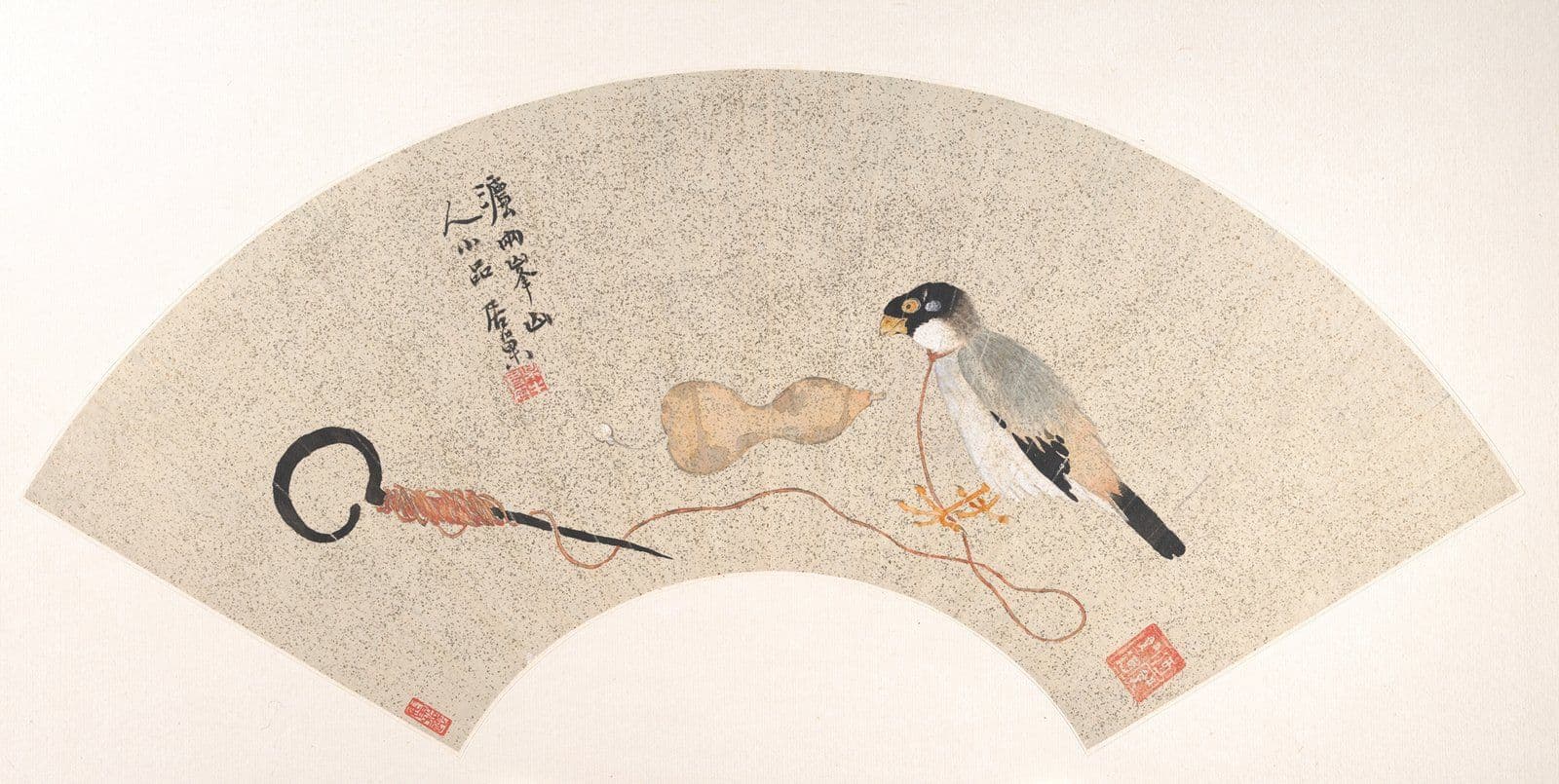
If the figures made his name, the bird-and-flower paintings made his living and, for many collectors, contain his freshest work. Here Ren Bonian is at his most spontaneous — magpies and mynahs, sparrows, ducks, flowering branches and garden rocks, painted with a wet, quick brush and a bright, confident palette.
He moved fluidly between two ancient approaches: the "boneless" (mogu) manner, in which forms are built from washes of colour without outline, and outlined drawing filled with pigment. Blending the two, he gave his birds weight and softness at once, and set them in compositions that leave the eye room to move. The best of these works have the quality Chinese connoisseurs prize above technical polish — living energy, the sense that the creature might shift on its branch. That standard is the very first of the six principles Xie He set down for judging Chinese painting some fifteen centuries earlier: spirit resonance, the demand that a painting breathe. Ren Bonian's birds pass that test with room to spare.
Reading the Shanghai School
Ren Bonian is usually described as the central figure of the Shanghai School (海上畫派) — not a formal academy but a loose current of painters working in and around the port in the later nineteenth century, catering to its merchants and its new money. What united them was less a single style than a shared situation: professional painters meeting urban demand, willing to be decorative, direct, and colourful in ways the austere literati mainstream had frowned upon.
Within that current Ren Bonian was the great synthesizer. He absorbed the figure tradition of Chen Hongshou, the bird-and-flower heritage of earlier masters, folk and decorative sources, and a dose of realist observation, and he fused them into something legible and alive. His example gave the professional painter a new confidence, and it fed directly into the modern era — a reminder that the twentieth-century revival of ink painting did not spring from nowhere but grew out of the commercial studios of Shanghai.
A working life, cut short
Ren Bonian's career was intense and, by the standards of a tradition that often revered its masters into old age, brief — he died in 1895, in his mid-fifties, at the height of his powers and demand. The compression matters for how we read him. There was no long, contemplative late period in which a scholarly reputation slowly settled; instead there was a working painter meeting orders, experimenting inside the pressure of the market, and refining a manner that had to satisfy buyers again and again.
That intensity left an unusually large and varied body of work, which is part of why he became so influential and, later, so widely copied. It also means genuine range is one mark of the hand: a real Ren Bonian oeuvre moves confidently between grand narrative figures, intimate portraits, and quick garden studies of birds and branches, all bound by the same live, elastic line. A body of work that is all one note, all one format, is worth a second look.
What collectors weigh
Ren Bonian was enormously productive and enormously popular, in his lifetime and ever since, and that popularity has an inevitable shadow: his work is heavily imitated and forged. Attributions therefore demand care.
Connoisseurs read several things together. Brushwork comes first — the characteristic confidence and elasticity of his line, the freshness of his colour, the way a figure's character is carried by the drawing. Then the inscription and, crucially, the seals; because seals are integral to a Chinese painting's identity and history, learning to read the artist's and collectors' seals on a Chinese painting is part of judging any work bearing his name. Provenance and publication history add weight, especially for larger or more ambitious pieces. As with any major and much-copied name, no single feature settles the question, and significant purchases belong with specialists who have comparative material to hand.
| What collectors read | On a convincing Ren Bonian | Warning signs ||---|---|---|| Line | Confident, elastic, expressive drapery and stance | Hesitant, traced, or lifeless || Colour (bird-and-flower) | Fresh, wet, and controlled, with living energy | Flat, muddy, or overworked || Seals and inscription | Consistent, integral to the picture | Mismatched, added, or wrong for the period || History | Documented ownership or publication | No trail, bargain price, casual attribution |
Common questions
Who was Ren Bonian?
Ren Bonian (Ren Yi, 1840–1895) was a professional painter and the central figure of the Shanghai School, the current of painters who supplied the booming treaty-port city in the later nineteenth century. Trained first by his portrait-painting father and shaped by the figure tradition of Chen Hongshou and the lineage of Ren-surnamed painters, he became celebrated for narrative figures and fresh, colourful bird-and-flower paintings, and he helped raise the standing of the professional painter in modern Chinese art.
What is Ren Bonian best known for?
Two bodies of work. His figure paintings — historical and legendary subjects and strikingly lifelike portraits, drawn with a confident, expressive line — are what first made his name. His bird-and-flower paintings, worked in a quick wet brush that blends the "boneless" wash technique with outlined colour, are prized for their spontaneity and living energy. Together they define a directness and vitality that influenced later masters, including the seal-carver and painter Wu Changshuo, whom he encouraged.
Why is authenticating a Ren Bonian work difficult?
Because he was extraordinarily prolific and popular, both in his lifetime and after, and popularity breeds imitation. Countless copies and forgeries circulate. Connoisseurs judge a work by reading its brushwork, colour, inscription, and seals together, and by weighing its ownership and publication history. No single feature is decisive on its own, so a serious attribution — especially for an ambitious or high-value piece — is a job for specialists with genuine comparative material.
Further reading
Lin Fengmian and modern Chinese painting — another bridge between tradition and the twentieth century.
Reading the seals on a Chinese painting — the marks that carry authorship and provenance.
How to buy Chinese art at auction — the practical guardrails for a much-copied name.
Browse our ink paintings
Modern hand-painted works in the ink tradition, each honestly described and clearly attributed, are in our ink painting collection — a grounded place to start if the energy of the Shanghai School is what drew you here.
Explore Further