Published July 11, 2026
Guan Shanyue's plum blossom paintings turned a sparse literati emblem into a monumental red icon. How to recognize his style — and vet a work before buying.
In 1973, a painting of plum blossoms nearly ended a career. Guan Shanyue's Qiao Bu Zheng Chun (俏不争春) — a dense thicket of red plum pressing upward across the full height of the sheet — was celebrated, reproduced, and then criticized in the political weather of the period, with even the direction of the branches read for hidden meanings. That a flower painting could carry that much weight tells you most of what you need to know about the plum blossom in Chinese art: it has never been just a flower.
This article looks at how Guan Shanyue (关山月, 1912–2000) took the oldest, most convention-bound subject in the Chinese painting canon and made it modern — what his red plum actually looks like on paper, how it differs from the sparse literati plum of earlier centuries, and what a collector should check before buying a work attributed to him.
From Lingnan student to national painter
Guan Shanyue was born in Guangdong province in 1912, the year the last dynasty fell, and his career tracks the whole arc of twentieth-century Chinese painting. His formation came through the Lingnan School (岭南画派), the Cantonese reform movement founded by Gao Jianfu, Gao Qifeng, and Chen Shuren. The Lingnan program was explicit: keep the Chinese brush, but let in Western and Japanese realism — atmosphere, light, contemporary subject matter — and make painting speak to a modernizing nation. Guan studied directly under Gao Jianfu, and the school's habits stayed with him for life: drawing from observation rather than copying old masters, and a willingness to put trucks, bridges, and construction sites into ink landscapes.
The 1940s hardened those habits. During the war years Guan traveled extensively through China's interior and northwest, sketching from life, and spent time at the Dunhuang cave temples studying and copying the Buddhist murals — an experience that pushed his color sense well beyond the restrained literati palette. Sketching trips remained his method for decades afterward; he taught for many years in Guangzhou and trained a generation of painters there.
His most public commission came in 1959, when he and Fu Baoshi jointly painted Jiangshan Ruci Duojiao (江山如此多娇, "This Land So Rich in Beauty") for the Great Hall of the People in Beijing — a monumental landscape based on a line from Mao Zedong's poem "Snow," with the title inscribed by Mao himself. Fu Baoshi brought his storm-soaked atmosphere — the same energy you can read about in his rain landscapes and the Bao Shi Cun brush method — while Guan contributed the solidity of observed landscape. The pairing made Guan a national figure, and it placed him permanently in the small group of painters trusted with state-scale work.
An old symbol under new management
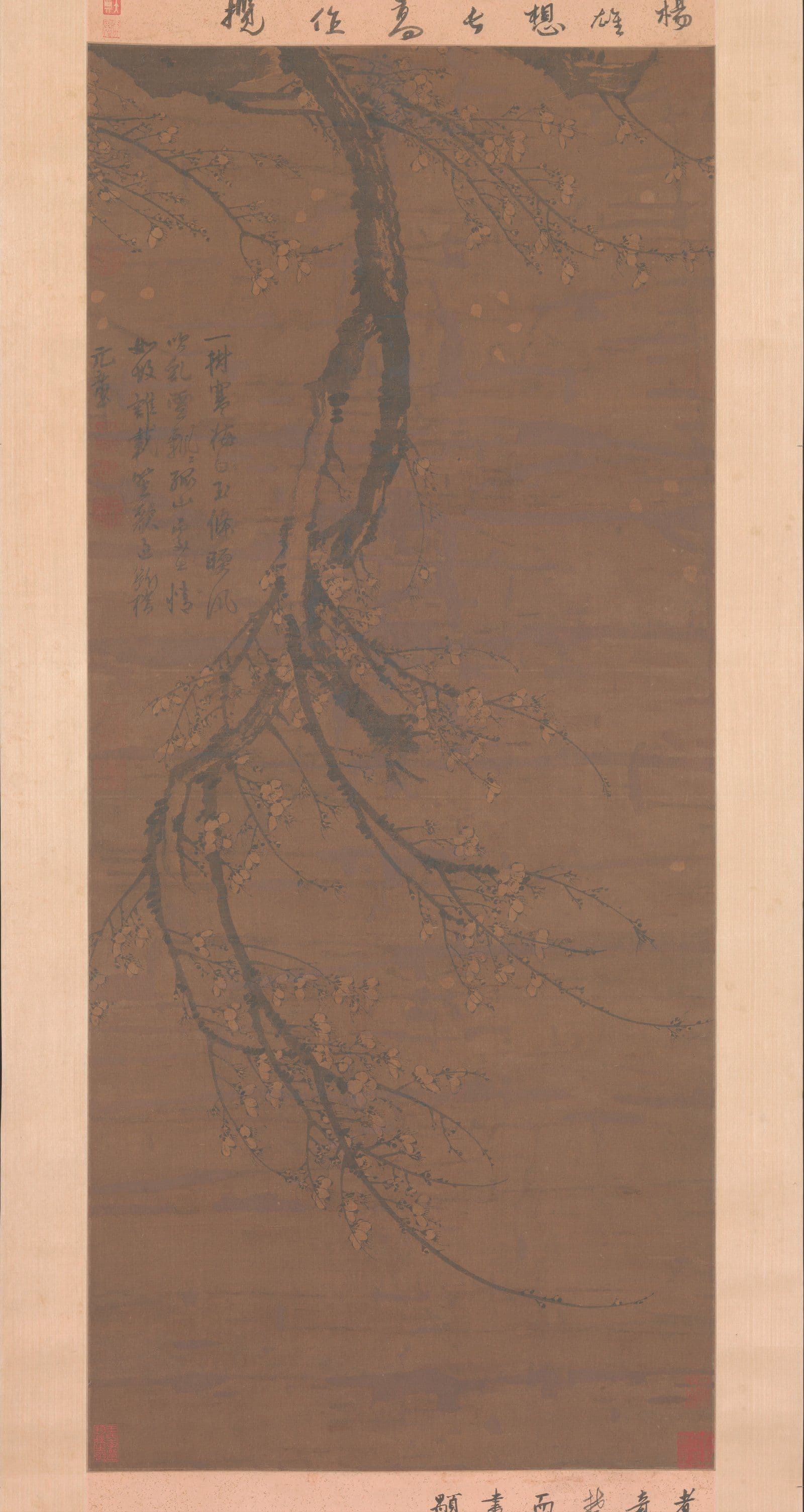
To see what Guan did to the plum blossom, you need the baseline he was working against. The flowering plum (梅, mei) blooms in late winter, on bare black branches, often through snow — and Chinese poets and painters spent roughly a thousand years turning that fact into a moral emblem. The plum is one of the Three Friends of Winter (松竹梅, pine, bamboo, plum) and one of the Four Gentlemen (梅兰竹菊); it stands for integrity that flowers under hardship. The classical ink-plum tradition that matured in the Song and Yuan periods — Wang Mian's ink plums are the textbook example — favored restraint: a few angular branches, sparse blossoms in pale ink or left as reserved white paper, and a great deal of emptiness. The subject was a self-portrait of the scholar: cold, upright, indifferent to spring's crowd.
Guan Shanyue kept the symbol and reversed nearly every formal decision. His mature plum paintings, particularly from the 1970s onward, are crowded where the literati plum is sparse, saturated where it is pale, and monumental where it is intimate. In the Mao-era reading — the title 俏不争春 comes from Mao's plum-blossom poem "Ode to the Plum Blossom" (卜算子·咏梅) — the flower was recast from a lonely scholar's emblem into an image of collective, optimistic vitality: beauty that does not compete for spring but announces it. Guan's red plum is the visual form of that recasting. It belongs to the same family of transformations as Li Keran's cinnabar mountains, where a classical landscape formula was flooded with revolutionary red, and Xu Beihong's galloping horses, where an old animal subject became a national symbol.
How to recognize a Guan Shanyue plum
Several traits recur across his plum paintings and are worth checking against any work you are considering:
- Structural trunks. Guan builds the composition on one or two heavy trunk movements — often rising diagonally or vertically through the entire sheet — brushed in dark, dry, textured strokes that feel closer to landscape rock than to flower painting. The branch architecture reads as engineering, not calligraphy alone.
- Dense, clustered blossoms. Where a Yuan-dynasty plum might carry a few dozen blossoms, a mature Guan plum carries hundreds, massed into clouds of color. The blossoms are dabbed in opaque red — frequently a hot vermilion — with darker accents for stamens, and they cluster along the upper reaches of the branches so the whole tree seems to be surging upward.
- Upward momentum. The characteristic direction of a Guan plum is ascent. New shoots kick up at steep angles, and the composition typically opens toward the top of the sheet. It is a deliberate reversal of the drooping, sideways elegance of much classical plum painting.
- Landscape air. Many of his plums are set against washes of sky, snow, or mist — Lingnan-style atmosphere carried over from his landscape practice — rather than floating on empty paper.
- Inscription and seals in a modern hand. His inscriptions are usually short, in a vigorous running script, with cyclical dates and his signature followed by seals. On important works the inscription often ties the image to a poem or occasion.
None of these traits alone authenticates anything — plenty of later hands can dab red blossoms — but their combination, especially the trunk structure and the controlled massing of color, is difficult to fake convincingly at full size.
The market signal
Guan Shanyue sits in the first rank of twentieth-century Chinese painters at auction, alongside the other Lingnan and academy masters. His works appear regularly in the modern Chinese painting sales at the major mainland and Hong Kong houses, and the red plum paintings — together with his pine and landscape subjects — are consistently the most sought-after part of his output. Large, well-documented plum compositions from the 1970s and 1980s have achieved multi-million-yuan results, and the market has been notably steady rather than speculative: demand is anchored by his museum presence (a dedicated Guan Shanyue art museum stands in Shenzhen) and by the state commissions that made his name.
Two practical notes follow from that demand. First, his plum imagery is among the most reproduced in modern Chinese art — as prints, as copies, and as outright forgeries — so provenance and documentation matter more than visual impression. Second, because his works were widely gifted and published during his lifetime, exhibition and publication records exist for many genuine paintings; a significant work with no paper trail deserves skepticism. Checking the seals and collector marks on a Chinese painting against published references is a sensible first step before any serious purchase.
Common questions
How do I tell an authentic Guan Shanyue plum painting from a reproduction?
Start with the medium. A genuine painting is ink and mineral color on xuan paper, with visible variation in stroke pressure, dry-brush texture in the trunks, and slight pooling where wet color settled — all of which a photomechanical print flattens. Examine the red blossoms under magnification: hand-dabbed color shows layered, irregular edges, while printed color shows uniform tone or dot patterns. Then check the inscription and seals against published references, and ask for provenance — exhibition history, publication, or a credible chain of ownership. For works at serious price levels, an opinion from a recognized specialist in modern Lingnan painting is worth the fee.
What do edition numbers mean if I'm buying a Guan Shanyue print?
A fraction such as 58/100 on a print means it is the fifty-eighth impression in an authorized run of one hundred. For modern Chinese masters, legitimate limited editions — often high-quality giclée reproductions authorized by the artist's estate or a museum — are collectible as decorative works, but they are reproductions, not originals, and should be priced accordingly. The number does not make the image rarer as art; it only documents the print run. Be wary of "editions" with no publisher, no documentation, or suspiciously large runs.
Why are so many of Guan Shanyue's plums red rather than ink monochrome?
Partly Lingnan training — the school embraced strong color from the start — and partly the politics of his era. Red carried unmistakable revolutionary meaning in the 1960s and 1970s, and the recasting of the plum as an optimistic national symbol, following Mao's plum-blossom poem, called for warmth and vitality rather than scholarly austerity. Guan did paint ink plums and softer palettes as well, but the saturated red plum became his signature because it fused the classical subject with the visual language of his own time.
Did Guan Shanyue only paint plum blossoms?
No. He was a full-range landscape painter first: wartime documentary scenes, northwest and Dunhuang subjects, socialist-construction landscapes, pines, and snowscapes. The 1959 Great Hall of the People commission with Fu Baoshi was a landscape, not a flower painting. The plum became his emblematic subject in later decades, but a collection of his work that ignored the landscapes would miss half the painter.
Further reading
- Wu Guanzhong's Jiangnan Water Villages — another twentieth-century master who rebuilt a classical genre from the inside.
- Qi Baishi's Shrimp: Why Six Brushstrokes Became an Icon — how a single subject becomes a master's signature, and a forger's favorite target.
- Zhang Daqian's Splashed-Ink Technique — the parallel reinvention of landscape painting in the same generation.
Browse our Guan Shanyue collection
Guan Shanyue is one of the masters in our gallery — see his profile and available works, including plum-blossom subjects, all honestly described and clearly attributed.
From the Kiln & Ink collection: Plum Blossoms for Spring, an archival giclée edition after Guan Shanyue, hand-numbered on xuan paper with a certificate of authenticity.
Explore Further