Published August 21, 2026
The Four Gentlemen in Chinese painting: what plum, orchid, bamboo and chrysanthemum each signify, and how to judge the brushwork in a painting of one.
A painting of a single bamboo stalk against blank paper looks, to a viewer meeting Chinese painting for the first time, like an unfinished study. There is no landscape, no colour, often no more than a dozen strokes. But hand that same sheet to a Chinese collector and they will read a full statement in it — a season, a virtue, a position on how a person should conduct themselves under pressure, and a claim about the painter's own character. The four plants that carry this freight are plum, orchid, bamboo and chrysanthemum, known together as the Four Gentlemen.
This guide explains what each of the four signifies, why they became a fixed set, how the technical demands differ between them, and what to look at when you are trying to judge one.
Why these four
The grouping is not botanical. It is moral and seasonal, and it comes out of the literati tradition — the painting done by scholar-officials rather than by court professionals, in which the point of a picture was to express the maker's cultivation rather than to describe the world accurately.
Each plant maps to a season, and each carries an associated virtue:
- Plum blossom — winter. Endurance; beauty produced under hardship.
- Orchid — spring. Refinement; integrity maintained without an audience.
- Bamboo — summer. Uprightness combined with flexibility; humility.
- Chrysanthemum — autumn. Withdrawal from office; dignity in late life.
Read as a set, they cover the full year, and they describe a complete model of scholarly conduct: hold up under cold, keep your standards when no one is watching, bend without breaking, and know when to retire. A scholar who painted all four was not illustrating plants. He was stating a position.
The plum flowers on bare wood in the cold, before there are leaves — beauty arriving in the worst conditions, entirely on its own resources. The orchid grows in remote valleys and scents the air whether or not anyone passes; it became the standard image for the person of quality who does not perform their quality. Bamboo is hollow inside, which reads in Chinese as empty-heartedness and so as humility, and it bends under snow and springs back, which reads as principled resilience. The chrysanthemum flowers as everything else is dying, and is bound tightly to the poet Tao Yuanming, who left official life to grow chrysanthemums by his east fence — so firmly bound that painting one is close to quoting him.
How the set became standard
The individual subjects are much older than the grouping. Bamboo painting in ink had already become a serious independent genre under the Song, with Wen Tong its most cited early master and Su Shi its most cited advocate — the theoretical claim that you must have the bamboo complete in your mind before the brush moves comes out of this circle. Plum, orchid and chrysanthemum each accumulated their own lineages.
What consolidated them into a fixed quartet was, in large part, printing. The painting manuals of the late Ming and Qing organised instruction by subject, and the Four Gentlemen made an efficient teaching unit, because between them they drill nearly every fundamental brush move a painter needs. The Mustard Seed Garden Manual is the best known of these compendia and did an enormous amount to standardise both the grouping and the accepted ways of rendering each plant. Once a subject enters a manual it acquires orthodox forms, and later painters position themselves relative to those forms — either by observing them or by pointedly departing from them.
By the Qing the set was thoroughly established, and painters became identified with particular members of it. Zheng Xie, working in Yangzhou, is inseparable from bamboo and orchid. In the modern period Wu Changshuo brought his seal-carver's density of line to plum, and Qi Baishi and his circle continued to treat the four as core repertoire rather than as exercises.
What each one demands of the brush
This is where the set earns its place in teaching, because the four plants require genuinely different handling.
Bamboo is the discipline test. The stalk is built from segmented strokes laid one above another, each stopping and restarting at the node, with the brush loaded to hold an even tone across the width. The leaves are single decisive strokes that must taper correctly and land at credible angles; a leaf cluster that is evenly spaced or symmetrical looks dead immediately. Nothing can be corrected. Ink on absorbent paper records hesitation permanently, which is why bamboo is the standard demonstration of whether a painter can actually control a brush.
Plum is about structure and interval. The branch is the drawing — angular, twisting, moving through the picture with abrupt changes of direction — and the blossoms are placed against it. The difficulty is spacing: the blossoms need to read as scattered in a natural rhythm, dense in places and sparse in others, rather than distributed evenly along the wood. Old trunks are often built with a dry, splitting brush to get the bark texture, then wet blossoms set against that dryness.
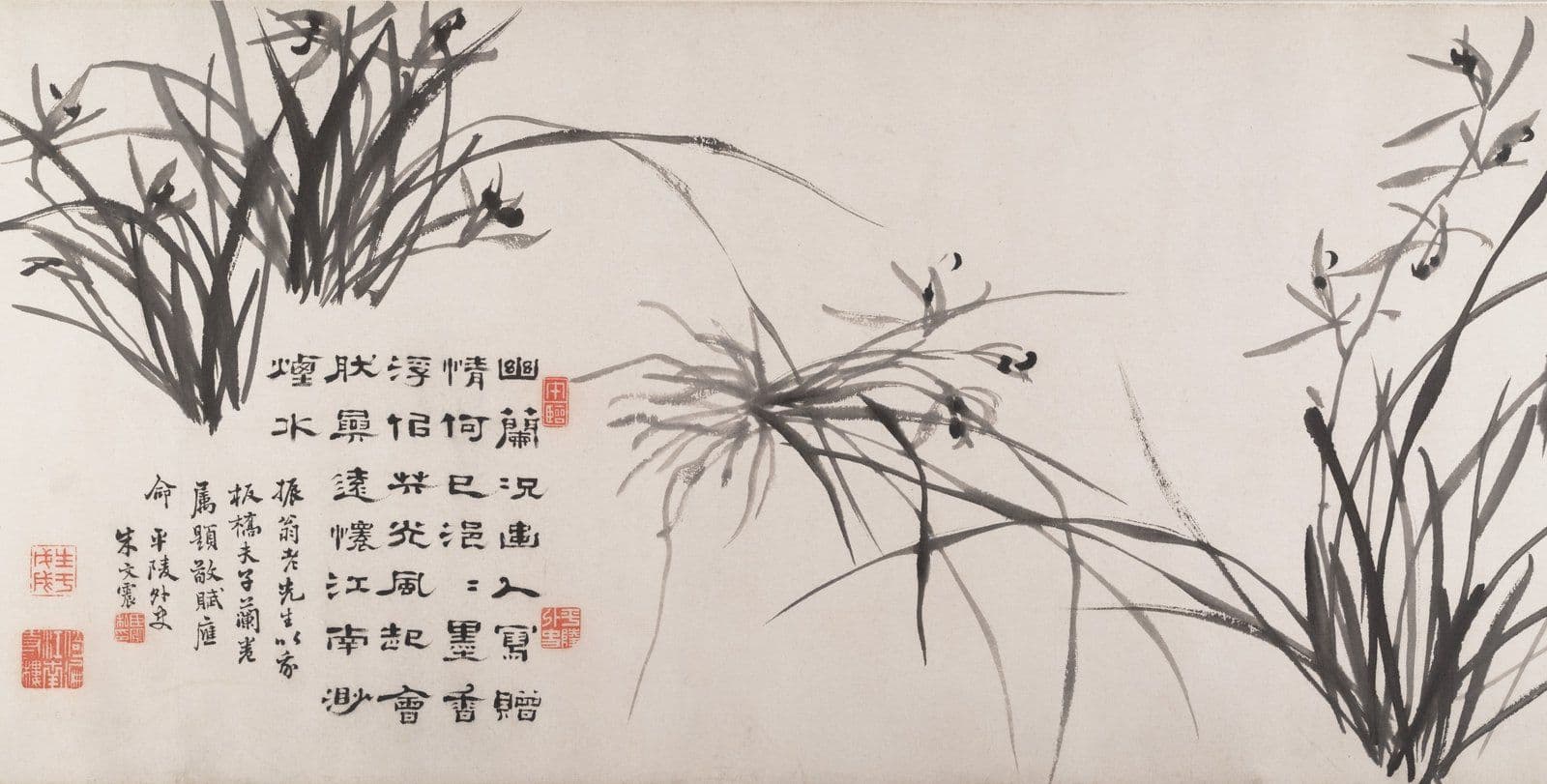
Orchid is the hardest to fake and the one connoisseurs watch most closely. It is almost entirely long, curving leaf strokes, each swelling and thinning as the brush pressure changes, and the crossings between leaves have to create a coherent space rather than a tangle. There is nowhere to hide: no texture, no colour, no density to disguise a weak line.
Chrysanthemum is the most compositionally complex of the four, since the flower head is built from many individual petal strokes radiating around a centre, and it must stay a single readable form rather than dissolving into marks. It usually carries more foliage than the others, which means managing several ink tones at once.
Because the four sit at the freehand end of the tradition, they are also the clearest illustration of what separates the two great modes of Chinese painting — the spontaneous and the meticulous. The distinction, and why the paper decides so much of it, is set out in our comparison of xieyi and gongbi painting.
Reading one in front of you
When you are judging a Four Gentlemen painting, most of the useful information is in the line rather than the subject.
Look first at whether the strokes have direction and speed in them. A confident leaf or branch shows where the brush entered, how the pressure changed, and where it lifted; a copied one tends to be even in width and slightly slow, because the copyist is following a shape rather than making a movement. Look at the ink tones and whether they vary meaningfully — a painter working from a full understanding of the subject will load the brush differently for near and far elements, so that some leaves sit forward and others recede.
Then look at what the painter left out. Empty paper is active in these compositions; the placement of the plant relative to the void, and the direction the composition seems to lean, is a deliberate decision. Crowding is usually a sign of insecurity.
Finally, read the inscription and seals as part of the picture rather than as a caption. In literati painting the calligraphy is by the same hand and to the same standard as the image, and its placement is compositional. A painting whose brushwork is fluent but whose inscription is stiff is telling you something. The principles that underlie all of this judgement — spirit resonance first, brushwork second — are the classical criteria set out in the six principles of Chinese painting.
Among modern masters, Wu Changshuo is the most rewarding painter to study for plum specifically, because he came to painting from seal carving and brought that weight and compression of line into the branch work. The pairing of two of the four in a single composition, as in Plum and Bamboo, is a common and readable format — winter and summer set against each other on one sheet. Guan Shanyue's treatment of the subject, discussed in his plum blossom paintings, shows how far the motif could be pushed toward scale and colour while remaining recognisably the same tradition.
Common questions
Do the Four Gentlemen have to be painted as a set of four?
No, and most of the time they are not. Single subjects are far more common than complete quartets, and pairings — plum with bamboo, orchid with rock — are a standard format. A full set of four hanging scrolls or an album covering all four is a deliberate and more ambitious statement, often made for a specific occasion. The grouping matters as a shared frame of reference; it does not oblige the painter to produce four pictures.
Is bamboo really considered the hardest to paint?
It is the most unforgiving rather than the most complex. Chrysanthemum asks more of your composition, and orchid asks more of your line quality over a long stroke. Bamboo's difficulty is that it is simple enough that every flaw is visible — the stroke count is low, the forms are known to every viewer, and there is no ornament to distract from a weak leaf. That combination is why it functions as the standard test.
Why is colour so often absent?
Because the tradition treats ink as sufficient. Graded ink tones were understood to contain the full range of colour implicitly, and restricting yourself to black demonstrated that you could carry a subject on brushwork alone. Colour does appear — plum blossoms in red or white are common, and modern painters use it freely — but monochrome remained the more prestigious choice for these subjects.
Does the season matter when hanging one?
Traditionally, yes. Scrolls were rotated rather than displayed permanently, and hanging a subject in its own season was normal practice. It is not a rule you are obliged to follow, but it is worth knowing that a plum scroll was made with winter viewing in mind, and it does read differently in the season it depicts.
Further reading
- Xieyi and Gongbi: The Two Modes of Chinese Painting — why the paper decides how a subject can be handled.
- The Six Principles of Chinese Painting — the classical criteria a literati painting is judged against.
- Guan Shanyue's Plum Blossom Paintings — one of the four subjects taken to modern scale.
- Chinese Ink Sticks: Pine Soot, Oil Soot and How Ink Is Graded — what the tonal range in these paintings is actually made of.
Browse the collection
These four subjects run through the whole modern ink tradition, and several of the painters who handled them best are in our catalogue: limited-edition archival giclée reproductions of the twentieth-century Chinese ink masters, printed on rice (xuan) paper or museum-grade cotton rag, hand-numbered and issued with a Certificate of Authenticity.
Explore Further