Published August 15, 2026
A collector's guide to Guan Shanyue: his Lingnan school training, the wartime travels, plums and landscapes, and how to assess works bearing his name.
Guan Shanyue: A Collector's Guide to the Lingnan Master
In 1943, with the coastal cities occupied and the war at his back, Guan Shanyue reached the oasis town of Dunhuang and went into the caves. He copied the Buddhist wall paintings by the dozen — medieval, monumental, nothing like the misty Cantonese hills he had trained on. The habit that trip confirmed, of drawing what was actually in front of him rather than what the tradition said a mountain should look like, stayed in his hand for the next half century.
This guide is for the buyer who keeps meeting the name — under a red plum, in an auction catalogue, on the wall text beside one of the most reproduced paintings in China — and wants the shape of the career: where Guan Shanyue sits inside the Lingnan school, which subjects carry his reputation, what his hand looks like up close, and which checks matter before money changes hands.
From Yangjiang to the Chunshui studio
Guan Shanyue (1912–2000) was born in Yangjiang, a coastal county in western Guangdong, and trained first as a schoolteacher — painting was the evening occupation until it became the day job. The turn came in the mid-1930s in Guangzhou, when Gao Jianfu took him into the Chunshui studio, the teaching atelier from which the Lingnan school's second generation emerged.
The Lingnan school was the modernizing wing of Cantonese painting. Its founders — Gao Jianfu, his brother Gao Qifeng, and Chen Shuren — had studied in Japan and came back arguing that Chinese ink painting had to absorb the observed world: real light, real distance, contemporary subjects, sketching from life. Take the brush and the paper from the old tradition, in other words, and take the eye from the new one.
Guan absorbed the doctrine completely. Alongside Li Xiongcai, Zhao Shao'ang and Yang Shanshen he became one of the four names collectors mean when they say "second-generation Lingnan," and of the four he was the one whose career bound itself most tightly to the public history of the People's Republic.
| Decade | Where | What a collector should know ||---|---|---|| 1930s | Guangzhou | Chunshui studio under Gao Jianfu; Lingnan doctrine of sketching from life || 1938–1945 | The interior | War years on the road; exhibitions funded travel; the 1943 Dunhuang copies || 1950s–1970s | Guangzhou | Professor at the Guangzhou Academy of Fine Arts; state commissions, including the 1959 Great Hall collaboration || 1980s–1990s | Guangzhou and Shenzhen | The red plums of his late fame; the donation that seeded the Guan Shanyue Art Museum (opened 1997) |
The war years made the eye
When Guangzhou fell in 1938, Guan went inland, and for the better part of a decade he moved through the southwest and northwest of China, exhibiting as he went and painting what the war put in front of him: burned towns, refugees, pack roads, river gorges. The 1943 journey along the old Silk Road corridor to Dunhuang produced a body of copies after the cave murals, together with sketches of herdsmen, camels and desert country that fed his work for years afterward.
Two things from this period matter to a buyer. First, the wartime and travel work establishes that Guan was a draughtsman before he was anything else — the late plums that dominate his market rest on decades of structural drawing. Second, the itinerary itself has become part of the connoisseurship: dated wartime works tie to a documented route, and a painting whose inscription puts the artist in the wrong province in the wrong year has answered your question before you had to ask it.
Plums, pines and the working landscape
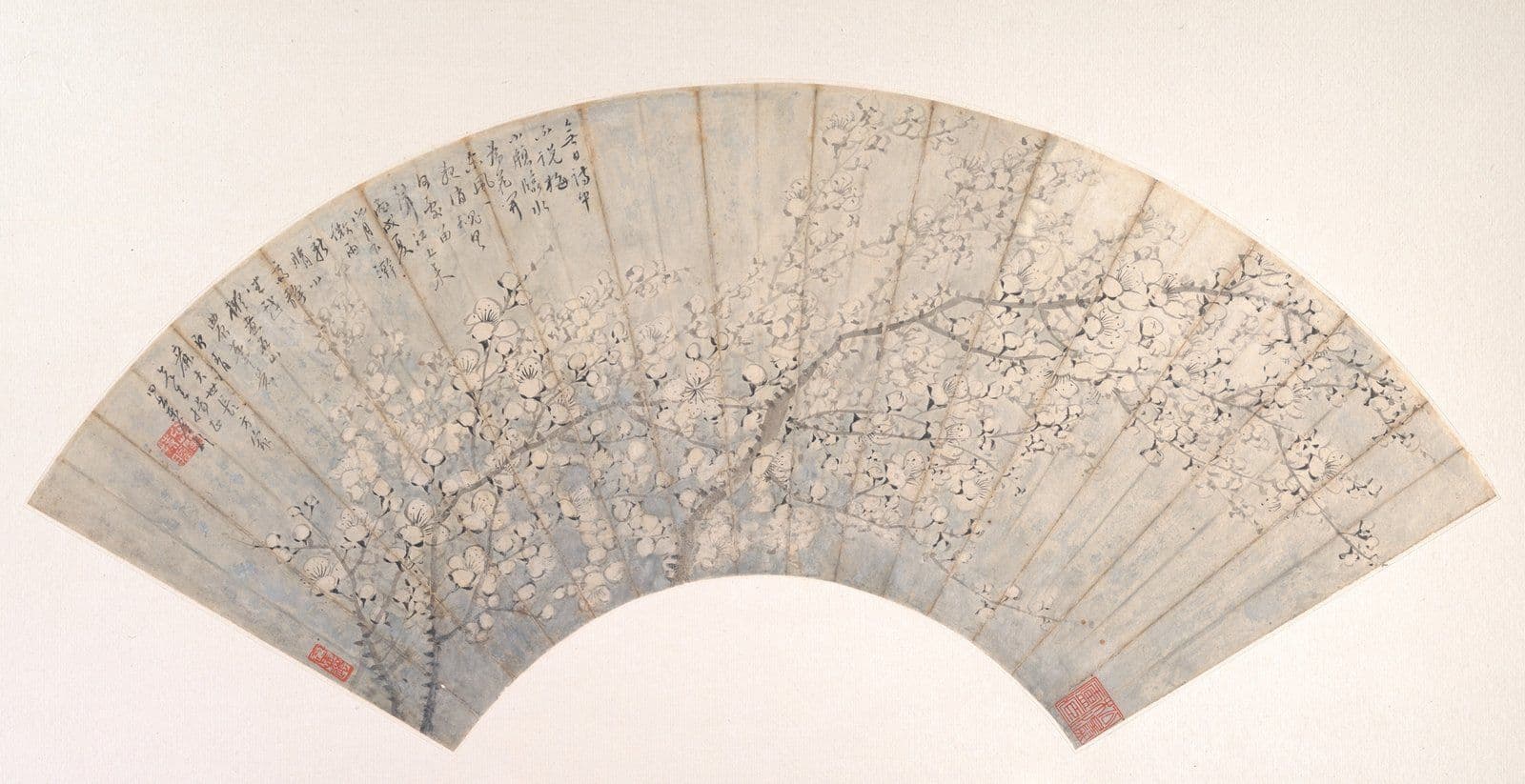
Ask a saleroom what "Guan Shanyue" means and the answer is red plum blossom. The dense, celebratory, vermilion-heavy plums of his last two decades are the works his market prices most readily, and they are treated at length in a separate guide to his plum-blossom painting. The short version: he reversed the sparse, austere convention of the literati ink plum and made the subject monumental.
But the plums are the roof, not the building. Under them sits a lifetime of landscape: Lingnan atmosphere carried into real places — river gorges, northern passes, southern coastlines — and, through the 1950s to 1970s, the working landscape of the construction decades: reservoirs, shelterbelt forests, ports and rail lines painted as seriously as any temple mountain. His 1973 Green Great Wall, a picture of coastal windbreak forest, is the type specimen of the mode. Late in life he returned again and again to pines, drawn with the same structural insistence as his plum trunks.
One collaboration stands apart. In 1959 Guan and Fu Baoshi painted This Land So Rich in Beauty, the vast landscape that hangs in the Great Hall of the People, on the theme of Mao's poem "Snow." The commission and its working process are covered in the guide to the Great Hall painting, and the other half of the partnership in the Fu Baoshi collector's guide. For Guan, it fixed a national reputation that the Cantonese art world alone could not have given him.
The hand up close
Guan Shanyue's paintings tend to declare themselves at two distances. Across the room, they read as weather: wet washes, saturated colour, a willingness to let a mountainside dissolve into atmosphere that is pure Lingnan. At reading distance, the structure shows — branches that fork with botanical logic, rock faces built in decisive dark strokes, figures and boats placed with a sketcher's economy. That combination — soft climate over hard drawing — is the signature, and it is what most imitations get wrong. A fake tends to have the colour without the construction: blossoms without a believable trunk.
His inscriptions are in a fluent running hand, usually signed Guan Shanyue (关山月), often with a date and a place; the travel habit means place-names do real work in his oeuvre. Seals vary across a six-decade career, so treat them as one input among several and run them through the standard checks in the step-by-step seal guide rather than as a verdict on their own.
The subject itself is a dating clue. Construction landscapes belong to the 1950s–70s; the full-blown red plum manner is overwhelmingly late; wartime realism sits in 1938–45. A painting dated to the 1940s in the late plum manner is answering that question for you.
The market, honestly
Supply has a particular shape. Guan gave a large body of his own work to the public: the Guan Shanyue Art Museum in Shenzhen, opened in 1997, was built around his donation, and the great state commissions hang where they were commissioned. What circulates privately is the rest — plums, pines, travel landscapes, calligraphy, dedication pieces — with demand historically deepest in Guangdong and Hong Kong salerooms and steady wherever modern Chinese painting is traded.
That public footprint is the collector's best friend. The museum's holdings and publications, and the exhibition record of a very public sixty-year career, give unusually rich comparative material. The works that clear an auction with conviction are the ones that plug into that record — published, exhibited, or with a provenance that touches the artist's circle. An unpublished red plum with no history and a generous size is where caution belongs; his fame in the Chinese-speaking world has kept copyists busy for decades.
In practice: judge the drawing before the colour, read the inscription against the documented itinerary, compare hand and seals against museum-published examples, and weigh the provenance before the picture. None of that is unique to Guan — it is the standard discipline for any heavily copied modern master — but his unusually well-documented life makes the discipline unusually workable.
Common questions
Was Guan Shanyue part of the Lingnan school?
Yes — he is one of its defining second-generation figures. He trained in Gao Jianfu's Chunshui studio in Guangzhou from the mid-1930s and spent his career inside the school's programme of joining Chinese brush technique to observed, contemporary subject matter. When dealers group him with Li Xiongcai, Zhao Shao'ang and Yang Shanshen as the four masters of that generation, this is the shorthand being used.
What is Guan Shanyue most famous for?
Two things. Among the broad public, the 1959 collaboration with Fu Baoshi for the Great Hall of the People, which reproduction has made one of the most widely seen Chinese paintings of the twentieth century. In the market, his red plum blossoms — the late, dense, vermilion manner that reversed the older, austere ink-plum convention.
How do I check a painting attributed to Guan Shanyue?
Structure first: his colour sits on firm drawing, and weak trunk-and-branch logic under confident red blossoms is the classic failure of imitations. Then documentation: his life is unusually well recorded — a museum devoted to him, decades of exhibitions and publications — so ask where the work has been, and compare hand, seals and subject-date logic against published examples. A work that fits the itinerary, the manner and the record asks little faith of you; a work that fits none of them is asking for all of it.
Did he only paint plum blossoms?
No. The plums dominate the late decades and the salerooms, but the career underneath is landscape — wartime realism, the Dunhuang-fed northwest subjects, and the construction-era working landscapes of the 1950s–70s — plus pines, figures and calligraphy. Serious collections tend to want the range, not just the signature flower.
Further reading
- Zhang Daqian: A Collector's Guide to Periods, Seals and Editions — the same hub treatment for the most copied name in modern Chinese painting.
- Li Keran: A Collector's Guide — another modern master whose late manner dominates his market.
- The Chinese Hanging Scroll, Explained — the format most Guan Shanyue works on the market arrive in.
Browse the collection
Guan Shanyue is one of the fifteen twentieth-century masters in our roster: his red plum is represented by Plum Blossoms for Spring, a limited-edition archival giclée on rice paper, hand-numbered and issued with a Certificate of Authenticity — and the full roster is at the collection.
Explore Further