Published August 20, 2026
Xieyi, the freehand mode of Chinese painting, set against meticulous gongbi: how they differ in brush, paper, history and the standards each is judged by.
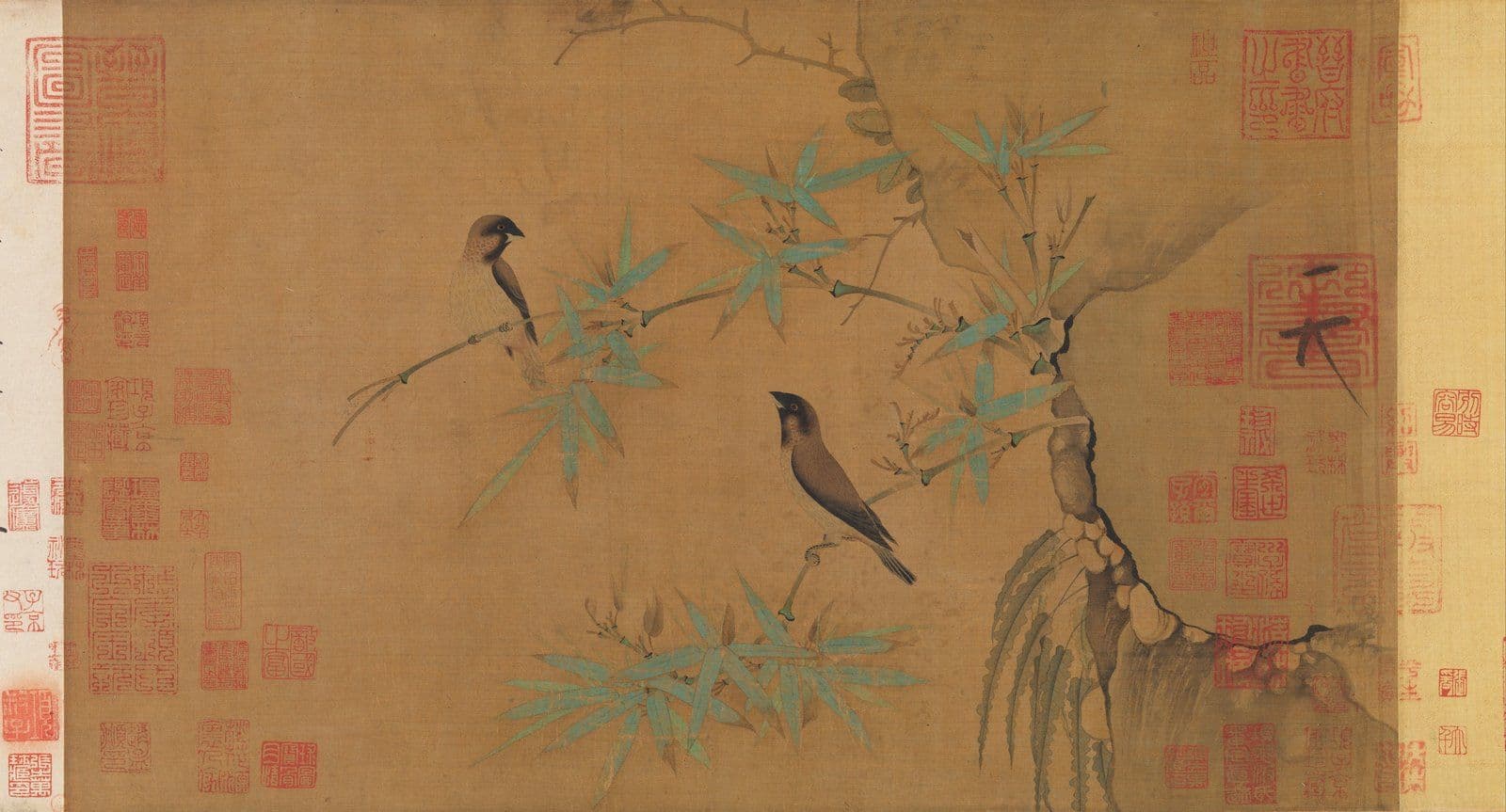
Put a Song academy bird-and-flower painting next to a twentieth-century ink shrimp and it is not obvious you are looking at the same tradition. One is built from outlines so fine they need magnification, filled with colour laid down in many thin layers on silk. The other is perhaps a dozen strokes on raw paper, done in a minute, with the grey of the ink doing the work that colour does in the first.
They are the same tradition, and the distinction between them — gongbi and xieyi — is the single most useful thing a collector can learn to see. This guide explains what each mode actually is, how each is judged, why the materials are not interchangeable, and what to look at when you are trying to work out whether a particular painting is good at what it is attempting.
The two modes, defined
Gongbi means, roughly, "meticulous brush". The image is constructed: fine ink outlines first, then colour or ink built up in repeated thin washes inside them. It is slow, it is planned, and it depends on control. The Northern Song painting academy is its high-water mark — Emperor Huizong's Finches and bamboo is the sort of object the whole mode is measured against.
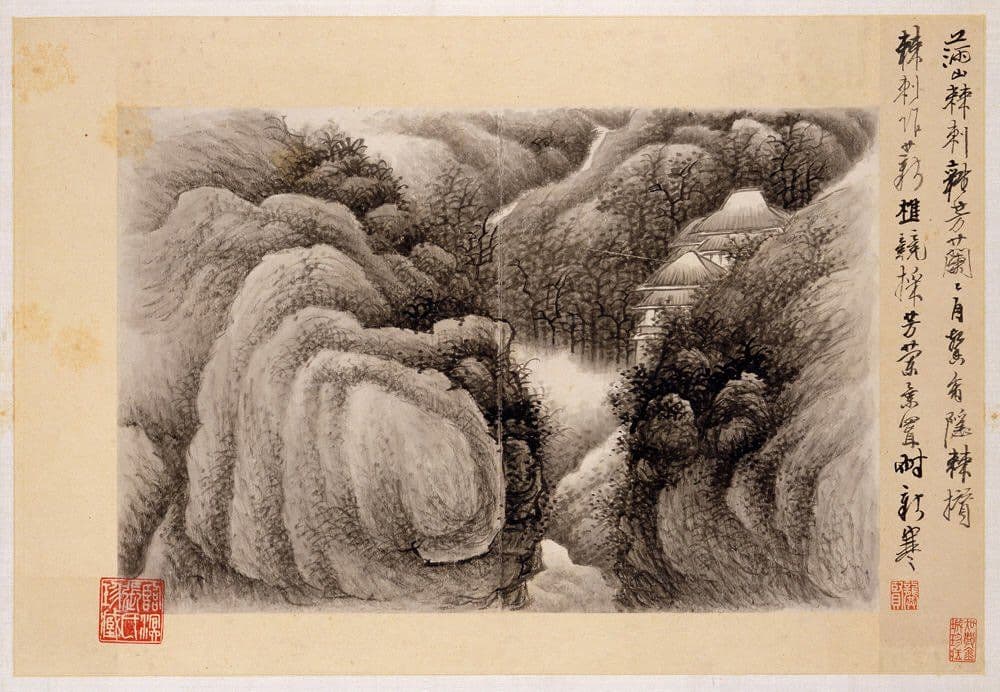
Xieyi means, roughly, "writing the idea". Form is stated in as few strokes as the subject allows, with the brush loaded to give tonal variation within a single mark. Ink usually dominates; colour, when it appears, is often applied without outlines. It looks fast because it is fast, and that is a fact about execution rather than about preparation.
There is a third term worth knowing, because it sits between them and is often mislabelled as one or the other. Mogu, "boneless" painting, applies colour or ink directly in shapes with no outline at all — no "bones", meaning no line structure. And baimiao is the opposite extreme: pure ink outline with no colour or wash whatsoever, the line carrying the entire image.
Xieyi itself divides by degree. Small freehand (xiaoxieyi) retains a good deal of descriptive detail and sits close to gongbi. Great freehand (daxieyi) reduces the subject to its minimum, and is the mode most Western viewers picture when they think of Chinese ink painting.
- Method — gongbi outlines first and then layers washes; xieyi puts down direct loaded strokes.
- Typical support — gongbi on silk or sized (shu) paper; xieyi on raw (sheng) xuan paper.
- Pace — days to months against minutes to hours.
- Colour — central to gongbi and applied in many thin layers; secondary or absent in xieyi.
- Failure mode — gongbi fails as stiffness, dead line and muddy layering; xieyi fails as emptiness, weak structure and mannerism.
- Judged on — gongbi on line control, evenness and colour depth; xieyi on brush energy, economy and ink tone.
The materials decide more than the intention
You cannot paint gongbi on raw xuan paper, and the reason is physical rather than stylistic.
Raw paper is unsized and highly absorbent. Ink hits it and spreads immediately into the fibres, blooming outward and feathering at the edges. That is exactly what a xieyi painter wants: the spread is expressive, the tonal bleed within a single stroke is half the effect, and the speed of the hand controls how far it goes.
Sizing — a treatment with alum and glue — closes the surface. On sized paper or on silk, ink sits where it is put, dries with a clean edge, and can be washed over repeatedly without disturbing what is underneath. That is what makes layering possible, and layering is what gongbi is.
So the choice of support is made before the first stroke and it is effectively irreversible. This is worth understanding in detail because it explains a great deal about how each mode looks — how xuan paper is made and how sizing changes its behaviour is the underlying mechanics, and the difference between working on silk and working on paper covers the other half.
Neither mode permits correction. On raw paper, a bad stroke is permanent within a second. In gongbi, an error in the underlying outline propagates through every layer of colour that follows it. The idea that meticulous painting is the safer discipline is a misreading — it simply distributes the risk over a longer period.
How the two modes came apart
Gongbi is the older institutional mode. Court and academy painting through the Tang and Song rewarded descriptive accuracy, finish and decorum; painters were professionals working to standards, and the Northern Song academy under Huizong formalised those standards to an unusual degree.
Xieyi grew out of a different social position. Scholar-officials who painted as an accomplishment rather than a trade valued the brush as an extension of calligraphic practice — the same tool, the same training, the same criteria of energy and control. From the Song and Yuan onwards this developed into an articulated preference: expressive brushwork over description, the painter's mind over the subject's appearance. By the Ming and Qing, painters such as Xu Wei and Bada Shanren had pushed freehand ink about as far as it goes.
That division is not just a matter of technique — it maps onto a long argument about what painting is for and who is qualified to do it, which we cover separately in literati painting versus court painting.
The twentieth century is where the split gets complicated, and where most collectors will actually be buying. Qi Baishi built a public style out of daxieyi at its most economical, while including passages of astonishingly fine descriptive detail in the same picture. Zhang Daqian worked convincingly in meticulous, colour-saturated modes derived from early wall painting and, later, in splashed ink about as far from gongbi as it is possible to get. Xu Beihong ran Western academic drawing training and ink painting in parallel.
The lesson is that mode is a choice per picture, not a fixed identity. Asking "was this artist a gongbi or a xieyi painter" is often the wrong question.
How to judge each one
The criteria genuinely differ, and applying the wrong set is the most common mistake a new collector makes.
Judging gongbi. Look at the line first, before the colour. It should be even in width where it means to be, and vary deliberately where it does not; it should not wobble, hesitate or show the point where the brush was reloaded. Then look at the colour: depth built from many thin layers reads differently from one thick application — it has luminosity, and the silk or paper texture stays visible through it. Muddiness means layers were applied before the previous ones dried, or too few, too heavy layers were used. Finally, look for stiffness. Great gongbi is exacting without being inert; the bird still has weight and the branch still grows.
Judging xieyi. Ignore how few strokes there are and ask whether the structure holds. A freehand bird still has a skeleton under it, and a painter who cannot draw produces strokes that sit on the paper without describing anything. Look at the tonal range within single strokes — a loaded brush should deposit several values in one movement, and a flat, uniform stroke usually means poor ink, poor loading, or hesitation. Look at the edges: confident strokes have clean starts and ends. And look at the composition of empty space, which in daxieyi is doing at least as much work as the marks.
The most useful single test for xieyi is whether the painting looks inevitable or looks lucky. Economy is the point of the mode, and a picture that works because of one fortunate accident reads differently from one where every stroke had to be where it is. Qi Baishi's shrimp are the standard demonstration of this, which is precisely why they are the most copied subject in modern Chinese painting.
Both modes are also read through the classical critical vocabulary, in which brush-and-ink quality and "spirit resonance" outrank likeness. That framework is old, still in use, and worth knowing before you read any Chinese-language catalogue entry — the six principles set out by Xie He is where it comes from.
Subject matter cuts across both modes, and bird-and-flower painting is the clearest case: it has a continuous gongbi tradition and a continuous xieyi one, running side by side for a thousand years on the same motifs. The bird-and-flower genre is the best place to see the two approaches compared directly on like subjects.
Common questions
Is xieyi easier than gongbi?
No, and the assumption causes real misjudgement in the market. Gongbi costs time and demands sustained control; xieyi costs years of preparation and demands that the control be complete before the brush moves, because nothing can be adjusted afterwards. The traditional formulation is that freehand painting is what you can do only after you no longer need to think about how. What is true is that bad xieyi is cheaper to produce than bad gongbi, which is why so much of it exists.
Which mode is worth more on the market?
Neither, as a category. Value follows the artist, the period, the quality of the individual work and its provenance, not the mode. What does vary is how the modes are distributed historically — surviving early meticulous work is rarer and largely institutional, while the twentieth-century market is dominated by freehand ink because that is what the leading modern names mostly produced.
Can one painting contain both?
Frequently, and noticing it is a good sign you are reading the picture properly. A common combination places a finely drawn insect or bird against a freehand branch or rock, so that the detailed passage draws the eye precisely because everything around it is loose. Qi Baishi used this contrast constantly. It is a compositional device, not a hybrid style.
How can I tell if a "gongbi" work is actually a print?
Look at the line under magnification. A brushed outline varies in width and density along its length and shows the fibre of the support at its edges; a printed line is uniform and often shows a dot structure or a perfectly consistent edge. Check whether colour sits in layers with visible texture beneath, or as a flat even film. This is a routine check and it is not rude to make it before buying.
Further reading
- Chinese Ink Painting: The Six Principles of Xie He — the critical vocabulary both modes are still judged in.
- Literati Painting vs Court Painting — the social argument underneath the stylistic one.
- Silk vs Paper in Chinese Paintings — why the support decides what the brush can do.
- Wu Changshuo: Flower Paintings and the Seal Carver's Line — freehand ink at the point where calligraphy and painting stop being separable.
Browse the collection
Almost everything Kiln & Ink stocks sits on the freehand side of this divide, because the twentieth-century masters we reproduce mostly worked there. Our limited-edition archival giclée reproductions are printed on rice (xuan) paper or museum-grade cotton rag, hand-numbered and issued with a Certificate of Authenticity — and the reason the paper matters is the same reason it mattered to the painters: it is what the tonal range of the ink depends on.
Explore Further