Published July 30, 2026
Pu Ru (Pu Xinyu) explained: the Qing imperial kinsman turned literati painter, the 'South Zhang, North Pu' pairing, and how to authenticate his work.
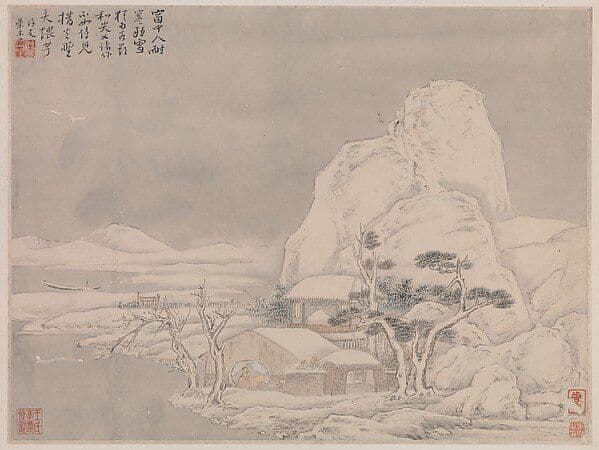
Look at a landscape signed Pu Ru and the first thing that registers is restraint. The mountains are built from small, deliberate texture strokes; the ink is clean rather than dramatic; a few lines of neat, upright calligraphy sit in one corner as if the painter were more interested in the poem than the picture. There is nothing showy about it. That quietness is easy to underrate — until you learn that the man holding the brush had been born inside the Qing imperial house and had watched that world end.
This article walks through who Pu Ru was, why collectors pair him with Zhang Daqian under the phrase "South Zhang, North Pu," what his paintings and calligraphy actually look like, and what to weigh before you trust a work that carries his name.
From the imperial clan to the studio
Pu Ru (溥儒, 1896–1963) was a member of the Aisin-Gioro clan, the ruling house of the Qing dynasty. He was a grandson of Prince Gong (Yixin), the powerful statesman who was himself a son of the Daoguang Emperor — which made Pu Ru a kinsman of Puyi, the last emperor. He is usually known by his art name, Xinyu (心畬), so you will see him signed and catalogued as Pu Xinyu as often as Pu Ru.
He grew up with access to a family collection of old paintings and calligraphy, and that collection did much of his teaching. Rather than train in a workshop, he learned by copying — studying and re-studying earlier masters until their methods became his own. This is the orthodox literati route: absorb the tradition through the hand, then let personal temperament shape what comes out. The distinction between that scholar-amateur ideal and the professional workshop is a real one in Chinese art, and it is worth understanding on its own terms; our note on literati painting versus court painting lays out why the categories matter for how a work is judged.
The fall of the dynasty in 1912 removed Pu Ru's world but not his education. He lived quietly for years, and painting shifted from a gentleman's accomplishment toward something closer to a living. By the 1920s and 1930s he was recognized in Beijing as one of the leading traditional-style painters of his generation. In 1949 he left the mainland and settled in Taiwan, where he taught and continued to paint until his death in Taipei in 1963.
"South Zhang, North Pu"
The phrase collectors reach for most often is Nan Zhang, Bei Pu — "South Zhang, North Pu." It pairs Pu Ru, based in the north in Beijing, with Zhang Daqian, associated with the south, as the two most admired painters working in the traditional manner during the Republican era. It is a period nickname rather than a formal ranking, but it tells you where the market placed him: at the very top of the conservative, tradition-facing wing of modern Chinese painting.
The pairing is instructive precisely because the two men were so different. Zhang Daqian was restless, theatrical, and endlessly inventive — a copyist of genius who eventually pushed into the splashed-ink and splashed-color abstraction of his late years. Pu Ru moved the other way. He stayed close to the Song and Yuan models he had absorbed as a young man and refined them rather than reinventing them. If Zhang represents how far a traditional training could be stretched, Pu represents how deep it could be cultivated.
Reading a Pu Ru painting
Pu Ru worked across the classic literati range: landscapes above all, but also figures, horses, flowers, and small studies. A few characteristics recur often enough to be useful anchors.
| What to look at | What is typical of Pu Ru ||---|---|| Overall mood | Refined, cool, unhurried; scholarly rather than dramatic || Landscape method | Small, controlled texture strokes; clear structure; Song- and Yuan-rooted composition || Ink and color | Clean, well-graded ink; restrained, often pale color washes || Figures and horses | Fine, economical line; elegant proportions || Calligraphy | Upright, disciplined, highly legible; treated as an equal partner to the image || Poem and signature | Frequently a self-composed poem in one corner, integrating word and picture |
That last point matters more with Pu Ru than with many painters. He was a poet and calligrapher first in his own self-image, and the inscription is rarely an afterthought. The three arts of poetry, calligraphy, and painting are meant to read as one gesture. If you cannot yet parse what an inscription is saying and where it sits in that tradition, our guide to reading a Chinese painting inscription is a good place to start, because with a literati painter the words carry as much of the value as the brushwork.
None of these traits is a proof of authenticity on its own — a skilled follower can imitate a manner. They are simply the qualities a genuine Pu Ru tends to have, and their absence is a reason to look harder.
Poetry, calligraphy, and the "three perfections"
Pu Ru would likely have resisted being called a painter first. In the scholar tradition he inherited, the ideal was the union of three arts — poetry, calligraphy, and painting, the san jue or "three perfections" — practiced by one hand as a single accomplishment. He was a serious poet and a disciplined calligrapher, and in his work the three are meant to be read together rather than ranked.
His calligraphy is upright, even, and highly legible, closer to the classical models than to the expressive extremes some modern calligraphers pursued. On a painting, the inscription is placed with care: the poem answers the image, the columns of characters balance the composition, and the seals complete it. This is why an inscription on a Pu Ru work rewards attention rather than being skimmed — it is part of the picture's argument, not a caption.
The same restraint governs his figures and horses. Where a professional might reach for drama, Pu Ru draws with an economical, confident line and lets elegance do the work. A galloping horse is described in a handful of sure strokes; a scholar beneath a pine is rendered without fuss. The through-line, whatever the subject, is a scholar's temperament: controlled, literate, and unwilling to overstate.
For a buyer, this integration has a practical consequence. A convincing Pu Ru has to hold up in all three registers at once — the painting, the calligraphy, and the poem — and a weakness in any one of them is a warning. A follower may copy a landscape competently and still betray himself in a stiff, imitative hand or an inscription that does not quite cohere. Judging the whole, not just the picture, is how the tradition itself asked these works to be read.
The market and the authentication problem
Pu Ru has a durable collector base, concentrated in Taiwan, Hong Kong, and among Chinese collectors in the United States and elsewhere, with steady appearances at the major auction houses. Demand for a famous name and a large surviving output are exactly the conditions under which imitations and misattributions flourish, so caution is warranted rather than optional.
Two lines of evidence do most of the work. The first is the signature, seals, and inscription taken together. Pu Ru used personal seals, and the way a seal is cut, inked, and placed is part of the record a serious buyer checks; our overview of painting seals and collector marks explains what these red impressions are and why they are studied so closely. The second is provenance — the chain of ownership, exhibition history, and publication that stands behind a work. Because his market is active and his name valuable, independent expert opinion is standard practice for anything of consequence; how that judgment is actually formed is the subject of our piece on how experts authenticate Chinese paintings.
The practical takeaway is simple. A calm, well-drawn landscape with an elegant poem is not, by itself, a Pu Ru. Treat the name as a claim to be supported, weigh the brushwork, the calligraphy, the seals, and the paper trail together, and get a qualified opinion before you commit real money.
Common questions
Are Pu Ru and Pu Xinyu the same person?
Yes. Pu Ru is the given name and Xinyu is his art name, so the two are used interchangeably. Catalogues, auction records, and museum labels may list him either way — as Pu Ru, Pu Xinyu, or occasionally with the surname romanized differently — but they all refer to the same painter (1896–1963).
Why is he called an "imperial" painter?
Because he was born into the Aisin-Gioro clan, the Qing ruling house, as a grandson of Prince Gong. He was a kinsman of the last emperor and grew up with the education and art collection of that world. He was not a court painter in the professional sense; the "imperial" label describes his lineage, not a palace job. That biography — an heir of the fallen dynasty who turned to poetry and painting — is part of why his work carries the aura it does.
What did Pu Ru mainly paint?
Landscapes are the core of his reputation, worked in a refined, tradition-rooted manner descended from Song and Yuan models. He also painted figures, horses, flowers, and small album studies, and he was an accomplished poet and calligrapher whose inscriptions are integral to his pictures rather than incidental.
Is a Pu Ru painting a safe purchase?
Only with the usual diligence. His name is valuable and widely imitated, so signature, seals, inscription, brushwork quality, and documented provenance all need to line up, and an independent expert opinion is the norm for significant works. Approach any attributed piece as a claim to be verified rather than a fact to be trusted.
Further reading
- Zhang Daqian's Dunhuang Period — the other half of "South Zhang, North Pu," and how deep immersion in old models shaped a modern master.
- Chinese Calligraphy: The Five Scripts Explained — the writing tradition Pu Ru mastered and treated as equal to his painting.
- Huang Binhong's Black Landscapes — a contemporary who took the tradition the opposite way, toward dense, accumulated ink.
Browse the collection
For the works themselves, Kiln & Ink issues limited-edition archival giclée reproductions of the modern ink masters — printed on rice paper, hand-numbered, and issued with a Certificate of Authenticity.
Explore Further