Published August 16, 2026
A collector's guide to Jiajing porcelain: the Daoist iconography, huiqing cobalt, wucai enamels, the reign's kiln flaws, and how to test the mark.
Pick up a piece of Jiajing blue-and-white and the first thing that registers is the colour. Where earlier Ming blue tends toward grey or a soft ink-wash tone, Jiajing blue is saturated and pushed toward violet — a dense, almost purplish note that sits on the glaze rather than sinking into it. The second thing you notice, if you turn the piece over and study the potting, is that the body is often not especially good.
That combination — intense colour, uneven craft, and a body of imagery unlike any other reign — is what makes Jiajing porcelain both distinctive and frequently misjudged. This guide covers what changed under the Jiajing emperor, how to read the iconography, what the quality range actually looks like, and what to check before buying.
The reign, and why it shows in the porcelain
The Jiajing emperor occupied the throne for roughly the middle decades of the sixteenth century, one of the longer reigns of the Ming dynasty. He is remembered for two things that both left marks on the ceramics: a deep and consuming commitment to Daoism, and a corresponding withdrawal from the day-to-day business of governing.
The Daoism is not background colour here. It is the single most useful key to identifying the reign's porcelain. The emperor's pursuit of longevity and immortality drove the decorative programme at the imperial kilns, and Jiajing wares carry a denser load of Daoist symbolism than the porcelain of any reign before or after.
Jiajing opens the stretch of Ming ceramics usually grouped as the late Ming, running through the short Longqing reign into Wanli — and the family resemblance across those reigns is strong enough that they are often studied together. The reigns immediately before, covered in Hongzhi and Zhengde reign marks, belong to a quieter and more restrained world. Jiajing is where the volume goes up.
Reading the iconography
If you learn one thing about Jiajing porcelain, learn the motif vocabulary. It dates pieces faster than any other single indicator.
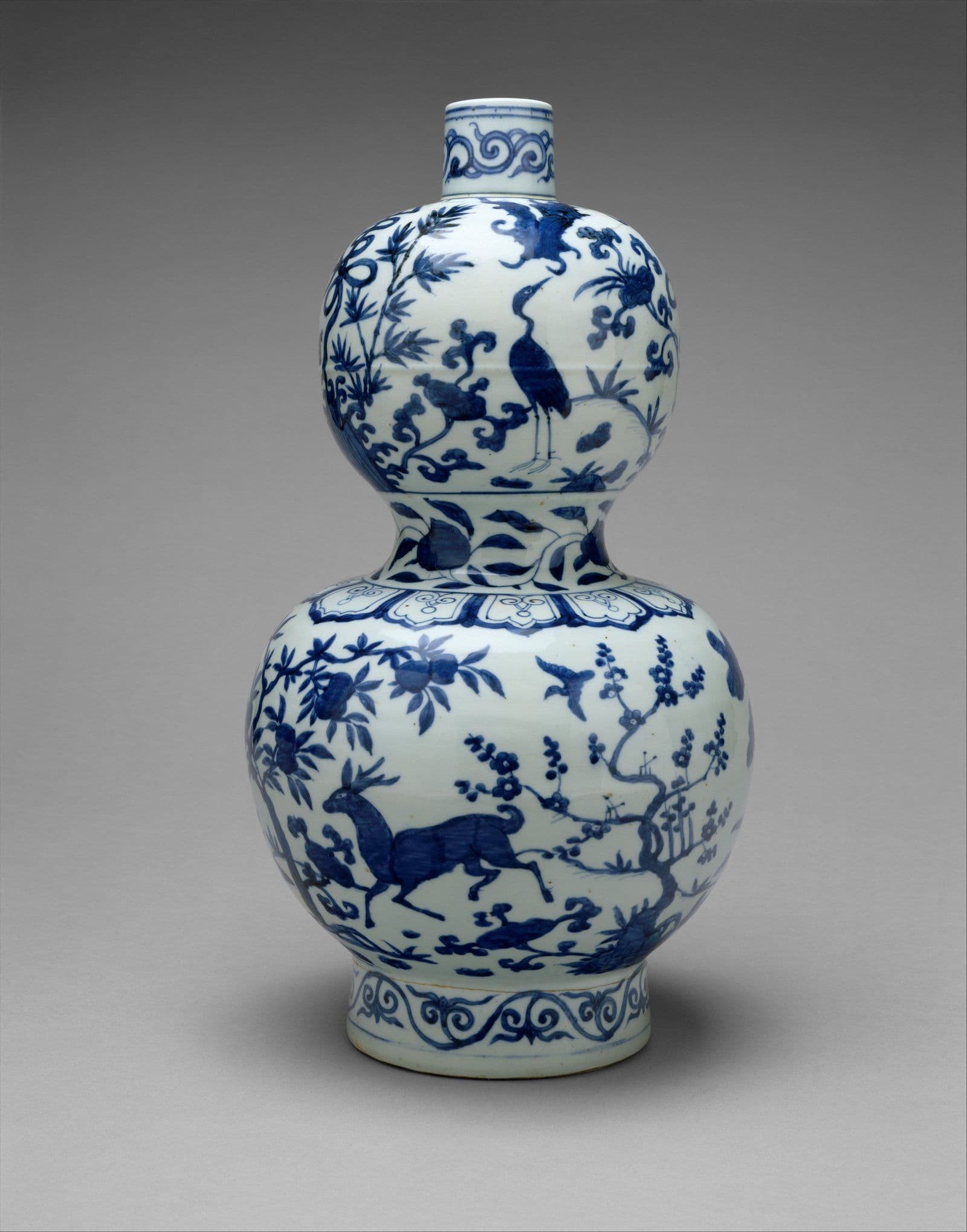
- Crane — longevity, and the mount of the Daoist immortals.
- Deer — longevity, and a rebus for official emolument.
- Lingzhi fungus — the fungus of immortality.
- Pine, bamboo and plum — endurance through winter.
- Eight Trigrams (bagua) — Daoist cosmology.
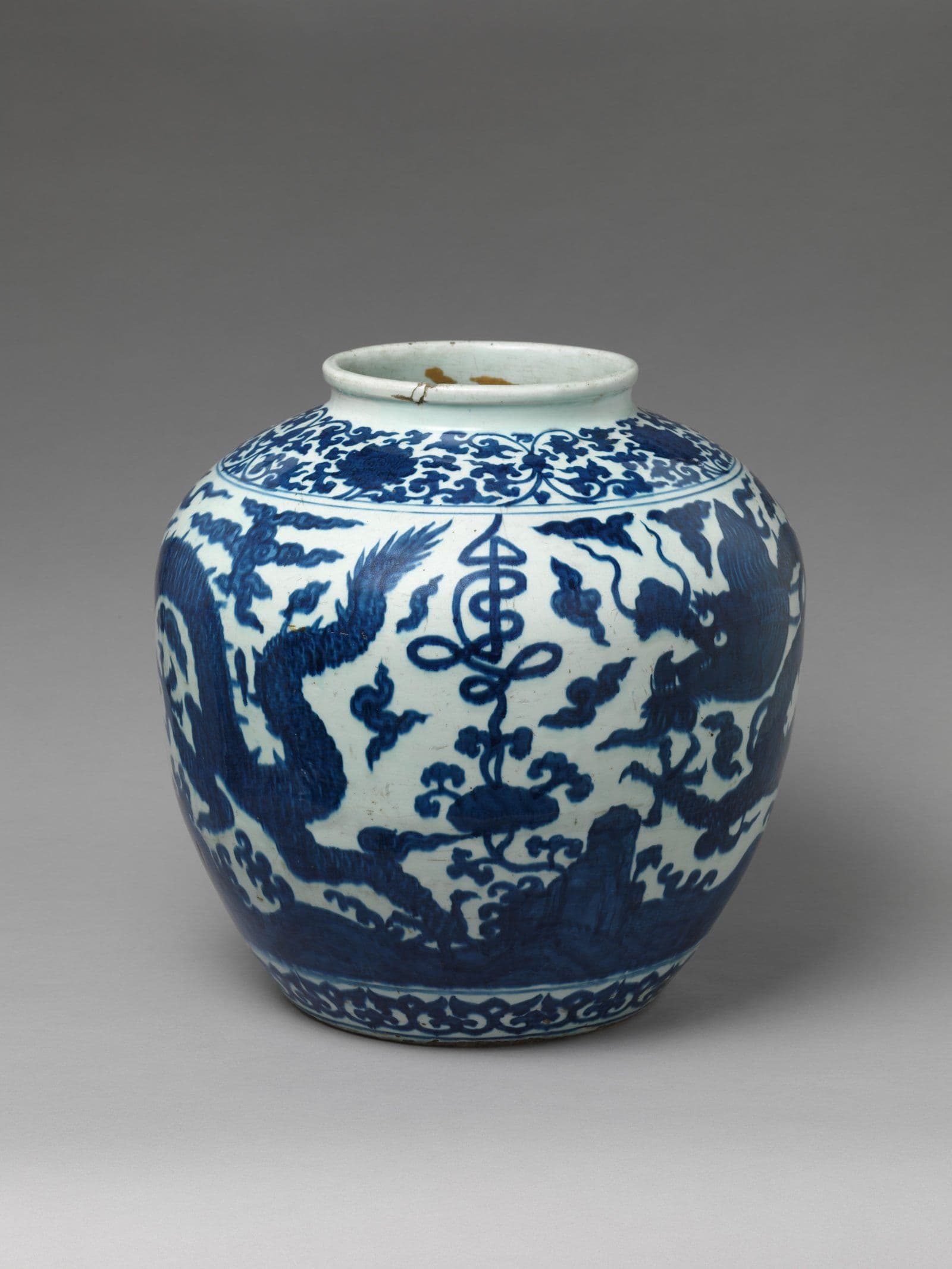
- The character 壽 (shou) — longevity, often enlarged into a roundel or repeated across a whole field.
- Boys at play — progeny and succession.
The longevity character deserves particular attention. On Jiajing pieces it is frequently treated as a design element in its own right — enlarged into a medallion, stylised into a tall archaic form, or repeated across a ground in dozens of variant writings. When you see a vessel whose principal decoration is a single large character rather than a pictorial scene, Jiajing should be near the top of your list.
Immortals, cranes flying among clouds, deer beneath pines, and trigram bands around a shoulder all belong to the same programme. Read together, they describe a court preoccupied with not dying.
The blue, and the cobalt behind it
The violet-toned blue of good Jiajing wares comes from an imported cobalt, known in Chinese sources as huiqing (回青) and in Western literature as "Muhammadan blue," brought in through the western trade routes. Refined and used well, it fires to a rich, slightly purple sapphire that is the reign's signature.
Used badly — or blended heavily with domestic cobalt to stretch supply — it produces something muddier and greyer. Both exist within the reign, sometimes within the same year, which is why colour alone should never carry an attribution on its own. The history of cobalt in blue-and-white porcelain traces how the ore sources shifted across the dynasties and why the colour changes with them.
Jiajing is also the reign in which wucai (五彩) — underglaze blue combined with overglaze enamels in red, green, and yellow — reaches its recognisable classic form. The palette is bold and the drawing is loose and energetic rather than refined. Wucai porcelain: reading China's five-color ware covers the technique and how to distinguish it from later imitations. Alongside these, the reign produced monochrome and coloured-ground wares: yellow grounds, iron-red, and green-enamelled pieces.
Quality: manage your expectations
This is where collectors new to the reign most often get caught, because the standard Jiajing piece does not look like a standard Chenghua or Yongzheng piece.
Imperial demand under Jiajing was enormous, and the orders placed on the Jingdezhen kilns ran well beyond what the imperial workshops could comfortably produce. The consequences are visible in the ware:
- Warping and distortion, especially on large forms. The great fish jars and wide-mouthed vats of this reign very frequently sit out of true, and a perfectly regular large Jiajing vessel is the exception rather than the rule.
- Uneven glaze, with pooling, thin patches, and pinholing.
- Firing flaws — kiln grit adhering to the foot, cracks, and stress lines that opened in the kiln rather than in use.
- Variable potting, with wall thickness that changes noticeably around a single vessel.
To meet the volume, imperial requirements were increasingly met by contracting work out to private kilns operating alongside the official ones — a practice that broadened output while widening the quality range further.
The practical implication for a buyer: a Jiajing piece with minor kiln flaws is normal and is not by itself evidence of a problem. Judge condition against what the reign actually produced, not against the imperial standard of a more disciplined era. Conversely, be alert when a "Jiajing" piece is suspiciously crisp, perfectly symmetrical, and flawlessly finished.
The mark, and the problem with it
The standard imperial mark of the reign reads 大明嘉靖年製 — "Made in the Jiajing reign of the Great Ming" — six characters in underglaze blue, normally written in regular script. You will find it in a vertical arrangement within a double circle on the base, or in a single horizontal line around the rim or shoulder on some forms.
The characters are typically written with some force, and the brushwork on genuine imperial examples is confident rather than fussy. Jiajing and Wanli marks: late Ming porcelain identification sets out the character forms in detail and is the page to work from when you have a mark in front of you.
Then the complication. The Jiajing mark is among the most frequently reproduced marks in Chinese ceramics. It was applied in later reigns — extensively in the Kangxi period, again during the Republic era, and continuously in modern production. A great many pieces bearing a Jiajing mark were made centuries after the reign ended.
Crucially, not all of these are forgeries. Chinese potters applied earlier reign marks as marks of homage and as a statement of the style being emulated, a convention explained in apocryphal marks on Chinese porcelain. The mark tells you what a piece is referring to; the body, glaze, cobalt, potting, and foot tell you when it was made. When those two disagree, the mark is the part that loses. For the general method, the seven-step guide to identifying and dating any piece is the framework to apply.
What to check before buying
A practical order of operations:
- Look at the foot first, not the mark. Ming foot rims, glaze meeting the biscuit, and the character of the exposed body carry more dating information than the characters on the base.
- Assess the blue. Is it the saturated violet of good huiqing, or a flat modern cobalt? Does it have depth and slight unevenness, or does it sit uniformly like a print?
- Read the motifs. Do they belong to the Daoist programme described above, and are they drawn with the period's characteristic looseness?
- Expect imperfection. Then ask whether the imperfections are the kiln flaws of the sixteenth century or the wear of later handling.
- Treat the mark as the last piece of evidence, not the first.
- Ask for provenance on anything expensive, and be more sceptical the closer the piece is to a textbook example.
For a sense of where the reign sits in the arc that follows, the Wanli reign a few decades later picks up the same story with many of the same pressures intensified — the guide to it is linked below.
Common questions
Is Jiajing porcelain a good place to start collecting Ming?
It can be, precisely because the quality range is so wide. The reign produced a large volume across every price level, which means genuine period pieces with honest kiln flaws circulate far more readily than the rarer wares of the early Ming. The trade-off is that the same abundance, combined with the popularity of the mark, means the field carries a heavy load of later copies. Start by learning the foot and the cobalt rather than the mark.
Why does so much Jiajing porcelain look badly made?
Because the imperial kilns were being asked for more than they could produce well. Warping, glaze faults, and irregular potting are characteristic of the reign rather than aberrations within it, and large vessels show it most. This is a genuine period trait, and the connoisseurship literature treats it as such. A large Jiajing jar that sits perfectly true deserves more scrutiny, not less.
What is the difference between Jiajing wucai and later wucai?
Jiajing-period wucai tends toward bold, loosely drawn designs with strong contrasts between the underglaze blue and the overglaze red and green, and it usually carries the period's kiln irregularities. Later imitations — especially nineteenth-century and modern ones — are typically more precisely drawn, more evenly enamelled, and cleaner in the body. Precision of drawing is generally an argument against the period, not for it.
Does a Jiajing mark on a piece mean it is a fake?
No. It means one of three things: the piece is of the period, the piece was made later in deliberate homage to the Jiajing style, or the piece is a deliberate forgery. The first two are both legitimate objects with legitimate markets, and distinguishing the second from the third is a question of intent that the object alone cannot always settle. Date the piece from its physical evidence and treat the mark as a claim to be tested.
Further reading
- Jiajing & Wanli Marks: Late Ming Porcelain Identification — the mark characters in detail.
- Wucai Porcelain: Reading China's Five-Color Ware — the enamel technique that defines the reign.
- Wanli Porcelain: A Collector's Guide to the Last Great Ming Reign — where the story goes next.
- Chinese Porcelain Marks: 7-Step Visual Guide — the master framework for dating any piece.
Browse the collection
Porcelain is a subject we write about rather than one we stock. What Kiln & Ink sells is paper: limited-edition archival giclée reproductions of the twentieth-century Chinese ink masters, each printed on rice (xuan) paper or museum-grade cotton-rag, hand-numbered, and issued with a Certificate of Authenticity, at roughly $300 to $1,200.
Explore Further