Published July 24, 2026
Wucai porcelain is Ming China's five-color ware. How to tell it from doucai, place Jiajing-Wanli pieces, and follow the palette into famille verte.
Pick up a densely painted Ming jar covered in red dragons, green lotus, and cobalt clouds, and you are holding wucai (五彩) — literally "five colors," though no one ever counted them out to exactly five. The name is a convention for polychrome, not an inventory. What makes it wucai and not something else is a specific way of building color: underglaze cobalt blue fired first, then a scatter of overglaze enamels fired again at a lower heat, with an iron-red line doing much of the drawing.
This guide sorts wucai from its close cousin doucai, walks through the Jiajing and Wanli wares that define the type for most collectors, and follows the palette forward into the Kangxi enamels that Western dealers later filed under "famille verte." Knowing where wucai sits in that sequence is half of dating any piece that comes across your table.
What "five colors" actually means
Wucai is a two-firing technique. The potter paints the cobalt-blue elements under the glaze, glazes and fires the piece to full porcelain temperature, then paints the remaining design in overglaze enamels — chiefly iron-red, copper-green, and antimony or iron yellow, sometimes with a brownish-black or aubergine — and fires a second time in a muffle kiln at a few hundred degrees lower. The blue is locked under glass; the enamels sit on top of it and, on close inspection, stand very slightly proud of the surface. Run a fingertip across a wucai panel and you can often feel the enamels as low ridges.
The palette reads bold and flat rather than shaded. Each color is a discrete field bounded by a drawn line, usually iron-red or black. There is no blending, no gradation from light to dark within a single petal — that softness belongs to a later invention. Wucai's charm is its graphic confidence: strong outlines, saturated fields, and a crowded, horror-of-the-void density that fills every reserve with dragons, phoenixes, fish, lotus scrolls, or the Eight Immortals.
Because the technique leans on overglaze iron-red for its outlines, a piece can be fully "five-color" even where cobalt blue is sparing. That freedom from underglaze blue is exactly what separates wucai from the more disciplined palette it is most often confused with.
Wucai versus doucai: the line that divides them
Doucai (斗彩) — "joined" or "contrasting" colors — uses the same two firings but a stricter grammar. In doucai, the entire design is first drawn in fine underglaze cobalt-blue outline. After the high firing, overglaze enamels are washed inside those blue outlines, coloring in a picture whose skeleton is already fixed in blue beneath the glaze. The blue does the drawing; the enamels do the filling. The result is delicate, small in scale, and famously associated with the Chenghua doucai wares whose reign marks collectors scrutinize.
Wucai reverses the emphasis. Instead of relying on an underglaze-blue armature, the wucai painter uses overglaze iron-red or black for outlines and reserves cobalt blue for whichever passages he wants blue — a robe, a wave, a sky. The drawing lives mostly above the glaze. So the quick test is this: if the outlines are cobalt blue under the glaze and the enamels are tucked neatly within them, you are likely looking at doucai; if the outlines are overglaze red or black and the blue appears only as one color among several, it is wucai.
Scale and mood follow from that difference. Doucai tends toward the small, refined, and intimate — cups, small jars, imperial precision. Wucai runs larger and louder — big jars, dishes, and vases meant to carry across a room. Neither is "better"; they are two answers to the same problem of getting many colors onto porcelain.
The Jiajing–Wanli high point
For most collectors, wucai is the ware of the Jiajing (1522–1566) and Wanli (1573–1620) reigns. These late-Ming decades pushed the type to its most exuberant: red-and-green dominated palettes, designs packed edge to edge, and imperial pieces marked in the six-character underglaze-blue Jiajing and Wanli reign marks that anchor late-Ming dating. Fish jars swimming with carp among waterweed, kraak-influenced dishes, and tall covered jars are the signature survivors.
Two features help place a piece in this period. First, the iron-red of Jiajing–Wanli wucai is often a warm, slightly orange tomato tone, applied thickly enough to sit up from the surface. Second, the potting is frankly less refined than the imperial porcelain of a century earlier — kiln grit on the foot, a faintly bluish or greyish glaze, and firing flaws are common and, on genuine pieces, expected. Over-perfect potting on a supposedly Wanli wucai jar is a reason to slow down, not speed up.
The cobalt of this era matters too, because wucai still depends on underglaze blue for part of its palette. The imported and blended cobalts used in the late Ming give a particular blue — sometimes greyish, sometimes with a violet cast — that ties wucai into the longer history of cobalt blue on Chinese porcelain. When the blue looks too clean and even, question the date.
From wucai to the famille palettes
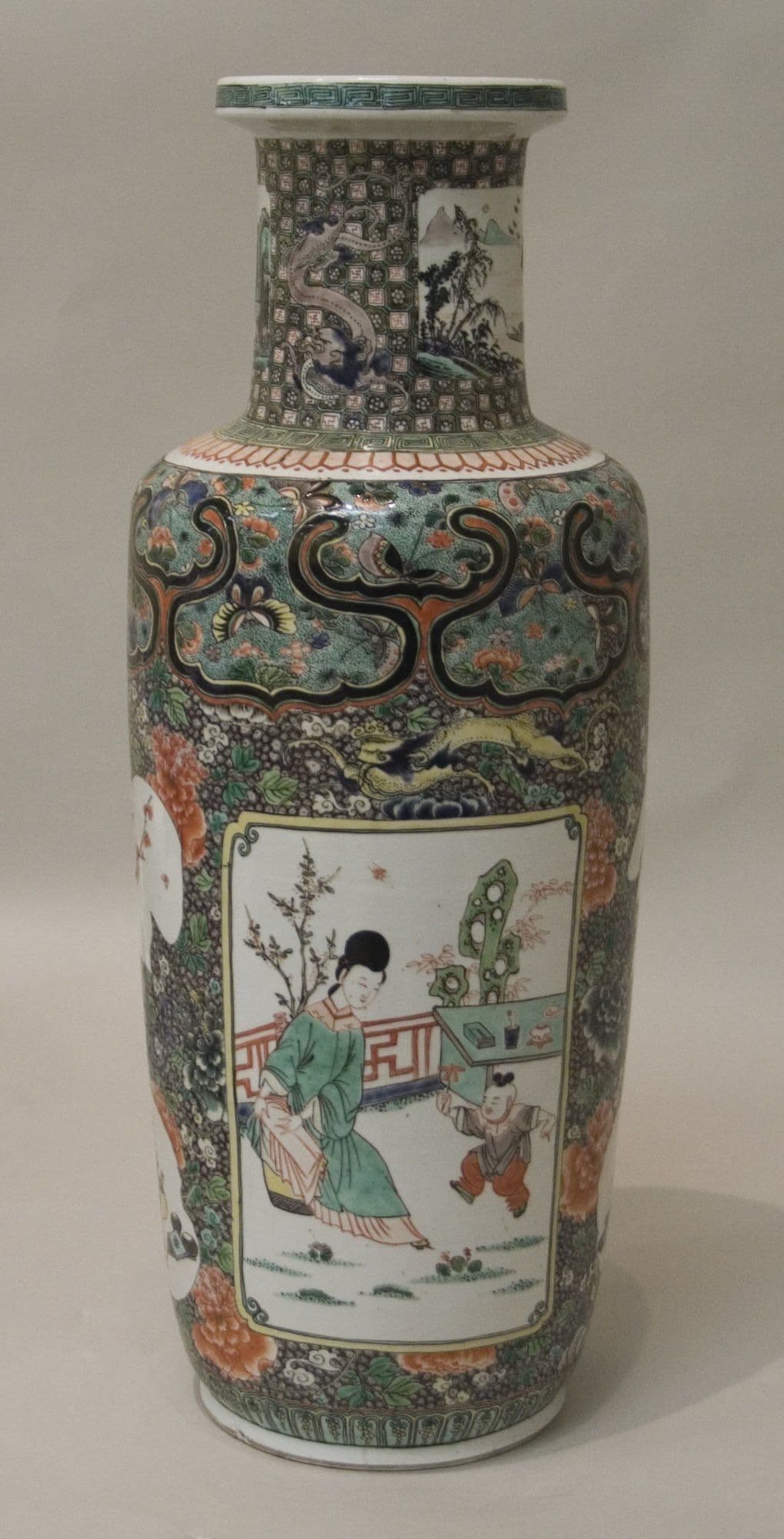
The story does not stop in the Ming. When the Kangxi kilns (1662–1722) reorganized porcelain decoration in the early Qing, they refined the overglaze palette and, crucially, developed an overglaze blue enamel. That single advance meant the whole design could now be painted above the glaze — no separate underglaze-blue firing required. The Chinese term for these bright Kangxi enamels remained wucai (sometimes yingcai, "hard colors"), but Western dealers, cataloguing the green-dominated result, coined a new name: famille verte.
So famille verte is, in the most useful sense, wucai grown up: the same graphic, outlined, saturated approach, now with a green-led palette and an overglaze blue that freed it from the two-part firing logic. Understanding that lineage keeps you from treating the two as unrelated — they are one continuous tradition renamed at the Qing threshold.
The next turn is the one that ends the wucai look. Late in the Kangxi reign and maturing under Yongzheng (1723–1735), potters introduced opaque, lead-arsenic white and a pink derived from colloidal gold. For the first time, enamels could be shaded — a petal could pass from deep rose to pale blush within its own outline. That is famille rose (fencai, "soft colors"), and its arrival makes the flat, hard-edged wucai palette suddenly look archaic. The distinction between these two Qing families is worth learning cold, and it is laid out in the guide to famille rose versus famille verte.
What this means when you handle a piece
Put the sequence in order and a lot of dating falls into place. Flat, hard-edged, red-and-green polychrome outlined above the glaze, with a supporting cast of cobalt blue: think wucai, and if it is bold and dense, think Jiajing–Wanli first. Fine blue outlines filled with contained enamels, small in scale: think doucai. Green-led overglaze palette with an overglaze blue and no underglaze component: think Kangxi famille verte. Shaded, opaque, pink-inflected enamels: you have crossed into famille rose and the eighteenth century.
None of this is a substitute for handling marks, feet, and glaze — but it orients you fast, and it keeps you from calling a Qing famille verte dish "Ming wucai" because both happen to be crowded with green.
Common questions
Does wucai always contain underglaze blue?
Classic Ming wucai usually does — cobalt blue, fired under the glaze, is one of its colors. But the technique is defined by its use of overglaze enamels and overglaze outlines, not by a mandatory blue. Some pieces use very little blue. And by the Kangxi period, the overglaze blue enamel let potters drop underglaze blue entirely while still calling the result wucai. So "has underglaze blue" is a strong clue for Ming pieces, not an absolute rule.
How is wucai different from famille verte?
They are the same graphic, outlined, saturated tradition — the difference is largely one of period and palette. Ming and transitional wucai relies on underglaze cobalt blue plus overglaze red, green, and yellow. Kangxi famille verte is a green-led Qing palette that added an overglaze blue enamel, so the whole design sits above the glaze. In Chinese the Kangxi wares are still called wucai; "famille verte" is the Western cataloguing name.
Why does so much wucai look crowded and slightly crude?
Density is a stylistic choice of the Jiajing–Wanli high point — designs were meant to fill the whole surface. The "crude" impression usually comes from late-Ming kiln standards: grittier feet, less even glaze, and visible firing flaws were normal even on good pieces. On genuine wares those imperfections are reassuring. Suspiciously flawless potting on a "Wanli" jar deserves scrutiny.
Is marked wucai always imperial?
No. Many wucai pieces carry reign marks, but marks were widely copied and applied out of reverence or commerce long after the reign named. A Jiajing or Wanli mark tells you what the piece aspires to, not necessarily when it was made. Judge the mark alongside potting, glaze, palette, and wear rather than trusting it alone.
Further reading
- Chinese monochrome glazes: a collector's guide — the single-color counterpoint to polychrome enameling.
- Kangxi reign marks and how to identify them — the reign where wucai became famille verte.
- The porcelain mark shape decoder — reading the cartouches that frame reign marks on enameled wares.
Browse the collection
If the marks and glazes here have you looking at Chinese art more widely, our own catalogue runs to paper rather than clay — archival giclée reproductions of the modern ink masters, hand-numbered on rice paper and supplied with a Certificate of Authenticity.
Explore Further