Published April 30, 2026
Chinese porcelain marks explained: reign, hall and studio marks, ceramic and pottery bases, Jingdezhen marks, and how to spot the common fakes.
Porcelain marks are the single most useful tool for dating and authenticating Chinese ceramics. They are also the most frequently misread, by buyers and dealers alike. This guide walks through the four families of marks you will encounter on Chinese porcelain — reign marks, hall marks, artist signatures, and shop marks — and the diagnostics that separate a Qing-dynasty original from a skilled twentieth-century reproduction.
The four families of marks
Marks on Chinese porcelain fall into four broad categories. Knowing which family you are looking at is the first identification step, before you ever try to read the characters.
Reign marks (年款) name the emperor and his reign era. They were standardised under the Ming and continue today; almost every imperial-quality piece from 1368 onward carries a reign mark on the underside. The format is six or four characters, read top-to-bottom, right-to-left, and almost always written in seal script (篆书) or regular script (楷书).
Hall marks (堂款) name a private studio, scholar's library, or workshop — for example 慎德堂 ("Hall of Cultivated Virtue"). Hall marks are characteristic of pieces made for a specific patron, often during late Qing and Republic-era production. They are not imperial; they often appear on very high-quality private commissions.
Artist signatures (作者款) name the painter or potter, with seal marks (印款) frequently accompanying them. These appear most often on twentieth-century work, on pieces from the Jingdezhen master kilns, and on tea-ceremony Yixing teapots.
Shop marks (商号款) name a retailer or workshop and are common on export wares. They are not authenticating in the imperial sense but help date a piece to a specific late-Qing or Republican production run.
Reading reign marks
The standard six-character imperial reign mark reads: dynasty-name (大明 or 大清) → reign-name (e.g. 康熙) → era-marker (年制 "made in the year of"). So the full mark for a Kangxi-era piece is 大清康熙年制 ("Made in the year[s] of the Kangxi reign of the Great Qing dynasty"). Four-character versions drop the dynasty: 康熙年制.
Reign marks were carefully copied. Throughout Qing history, kilns deliberately produced pieces marked with earlier emperors' reign marks — this is called 寄托款 ("sent-back marks") and is not forgery in the modern sense; it is a tribute to a celebrated reign. A Kangxi-marked piece may genuinely date to the Yongzheng or Qianlong reign that followed; both are imperial Qing pieces, and both can be valuable.
Modern forgeries copy reign marks too. The diagnostic difference is the brushwork itself. Genuine reign marks were written by trained court calligraphers — the strokes have weight variation, the pressure changes mid-character, the spacing between characters is loose and confident. Twentieth-century reproductions tend to be too even, too tight, with characters that read as printed rather than written. Look at any real Kangxi mark next to a 1980s Jingdezhen reproduction; the difference is immediate once you know to look.
Hall marks and the late-Qing private patron market
By the mid-Qing dynasty, the imperial kilns at Jingdezhen had begun producing private commissions for high officials and wealthy collectors. These pieces carry hall marks rather than reign marks. Common late-Qing hall marks include 慎德堂 (Daoguang's studio), 大雅斋 (Cixi's studio), and 永慶長春 (a celebrated Daoguang-era hall).
Hall marks are usually written in regular script and are placed on the foot rim or underside. They do not authenticate a piece as imperial; they identify the patron. But because hall-mark pieces were typically produced to imperial-grade standards, the porcelain itself is often as fine as palace-mark wares. Collectors specifically seek out hall-mark Daoguang and Tongzhi pieces for this reason.
Twentieth-century artist signatures
Republic-era and post-1949 Jingdezhen porcelain often carries the artist's signature in red enamel or underglaze blue, with one or two seal marks. The conventions follow the broader Chinese painting tradition: a name signature in regular or running script, plus a smaller seal in stylised seal script. The seal is usually the artist's studio name or a poetic alias.
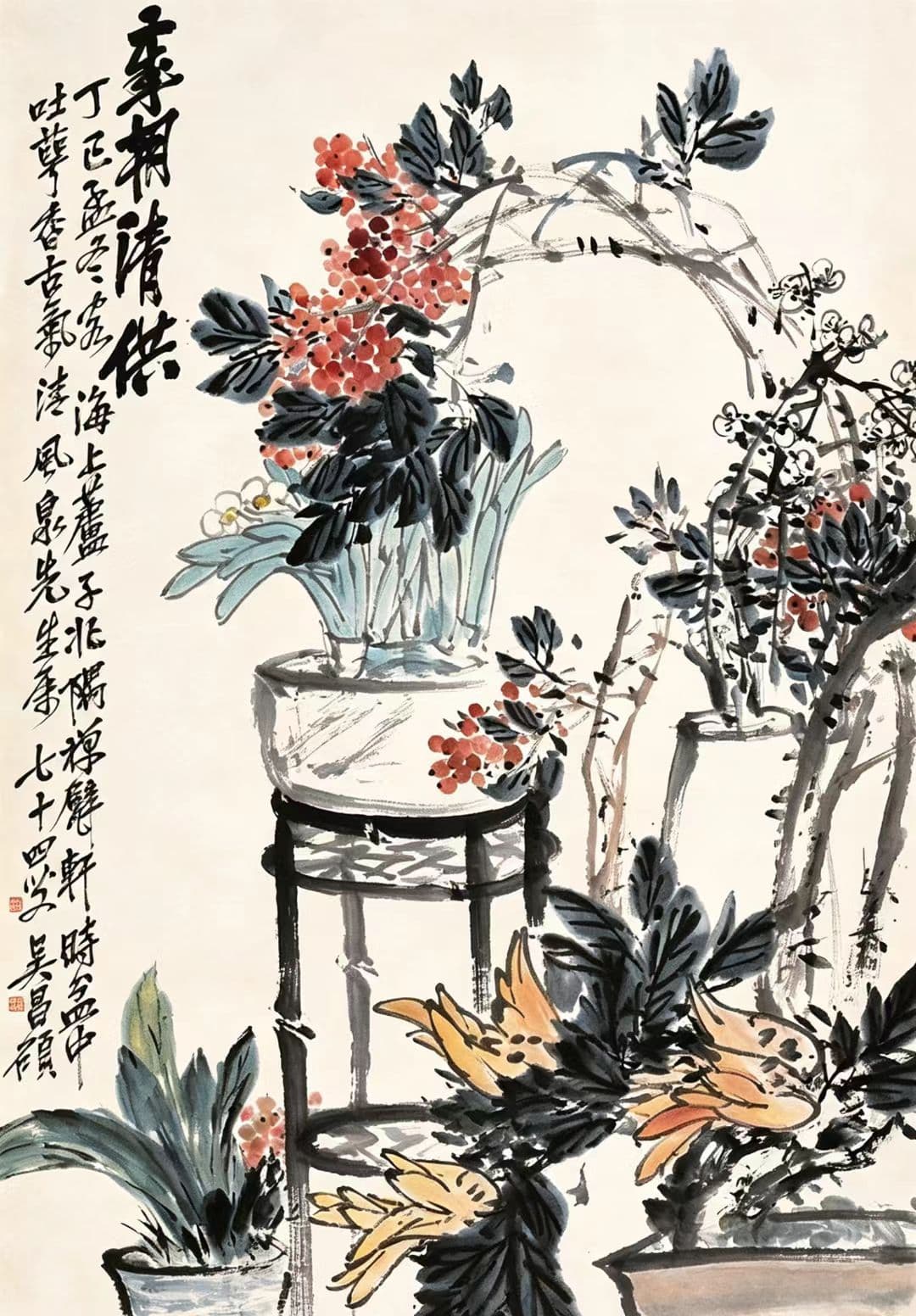
This is the convention you will also see on twentieth-century Chinese ink paintings — and not by coincidence. The painters and the porcelain decorators were often the same people, or trained in the same studios. The signature on a Wu Changshuo porcelain panel is the same hand that signed his ink paintings. The seal styles cross-pollinate.
How forgers fail
The four most common ways twentieth-century reproductions give themselves away:
First, the foot ring. Genuine pieces have hand-finished foot rings with subtle irregularities and traces of the original kiln stilts. Modern reproductions have machine-cut, perfectly even foot rings.
Second, the glaze pooling. On genuine pieces the glaze pools and crawls in subtle ways — pinholes, micro-bubbles, slight unevenness. Modern reproductions have uniformly smooth glaze without any of these markers of hand-thrown firing.
Third, the brushwork inside the mark. As noted above, the calligraphy on genuine reign marks has ink-load variation that printed-style modern marks lack.
Fourth, the body weight and ring. Tap a genuine Qing porcelain piece and it rings with a high, sustained note. Modern body composition is denser and gives a duller thud. This is one of the oldest authenticator's tricks and it still works.
Working with a piece you own
If you have inherited or acquired a piece of Chinese porcelain and want to identify it, work in this order: photograph the entire piece including the underside; identify the mark family (reign / hall / artist / shop); photograph the foot ring; photograph any glaze irregularities; consult a published reference such as the V&A's online porcelain marks database or Christie's reign-mark guide for a visual match. If after that you believe the piece is significant, take it to a major auction house for a free authentication — both Christie's and Sotheby's offer this for any piece they would consider for sale.
From porcelain to ink
The skill of reading marks transfers directly to the appreciation of Chinese ink painting. The same seal calligraphy traditions that mark Qing porcelain mark twentieth-century master paintings — Qi Baishi, Wu Changshuo, Pan Tianshou — and learning to read porcelain seals is a fast track to reading the seals on Chinese paintings. The two markets sit alongside each other historically and visually; collectors of one almost inevitably begin to look at the other.
If this guide is your starting point in Chinese material culture, the natural next step is to see how the same calligraphic vocabulary plays out on Chinese ink and rice paper — where the seal is part of the composition, not just authentication. The Kiln & Ink collection of twentieth-century master prints documents that lineage in detail.
From the Kiln & Ink collection: Flower Basket with Dragonfly, an archival giclée edition after Wu Changshuo, hand-numbered on xuan paper with a certificate of authenticity.
Explore Further