Published May 14, 2026
Jiajing and Wanli reign marks look almost identical. The porcelain they sit on tells very different stories. A collector's reading guide.
Pick up a 16th-century Ming bowl and look at the base. If the six characters underneath read "made in the great Ming Jiajing reign" or "made in the great Ming Wanli reign," you're holding a piece that came out of the kilns during two of the longest reigns in Ming history — together accounting for most of the second half of the 16th century at Jingdezhen, with the short Longqing reign sitting between them. The marks look almost identical at first glance. They behave very differently in the market.
This article walks through what separates Jiajing (1522–1566) from Wanli (1573–1620) by mark, by palette, by typical form, and by the categories of piece — imperial, commercial export, late-Ming revivals — you're likely to encounter wearing each one. By the end you should be able to read the mark, place it in context, and avoid the two most common pitfalls collectors hit with late Ming porcelain.
Two long reigns, two distinct moods
Jiajing was an emperor preoccupied with Daoist alchemy and immortality. Wanli inherited the throne as a child and spent his later years famously absent from court. Both reigns are remembered, in the porcelain history, for very different qualities.
The Jiajing kilns produced bold, saturated blue-and-white in a deep, almost violet tone — a color that comes from imported cobalt blended with domestic sources. Decoration leans toward Daoist iconography: cranes, deer, immortals, the character for longevity (寿) repeated as a pattern, gourds, the eight trigrams. If a Ming jar is covered in stylized clouds and crane medallions, Jiajing is the first place to look.
The Wanli kilns, by contrast, faced a different reality. Imperial demand was enormous — palace orders ran at very high volumes — but quality control slipped, the cobalt supply weakened, and the body of the porcelain often shows kiln grit, glaze pooling, and warping that would have been rejected a century earlier. Wanli blue tends to be a grayer, sometimes silvery blue, with the decoration densely packed: dragons writhing through cloud scrolls, lotus scrolls running edge to edge, lobed cartouches dividing the surface into compartments. Where Jiajing breathes, Wanli crowds.
For a longer look at how Ming reign marks fit together as a system, the Ming dynasty reign marks guide covers the five reigns most collectors will see in the market.
The marks side by side
Both reigns use the standard six-character imperial mark format, written in regular script (楷书), most often in two columns of three characters, read top-to-bottom and right-to-left. Both are typically painted in underglaze cobalt blue inside a double circle on the base of the piece.
The marks themselves read:
| Reign | Six characters | Pinyin | Translation ||---|---|---|---|| Jiajing | 大明嘉靖年製 | dà míng jiā jìng nián zhì | Made in the great Ming Jiajing reign || Wanli | 大明萬曆年製 | dà míng wàn lì nián zhì | Made in the great Ming Wanli reign |
Two characters distinguish them: 嘉靖 (jiā jìng) versus 萬曆 (wàn lì), in the third and fourth positions when reading the mark in its standard right-column-first order. Both reigns also occasionally used four-character marks (omitting "great Ming"), and both can appear in single-line horizontal layouts, especially on smaller objects like cups and dishes where vertical space is constrained.
A few visual habits worth knowing:
Jiajing brushwork in the mark tends to be confident, slightly heavy, with strokes that taper deliberately. The double circle around the mark is usually clean and continuous.
Wanli brushwork in the mark is often looser, faster, sometimes with broken strokes where the brush ran dry. The double circle can show gaps, and on lesser pieces the mark may be painted hastily.
These are tendencies, not tests. The best Wanli imperial pieces show beautifully controlled mark calligraphy; the worst late Jiajing commercial pieces show the same shortcuts as Wanli. The mark alone is one input among several.
Bodies, glazes, and the export story
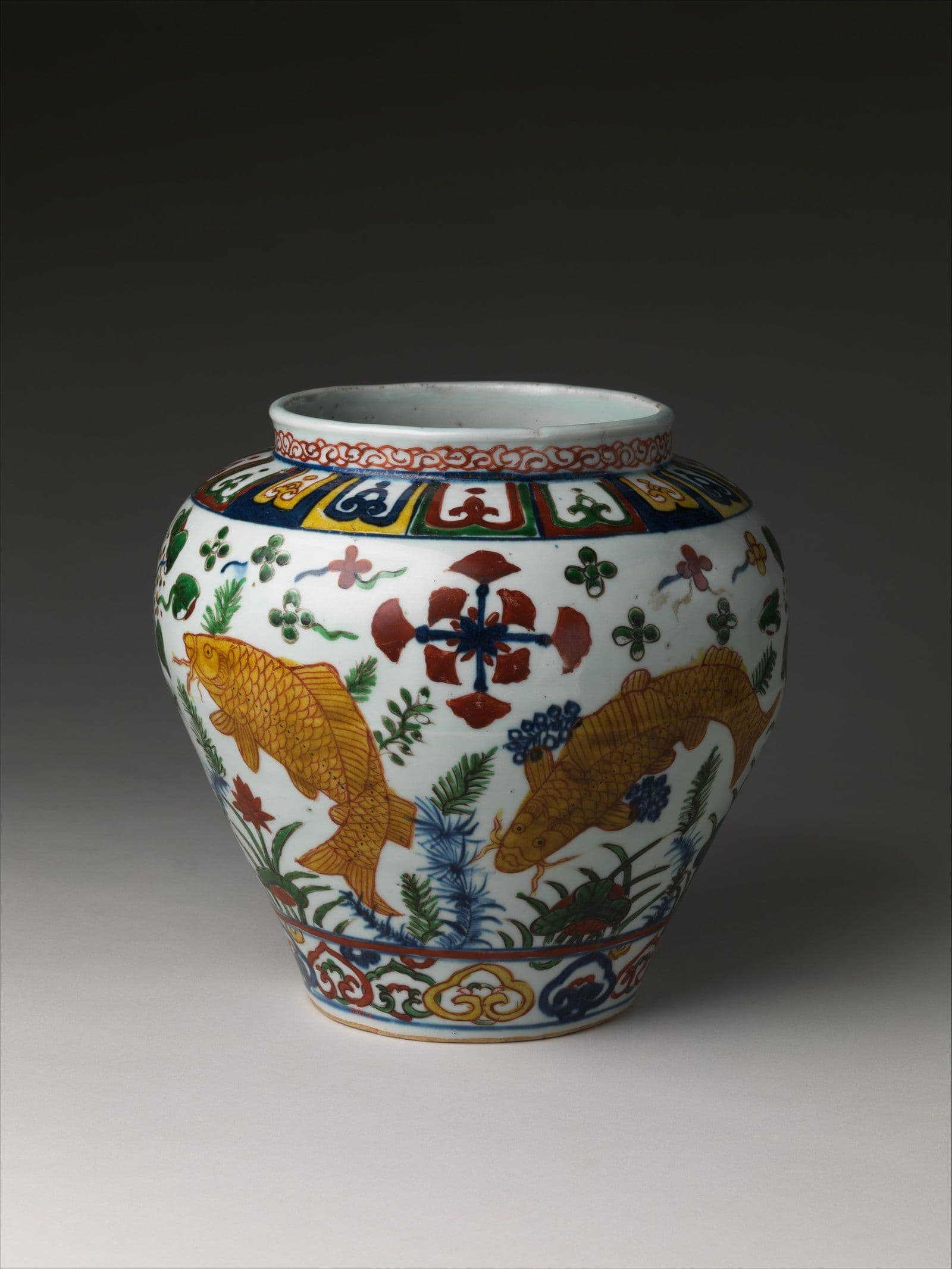
The decorative differences run deeper than the marks. Jiajing pieces, particularly imperial wares, often combine underglaze cobalt blue with overglaze iron-red and yellow enamels — a combination known as wucai (五彩), meaning "five colors." The wucai palette uses red, green, yellow, purple-aubergine, and the underglaze blue as the fifth color. Jiajing wucai tends to be vivid and decorative; the iron-red appears as a coral-orange against the blue.
Wanli inherited and expanded the wucai tradition. Wanli wucai pieces are densely decorated, often with figures, scrolling foliage, and panels of dragons. The palette is similar but the compositions are busier — the visual reading is "everything everywhere" rather than "carefully balanced motif."
For a deeper look at the cobalt-blue side of this story — how the pigment itself differs between imperial and export pieces, and what each color reveals — the iron-red versus underglaze blue marks discussion sets out the pigment technology.
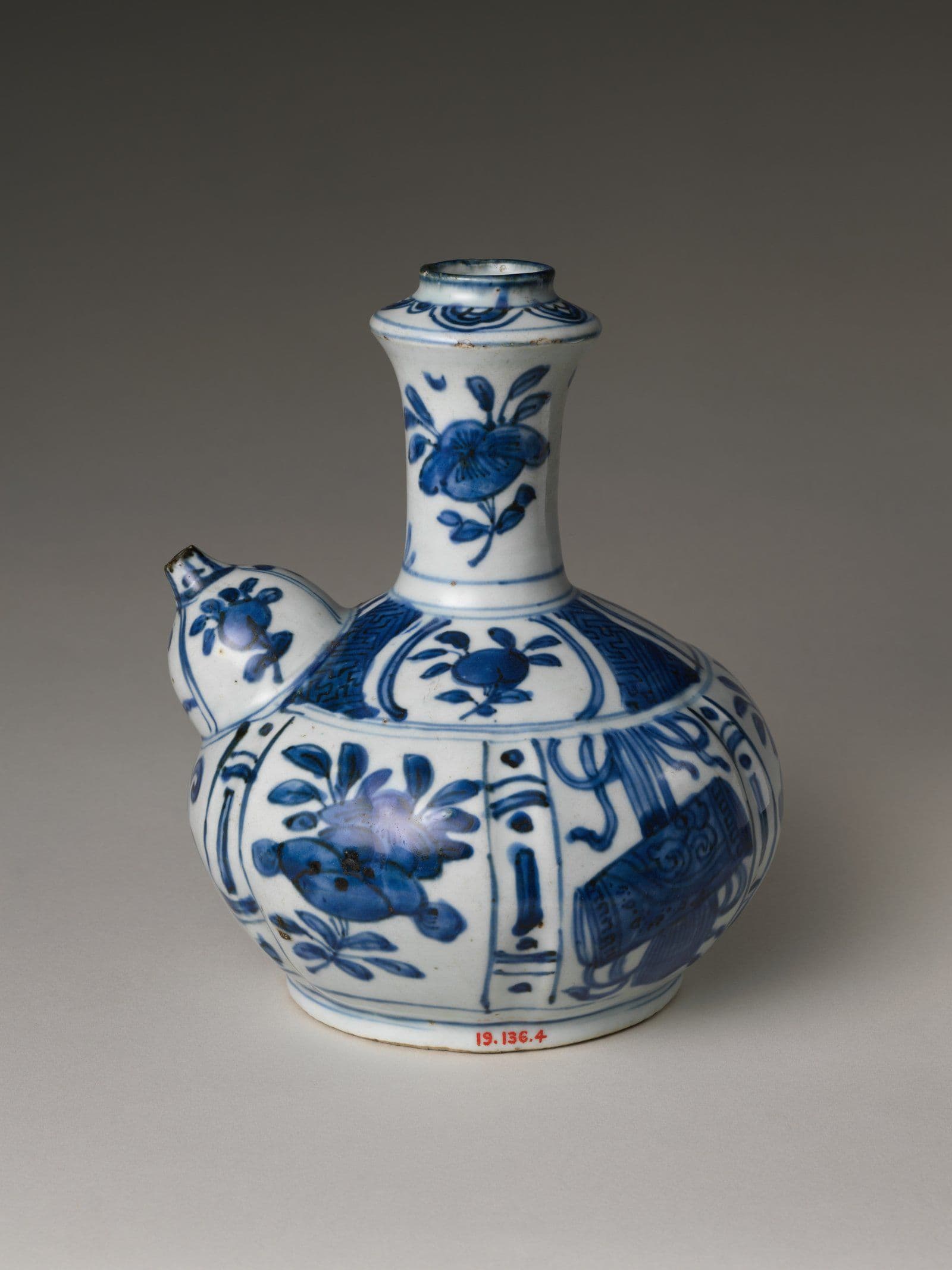
The export trade matters more for Wanli than for Jiajing. By the late 16th century, Portuguese and then Dutch traders were buying enormous quantities of Chinese porcelain for European markets. The Wanli reign saw the rise of what would later be called kraak porcelain — wide-rimmed dishes with paneled decoration, often featuring Chinese figures in landscapes, animals, and floral medallions, made specifically for export. Much of this kraak was unmarked, but some carries Wanli marks or apocryphal earlier marks. Jiajing porcelain reached Europe in smaller quantities and is less associated with the kraak style; the kraak phenomenon is fundamentally a Wanli-and-later development.
Imperial, commercial, and apocryphal — three tiers to recognize
Within each reign, porcelain falls into roughly three categories, and the mark by itself doesn't always tell you which one you're holding.
Imperial ware was made at the imperial kiln in Jingdezhen for direct palace consumption. These pieces show the best body, the cleanest glaze, the most carefully painted decoration, and properly written marks. For both Jiajing and Wanli, surviving imperial pieces are concentrated in major museum collections — the Palace Museum in Beijing and Taipei, the British Museum, the Met, the Victoria and Albert. On the open market, period-genuine imperial Jiajing and Wanli pieces appear, but they command serious prices and require provenance.
Commercial ware was made at the same kilns and surrounding private kilns for sale to wealthy domestic households and, increasingly during Wanli, for export. The body is thinner or thicker than imperial standards, the decoration is competent but less refined, and marks may be present or absent. A wedding bowl from a wealthy Wanli merchant family will read as Wanli stylistically — it just isn't palace-grade.
Apocryphal-mark ware is the third tier, and it's where most market confusion lives. Throughout the Qing dynasty and into the Republic period, kilns produced pieces in Jiajing and (especially) Wanli styles that carry Jiajing or Wanli reign marks. This wasn't necessarily fraud — Chinese ceramic tradition treats reign marks partly as homage, marking the style and aspiration rather than literal date of manufacture. A Kangxi piece with a Wanli mark, painted in the Wanli style, is a Kangxi piece honoring Wanli; on its own terms it's not "fake." For a fuller account of why this convention exists, the apocryphal marks tradition covers the cultural logic that frames the practice.
The practical problem is that most pieces carrying Jiajing or Wanli marks on today's market are not from the reigns themselves. They're 18th-, 19th-, or early 20th-century homages. Dating them requires looking past the mark — at the body, the glaze quality, the cobalt tone, the foot rim, and the brushwork style as a whole.
Reading the foot rim and the base
After the mark, the foot rim is the second-best dating evidence on a Ming piece. Both Jiajing and Wanli show characteristic foot treatments that differ from earlier Ming reigns and from Qing copies.
Late Ming foot rims tend to be slightly tapered inward, with a chatter-marked or knife-trimmed unglazed footring. The base inside the footring is usually glazed — sometimes thinly, with the glaze pooling at the join — and may show small firing spots (iron-red specks from oxidized iron in the body where the glaze was thin). On Jiajing pieces these spots are common; on Wanli pieces they're slightly more pronounced.
A clean, white, well-finished foot rim with no firing spots, no chatter marks, and a perfectly glazed base is more likely an 18th- or 19th-century homage than a period Jiajing or Wanli piece. The kilns of the late Ming were less fastidious about base finish than the high-Qing kilns that came after them.
For a methodical 8-checkpoint approach to authentication that goes beyond the mark and the foot rim, how to spot fake Chinese porcelain marks lays out the framework dealers actually use.
What the market currently values
Period-genuine Jiajing and Wanli imperial wucai pieces in good condition belong in the top tier of late Ming collecting. Commercial period pieces — well-painted private-kiln blue-and-white from either reign — occupy a middle tier where condition, decoration quality, and visual presence drive value more than the mark itself. Apocryphal-mark Qing and Republic pieces can still be excellent objects, valued for their own period and craftsmanship; pricing them honestly means dating them honestly.
Three observations that hold up across recent auction seasons:
Late Ming pieces with strong provenance and good condition continue to find buyers, even when the broader Asian art market is soft.
Wanli kraak export pieces have a distinct collector base — partly Asian art collectors, partly maritime-history and Dutch-Golden-Age collectors — and command prices independent of the imperial-porcelain market.
The "Jiajing or Wanli" question matters less than "period, Qing homage, or Republic copy" for valuation. A period commercial Wanli piece can be worth more than an apocryphal-mark imperial-style Kangxi piece, and vice versa, depending on the specific objects.
Common questions
How do I tell Jiajing from Wanli at a glance?
Look at the two distinguishing characters in the mark — 嘉靖 versus 萬曆 — but also at the overall character of the piece. Jiajing leans Daoist (cranes, immortals, the longevity character), Wanli leans dense and crowded (panels of dragons, lotus scrolls running edge to edge). Jiajing blue is deeper and slightly purplish; Wanli blue is grayer or silvery. Neither rule is absolute, but they're a useful first filter before you commit to a closer look at the body and foot.
Are unmarked Wanli pieces worth less than marked ones?
Not necessarily. Most kraak export porcelain was unmarked, and good period kraak commands strong prices on its own terms. Within the domestic-market category, a marked commercial Wanli piece can be slightly easier to sell than an unmarked one, but the mark alone rarely changes the valuation tier. Condition, decoration quality, and provenance matter more.
Why do so many later pieces carry Jiajing or Wanli marks?
Three reasons. First, the homage tradition: Chinese kilns have honored earlier reigns for centuries, especially Kangxi and Yongzheng kilns reaching back to admired Ming styles. Second, the commercial appeal: a Jiajing or Wanli mark signals depth of tradition to buyers. Third, the decorative idea: many Qing pieces are deliberate stylistic revivals — they're meant to evoke late Ming, and the mark is part of that evocation. Reading a Ming mark on a Qing piece as "fake" misunderstands the convention.
What's the practical first step if I think I have a Jiajing or Wanli piece?
Photograph the mark, the full piece, and the foot rim under good neutral light. Note the dimensions, weight, and any condition issues honestly. Take the photographs to a specialist — a major auction house's Asian Art department offers free informal valuations, and reputable dealers will look at clear photographs. The mark is one input; the piece as a whole is what gets dated.
Further reading
Ming Dynasty Reign Marks Guide — the five Ming reigns most collectors will encounter, in one reference.
Apocryphal Marks on Chinese Porcelain — why a Qing piece can honestly bear a Ming mark.
How to Spot Fake Chinese Porcelain Marks — the 8-checkpoint framework dealers use.
Iron-Red vs Underglaze Blue Marks — the pigment story behind Ming and Qing marks.
Browse our Chinese porcelain
Hand-painted contemporary pieces in the late Ming tradition, each faithfully marked and honestly described. Pieces in this category draw on Jiajing and Wanli motifs — wucai palettes, scrolling lotus, dragon medallions — interpreted by living artisans rather than passed off as period antiques.
Explore Further