Published June 3, 2026
A short history of cobalt in Chinese blue-and-white porcelain — Persian Mohammedan blue, the Ming peaks, late-Ming purplish ink-blue, and Qing imperial refinement.
The blue-and-white porcelain that fills museum galleries from Istanbul to Boston is, at one level, a remarkably consistent thing — white porcelain body, cobalt-blue painted decoration under a transparent glaze, fired hot. At another level it is six hundred years of small variations in cobalt source, painting technique, glaze chemistry, and firing schedule that any practiced eye reads at a glance. Collectors who develop a feel for those variations stop seeing "blue-and-white" as one category and start seeing the half-dozen distinct things it actually is. This article is a short history of cobalt — where it came from, how the colour shifted across centuries, and what those shifts let a collector read about a piece of porcelain that turns up at a dealer's table.
What cobalt actually does in a porcelain glaze
Cobalt is a transition metal that, when painted onto a porcelain body and fired under a transparent feldspathic glaze, produces a blue colour that ranges from a thin grey-blue through a vivid sapphire to a near-black ink-purple. The colour the collector sees in the finished piece depends on four interacting variables: the chemical purity of the cobalt ore, the trace elements that ride with it (iron, manganese, copper, arsenic), the thickness of the painted layer, and the temperature and atmosphere of the firing.
The Chinese porcelain tradition's distinguishing technical achievement was solving, repeatedly across centuries, the problem of painting cobalt at a temperature high enough to vitrify the porcelain body and the glaze together — typically 1280-1320°C in a reducing atmosphere — without burning out the colour. That is harder than it sounds, and the centuries-long evolution of blue-and-white is in large part an evolution in how to source cobalt that survives the firing, and how to paint it so the colour reads as the painter intended through the molten glaze layer above.
The Yuan dynasty origin and Mohammedan blue
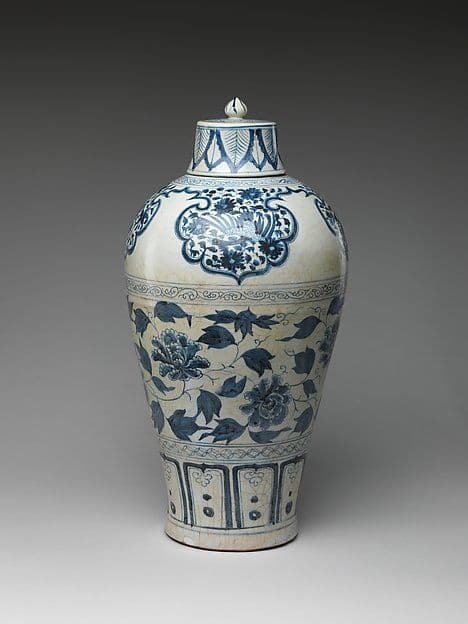
The earliest documented Chinese blue-and-white porcelain in the form collectors recognize today emerges in the Jingdezhen kilns of the mid-fourteenth century, during the late Yuan dynasty. The cobalt used was largely imported, traded west from Persia along the Silk Road, and Chinese ceramic literature later names it Sumali qing or Sulima qing — a transliteration of an Arabic or Persian source name. Western scholarship calls it "Mohammedan blue," reflecting its origin in the Islamic trade network.
Mohammedan blue carried a distinctive trace-element fingerprint: high iron, low manganese, and small amounts of arsenic. The resulting fired colour is a deep sapphire blue, sometimes with characteristic dark "heaping and piling" spots where the iron content concentrated and pulled the cobalt deeper into the glaze surface. The heaped spots are diagnostic for serious Yuan and early Ming blue-and-white — collectors learn to look for them, and the absence of heaping in a piece purporting to be Yuan or early Ming reads as suspicious.
The economics of imported cobalt drove the geography of early blue-and-white. Jingdezhen, the porcelain capital, was inland and far from the trade routes that brought the cobalt in, which meant the imported ore was expensive and used selectively. A short summary of the major periods sits in the Ming dynasty reign marks guide, which covers the period during which blue-and-white reached its first artistic peak.
The Ming refinement: Yongle, Xuande, Chenghua
The Yongle (1402-1424) and Xuande (1425-1435) reigns produced what most specialists consider the peak of imported-cobalt blue-and-white. The cobalt is rich, the painting confident, the heaping and piling deliberate as an aesthetic effect rather than a technical defect. Xuande-period pieces in particular carry a depth of blue that later attempts to imitate fail to match, and Xuande became the most copied reign in subsequent centuries' apocryphal-mark traditions.
The Chenghua reign (1465-1487) marks a transition point. By this period the imported Mohammedan blue supply had grown intermittent, and Chinese potters began blending it with domestic Chinese cobalt — Pingdeng qing, mined in Jiangxi province — which carried higher manganese and lower iron. The blended cobalt produced a paler, softer blue, and Chenghua-period blue-and-white is recognizable for that softer palette as well as for the small, refined decoration scale the period favoured. The reign also pioneered the doucai technique of underglaze blue outlines filled with overglaze enamels, which is its own collecting category.
For collectors learning to read reign marks alongside cobalt colour cues, the chinese porcelain marks guide is the foundation reference; cobalt colour and mark style developed together and the two cues confirm each other when both are present.
The Jiajing and Wanli late Ming variations
The mid-to-late Ming reigns of Jiajing (1521-1567) and Wanli (1572-1620) saw a return to predominantly domestic cobalt, with a distinctive purplish-blue tonality that came from higher manganese content. Jiajing blue is often described as inky, sometimes nearly black-purple in the heaped areas, and the painting style of the period grew dense and elaborate to match the strong palette. Wanli blue is somewhat lighter than Jiajing but retains the purplish cast, and the period saw a major expansion of export porcelain trade to Europe — the early Dutch kraak porcelain that filled seventeenth-century Dutch still-life paintings is largely late Wanli production. The late Ming reign marks framework covers the period in more detail.
The Qing imperial blue: Kangxi to Qianlong
The Qing imperial kilns at Jingdezhen, reorganized under Kangxi (1662-1722), produced blue-and-white at a technical standard arguably higher than any preceding period. The cobalt used was now reliably domestic, processed and refined to a consistency that earlier potters had achieved only occasionally. Kangxi blue is bright, clear, layered in deliberate gradations from pale sky to deep ink — sometimes called "graduated blue" or fenshui (water-divided) blue, painted in carefully washed tones that read almost like ink-painting tonal range.
Yongzheng (1722-1735) and Qianlong (1735-1796) period blue-and-white continued the technical refinement, with palettes that favoured an even, controlled blue without the heaping and piling that earlier collectors had prized. The Qianlong reign in particular produced enormous quantities of blue-and-white, much of it bearing the six-character seal mark that became the most-copied reign mark in subsequent centuries. The technical perfection of Qing imperial blue-and-white is sometimes faulted aesthetically as too smooth, lacking the spontaneity of the Yongle-Xuande peak; the criticism is itself a comment on what the Qing technicians had achieved.
A quick summary of cobalt fingerprints by period:
| Period | Primary cobalt source | Typical fired tonality | Diagnostic cues ||---|---|---|---|| Yuan / early Ming | Mohammedan blue (Persian import) | Deep sapphire | Heaping and piling, iron-spot pooling || Yongle / Xuande | Mohammedan blue | Rich sapphire | Heaped spots deliberate, deep saturation || Chenghua | Blended Mohammedan + domestic | Soft pale blue | Smaller scale decoration, softer palette || Jiajing / Wanli | Domestic Pingdeng qing | Purplish ink-blue | Dense painting, inky tonality || Kangxi | Refined domestic | Bright graduated blue | Multi-tone fenshui gradations || Qianlong | Refined domestic | Even controlled blue | Smooth tonality, no heaping |
What this means for a collector at a dealer's table
The practical use of cobalt history at the collecting level is in answering one of the most common dealer-room questions: does the colour of the blue look right for the claimed period? A piece presented as Yongle without any heaping or piling, or as Kangxi without the multi-tonal graduations the period was known for, or as Chenghua with a saturated late-imported sapphire palette, prompts a closer look at the rest of the piece. The cobalt alone is not a verdict — many factors can shift the fired colour, and the colour photograph the collector remembers from the auction catalogue may not match what arrives in hand — but the cobalt is a starting point for the broader examination.
For collectors building their reading discipline beyond cobalt to the mark and the foot rim, the foot-rim dating framework reads alongside this article. Marks, foot rim, body porcelain, glaze quality, and cobalt tonality together form the four-corner reading that distinguishes a genuine period piece from a later apocryphal one.
Common questions
Why is Yuan and early Ming blue often patchy or uneven?
The "heaping and piling" effect arises from the iron content in Mohammedan blue, which concentrated during firing and pulled the cobalt deeper into the glaze. Later collectors and potters came to prize the effect aesthetically, and Qing-period imitations sometimes added iron-bearing pigment in spots to mimic it. Genuine heaping has a particular three-dimensional quality that imitation has trouble reproducing.
How can you tell domestic Chinese cobalt from imported Mohammedan blue without lab analysis?
You cannot tell with certainty by eye. What you can read is the fired tonality and the painting technique, which together suggest which cobalt source the painter was working with. Confirmed identification requires X-ray fluorescence or similar analytical method that captures the iron-to-manganese ratio.
Did the Qing court really prefer the smoother, more controlled cobalt blue, or was it just a technical consequence?
Both, and they reinforced each other. The Qing imperial taste favoured technical refinement and visual order across many decorative arts, and the cobalt-processing improvements at Jingdezhen made that refinement achievable. The aesthetic and the technical evolved together.
How does Korean and Japanese blue-and-white differ from Chinese in cobalt terms?
Korean Joseon-period blue-and-white tends toward a softer, greyer blue than Chinese contemporaries, partly because the cobalt sources were different and partly because the painting tradition emphasized restraint. Japanese Arita and Imari blue-and-white drew on Chinese technical knowledge but developed distinct painting conventions that read differently even when the cobalt tonality is similar.
Where in the porcelain industry today is traditional cobalt-blue painting practiced at the historical standard?
A small number of workshops in Jingdezhen still practice high-temperature underglaze cobalt painting at a standard that approaches the Qing imperial work, though typically at low production volume and high price. The traditional knowledge is more documented and studied today than it has been at most points in the past two centuries, even as the working practitioners are fewer in number.
Further reading
The chinese porcelain marks guide is the master reference for identifying period and authenticity from the underside of a piece.
The foot-rim dating framework covers the unglazed foot rim cues that confirm or contradict the visual read of glaze and cobalt.
The Ming dynasty reign marks guide and the late Ming Jiajing-Wanli framework cover the periods when the cobalt-blue tradition reached its first peak.
Blue-and-white porcelain rewards the collector who learns to read its colour as a historical fingerprint. The cobalt at the surface carries a record of trade routes, mining sources, court taste, and kiln technique across six centuries — and the developed eye reads that record at a glance, before turning the piece over to confirm what the colour first suggested.
Explore Further