Published July 22, 2026
How to identify Hongzhi and Zhengde reign marks (1488-1521): mark forms and calligraphy, imperial yellow glaze, Arabic-inscribed wares, and a dating checklist.
Turn over a Ming dish and you may find six small underglaze-blue characters that belong to neither of the famous names. Not Chenghua, whose delicate wares set auction records; not Jiajing, whose purplish blue announces the late Ming. Between them sit two reigns most mark guides hurry past — Hongzhi (1488–1505) and Zhengde (1506–1521) — thirty-four years that produced some of the most refined porcelain of the entire dynasty.
This guide shows you how to read a Hongzhi mark and a Zhengde mark, what the wares of each reign actually look like, and how to place an unfamiliar piece within the mid-Ming sequence with some confidence.
Where the quiet reigns sit
The imperial mark system was still young in the late fifteenth century. Reign marks had become standard practice on imperial porcelain only a few generations earlier, and the conventions — six characters, regular script, underglaze blue, a double circle — were settled but not yet ossified. If you're new to the system itself, start with our complete guide to Chinese porcelain marks and come back; this article assumes you can already parse "Da Ming ___ Nian Zhi" ("made in the ___ reign of the great Ming").
The sequence around our two reigns runs:
| Reign | Dates | Reputation ||---|---|---|| Chenghua | 1465–1487 | Doucai palette, chicken cups, the most faked marks in porcelain history || Hongzhi | 1488–1505 | Conservative refinement; the great age of imperial yellow || Zhengde | 1506–1521 | Transition; Arabic-inscribed wares; four-character marks || Jiajing | 1522–1566 | Dark purplish blue, Daoist imagery, huge output |
Hongzhi and Zhengde are "quiet" for a simple reason: less porcelain. The Hongzhi emperor was famously conscientious and frugal, and court records point to repeated economies at the imperial kilns during his reign. Zhengde's court was anything but frugal, yet its porcelain output remained modest next to the flood that began under Jiajing. Scarcity kept these reigns out of the popular imagination — and, usefully for collectors, largely out of the repertoire of later mark-copyists as well.
Neither reign represents a decline. Hongzhi wares in particular carry Chenghua's refinement forward with barely a step down, and specialists have always known it. The quiet is historical accident, not a verdict on quality.
Reading a Hongzhi mark
The standard imperial Hongzhi mark is six characters, 大明弘治年制 ("Da Ming Hongzhi Nian Zhi"), written in underglaze blue regular script, arranged in two columns of three characters, enclosed in a double circle on the base. This is the same architecture as a Chenghua mark, and the family resemblance extends to the writing itself: neat, contained, slightly soft characters, without the muscular flourish of early-Ming or the mechanical crispness of later copies.
Points worth attention:
- The calligraphy is disciplined but gentle. Hongzhi mark-writers continued the rounded, unassertive manner of the Chenghua marks — a useful comparison, since Chenghua's mark calligraphy is unusually well documented thanks to the intense study of that reign. Our guide to Chenghua marks and doucai wares shows the manner these writers inherited.
- Blue tone is soft. The cobalt of the period fires to a quiet, even, slightly grayish blue. A harsh, blackish, or violently bright mark should raise questions.
- Placement is consistent. Imperial pieces carry the mark centered on the base, under the glaze, within the double circle. On the famous yellow-glazed wares, the base remains white and the mark reads clearly against it.
Genuine Hongzhi imperial porcelain is scarce, so the base you are most likely to encounter with this mark belongs to a later piece. But — unusually — not a flood of them: Hongzhi never acquired the glamour that made Xuande, Chenghua, Kangxi, and Qianlong the stock apocryphal marks of later centuries.
Reading a Zhengde mark
Zhengde marks keep the same script and the same underglaze blue but loosen the rules in two visible ways.
First, four-character marks are unusually common: 正德年制 ("Zhengde Nian Zhi"), dropping the dynasty name. Six-character versions exist, but Zhengde is the reign where the four-character form becomes a familiar sight on imperial wares rather than an exception.
Second, the frame varies. Zhengde marks appear within the traditional double circle and also within a double square — a format that suits the four-character version's compact, blockish arrangement. The writing tends to be slightly larger and more evenly spaced than Hongzhi's, with strokes of steady width; some describe it as plainer, closer to a clerk's hand than a calligrapher's.
Two cautions. The four-character habit means a Zhengde attribution rests more heavily on the ware itself — body, glaze, blue, form — than on the mark's text alone, since four characters give the eye less to work with. And late in the reign, catalogues often note the arrival of a darker, more purplish imported cobalt on some pieces — the material that would define Jiajing blue-and-white — so a "Jiajing-looking" blue does not by itself rule out a very late Zhengde date.
The wares behind the marks
Marks are only half the identification. The two reigns each have a signature achievement, and knowing them anchors everything else.
Hongzhi: imperial yellow. The low-fired yellow glaze of the Hongzhi reign — the so-called "delicate yellow," often praised with the descriptor "chicken-fat yellow" — is generally treated as the summit of yellow monochrome in Chinese ceramics. Applied over a fired surface and fixed in a second, cooler firing, it produced an even, warm, translucent tone that later reigns chased but rarely equaled. Dishes and bowls in this glaze, with the six-character mark on a white base, are the reign's defining objects. The Qing court's own rank-coded yellows descend from this achievement — we've traced that story in our guide to Qing imperial yellow porcelain. Both mid-Ming reigns also paired yellow with green — most famously in green-dragon designs — though attribution between them is work for the ware, not the mark alone.
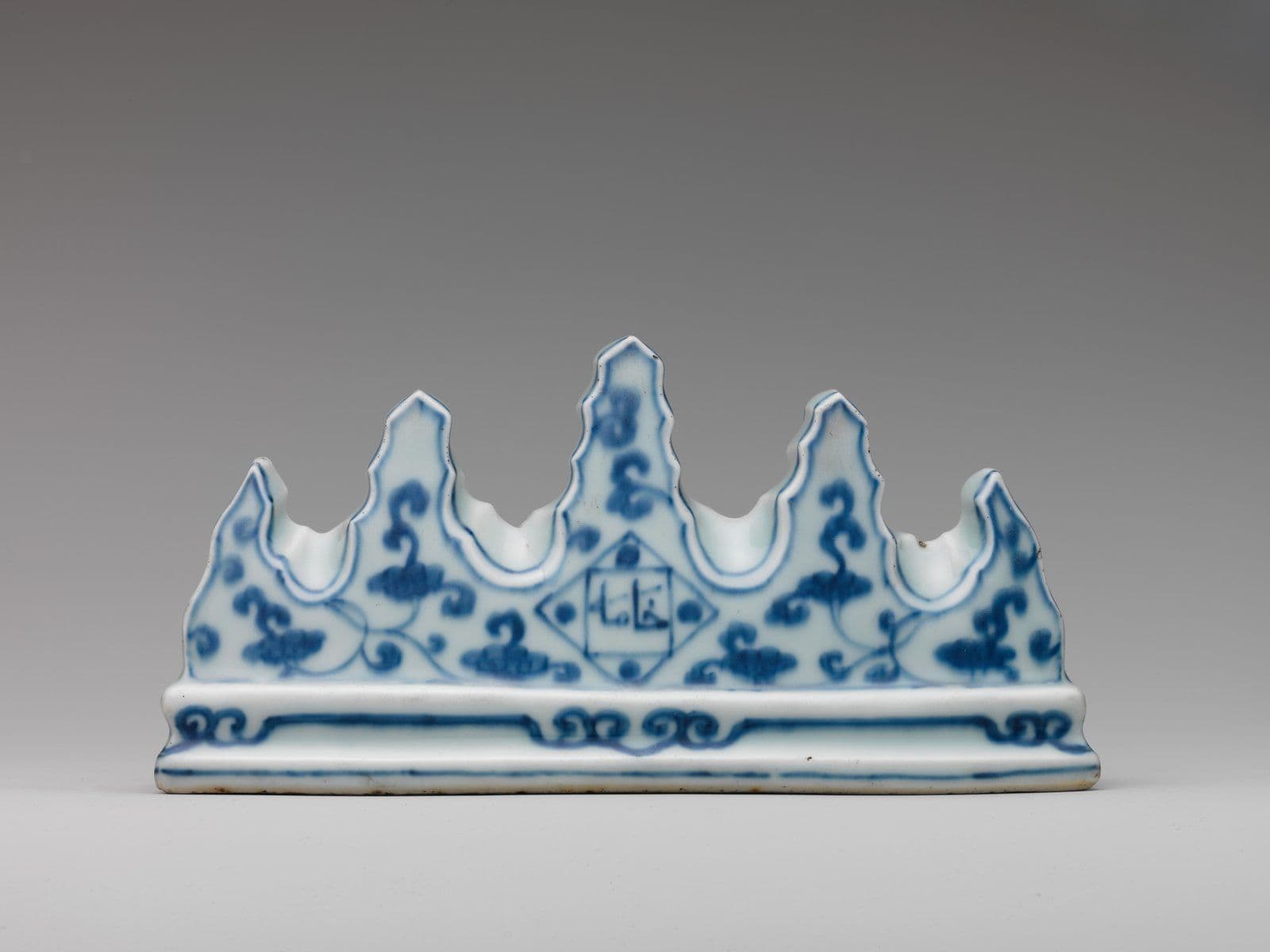
Zhengde: the Arabic-inscribed wares. The Zhengde court produced a remarkable group of blue-and-white objects — brush rests, table screens, boxes, vases — decorated with Arabic and Persian inscriptions set in medallions. The inscriptions are pious phrases and aphorisms; the shapes are largely scholar's-desk objects; older Western literature calls the group "Muhammadan wares." Their exact court context is still debated — the emperor's fascination with foreign languages and the influence of Muslim eunuch officials are both cited — but the objects themselves are unmistakable, and nothing quite like them was made before or after. For a collector, an Arabic-inscribed scholar's object with a Zhengde mark is the reign's calling card.
A dating checklist for the mid-Ming
When a piece claims Hongzhi or Zhengde, run through five checks in order:
- Mark architecture. Six characters in a double circle suits either reign; four characters, or a double square, points toward Zhengde. Mark text, column arrangement, and frame should agree with the claimed reign's habits.
- Mark calligraphy. Soft, contained, Chenghua-like writing for Hongzhi; plainer, more evenly spaced writing for Zhengde. Compare against published, provenanced examples rather than memory.
- The blue. Quiet grayish-blue for most of the period; a distinctly purplish, dark blue belongs to the very end of Zhengde at the earliest.
- Body and glaze. Both reigns continue the fine white body and smooth, faintly tinted glaze of the Chenghua standard. Coarse bodies, glassy modern glazes, or mechanical perfection all argue against the label.
- The wear argument. Five centuries leave evidence — soft foot-rim wear, scattered surface scratches consistent with use and storage. A pristine base with sharp, gritty edges deserves suspicion.
And keep the apocryphal-marks logic in mind: later potters who borrowed earlier reign marks overwhelmingly reached for the famous reigns. We've covered how that homage system works in apocryphal marks on Chinese porcelain — its relevance here is statistical. A Hongzhi or Zhengde mark was rarely worth faking for prestige in the Qing dynasty, so the honest-homage explanation that softens so many Kangxi-marked pieces is less available. A mid-Ming mark on a piece that isn't mid-Ming is more likely a deliberate modern deception than an old compliment.
Common questions
Are Hongzhi and Zhengde porcelains rarer than Chenghua?
Imperial output across all three reigns was small by later standards, and all three are scarce today. Chenghua's fame — and prices — rest on the doucai wares and their extraordinary market history rather than on greater abundance. In practice, fine marked Hongzhi and Zhengde imperial pieces appear at auction less often than Jiajing or Wanli material and are keenly contested by specialists when they do.
Why do some Zhengde pieces have Arabic writing on them?
A distinctive group of Zhengde court wares — mostly writing-table objects — carries Arabic and Persian inscriptions in decorative medallions. The usual explanations involve the emperor's documented interest in foreign cultures and languages and the prominence of Muslim officials at his court. Whatever the precise motive, the group is unique to the reign and is one of the strongest reign-attribution signals in Ming porcelain.
What is "chicken-fat yellow"?
A traditional description of the finest Hongzhi-period yellow glaze — an even, warm, slightly translucent low-fired yellow with a texture likened to rendered chicken fat. The term is connoisseurs' shorthand for the smooth depth of the best examples rather than a technical category.
Do fake Hongzhi and Zhengde marks exist?
Yes, though the pattern differs from famous reigns. Historic apocryphal use is comparatively rare, but modern fakes exist because the genuine wares — especially Hongzhi yellow — are valuable. The checklist above, plus honest wear and credible provenance, is the practical defense; for significant pieces, expert examination is worth its cost.
Further reading
- Xuande Reign Marks: Identification — the reign whose mark set the template every later writer followed.
- Jiajing and Wanli: Late Ming Marks — what happens to marks and blue tone immediately after Zhengde.
- Ming Dynasty Reign Marks: The Complete Guide — the full dynastic sequence in one place.
- Dating Chinese Porcelain by the Foot Rim — the underside evidence that marks can't fake easily.
Browse the collection
If the marks and glazes here have you looking at Chinese art more widely, our own catalogue runs to paper rather than clay — archival giclée reproductions of the modern ink masters, hand-numbered on rice paper and supplied with a Certificate of Authenticity.
Explore Further