Published August 5, 2026
Wanli porcelain explained: imperial wucai, kraak export dishes, the greyish late-Ming blue, and what each tier of the market realistically offers.
Hold a kraak dish up to a window and the porcelain barely interrupts the light. The rim is thin enough to glow, the moulded panels catch shadow in shallow ribs, and the blue sits slightly soft under the glaze, as if breathed on rather than painted. Dutch painters noticed the same things four hundred years ago: the blue-and-white dishes heaped with lemons and oysters in seventeenth-century still lifes are, more often than not, Wanli export porcelain. Owning one now means owning the object those painters reached for when they wanted to show the wider world arriving on a table.
The Wanli era (1573–1620) was the longest of the Ming dynasty and the last in which the dynasty's kilns ran at full imperial ambition. It produced two very different bodies of porcelain — dense, busy imperial wares and thin, fast, outward-bound export wares — and because both survive in quantity relative to earlier reigns, Wanli is one of the most realistic points of entry into genuine Ming porcelain. This guide covers what the reign made, what survives, and how a buyer tells the tiers apart.
The reign behind the porcelain
The Wanli Emperor came to the throne as a boy and reigned for nearly half a century, much of it, in his later years, spent conspicuously absent from his own court. The administrative drift that historians associate with the late Ming had a ceramic dimension: the court placed enormous orders with the imperial kilns at Jingdezhen through the middle of the reign, straining them to the point of protest, and by the reign's final years imperial production had largely fallen silent — the prelude to the so-called Transitional period, when the kilns turned to private and foreign customers instead.
That trajectory is why "Wanli" means two things in the market. On one side stand the official wares made for the court: five-colour wucai pieces, blue-and-white with the six-character reign mark, boxes, jars and altar vessels in shapes the palace ordered. On the other stands the export flood — kraak dishes, bowls and bottles made thin, decorated quickly, and shipped out through ports the court barely controlled. One reign, two porcelains, two very different collecting propositions.
Imperial Wanli: wucai and the last blaze of the Ming kilns
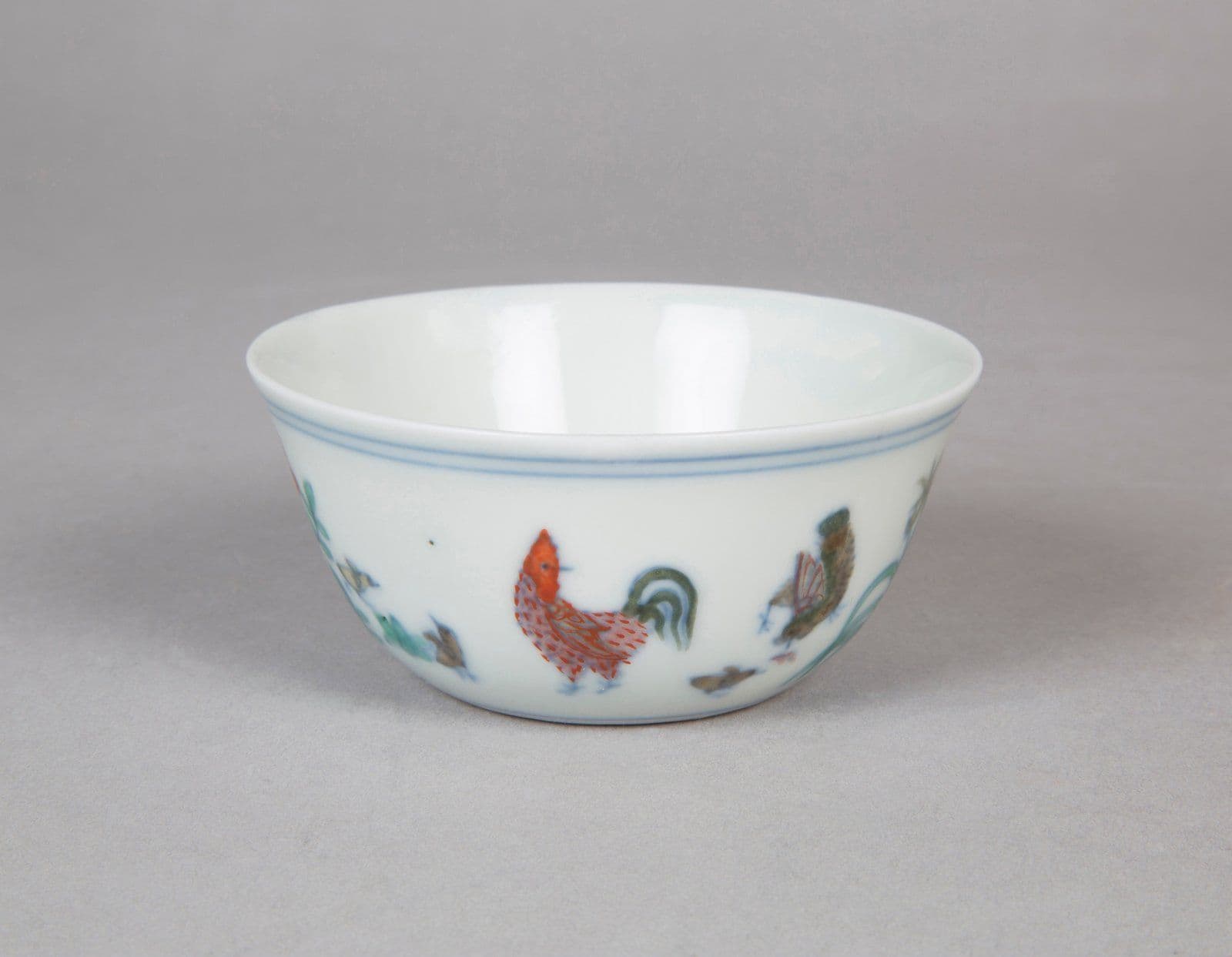
The glory of official Wanli porcelain is wucai — "five colours" — in which underglaze cobalt blue is joined by overglaze red, green, yellow and aubergine enamels. Wanli wucai is dense to the point of horror vacui: dragons writhing through crowded scrolling lotus, the celebrated "hundred deer" jars, garlic-mouth vases and tiered boxes packed edge to edge with pattern. It is not subtle porcelain, and it was not meant to be; it is the late Ming court's taste made visible, and at its best it has tremendous energy.
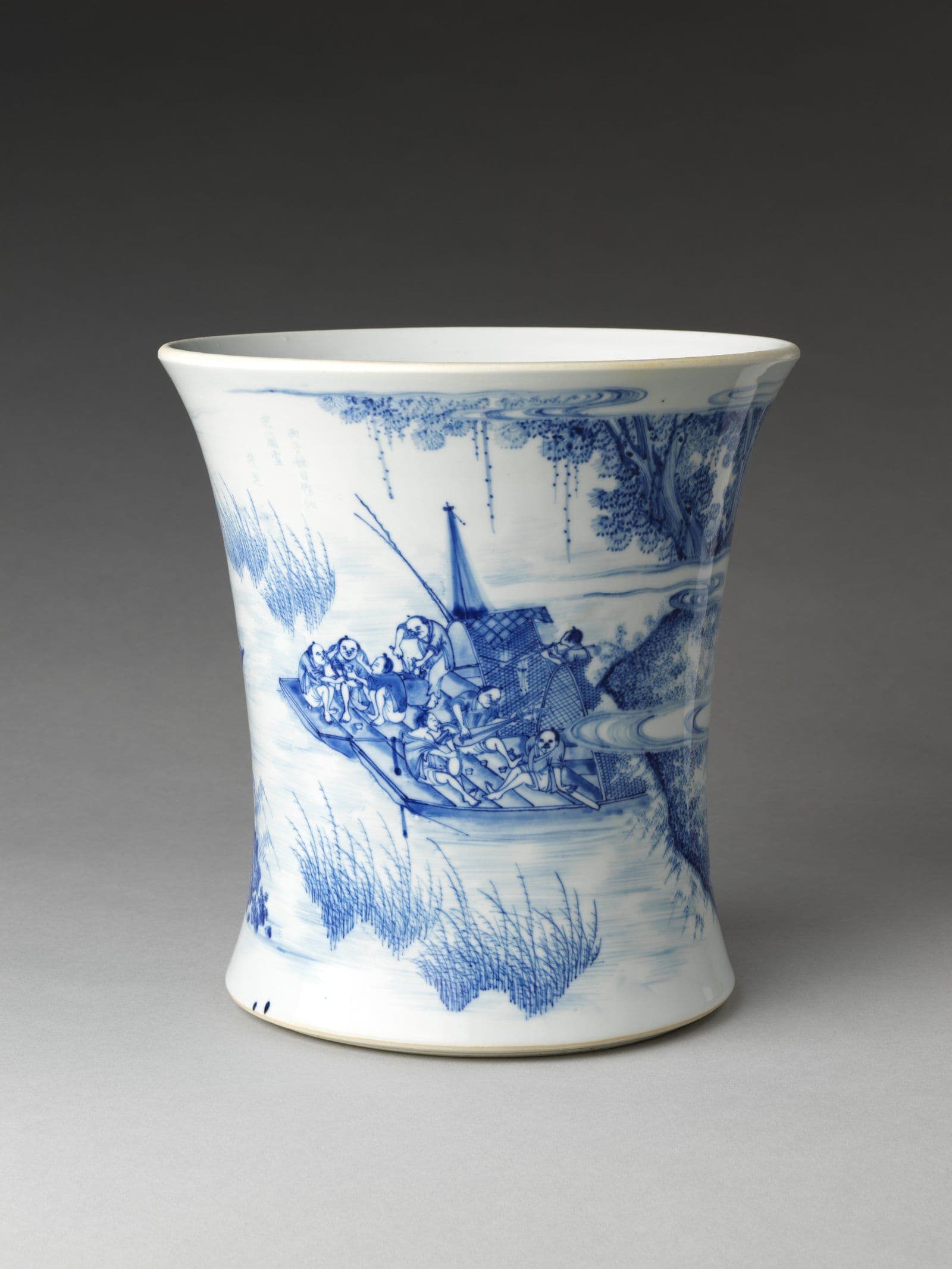
The blue tells its own story. The intense violet-blue of the preceding Jiajing reign depended on imported cobalt; as supplies of that pigment ran down, Wanli blue drifted toward the grey and the soft. Potting is often heavier and less refined than the early Ming benchmarks — next to Xuande blue-and-white, a Wanli piece usually feels like the end of a long story rather than the beginning. Reign marks are typically six characters in underglaze blue, da Ming Wanli nian zhi, and because the mark was copied for centuries afterwards, a Wanli mark should be read alongside the late-Ming marks of Jiajing and Wanli rather than taken at face value — the general rule of the porcelain marks guide that a mark is a claim, not a date, applies with full force here.
Kraak and the export boom
While the court's orders faltered, the outward trade accelerated. Kraak porcelain — the name most likely borrowed from the Portuguese carracks that carried it — is the thin, panelled blue-and-white that Europe first met in bulk. When the Dutch seized a Portuguese carrack in 1603 and auctioned its porcelain cargo in Amsterdam the following year, the sale electrified northern Europe and helped set off a century of demand that the Dutch East India Company organised into a system.
Kraak has a look you learn once and recognise forever: a central roundel with deer, birds, flowers or figures, surrounded by radiating panels of emblems and flower sprays; thin greyish body, glaze that often pulls back from the rim in tiny bites, and unglazed bases showing kiln grit. It was made fast and priced to move, which is exactly why it survives in quantity — in inherited European households, in Middle Eastern and Southeast Asian collections, and in shipwreck cargoes that periodically reach the market with salvage documentation attached. When Chinese supply broke down in the mid-seventeenth century, Japanese kilns at Arita copied the kraak formula closely enough that late panelled dishes deserve a second look before being called Chinese at all.
What survives, and what it costs
Wanli porcelain reaches today's buyer in three broad tiers.
| Tier | What it is | How it presents | Availability || --- | --- | --- | --- || Imperial wares | Court-ordered wucai and marked blue-and-white | Dense decoration, reign marks, palace shapes | Rare; museum and top-auction territory || Domestic wares | Unmarked or commercially marked pieces for the home market | Freer painting, varied quality | Middle of the market || Kraak export | Thin panelled blue-and-white made for the outward trade | Panelled borders, rim frits, kiln grit | The most accessible genuine Ming there is |
The practical consequence: genuine imperial wucai is a serious rarity commanding six and seven figures when it appears, while honest kraak dishes remain among the least expensive ways to own real Ming porcelain — often costing less than a good reproduction of something grander. Condition expectations differ by tier, too. On kraak, small rim frits and firing flaws are normal and priced in; on imperial wares, condition is judged far more severely. Either way, the damage vocabulary — hairlines, frits, star cracks, restoration — is the same one covered in our porcelain condition guide, and it should be applied before any discussion of price.
Buying Wanli today: a short checklist
A buyer approaching a "Wanli" piece can work through five questions. First, the mark: is there one, and does its calligraphy and layout sit convincingly beside documented late-Ming marks? Apocryphal Wanli marks appear on Kangxi-period and later wares, so the mark alone settles nothing. Second, the blue: late-Ming cobalt tends grey and soft; a hard, bright, perfectly even blue argues for a later date. Third, the potting: thin, light, slightly warped bodies with rim frits point to kraak; heavy, precise, pristine bodies deserve suspicion in proportion to their perfection. Fourth, the base: kiln grit, an unglazed foot ring, and honest wear are good company; an immaculate white base on a supposedly sixteenth-century dish is not. Fifth, the paper trail: shipwreck pieces should carry salvage documentation, and anything ambitious should have a provenance that predates the modern reproduction industry.
None of these is decisive alone. Together they sort most of the market quickly — and they explain why experienced buyers often prefer a plainly honest kraak dish over a grander piece whose story has to do too much work.
Common questions
Is kraak porcelain really Ming porcelain?
Yes. Kraak is genuine Chinese porcelain of the late Ming, made largely during the Wanli era for export. Its reputation as a "lesser" ware comes from its speed of manufacture, not its date. For a collector it is the most accessible category of authentic Ming porcelain: widely available, well documented, and easy to study in museum collections. The main caveats are condition — thin rims chip easily — and the seventeenth-century Japanese copies of the kraak style, which are collectable in their own right but are not Chinese.
Why do so few Wanli pieces have perfect glaze and rims?
Because of how they were made. Export wares were potted thin and fired fast, so tiny rim flakes, glaze pulls and kiln grit on the base are part of the type. Imperial wares were held to higher standards, but four centuries of use take their toll on anything. A Wanli piece in improbably perfect condition invites two possibilities — exceptional luck or a later date — and the second is more common.
What does a Wanli reign mark look like?
The standard form is six characters in underglaze blue reading da Ming Wanli nian zhi — "made in the Wanli reign of the great Ming" — usually in two columns within a double circle on the base. But the mark was copied extensively in later centuries, so it should be read as one piece of evidence among several: calligraphy, cobalt tone, potting and wear all have to agree with it before the date deserves belief.
Is Wanli porcelain a good place to start collecting Ming?
For most people it is the best place. The export tier offers genuine, honest Ming objects at approachable prices, with enough surviving examples that you can handle and compare before buying. The skills it teaches — reading cobalt, judging potting, spotting frits and restoration — transfer directly to more expensive reigns. Start with a kraak dish you can afford to be wrong about, and trade up as your eye improves.
Further reading
- Ming Dynasty Reign Marks: A Guide — the full sequence of Ming marks and how to read them.
- Kangxi-Era Porcelain: A Collecting Guide — the next great chapter after the Ming kilns revived.
- Shunzhi and the Transitional Period — what happened between the Wanli kilns falling silent and the Qing revival.
- Kraak and Chinese Export Porcelain Marks — a closer look at the export wares and their marking habits.
Browse the collection
Porcelain is a subject we write about rather than one we stock. What Kiln & Ink sells is paper: limited-edition archival giclée reproductions of the twentieth-century Chinese ink masters, each hand-numbered and issued with a Certificate of Authenticity.
Explore Further