Published September 30, 2026
Huang Junbi paintings: how to read his waterfalls and brushwork, the signatures and seals to expect, where the copies come from, and what to check.
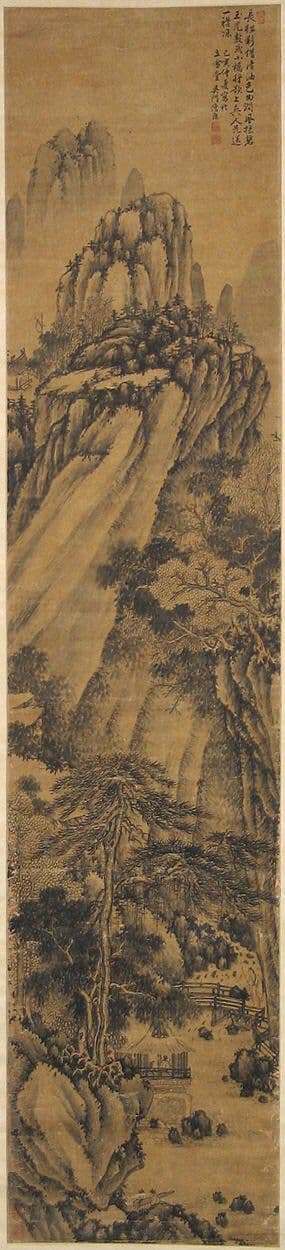
Hold a Huang Junbi waterfall up at arm's length and the first thing you notice is that the water is not painted at all. The cascade is the untouched white of the paper, shaped entirely by what sits on either side of it: wet, dragging strokes of dark ink for the wet rock, a bruise of pale grey wash where the spray hangs, and a scatter of dry-brush scrub clinging to the ledges. Turn the scroll slightly to the light and you can see the order he worked in, because the ink layers do not blend where they meet. That white channel is the signature of a painter who spent sixty years thinking about how falling water behaves.
This guide walks you through who Huang Junbi was and why his name carries differently in Taipei than in Beijing, how to read his brushwork and his favourite subjects, the signatures and seals you should expect, where the fakes come from and what gives them away, what the market has actually paid attention to, and what to check on the paper and mounting before you buy.
Who he was
Huang Junbi, also romanised as Huang Chun-pi, was born in 1898 in Nanhai county in Guangdong, in the commercial hinterland of Canton. He trained in the traditional way, by copying, working through the Song and Yuan masters and through the Qing orthodoxy that stood between him and them, and he also had early exposure to Western drawing at a time when that was becoming ordinary for an ambitious young painter in the south. He taught in Guangzhou and Nanjing, and in 1949 he moved to Taiwan, where he spent the rest of his life. He died in Taipei in 1991.
In Taiwan he became an institution rather than merely a painter. He led the art department at what became National Taiwan Normal University, and for decades effectively decided what a generation of Taiwanese art teachers understood ink painting to be. He also gave painting lessons to Soong Mei-ling, which placed him close to the centre of official cultural life. His studio name, Baiyuntang, "White Cloud Hall", appears on his seals and on the treatise in which he set out his own painting methods.
The three who crossed the sea
Collectors will constantly see Huang Junbi grouped with Zhang Daqian and Pu Ru as the "three masters who crossed the sea", the trio of established mainland painters whose move to Taiwan around 1949 reset the island's ink painting. The grouping is useful shorthand and it is also a market fact: it is the frame in which Taiwanese and overseas Chinese collectors were taught to see him, and it explains why his work has a strong following in Taipei, Hong Kong and Southeast Asia while being comparatively thin on the ground in mainland collections.
It is worth knowing what the grouping obscures. Pu Ru was an imperial relative working a scholarly, literati line; Zhang Daqian was a shape-shifter who could paint in any historical hand and then invented his own splashed-colour manner. Huang Junbi was the most conservative of the three in structure and the most physical in handling. He kept the built landscape of the Song academy, with its receding planes and its architecture of rock, and drove wet ink through it at speed.
Waterfalls, and why they matter
If one subject fixed his reputation it is the waterfall, feipu, "flying cascade". He returned to it for decades and built a repeatable vocabulary for it. He travelled widely from the 1950s onward and painted the great falls he saw abroad as well as the Chinese sites that landscape painting had always used, which is unusual: most of his contemporaries were painting places they had read about rather than places they had stood in front of.
What to look for in a good example:
- Reserved white water. The cascade is negative space, never white pigment. If the water is painted in with opaque white, the work is not his.
- Wet rock, dry scrub. He loads the brush heavily for the mass of the cliff and then switches to a nearly dry brush for vegetation and texture strokes on top. The contrast between the two is sharp and deliberate.
- Spray as graded wash. Mist at the foot of the fall is built from thin layers of grey wash, applied so the paper still breathes through them. Muddy, overworked spray is a common tell in copies.
- Structure under speed. However fast the brushwork looks, the rock reads as solid and the planes recede in order. Fakes usually get the speed and lose the structure.
His other recurring subjects are figures in landscape, pine and rock compositions, and occasional animals. The figures are small and summary, placed to give the cliff its scale.
Reading the brush
Huang Junbi is a useful painter to study because his method is legible. He was a teacher who wrote down what he did, and the sequence he taught is visible in the finished work: outline and structural strokes first, then texture strokes, then wash, then accents in the darkest ink. Compare this with the layered, additive approach of Huang Binhong's five brush and seven ink methods, where the surface is built up over many sessions until the ink itself becomes the subject, or with the sponged and rubbed cloud and water effects of Lu Yanshao's cloud and water passages, which are closer in subject and far apart in technique.
If you are new to judging this kind of picture at all, the compositional grammar he is working inside is set out in our guide to Chinese landscape painting and the shanshui tradition. Knowing where the eye is supposed to enter a landscape and how it is supposed to travel makes a weak copy obvious much faster than any connoisseurial instinct.
Signatures, seals and inscriptions
He signed consistently with his three characters and dated many works by the Republican year or by the cyclical ganzhi pair, and his inscriptions are typically short: a title, a place, a date, occasionally a line of verse. Long philosophical colophons are not his habit.
Seals to expect include his name seals and the White Cloud Hall studio seal. A few points of practice:
- Position is conventional, not random. Signature and seals sit where the composition leaves room, usually upper or lower corner, and never crowd the reserved water.
- Seal impressions should sit in the paper. Genuine impressions show slight unevenness in the vermilion and a faint impression in the fibre. Flat, uniform, printed-looking seals are a red flag.
- Count the seals against the picture's ambition. A modest hanging scroll covered in collectors' seals and a dozen of the artist's own deserves scepticism.
Our guides to Chinese artist signatures and how to identify them and to painting seals and collectors' marks cover the mechanics in more detail, including how to photograph a seal so it can be compared with a published impression.
Copies, studio work and outright fakes
Three different things get called fakes and they are not the same problem.
- Teaching copies. He taught for decades, and students copied their teacher; that is how the tradition works. Some of these copies are honest, unsigned exercises that later acquired a signature. The long tradition behind this practice is described in our piece on copying as a Chinese painting tradition.
- Trade fabrications. Because his vocabulary is systematic, it is imitable. Waterfall compositions are produced in quantity for the tourist and decorative trade, and the better ones reach auction with invented provenance.
- Reprints and photographic reproductions passed off as originals. Look at the ink under a loupe. Brushed ink has a grain and an edge that varies along the stroke; printed ink has a dot structure or a uniform edge, and sits on the surface rather than in the paper.
Practical order of examination: paper and mounting first, then ink behaviour, then composition, then signature and seals, then paperwork. Beginners reverse this and start with the signature, which is the easiest element to forge.
What the market pays attention to
Prices have been made in Taipei and Hong Kong more than anywhere else, and the market grades him on subject and date. Mature waterfalls in good condition on a generous format are the core of his market; late repetitive work, small decorative fan paintings and pictures with heavy restoration sit well below. His name does not carry the multiples that Zhang Daqian's does, which for a collector is mostly good news: a well-chosen, well-documented Huang Junbi is still a picture you can buy on its merits rather than on its label.
Documentation matters more than usual here, because so much of the material moved through informal channels in Taiwan and Southeast Asia in the second half of the twentieth century. Exhibition labels, publication in a catalogue, and a clean chain of ownership all move the needle.
Common questions
Is Huang Junbi the same as Huang Chun-pi?
Yes. They are two romanisations of the same name, the first in pinyin and the second in the older Wade-Giles-derived form still common in Taiwan and in older auction catalogues. You will also see the studio name Baiyuntang, or White Cloud Hall, used as a shorthand for him. When you are searching auction records or library catalogues, search all three, because records from the 1960s to the 1990s overwhelmingly use the older spelling and a pinyin-only search will miss most of his published history.
How do I tell a real Huang Junbi waterfall from a decorative copy?
Start with the white of the water. In a genuine work it is untouched paper, shaped by the ink placed beside it, and its edges are irregular because they follow the rock. Copies tend to outline the water, or paint it in with white, or make its edges too even. Then check whether the rock still reads as solid: copyists reproduce the speed of his brush and lose the underlying structure, so the cliff flattens into a pattern of marks. Finally, look at the spray, which should be thin graded wash rather than opaque grey.
Does he count as a modern or a traditional painter?
Both, and the tension is the point. He kept the structural landscape of the Song academy and the whole apparatus of brush conventions, and he applied them to places he had personally travelled to, at speed, with a wetness that no Qing orthodox painter would have permitted himself. He is usually classed with the twentieth-century masters who renewed ink painting from inside the tradition rather than by importing Western form.
Where can I see his work in person?
His work is held in Taiwanese public collections and appears regularly in twentieth-century Chinese painting sales in Taipei and Hong Kong. For a collector, viewing days at those sales are the most reliable place to handle a number of his pictures side by side, which is the only way to calibrate an eye for his ink. Museum displays rotate, so check current exhibitions rather than relying on a permanent-collection assumption.
Further reading
- Chinese hanging scroll formats and how they work — the format most of his waterfalls take, and what condition problems it hides.
- Chinese art provenance documents and how to read them — what a usable ownership history looks like for a twentieth-century Taiwanese picture.
- Shipping, insurance and storage for Chinese art — how to move and keep a scroll without damaging it.
Browse the collection
Huang Junbi is a painter we write about rather than one we stock. What Kiln and Ink offers is limited-edition archival giclée reproductions of the twentieth-century Chinese ink masters, hand-numbered and issued with a Certificate of Authenticity, printed on papers chosen for their behaviour over decades rather than their effect in a photograph. If his waterfalls have sent you looking for the wet-ink line of that generation, the landscape and brush-method artists in our collections are the closest place to start.
Explore Further