Published August 13, 2026
The Chinese hanging scroll explained: the parts of the mount, why scrolls were rotated rather than left hanging, and how to display and store one today.
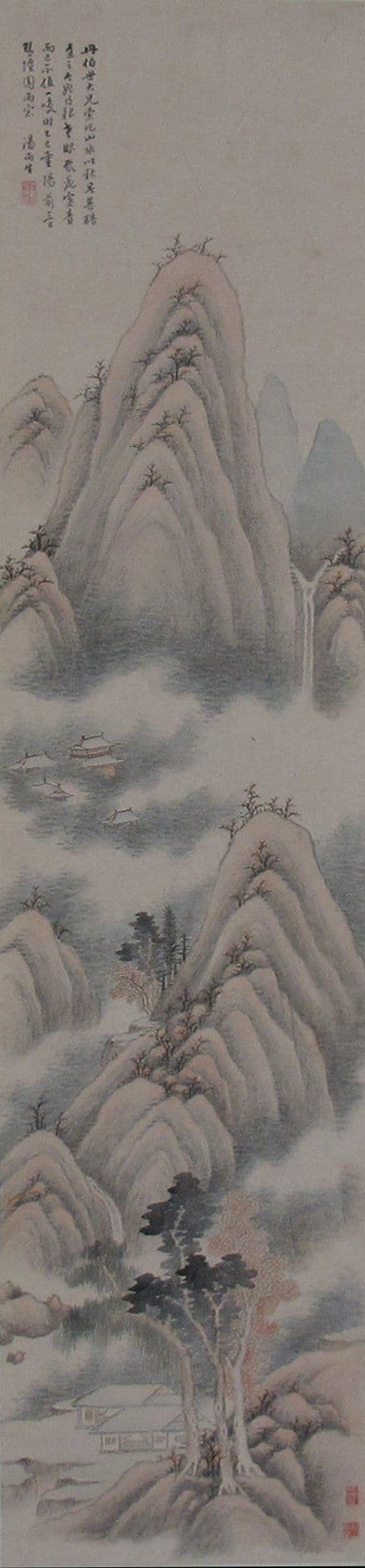
Late on a winter afternoon, the light in a room drops and slants, and a hanging scroll on the wall does something a framed picture never quite does: the silk borders pick up the warmth, the paper softens, and the vertical column of mountain and mist seems to hang in the air rather than sit on the wall. A scroll is not a painting in a frame. It is a painting built into a flexible textile machine — one designed to be hung, taken down, rolled, stored and hung again, sometimes for centuries.
This guide explains how the format works: the parts of a scroll mount and what each does, why the tradition treats hanging as an event rather than a permanent state, and the practical questions — light, humidity, storage, framing — that come with actually living with one in a modern home.
What a hanging scroll is — and is not
The hanging scroll (lizhou, often just "scroll" in English) is the vertical display format of Chinese painting: a painting or calligraphy on paper or silk, backed with layers of paper paste-lining, surrounded by silk borders, with a thin stave at the top and a weighted wooden roller at the bottom. It hangs from a cord; it rolls up around the bottom roller for storage.
It is one of several traditional formats, and the differences are practical, not cosmetic. The handscroll is horizontal and private — unrolled section by section on a table, an arm's length at a time, never displayed whole. Album leaves and fans are small, intimate formats that live in boxes and folding covers. The hanging scroll is the public face of the tradition: the format for the reception hall, the studio wall, the temple pillar — made to be seen across a room, whole, at a distance.
That public role shaped its proportions. Hanging scrolls run tall — a painting of moderate size becomes an object one and a half to two times its height once mounted — and the composition inside was conceived for vertical reading, foreground at the bottom, distance at the top. Li Keran's monumental red-mountain compositions, for instance, only make full sense in this format, the ridgelines stacked up the column of the sheet; his Ten Thousand Mountains Bathed in Red is a textbook case of a picture that uses the scroll's verticality as part of its meaning.
The anatomy of the mount
A traditional mount is a layered construction with named parts. The names vary by region and period, but the working vocabulary a collector meets looks like this:
| Part | Where it sits | What it does ||---|---|---|| Heaven (tiantou) | The silk panel above the painting | The larger upper margin; visually "lifts" the painting || Earth (ditou) | The silk panel below the painting | The smaller lower margin; heaven is conventionally taller than earth || Poem hall (shitang) | Optional blank panel directly above the painting | Space for an inscription or colophon by the owner or a admirer || Border strips | Narrow silk framing the painting itself | Separate image from mount; their silk and colour date remounts || Startled-swallow ribbons (jingyan) | Two loose ribbons hanging from the top | Decorative today; the name preserves their reputed original job of scaring birds off the scroll || Top stave | Thin flat wood strip at the top edge | Carries the hanging cord || Bottom roller | Round weighted rod at the base | Keeps the scroll taut when hung; the core it rolls around when stored || Roller knobs | The end caps of the bottom roller | Wood, lacquer, porcelain, ivory or jade on grander mounts; a quality signal |
Two things about this table matter beyond vocabulary. First, the mount is structural: the paste linings behind the painting are what let a fragile sheet survive rolling and unrolling for generations. Second, the mount you see is almost never original. Scrolls are remounted every few generations as silk wears and paste dries out, and the quality of the most recent remount — clean margins, well-matched silks, no cockling — tells you how the object has been cared for. We cover that side in detail in the guide to Chinese painting mounting; the short version is that a bad remount can flatten ink, trim edges and halve a painting's value, so the mount deserves as slow a look as the picture.
Hung for an occasion, not forever
The deepest difference between a scroll and a framed painting is temporal. In the tradition, hanging a scroll was an act — done for a season, a festival, a guest, a mood — and taking it down again was part of the same rhythm. A studio might rotate scrolls monthly; a household would bring out auspicious subjects for the New Year and put them away after. Permanent display was never the design assumption, and the format's whole engineering — rollable, storable, remountable — follows from that.
This is worth taking seriously rather than treating as a quaint custom, for two reasons. Practically, rotation is conservation: paper and silk that spend most of the year rolled in a dark box, and weeks rather than decades on the wall, are spared most of the light damage that ruins works on paper. We make the same argument in our practical guide to displaying Chinese scroll paintings — rotation is not a compromise on enjoyment, it is the traditional form of it. And experientially, rotation keeps the work alive. A picture that is always on the wall disappears into it; the scroll you re-hang each autumn gets looked at.
If you keep only one habit from the tradition, make it this one: own more scrolls than wall, and move them.
Living with a scroll in a modern home
The practical questions are simple to state and worth getting right.
Where to hang. An interior wall out of direct sunlight, away from radiators, vents, fireplaces and exterior-wall damp. Kitchens and bathrooms are out. The classic position — visible from where people actually sit, with room to stand back — matters more than any rule; a scroll is a distance object.
Climate. Paper and silk want stability more than any particular number. Repeated swings in humidity make the layered mount expand and contract at different rates, which is where waves, cockling and crease lines come from. Moderate, stable humidity, no direct heat, no spotlights an inch from the silk.
Handling. Unroll and roll on a clean table, supporting the roller with both hands, never pinching the painting surface. Roll snugly but not tight, and never crease a scroll back on itself. Most damage to scrolls is handling damage, and it happens in seconds.
Storage. Rolled, wrapped in acid-free tissue or soft cloth, laid horizontally in its box — traditional paulownia-wood boxes exist for good reason, but any clean, dark, stable drawer beats a bright shelf. Check stored scrolls once or twice a year.
To frame or not. Framing a scroll flat behind glazing is common in Western collections and defensible for a fragile or frequently displayed piece — it controls dust and handling. But understand the trade: framing freezes an object designed to move, adds pressure points, and usually requires the mount to be altered. For anything of value, that is a conversation with a conservator, not a framer's default.
What to check when buying
Condition questions specific to the format: look along the scroll under raking light for horizontal creases (from tight or careless rolling) — fine ones are near-universal in older scrolls, but cracked, lifting or repaired creases across the image are a real cost. Look for foxing spots, water tide-lines at top or bottom, splits at the edges of the painting panel, and patches visible from the back. Ask when it was last remounted and by whom. And weigh the mount itself: fresh gaudy silk on a supposedly old painting is not proof of fraud, but it is a question that deserves an answer, since remounting is also how problem paintings are dressed up for sale.
Common questions
Why is a hanging scroll not kept on display permanently?
Because the format was engineered for rotation. Light slowly bleaches ink and embrittles paper; the traditional cycle — hung for a season, then rolled and rested in a dark box — is both the cultural practice and highly effective conservation. Permanent hanging is the single most common way modern owners damage scrolls.
What is the panel of writing above some paintings?
That is the poem hall (shitang) — an optional panel above the image where an owner, friend or later admirer added an inscription or poem. A good colophon there can add historical and financial value; it is part of the object's biography, not graffiti.
Can I frame a Chinese scroll?
You can, and for heavily handled or fragile pieces it has real protective logic. But it alters an object designed to roll, so for anything valuable, have a paper conservator — not a high-street framer — do the assessment. For most scrolls in good condition, the better answer is correct hanging hardware, sane light, and rotation.
How should I store scrolls I am not displaying?
Rolled around their bottom roller, wrapped in acid-free tissue or soft cloth, horizontal in a box or drawer — dark, dry, stable, and checked a couple of times a year. Never store a scroll standing on its roller ends, and never in an attic or basement with seasonal humidity swings.
Further reading
- How to View a Chinese Handscroll: The Original Slow Art — the horizontal sibling format and its completely different viewing ritual.
- Album Leaves and Fan Paintings: The Affordable Formats — the small formats, and why they are the value entry point.
- Chinese Painting Mounting (Zhuangbiao): Why It Matters — the craft behind the mount, and how remounting affects value.
- How to Display a Chinese Scroll Painting: Practical Guide — the hands-on companion to this piece.
Browse the collection
Most of the twentieth-century ink masters' compositions in the Kiln & Ink collection were conceived for exactly this vertical format: limited-edition archival giclée reproductions on xuan paper or museum-grade cotton rag, hand-numbered with a Certificate of Authenticity, typically $300–$1,200 — each one ready for the mounting or framing choice this guide has just walked you through.
Explore Further