Published September 21, 2026
The Chinese horse painting tradition from Han Gan to Xu Beihong: what the horse meant at each stage, how to read one, and how copies give themselves away.
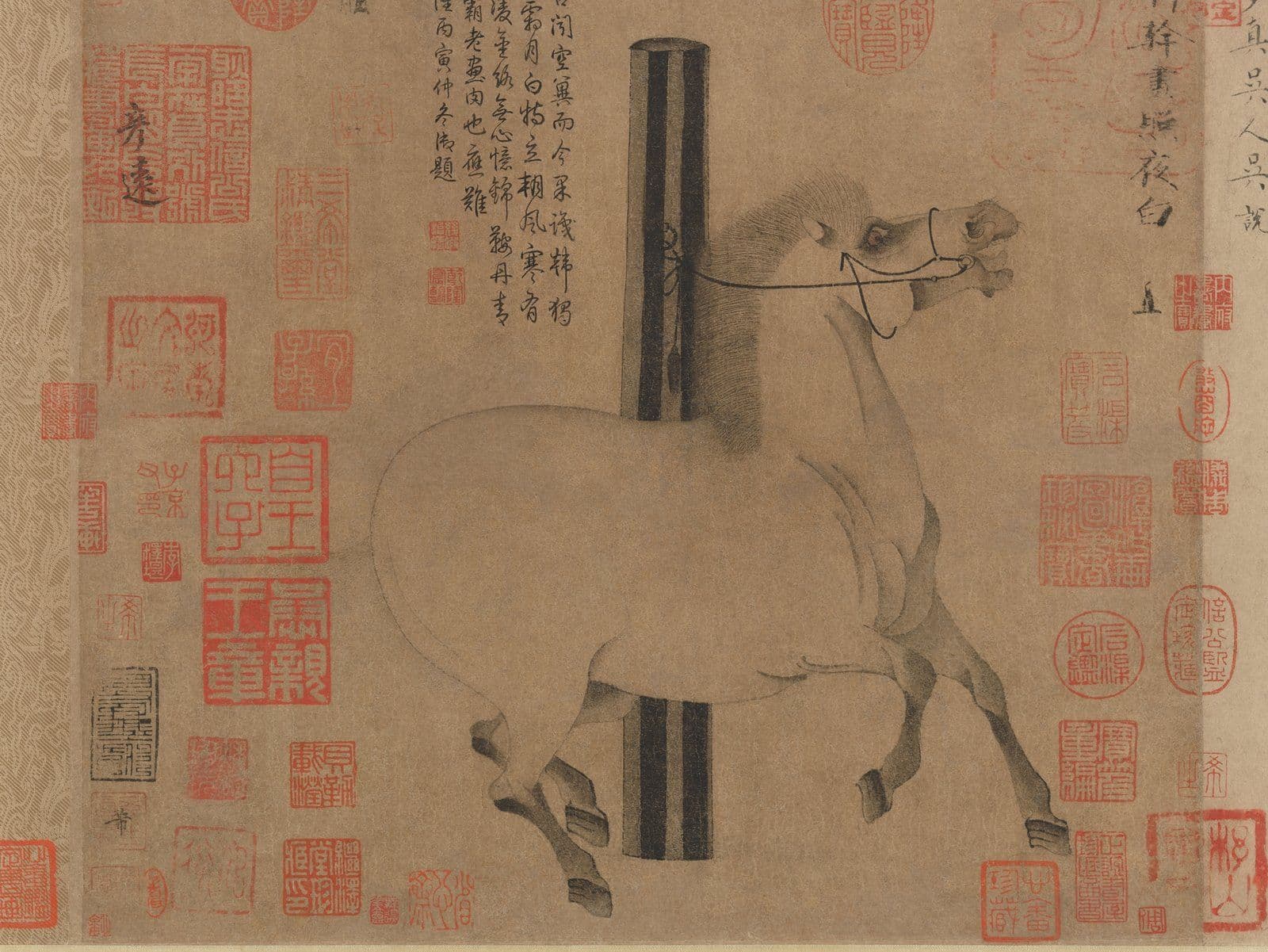
Hold a Tang horse painting close and the first thing you notice is how little is actually described. A line runs from the crest of the neck to the withers, breaks, and picks up again at the flank. The belly is one unbroken curve. There is no landscape, no cast shadow, often no ground at all — only the animal, turned slightly towards you, the weight already shifted onto one hind leg. Everything the painter knew about horses had to be carried by that outline and by the placement of four hooves on blank silk.
This guide walks you through the Chinese horse painting tradition from the Tang court to the twentieth century. You will finish it able to say what the horse meant at each stage, how Han Gan, Li Gonglin, Zhao Mengfu, Giuseppe Castiglione and Xu Beihong each solved the same animal differently, how to separate a court horse from a scholar's horse at a glance, what the inscription and seals on a horse painting are telling you, and which part of the tradition is most heavily copied today.
Why the horse carried more weight than other animals
Horses were a strategic asset before they were a subject. The steppe frontier decided dynastic security, and good cavalry stock had to be bred, bought or received as tribute from Central Asia. Imperial stables were counted, catalogued and guarded, and the officials who ran them were senior men. A painting of a particular horse was closer to a portrait of a person than to an animal study.
That literal value acquired a second, moral one. The physiognomy of horses, xiangma, was a real expertise: judging bone, wind and temperament from the standing animal. Out of it came the figure of Bole, the legendary judge who could recognise a thousand-li horse in a cart-puller's traces. From the Han dynasty onwards a writer who felt overlooked reached for that image — the horse is talent, and the connoisseur who spots it is the ruler who ought to employ him. A scholar painting a bony, unridden horse was rarely painting only a horse.
Han Gan and the Tang court horse
Han Gan worked in the eighth century in the service of Emperor Xuanzong, at the height of Tang confidence and at the height of Tang horseflesh. The tradition records that when he was told to study under an established master of the subject, he answered that the horses in the imperial stables were his teachers.
The Tang court horse is heavy. The neck arches, the chest is broad, the rump is round and fully fleshed, and the legs look short against that mass. The line is even in width, drawn slowly, with colour laid inside it rather than modelling it. Nothing is exaggerated for effect; the exaggeration is in the health of the animal.
The single most famous surviving example is the handscroll known as Night-Shining White, a study of a charger of Xuanzong tethered to a post, in the collection of the Metropolitan Museum of Art. The horse strains against the tether, mouth open, mane lifted, and the whole drama is confined to a body that stays firmly on the ground.
Li Gonglin and the horse reduced to line
By the Northern Song the subject had moved into scholarly hands, and colour went with it. Li Gonglin painted horses in baimiao, "plain drawing" — ink outline on paper or silk with little or no colour, the discipline that treats the brush line as a complete statement rather than a boundary to be filled.
His best-known composition shows five tribute horses, each led by its groom, each identified in an accompanying note. The horses are individuals; so are the grooms, several of them Central Asian, drawn with the same unhurried line. Stripping out colour forced everything onto proportion and contour, and it made the subject portable into the scholar's world, where painting in ink alone was the mark of an amateur in the honorific sense.
This is the moment when the divide you will use constantly first opens. Colour, careful finish, a named animal and a documentary purpose point one way; ink alone, visible brushwork and an implied argument point the other. The distinction between court painting and literati painting is more useful with horses than with almost any other subject, because both camps kept painting them for another eight hundred years.
Zhao Mengfu and the Yuan horse as a position
Zhao Mengfu (1254–1322) was a descendant of the Song imperial house who took office under the Mongol Yuan. He painted horses and grooms repeatedly, and he painted them deliberately in an archaic manner, reaching back past the Song to the Tang.
That choice was the content. Returning to an older style, fugu, was a way of asserting continuity with a fallen order while serving the new one, and the grooms in foreign dress are not neutral either. Yuan viewers read these paintings as statements about service, loyalty and what a man owes a dynasty, and the inscriptions friends added around them argue the point openly.
His contemporary Ren Renfa pushed the allegory until it was no longer deniable, pairing a glossy, well-fed horse with a starved one and letting the viewer apply it to officials. When you meet a Yuan horse, assume an argument is being made and look to the writing on the scroll to find out what it is.
Castiglione and the Qing imperial hybrid
The Jesuit painter Giuseppe Castiglione (1688–1766), known in Chinese as Lang Shining, spent his career in the Qing court workshops under the Kangxi, Yongzheng and Qianlong emperors. He was trained in European oil practice and made to work in Chinese materials on silk and paper, and the result is a genuinely hybrid animal.
His horses have modelled flanks with light falling across them, foreshortened bodies, and an anatomy built on European study; they stand in landscapes that use Chinese conventions for rock, tree and distance, and they are mounted in scroll format. His long handscroll of a hundred horses at pasture is the showpiece of the manner. Qianlong was delighted by it. Chinese critics of the period were cooler, and their complaint is a useful diagnostic: shading and cast shadow were seen as tricks of appearance rather than as brushwork carrying character.
For a collector the Qing court horse is easy to recognise. Look for tonal modelling inside the contour, hooves that sit on a described ground plane, and a level of finish that suppresses the individual stroke.
Xu Beihong and the running horse
Xu Beihong (1895–1953) studied in Paris in the 1920s, drilled in life drawing and equine anatomy, and returned convinced that Chinese painting needed the structure of Western study without adopting its surface. His horses are the result, and they changed what the subject means.
He painted them in xieyi rather than gongbi — freehand, fast, in wet ink on absorbent paper, with the neck and haunch laid in as broad saturated washes and the mane and tail dragged out in splayed dry brush. The skeleton underneath is accurate; the handling is not descriptive at all. Almost always the horse is riderless, unbridled and moving away from or across the viewer rather than posing.
The timing gave the image its charge. Through the 1930s and 1940s, with the country at war, a masterless galloping horse read immediately as national resolve, and the artist said as much in his inscriptions. That is why this one motif escaped the art world entirely and became a general emblem, reproduced on everything, and why the symbolism of his galloping horses is worth reading properly rather than absorbing by osmosis.
How to look at a horse painting
- Find the ground. No ground and a floating animal points to the Tang-derived and literati lines; a described ground plane with shadow points to the Qing court hybrid.
- Ask what the line is doing. An even contour that encloses colour behaves differently from a stroke that is itself the muscle. The second is a scholar's or a modern painter's habit.
- Count the ink values. A Xu Beihong horse works in three or four clearly separated tones. A copyist usually produces five or six muddy ones because the brush was reloaded mid-stroke.
- Read the tack. Saddle, bridle, tassels and the presence of a groom mark the animal as property and the painting as record. Bare horses are almost always carrying an idea.
- Read the writing. The inscription gives you the occasion, the recipient and often the argument, and reading a painting's inscription will tell you more about a horse scroll than the horse will.
Copies, versions and the modern market
Horses are the most copied subject in modern Chinese painting, and the copying is not all dishonest. Making close versions of admired works was a standard part of training, and the Chinese tradition of copying produced honest study pieces, workshop versions and outright forgeries that all look superficially alike a century later.
What separates them is stroke behaviour. A wet ink horse cannot be corrected: once the wash is on xuan paper the fibre has taken it, so a genuine passage shows one decision per stroke, with hard starts, clean lifts and fibre bleeding evenly outwards. Copies show hesitation — a stroke laid twice, edges nudged back into line, a tail that was extended after the fact. Check the joins between neck wash and shoulder, and the belly line, which is the hardest single stroke in the subject.
Common questions
Why did Xu Beihong paint so many horses?
Partly because he could: he had drilled equine anatomy for years and the motif suited a fast ink method he had spent a decade developing. Mostly because the image worked. During the war years a riderless galloping horse stood for a country refusing to be broken, and he repeated and refined it for patrons, exhibitions and fundraising. Repetition of a signature motif was normal practice for a twentieth-century ink master, so a second, third or tenth version is not in itself a sign of anything wrong.
Are the famous Tang horse paintings really by Han Gan?
A small number of works are accepted as Tang and associated with him by long and well-documented collection histories, and museums word those attributions carefully for good reason. Much of what circulates under his name is later: Song and Yuan painters copied and re-imagined Tang horses deliberately, and the copies were themselves collected and inscribed. Treat "Han Gan" on a label as shorthand for the Tang court manner unless an institution states otherwise.
What does a horse symbolise in Chinese painting?
It depends on whether it is dressed. A saddled, bridled horse with a groom is wealth, rank and imperial reach — the animal as possession. A bare horse, especially a thin one, is talent unemployed and waiting for a judge to recognise it, following the Bole legend. A galloping unbridled horse in a twentieth-century painting is usually national spirit. The horse also runs seventh in the zodiac cycle and appears in New Year imagery with the general sense of advancement and speed.
How do I tell a printed reproduction from an original ink horse?
Look at the paper under raking light. Original ink sinks into xuan paper fibres and shows soft, uneven bleed at the edge of a wash, and the sheet often cockles slightly where it was wettest. A print sits on the surface with a uniform edge, and under a loupe most reproductions break into a regular dot or spray pattern. Turn the sheet over: ink usually shows through from the back, whereas most prints do not.
Further reading
- Xu Beihong: A Collector's Guide — the wider body of work the horses sit inside.
- How Experts Authenticate Chinese Paintings — the order in which evidence should actually be weighed.
- The Six Principles of Xie He — why "spirit resonance" outranked likeness, and what that meant for animal subjects.
- Reading Chinese Painting Seals — collector marks are how a Tang horse acquired its biography.
Browse the collection
Xu Beihong is one of the twentieth-century masters whose work Kiln and Ink reproduces as limited-edition archival giclee prints, hand-numbered and issued with a Certificate of Authenticity. The earlier horses in this guide are subjects we write about rather than ones we stock, since the surviving Tang, Song and Yuan scrolls sit in museum collections. If the modern end of the tradition is what draws you, browse the collection and start with the ink work of the 1930s and 1940s.
Explore Further