Published September 13, 2026
Guanyao and minyao explained: how imperial kiln porcelain was made and inspected, why private kilns fired court orders, and how to tell the two apart.
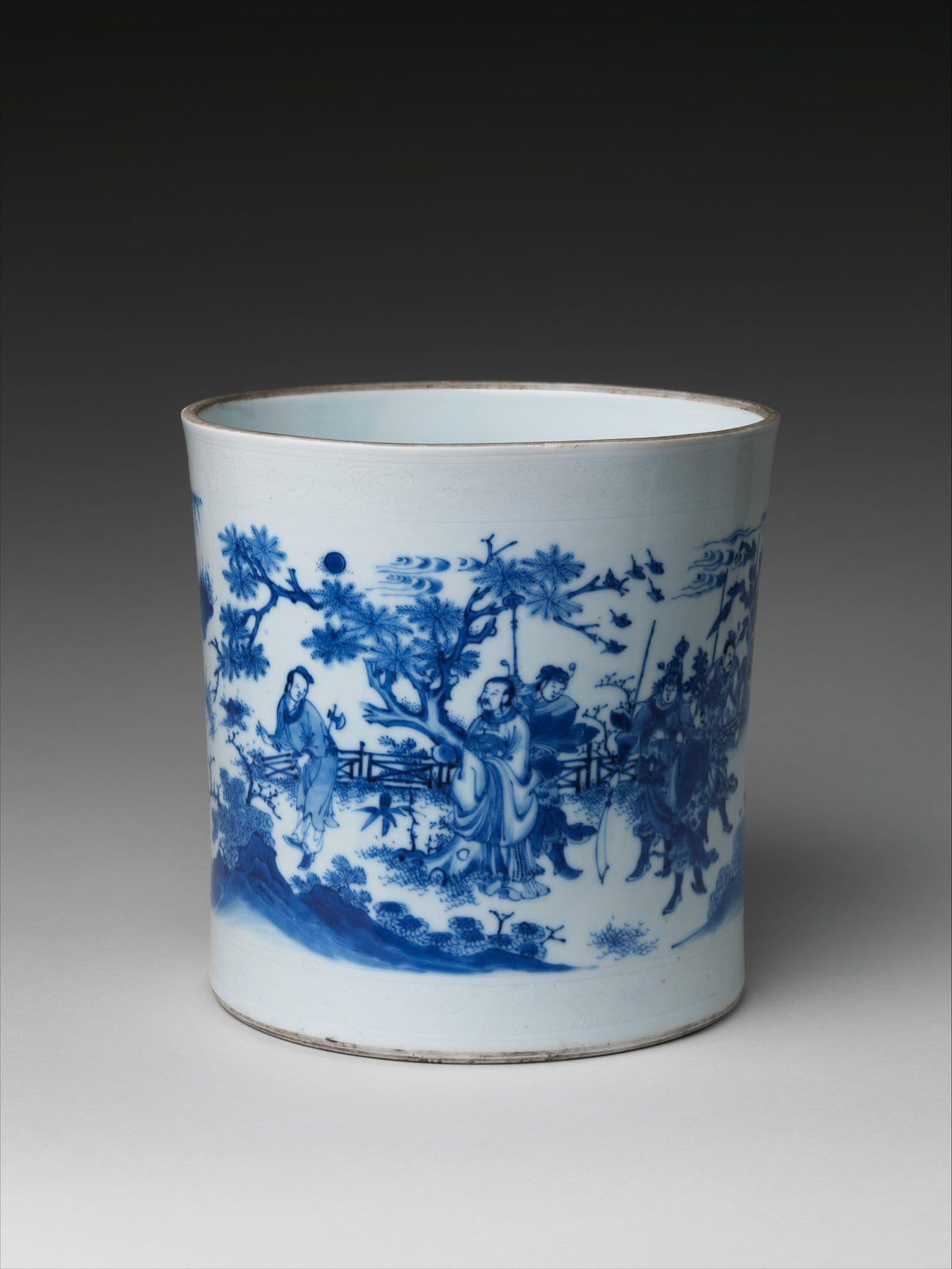
Set two blue-and-white dishes of the same period side by side on a table and the difference announces itself before you have picked either one up. The first is thin, its rim true, the cobalt held inside the drawn line, the foot cut clean and wiped free of grit. The second is heavier, its glaze pooling faintly at one side, the brushwork quicker and looser, a few specks of kiln sand still fused to the footring. Both came out of Jingdezhen. Only one was made to be carried into a palace.
This guide walks you through the distinction between guanyao and minyao: what the two terms have meant at different points in Chinese history, how the imperial kiln system was actually organised, the practice that blurred the line between court and commercial production, the features on an object that point one way or the other, and why the difference sits at the centre of how Chinese porcelain is valued today.
Two words, and a trap in the first one
Guanyao, "official ware", and minyao, "people's ware", are the ordinary Chinese terms for porcelain made for the court and porcelain made for everyone else. Used loosely they simply mean imperial and non-imperial.
The trap is that guanyao also names a specific ware. Guan ware of the Song dynasty is a grey-bodied, thickly glazed stoneware with a deliberate crackle, made under direct court supervision, and it belongs to a completely different conversation from the white porcelain of Jingdezhen. When a Song specialist says guan ware they mean that ware. When a dealer in Ming and Qing porcelain says guanyao they mean the imperial kilns.
Read the period first, then the term. A note that a piece is guanyao tells you nothing until you know whether the speaker is standing in the twelfth century or the eighteenth.
How the imperial kiln system worked
Court demand for porcelain was organised from Jingdezhen in Jiangxi, where the clay, the fuel and the skill had already concentrated. Under the Yuan the court established a porcelain bureau there; under the Ming an imperial factory was set up at Zhushan, Pearl Hill, in the middle of the town, and the Qing continued and reorganised it.
The imperial factory was not a kiln in the sense a private workshop was. It was an administrative body that commissioned, supervised, inspected and rejected. Orders arrived from the palace specifying forms, decoration and quantities. The factory drew on the town's labour, took the best of the raw materials, and worked without the constraint that governs every commercial pot: the price.
That single freedom explains most of what you see on the object. An imperial dish could be thrown thin and lost in the firing, and another thrown to replace it. Cobalt could be levigated and refined until it drew a clean line. A painter could spend a day on a border that a workshop across the river would finish in minutes.
Inspection was severe. Excavation at Zhushan has recovered enormous quantities of deliberately broken imperial wares, smashed and buried rather than allowed out of the compound. Pieces failed for warping, for a flaw in the glaze, for a mark drawn slightly out of true.
The Qing directors are the best documented part of the story. Under the Kangxi, Yongzheng and Qianlong emperors a succession of officials ran the factory, of whom Tang Ying is the most celebrated, a supervisor who wrote about the processes in detail and under whom the technical range of the kilns widened considerably. The monochrome glazes developed in this period, discussed in the guide to Chinese monochrome glazes, are the clearest demonstration of what an unlimited budget and a chemist's patience could achieve.
Guanda minshao: the line blurs
By the later Ming the imperial factory could not meet demand from its own kilns alone, and a practice grew up that the Chinese sources call guanda minshao, "official orders fired in people's kilns". The imperial factory contracted work out to the best private workshops in the town, supplying the design and inspecting the result.
This matters more than any other single fact in this article, because it means imperial and commercial production came out of the same kiln sheds, sometimes from the same hands, sometimes stacked in the same firing. The clean division implied by the two words is an administrative one, not a geographical one.
It also explains a category of object that confuses new collectors: pieces of clearly imperial quality that carry no mark, and pieces with fine imperial decoration on a body that is not quite good enough. The best private workshops were very good indeed, and in the Qing they were selling to officials, to wealthy merchants and to the export trade, all of whom wanted what the court had.
Reading the object
No single feature settles the question. Weigh them together, in this order.
- Potting and weight. Imperial wares are potted to an even thickness and feel lighter than their size suggests. Feel the rim between finger and thumb, then the base, then the wall between them. A commercial piece is thicker where thickness is cheap.
- The foot. The most informative surface on any Chinese porcelain. Imperial footrings are cut precisely, evenly chamfered and wiped clean; commercial ones show tool marks, uneven glaze edges and adhering grit. The full vocabulary is in the guide to dating porcelain by the foot rim.
- The cobalt. Refined cobalt sits inside the drawn outline and holds a stable tone; less refined cobalt bleeds, greys and pools into dark spots. The changing supply of the ore over five centuries is traced in the history of cobalt in blue and white.
- The drawing. Look at the least important part of the decoration: a border, the underside of a dish, the back of a rock. Imperial painters finished the parts nobody was meant to study. Commercial painters, paid by the piece, did not.
- Glaze and surface. An even glaze that stops in a crisp line at the foot, without pooling, thinning at the rim or pinholing, is expensive to achieve and was achieved routinely at the imperial factory.
- Consistency across a set. Imperial wares were made in series to a standard. If you can see two or three from the same commission, their sameness is itself evidence.
What the private kilns made
Minyao is not a synonym for poor. It covers the overwhelming majority of Chinese porcelain ever made, including a great deal that is more interesting than the court wares of the same decade.
The private kilns supplied temples, scholars, merchants, restaurants and households; they made the shipwreck cargoes that furnished Southeast Asia, and the kraak dishes that reached Amsterdam and are described in the guide to export porcelain and kraak marks. They made the armorial services ordered from Europe, the coarse Swatow wares shipped from the Fujian coast, and the painted wares of the late Ming that European collectors have always preferred to the tighter court style.
They also worked with a freedom the imperial painters did not have. Much of the liveliest Chinese ceramic painting, in the transitional period between the Ming and the Qing in particular, comes from the private kilns, at a moment when court patronage had collapsed and the best hands were working for a commercial market.
Judging quality within minyao is a separate skill from telling minyao from guanyao, and it is the one that finds value on the open market.
Marks are the weakest evidence
An imperial reign mark is a claim, not a credential. Private kilns applied Ming reign marks throughout the Qing and applied Qing reign marks throughout the twentieth century, as reverence, as shorthand for a style, and as commerce.
The apocryphal mark is so common that it forms its own field of study, set out in the note on apocryphal marks on Chinese porcelain. The scale of imitation is such that Chenghua marks on later pieces vastly outnumber genuine Chenghua wares, a pattern examined in the article on Chenghua doucai marks.
The practical rule is that the mark is the last thing you look at and the first thing you discount. Establish the period from the body, the foot, the glaze and the decoration, then ask whether the mark is consistent with what you have found. The full sequence of examination, from body to mark, is worth following every time.
What the market pays for
The imperial premium is the single largest multiplier in Chinese ceramics, larger than age and much larger than size. A documented imperial piece of a good reign sits at the top of the market; a competent commercial piece of the same decade, with the same decoration, sits far below it.
Three things drive that gap. Imperial wares are finite, because the commissions were finite and the rejects were destroyed. They are the objects mainland Chinese collectors have concentrated on since the market reopened. And they are the easiest category to research, because palace records, excavated shards and museum collections give a scholar something to compare against.
The corollary is where value now lies for a collector of ordinary means. Provincial and private wares of high quality remain reasonably priced, are far less faked in the top grades, and reward the eye rather than the wallet. The question to bring to a dealer is not whether a piece is imperial. It is whether it is the best example of its own kind.
Common questions
Does guanyao always mean the piece has a reign mark?
No. Imperial wares of some periods, particularly parts of the early Ming and the Kangxi reign, were frequently made without marks or with symbols rather than reign marks. Conversely, most objects carrying reign marks are not imperial. Treat the presence or absence of a mark as one piece of evidence among several, and never as the deciding one.
Were imperial and private kilns in different places?
They were separate organisations rather than separate places. The imperial factory stood at Zhushan in Jingdezhen, surrounded by the private kilns of the same town, and from the later Ming onward a substantial share of imperial orders was contracted out to those private workshops under supervision. The best commercial kilns were neighbours and suppliers to the court operation, not rivals in another region.
Is minyao always worth less than guanyao?
As a general market rule, yes, and by a wide margin at the top. But quality within minyao ranges enormously, and a fine transitional-period jar or an early kraak dish in exceptional condition will out-price a dull, damaged nineteenth-century imperial piece. Rarity, condition and quality of painting do the work within each category.
How do I start training my eye for the difference?
Handle imperial pieces in museums where handling sessions are offered, and in dealers' galleries where they are usually offered freely. Ask to compare two objects of the same period at different grades, and look at the foot and the least important passage of decoration on each. The difference is mostly a matter of finish, and finish is learned by touch rather than from photographs.
Further reading
- Chinese porcelain marks — how reign marks are written, placed and read.
- Dating porcelain by the foot rim — the underside, and what it says about the workshop.
- The porcelain authentication checklist — the order of examination, from body to mark.
Browse the collection
Jingdezhen porcelain is a subject we write about rather than one we stock. Kiln and Ink publishes limited-edition archival giclee reproductions of the twentieth-century Chinese ink masters, hand-numbered and issued with a Certificate of Authenticity, whose makers inherited the same argument between court taste and the freer hand of the workshop. The current editions are in the collection.
Explore Further