Published September 16, 2026
Chenghua porcelain explained: palace bowls, doucai enamels, the chicken cups, the most copied mark in Chinese ceramics, and what a collector can buy.
Hold a Chenghua cup in your palm and the first thing you notice is that it is smaller than you expected. The whole vessel sits inside a closed hand. Turn it and the glaze moves against the light like warm wax rather than glass, faintly ivory where it thickens at the foot. The blue is soft, greyish, completely free of the black-speckled pooling that marks the wares of two generations earlier. Underneath, six characters in a double square, written in a rounded hand that looks almost tentative. Nine times out of ten that mark is the only Chenghua thing about the piece, and learning why is the whole education.
This guide walks you through the twenty-two years of the Chenghua reign and the wares that made it legendary: what the imperial kilns actually produced, why the blue changed, how doucai enamelling works, what the celebrated chicken cups are and why they cost what they do, how the mark should look, and how to approach a market in which convincing copies outnumber originals by an enormous margin.
The reign and the scale of what survives
The Chenghua emperor reigned from 1465 to 1487, and the imperial kilns at Jingdezhen worked for him throughout. The output was small in every sense. Most pieces are cups, small bowls, small dishes, stem cups and little covered jars, rarely more than twenty centimetres in any dimension. There are no towering temple vases, no great chargers of the kind the early Ming court sent west.
That smallness was a choice, not a limitation. The wares were made for use in the palace, held and drunk from rather than displayed, and the potting is correspondingly thin and even. Excavation of the imperial kiln site at Zhushan in Jingdezhen in the late 1980s recovered great quantities of Chenghua wasters, deliberately smashed to keep seconds out of circulation, and those shards remain the reference standard against which everything else is measured.
Genuine imperial Chenghua porcelain is rare in absolute terms. Most of it is in institutional collections, above all in Taipei and Beijing, and the number in private hands is small enough that specialists can more or less account for it.
Why the blue is different
The blue and white of the Yongle and Xuande reigns was painted with imported cobalt, high in iron, which fired to a deep violet-blue and pooled into near-black concentrations where the brush loaded. Collectors call that effect heaping and piling, and it is the signature of early fifteenth-century wares.
By the Chenghua reign the kilns were using a domestic cobalt from Jiangxi, lower in iron and higher in manganese. It fires to a softer, greyer, more even blue, and it does not speckle. The result is a quieter palette that suits the small, precise drawing of the period. If you would like the longer story of the pigment itself, the history of cobalt in blue and white sets out how the supply lines changed.
The practical point for a collector is that a Chenghua-marked piece painted in a dark violet blue with heavy iron spotting is telling you something. Either it is an earlier ware with a later mark, or it is a copy by someone who knew the famous early Ming look better than the reign they were imitating.
Palace bowls
The single most admired group of Chenghua blue and white is the set of small bowls known as palace bowls, gongwan. They have a gently rounded body, a slightly everted lip, and a foot cut small in proportion to the width. The decoration is a continuous floral scroll — lotus, day lily, gardenia, melon vine — drawn in outline and then filled with a graded wash.
Two habits distinguish the drawing. The outline is fine and unhurried, and the wash inside it stops short of the line rather than flooding over it. And the composition breathes: there is more white ground here than a late Ming painter would have tolerated.
Doucai: how it was made
Doucai, "joined colours", is the technique the reign is remembered for. It is a two-stage process and understanding the sequence is what lets you judge a piece.
- Stage one. The design is outlined in underglaze cobalt on the raw body. The outline is complete: every petal, every feather, drawn as a closed contour. The piece is glazed and fired at high temperature.
- Stage two. Overglaze enamels are filled into the outlined areas, and the piece is fired again at a much lower temperature.
- The palette. Iron red, two or three greens, a transparent yellow and a thin, matt aubergine. There is no pink, no true overglaze black, and no opaque white. The aubergine in particular has a dry, slightly pitted surface that later imitators consistently fail to reproduce.
- The join. On genuine pieces the enamel sits inside the blue outline but does not always sit neatly: small gaps of white ground show. Copies tend to be tidier.
Doucai is often confused with wucai, the five-colour enamelling that dominates the later Ming. The difference is the outline: wucai draws its contours in overglaze colour and uses underglaze blue as one colour among several, while doucai draws everything in blue first. A comparison with the wucai wares of the sixteenth century makes the distinction obvious in the hand.
The chicken cups
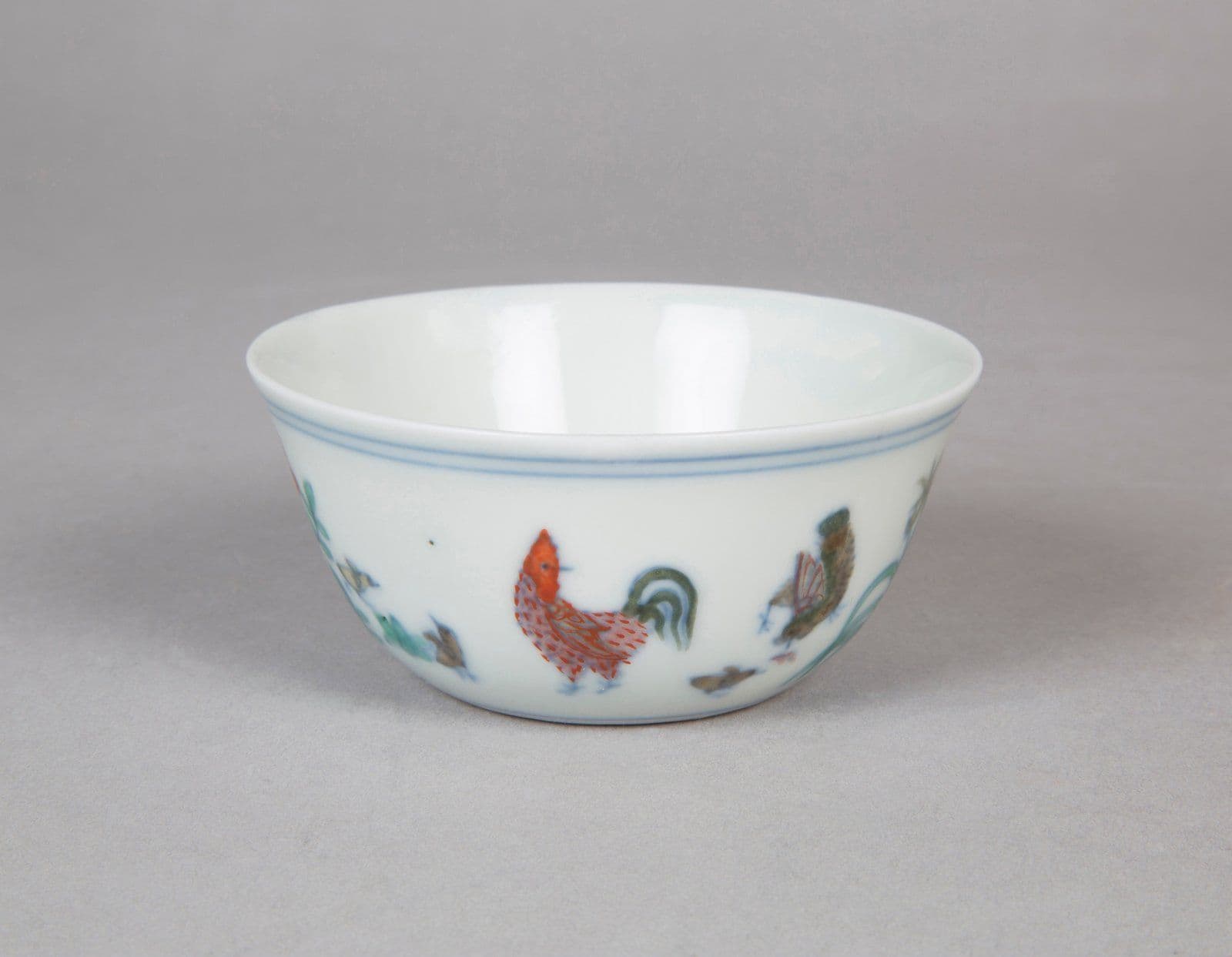
The most famous object of the reign is a doucai wine cup a little over eight centimetres across, painted with a cock, a hen and their chicks among rocks and flowers. A handful survive. They were already legendary in the late Ming, when writers record Chenghua cups changing hands for sums that scandalised them, and one sold in Hong Kong in 2014 for a price that set a record for Chinese porcelain.
The cups have been copied continuously ever since, in every reign from Kangxi onward and in every decade since. A Qing copy is a legitimate collectable in its own right and should be sold as one. What makes the original hard to reach is not only rarity but documentation: the surviving examples have known histories, and a chicken cup without one is asking you to believe something improbable. The record prices attached to this shape are a reason for caution, not for optimism.
The mark
The Chenghua reign mark is the most copied inscription in Chinese ceramics, which makes it simultaneously the least reliable evidence and the most studied. It reads "Da Ming Chenghua nian zhi", made in the Chenghua reign of the Great Ming, in six characters in two vertical columns, underglaze blue, usually enclosed in a double square frame and occasionally in a double circle.
The hand is the point. Genuine marks are written in a rounded, slightly compressed regular script that has been described, fairly, as looking like a competent child's writing: the strokes are blunt, the characters sit tight inside the frame, and the frame itself is drawn freehand and is rarely quite square. The blue of the mark is the same soft grey-blue as the decoration, and it sinks into the glaze rather than sitting on it.
Qing copyists knew all of this and worked hard at it. Yongzheng imitations in particular are superb, made by potters with access to genuine pieces and no intention to deceive anyone about the century. Learning the Chenghua doucai mark in detail is the necessary next step, and reading the broader Ming sequence puts that hand in context.
Chenghua marks on later wares
A Chenghua mark on an eighteenth or nineteenth-century piece is usually homage rather than fraud. The convention of writing an admired earlier reign on a new ware runs through Chinese porcelain and carries no implication of dishonesty at the point of manufacture. Apocryphal marks become a problem only when a seller uses one to claim a date the object cannot support.
So the sequence of questions is fixed. What is the shape, and did Chenghua make it? What is the tone of the blue? How thin is the potting, and how does the glaze sit at the foot? Only then, what does the mark say? A piece whose body and glaze belong to the eighteenth century is an eighteenth-century piece whatever is written underneath, and the best of the Yongzheng wares are worth owning on their own terms.
Buying: what is realistic
Very few collectors will buy imperial Chenghua porcelain. What is available, and rewarding, is the long tail of wares made in admiration of it.
- Qing imperial copies. Kangxi, Yongzheng and Qianlong doucai in the Chenghua manner, often with Chenghua marks, sometimes with their own. The best are technically finer than their models.
- Late Qing and Republic copies. Competent, decorative, and priced accordingly. Check the enamel surface: too glossy, too even, and the aubergine too purple.
- Contemporary Jingdezhen reproductions. Honest ones are sold as such and are useful study pieces. Buy one deliberately and keep it beside your reference books.
Whatever the tier, run the standard checks: ultraviolet light for restoration, a long look at the foot ring and the glaze line, and a hard question about where the piece has been. The porcelain authentication checklist is the routine to follow before money changes hands.
Common questions
How can I tell a real Chenghua piece from a Qing copy?
Start with weight and size. Chenghua imperial wares are small and thinly potted, and the glaze has a soft, slightly opaque warmth; Qing copies are usually a touch heavier, with a brighter, glassier surface. Then look at the blue: soft grey-blue on a genuine piece, often cleaner and more brilliant on an eighteenth-century one. The mark is the last check, not the first, and on its own it settles nothing.
Why are Chenghua wares so small?
They were made for palace use — wine cups, tea bowls, small dishes for the table — rather than for display or for diplomatic gifts. The reign produced no large ceremonial forms of the kind the early Ming court commissioned, and the delicacy of the potting suited objects meant to be lifted with one hand.
Is doucai a Chenghua invention?
The technique of combining underglaze blue outline with overglaze enamel filling appears before the reign in experimental form, but Chenghua is where it becomes a controlled imperial product with a settled palette and a recognisable style. That is why the name and the reign are tied together, and why later doucai is judged against it.
What happened to the kilns after 1487?
Production continued under the Hongzhi and Zhengde emperors, with smaller output and a gradual return to larger forms and, in time, to imported cobalt. The refinement of the Chenghua years was not sustained. The mid-Ming reigns that follow are collectable in their own right and much less imitated.
Further reading
- Ming dynasty reign marks guide — where Chenghua sits in the full sequence.
- Xuande blue and white porcelain guide — the reign whose imported cobalt Chenghua replaced.
- Wucai porcelain five colour guide — the enamelling tradition doucai is most often confused with.
- Most expensive Chinese porcelain records — where the chicken cups sit in the auction history.
Browse the collection
Chenghua porcelain is a subject we write about rather than one we stock. Kiln & Ink publishes limited-edition archival giclée reproductions of the twentieth-century Chinese ink masters, hand-numbered and issued with a Certificate of Authenticity. The connection is closer than it looks: the Chenghua painters worked in outline and fill, drawing a closed contour and then letting colour settle inside it, which is the discipline that governs gongbi painting as well. Browse the collections if you want to see that habit of the brush at five centuries' remove.
Explore Further