Published July 30, 2026
Xuande blue-and-white porcelain explained: the imported cobalt, heaping-and-piling, orange-peel glaze, and why the Xuande mark almost never means a Xuande date.
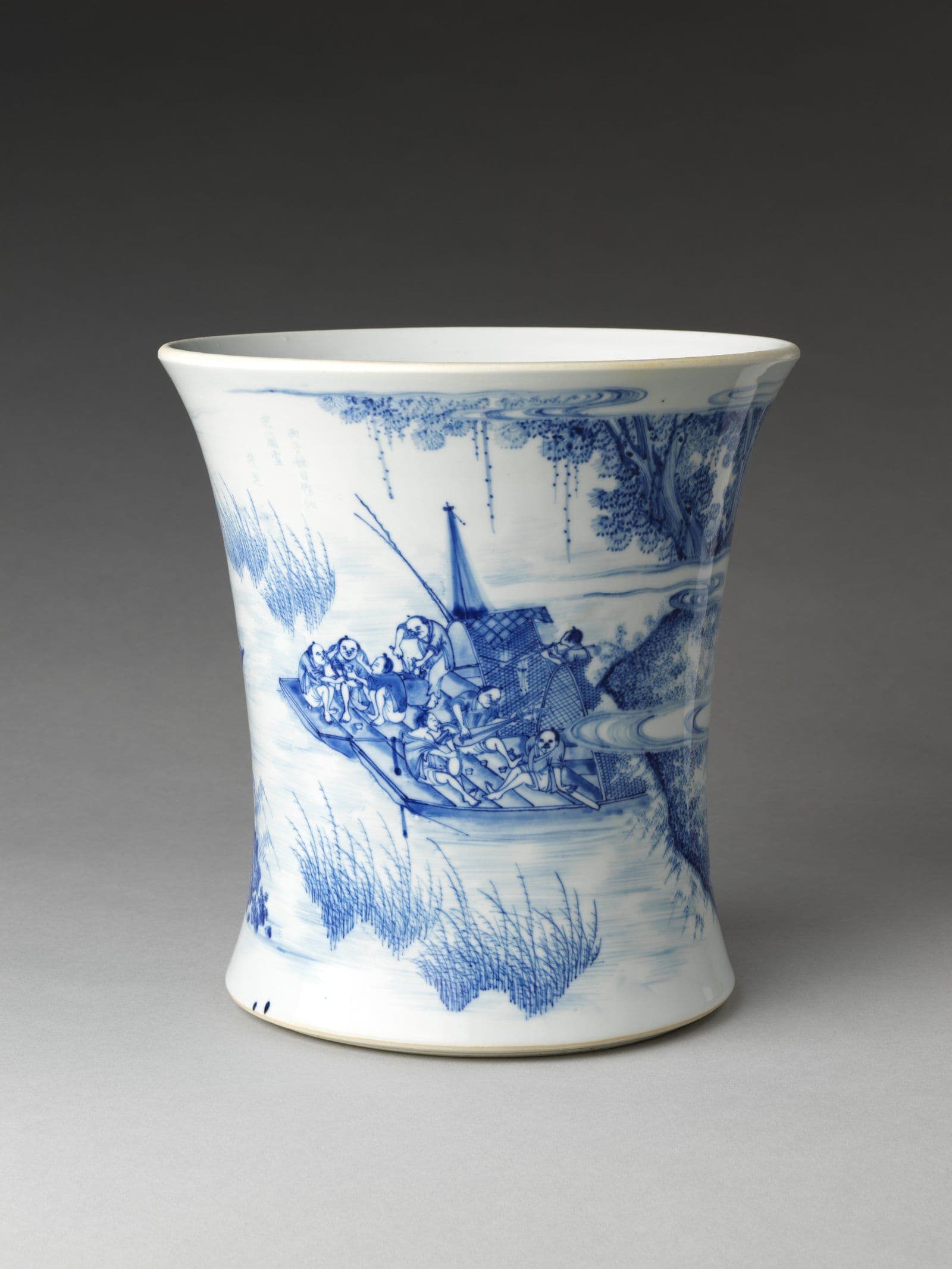
Look closely at the blue on a piece of early Ming porcelain and you may notice something the later, cleaner cobalt lacks: dark, almost blackish flecks concentrated where the color runs deep, sometimes sunk slightly into the glaze so that the surface feels faintly uneven under a fingertip. That effect — collectors call it "heaping and piling" — is one of the tells of the reign that most people mean when they say a blue-and-white is "as good as it gets." That reign is Xuande.
This article explains what makes Xuande blue-and-white the classic Ming benchmark, how to recognize its characteristic look, why the reign matters in the history of the ware, and — most important for anyone buying — why a Xuande mark almost never means a Xuande date.
Why Xuande is the benchmark
The Xuande reign (1425/1426–1435) sits, with the Yongle reign just before it, at the summit of blue-and-white's reputation. The porcelain of these two early Ming reigns became the standard against which later blue-and-white was measured, admired for a combination of strong potting, generous form, and a deep, saturated cobalt that no later period quite reproduced in the same way.
The ware did not appear from nowhere. The technology of painting in cobalt under a clear glaze had already been perfected in the fourteenth century, when the potters of Jingdezhen created the export-scale dishes and monumental vases now recognized worldwide; our guide to Yuan blue-and-white traces that origin. What the early Ming reigns added was imperial refinement — a court standard, tighter control, and a body of shapes and designs that would be copied for the next five hundred years.
The look: cobalt, "heaping and piling," and orange peel
Three physical characteristics do most of the identification work, though none is a guarantee on its own.
- Imported cobalt. The classic early Ming blue is usually attributed to an imported cobalt ore, richer in iron than domestic sources. It fires to a deep, slightly violet-toned blue and tends to break to near-black where it pools.
- Heaping and piling. Because that cobalt was uneven and iron-rich, it concentrates into dark spots and streaks, often with a pitted or sunken quality where it gathers most heavily. This "heaping and piling" is prized as a sign of the period's cobalt — and, precisely because it is prized, it is also imitated.
- Orange-peel glaze. The clear glaze over early Ming wares frequently has a faintly dimpled surface texture, likened to the skin of an orange, visible in raking light.
To read any of these correctly you need a working sense of how cobalt behaves under the glaze in the first place; our history of blue-and-white and the cobalt that made it is the background that turns these tells from jargon into something you can actually see.
Typical Xuande forms include bowls, dishes, stem cups, flattened flasks, and the distinctive "monk's cap" ewer, decorated with dragons, fruiting and flowering sprays, waves, and lotus scrolls. The drawing is confident and fluid rather than fussy.
A turning point for reign marks
Xuande is not only a high point for the ware — it is a hinge in the history of how porcelain was marked. Earlier imperial porcelain was rarely inscribed with a reign mark, as our note on Hongwu and Yongle early Ming wares describes. From Xuande, the six-character reign mark — reading Da Ming Xuande Nian Zhi, "made in the Xuande reign of the Great Ming" — became a standard feature of imperial porcelain.
Xuande is also famous for putting the mark in unexpected places. Where later reigns almost always place the mark on the base, Xuande examples turn up marked on the side, the rim, the interior, or the shoulder — hence the old collector's saying that "Xuande marks appear all over the vessel." Reading the mark itself, character by character, is its own subject; we cover it in the dedicated Xuande reign-marks identification guide, which is the companion to this page.
The copy problem is the whole game
Here is the sentence to keep in mind before you buy anything: the more revered a reign, the more its mark is copied — and no reign is more revered than Xuande.
Because Xuande set the standard, later potters honored it by writing its mark on their own wares. The great Qing reigns of Kangxi, Yongzheng, and Qianlong all produced porcelain bearing an apocryphal Xuande mark, sometimes as sincere homage to a golden age, sometimes to trade on the name. Add centuries of outright forgery aimed at collectors, and the result is stark: the overwhelming majority of pieces carrying a Xuande mark were not made in the Xuande reign.
That does not make the mark useless — it makes it a starting point. The table below sorts what actually helps.
| Evidence | What it tells you ||---|---|| The reign mark alone | Very little about date; it was copied for 500 years || Cobalt tone and "heaping and piling" | Consistent with (not proof of) the early Ming period || Potting, weight, and form | Whether the shape matches known Xuande types || Foot rim and base finish | A strong dating clue; wear, glaze, and cutting all speak || Glaze surface (orange peel) | Supports an early date when present with other tells || Provenance and expert opinion | The decisive factors for anything of value |
Two of these deserve a closer look on their own. The base and foot rim carry a surprising amount of dating information — the way the clay was cut, how the glaze pools at the edge, and how the piece has worn; our guide to reading the foot rim explains how specialists use it. And because the mark is the single most faked element, it pays to know the specific ways a copied or forged mark gives itself away, which is the subject of spotting fake porcelain marks.
The honest position for a collector is humility. A genuine Xuande piece is a museum-grade rarity, and most of what carries the mark is later — sometimes fine and collectable in its own right as a Qing homage, sometimes not. Judge the porcelain, weigh the evidence together, and get a qualified opinion before treating a Xuande mark as a Xuande date.
Yongle, Xuande, and the reality of supply
Collectors often ask how to tell Yongle blue-and-white from Xuande, since the two early Ming reigns are grouped together as the golden age. The honest answer is that it is difficult, and the marks are the crux of it. Yongle porcelain was very rarely reign-marked, so an unmarked early Ming piece of the highest quality is often catalogued simply as "Yongle/Xuande" or "early Ming." Xuande, by contrast, marked freely — which is exactly why so many later and fake pieces borrow its name. The presence of a Xuande mark, then, is as likely to point away from the reign as toward it.
The larger reality is one of scarcity. Genuine early Ming imperial blue-and-white is museum-grade material. The pieces that come to auction with secure attributions are few, heavily studied, and priced accordingly, while the vast majority of "Xuande" pieces on the wider market are later homages or outright copies. For most collectors the sensible path is to learn the look on documented museum examples, treat any market piece bearing the mark with skepticism, and reserve real money for objects backed by expert opinion and a credible ownership history. Enjoying the ware as the benchmark it is does not require owning a fifteenth-century original — and pretending a marked piece is one is the fastest way to lose money in this field.
Common questions
What makes Xuande blue-and-white so prized?
The combination of deep, iron-rich imported cobalt, confident potting and drawing, and the "heaping and piling" effect that later cobalt did not replicate. Together with the Yongle reign, Xuande set the standard for blue-and-white, and its wares became the model that later potters — and forgers — tried to match for centuries.
What is "heaping and piling"?
It is the dark, sometimes near-black concentration of cobalt that gathers into spots and streaks in early Ming blue-and-white, occasionally pitting the surface where the color pools. It results from the uneven, iron-rich imported cobalt of the period and is treated as a hallmark of the early Ming look — which also means it is frequently imitated.
Does a Xuande mark mean the piece is from the Xuande reign?
Almost never. Xuande was so admired that its six-character mark was applied to porcelain for the next five hundred years — as homage in the Kangxi, Yongzheng, and Qianlong reigns, and as deliberate forgery since. The mark is a research starting point to be weighed against cobalt, potting, foot rim, glaze, and provenance, not a certificate of date.
Where is the Xuande mark usually found?
Unusually, in many places. Later reigns almost always mark the base, but Xuande examples are found marked on the side, rim, interior, shoulder, or base — the origin of the saying that Xuande marks appear all over the vessel. The mark's position is one small clue among many, not proof in itself.
Further reading
- Ming Dynasty Reign Marks: A Guide — where Xuande fits in the full sequence of Ming imperial marks.
- Jiajing and Wanli Late-Ming Marks — how imperial marking developed later in the dynasty, after the Xuande benchmark.
- Chenghua Doucai Marks — the other fifteenth-century reign whose wares became a benchmark later potters revered and copied.
Browse the collection
Porcelain is a subject we write about rather than one we stock. What Kiln & Ink sells is paper: limited-edition archival giclée reproductions of the twentieth-century Chinese ink masters, each one hand-numbered and issued with a Certificate of Authenticity.
Explore Further