Published May 12, 2026
Read Chenghua doucai marks like a specialist: the soft palette, the brushwork tells, and why later Qing-period homages are still seriously collectible.
Turn over a small porcelain cup decorated in soft pinks and pale blues and look at the base. If you see six neat characters — 大明成化年製 — what you are almost certainly holding is not Chenghua-period porcelain. The Chenghua reign (1465-1487) produced what specialists consider the most technically refined small wares in the entire imperial canon, and they have been homaged, imitated and forged ever since. Some of those later pieces are themselves serious collector wares. Most are not.
This article gives you a working framework for telling the three categories apart: genuine 15th-century Chenghua doucai, period-respectful homages from later imperial reigns, and modern reproductions made to deceive. None of it will replace a specialist hands-on examination — but it will sharpen what you see before you spend.
What doucai actually is
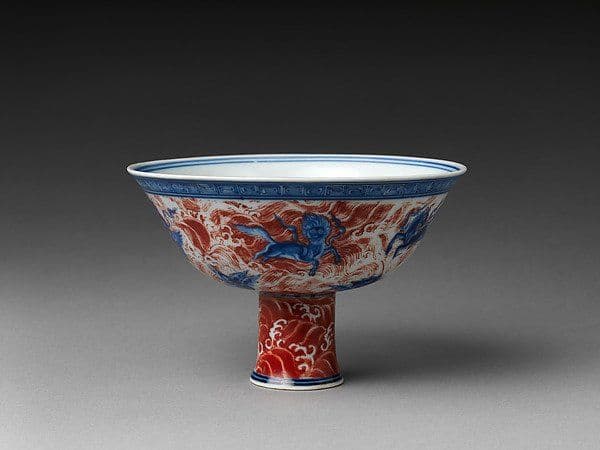
Doucai (鬥彩, "contesting" or "joined" colors) is a two-firing technique. A potter first paints the outline of the design in cobalt blue under the glaze, then fires the piece at high temperature. The result is a ghostly blue-outlined drawing on a pure white body. Coloured enamels — soft red, leaf green, butter yellow, aubergine — are then applied inside those outlines and the piece is fired a second time at a lower temperature to fuse the enamels onto the glaze surface.
This sounds simple. It is not. The cobalt outline has to fire to exactly the right register so the enamels sit precisely inside it. Misalignment by even a millimetre reads as sloppy. The palette has to be soft enough to harmonise with the pale cobalt without overwhelming it. And because the second firing is at a lower temperature, the enamels remain proud of the glaze surface — you can feel them with a fingernail. That tactile difference is one of the first tests a specialist applies.
Doucai existed in embryonic form during the Xuande reign (1426-1435), but it was Chenghua workshops at Jingdezhen that refined the technique into the small jewel-like wares — chicken cups, stem cups, lidded jars — that defined imperial taste for the next four hundred years. For more context on the broader Ming imperial marking tradition that Chenghua sits inside, see our overview of Ming reign marks.
Why Chenghua doucai is the connoisseur's holy grail
Three reasons converge.
The first is scarcity. Chenghua kilns produced relatively small quantities, the wares were small in scale, and breakage over five centuries was high. The catalogued imperial holdings in major museums number in the hundreds, not thousands. Pieces in private hands are vanishingly few, and a fresh-to-market genuine Chenghua doucai is a generational event in the salesrooms.
The second is technical mastery. Chenghua doucai represents a peak of small-format painted porcelain that later Qing imperial wares — even the celebrated Yongzheng and Qianlong falangcai — referenced openly as a benchmark. The cobalt is softer than the deep sapphire blues of the earlier Xuande reign. The enamel palette is famously restrained. The brushwork is fluid rather than draughtsmanlike.
The third is cultural status. Successive emperors and connoisseurs treated Chenghua doucai as the apex of imperial small wares. Kangxi, Yongzheng and Qianlong all commissioned doucai pieces that wore the Chenghua mark not as forgery but as homage — a practice explored in detail in this piece on apocryphal Chinese porcelain marks. The same cultural reverence that drove this homage tradition is what keeps Chenghua-marked pieces in such high demand today.
What the Chenghua six-character mark looks like
The standard imperial mark of the period is six characters arranged in two vertical columns of three: 大明成化年製 ("Made in the Chenghua era of the Great Ming"). It is most often written in underglaze blue regular script (kaishu), occasionally bounded by a double circle or — less often — a double square. The mark sits on the inside of the foot rim, in the centre of the base.
Several visual features distinguish Chenghua-period writing of the mark from the later imperial reigns that copied it:
| Feature | Chenghua period | Common later homage tells ||---|---|---|| Cobalt tone | Soft, slightly washed pale blue | Deeper, more saturated blue (Qing pieces) || Brushwork | Fluid, slightly irregular, almost calligraphic | More mechanical, even, "drawn" feel || Character spacing | Slightly uneven, hand-set | Evenly spaced, jig-laid feel || Frame | Sometimes a slightly wobbly double circle | Crisper geometric circle or no frame at all || Position | Centred but with handworked variation | Often perfectly centred (mechanical) |
None of these alone is conclusive. The cobalt tone in particular varies because the pigment used at Chenghua kilns was already different from Xuande's high-iron cobalt, and the painter's loading of the brush adds further variation. For a fuller character-by-character walkthrough of how to read a six-character mark, see this tutorial on reading porcelain marks.
Four tells of a genuine Chenghua piece versus a later homage
Read these as a checklist a specialist runs in the first thirty seconds of handling a piece.
1. Scale. Genuine Chenghua doucai is almost always small. Chicken cups, stemcups and lidded jars are typical; the cup form sits comfortably in a closed adult hand. A large vase or jar with a Chenghua mark is almost certainly later. The technique was developed for intimate wares.
2. Palette. The signature Chenghua enamel set leans toward soft tonalities — a thin tomato red, a pale apple green, a butter yellow, sometimes aubergine. Later homages — particularly Qing-period — often reach for deeper, more saturated reds and greens that were technically available by the Kangxi era but rarely used in Chenghua's own time. If the enamel reads "rich," it is probably later.
3. Enamel surface. Run a fingernail or a soft probe across the design. Genuine Chenghua enamels sit proud of the glaze with a slight tactile rise. The enamel surface is matte rather than glossy and shows fine crizzling under magnification. Modern industrial reproductions often have a smoother, glassier enamel and lack this tactile rise.
4. The mark's brushwork relative to the painting. The hand that painted the figural design and the hand that painted the mark are usually the same workshop. On a genuine piece both share the same fluid, slightly irregular touch. A common forgery tell is a beautifully painted mark on a piece whose figural decoration is comparatively stiff, or vice versa. This mismatch is one of the most reliable red flags. A wider forgery-detection framework develops this idea across all reign marks.
Why later homages are still collectible
Western collectors new to Chinese porcelain often assume that a Chenghua mark on a Qing-period piece is forgery. It can be — but most Chenghua-marked Qing imperial wares are not deceptions. They are homages.
Imperial porcelain orders during the Yongzheng and Qianlong reigns explicitly requested doucai pieces "in the Chenghua style," and the resulting wares carried the Chenghua six-character mark as a respectful citation of the source tradition. The Yongzheng emperor in particular treated Chenghua doucai as the standard against which his own kilns should be measured. These Qing-period Chenghua-marked pieces can be exceptional in their own right — sometimes technically finer than the originals they reference, sometimes a touch heavier in the palette, but always serious imperial work.
The market reflects this. A confirmed Qing-period doucai with a Chenghua mark is valued on its own merit, not as a failed Chenghua. Yongzheng-marked doucai of the same body and decoration is typically valued higher than its Chenghua-marked Qing equivalent precisely because the Yongzheng mark is the truthful one — but the Chenghua-marked Yongzheng piece is not a forgery and not a discount.
Modern reproductions are a different matter. They tend to fail the four tells above, often dramatically, and they tend to be too large, too saturated, too glossy, and too perfectly centred.
Common questions
Why are so many Chenghua-marked pieces in circulation?
For four centuries imperial Chinese kilns, provincial workshops and (later) commercial potters all produced Chenghua-marked doucai in various honest and dishonest grades. Successive Qing emperors commissioned Chenghua-marked pieces as homage. Republican-era and modern workshops produced commercial copies in large quantities. The result is that for every genuine Chenghua doucai in the wild there are probably thousands of later pieces wearing the same mark. Most of these are not forgeries in the deceptive sense — they are within a longstanding tradition of period reference.
Can I authenticate a Chenghua piece from photographs?
Not reliably. Cobalt tone reads differently under different lights and white-balances; enamel tactility cannot be photographed; foot-rim characteristics need handling. A photograph can rule a piece out — wrong scale, obviously modern enamels, mechanical brushwork — but cannot rule a piece in. For any candidate of genuine interest, plan on hands-on examination by a specialist with comparative material available.
What is the relationship between Chenghua doucai and "chicken cups"?
The chicken cup (鸡缸杯) is a small wine cup decorated with hens, roosters and chicks among rocks and plants, painted in doucai. The form was perfected in the Chenghua reign and became the most copied doucai pattern in the entire imperial tradition. Almost every later imperial reign produced its own chicken cups — Kangxi, Yongzheng, Qianlong, and well into the Republican period. A "Chenghua chicken cup" without further qualification could be from any of these centuries. Provenance and physical examination separate them.
How do I tell a serious homage from a deceptive forgery?
Honest homages tend to be technically excellent, with appropriate weight, well-fired glazes, and confident workshop-level brushwork. They wear the Chenghua mark openly without trying to disguise their later origin — the foot-rim profile, glaze, and palette all read of their actual period. Deceptive forgeries try to fake age: artificial wear on the foot rim, brown staining inside the mark, distressed glaze surfaces. The presence of "trying-too-hard" age signals is itself a forgery tell.
What is a realistic budget to start collecting Chenghua-style doucai?
If you mean genuine 15th-century Chenghua, the floor for an entry piece in major salesrooms is high six figures and the ceiling is well into eight. If you mean honest Qing-period imperial Chenghua-marked doucai, the range is much broader — fine Yongzheng or Qianlong pieces can run from five figures to seven depending on form, condition and provenance. Republican-period commercial doucai can be acquired at three to four figures and is a legitimate way to learn the palette before committing to imperial-tier examples.
Further reading
Qing Dynasty Reign Marks Chart — the eleven reigns whose kilns most often produced Chenghua-marked homages.
Chinese Porcelain Studio and Hall Marks — beyond reign marks, the personal-studio inscriptions that often accompany homage pieces.
Iron Red vs Underglaze Blue Marks — Chenghua marks are almost always underglaze blue, but the contrast with iron-red marking traditions is useful context.
A Complete Reference to Chinese Vase Stamps — the master reference that ties marks across all eras and techniques together.
Browse our Chinese porcelain
Hand-painted Chinese porcelain in the literati and imperial traditions, all honestly marked and clearly described. — a curated entry point for collectors who want to live with the tradition rather than only study it.
Explore Further