Published August 24, 2026
Zhang Boju bought the oldest surviving Chinese calligraphy on paper and the earliest landscape scroll, then handed both to the state. How he did it.
In 1956 a middle-aged man walked into a government office in Beijing and handed over eight scrolls. One of them was a short, damaged piece of paper covered in about eighty-four characters of draft cursive. It is the oldest surviving work of Chinese calligraphy on paper that can be attached to a named scholar. He was given a paper certificate of commendation in return, and he appears to have considered the exchange fair.
This is an account of how Zhang Boju (1898–1982) assembled a private collection that included the earliest Chinese landscape scroll and the earliest named-scholar calligraphy, what it cost him to keep those objects inside China, and why the story matters to anyone who buys Chinese art today.
The banker's son who bought the wrong things
Zhang Boju was born in 1898 in Xiangcheng, Henan, into a family close to the centre of late-Qing and Republican finance. His father, Zhang Zhenfang, was a senior figure in the Salt Industry Bank, one of the major private banks of the period, and Zhang Boju held a directorship there. He had money in the way that made collecting possible, and he had the education that made it interesting: he wrote classical ci poetry, he was a serious amateur of Kunqu and Peking opera, and he took the studio name Congbi.
He is usually counted among the men later nicknamed the Four Lords of the Republic, though the membership of that list varies depending on who is telling it. What is not in dispute is the shape of his spending. Men in his position bought property, or mistresses, or racehorses. Zhang Boju bought paper.
The distinction matters because it explains the pattern of everything that follows. He was not buying investments and he was not buying decoration. He was buying specific objects that he believed should not leave the country, and he kept buying them well past the point where the purchases made financial sense.
What set him off: a horse that left
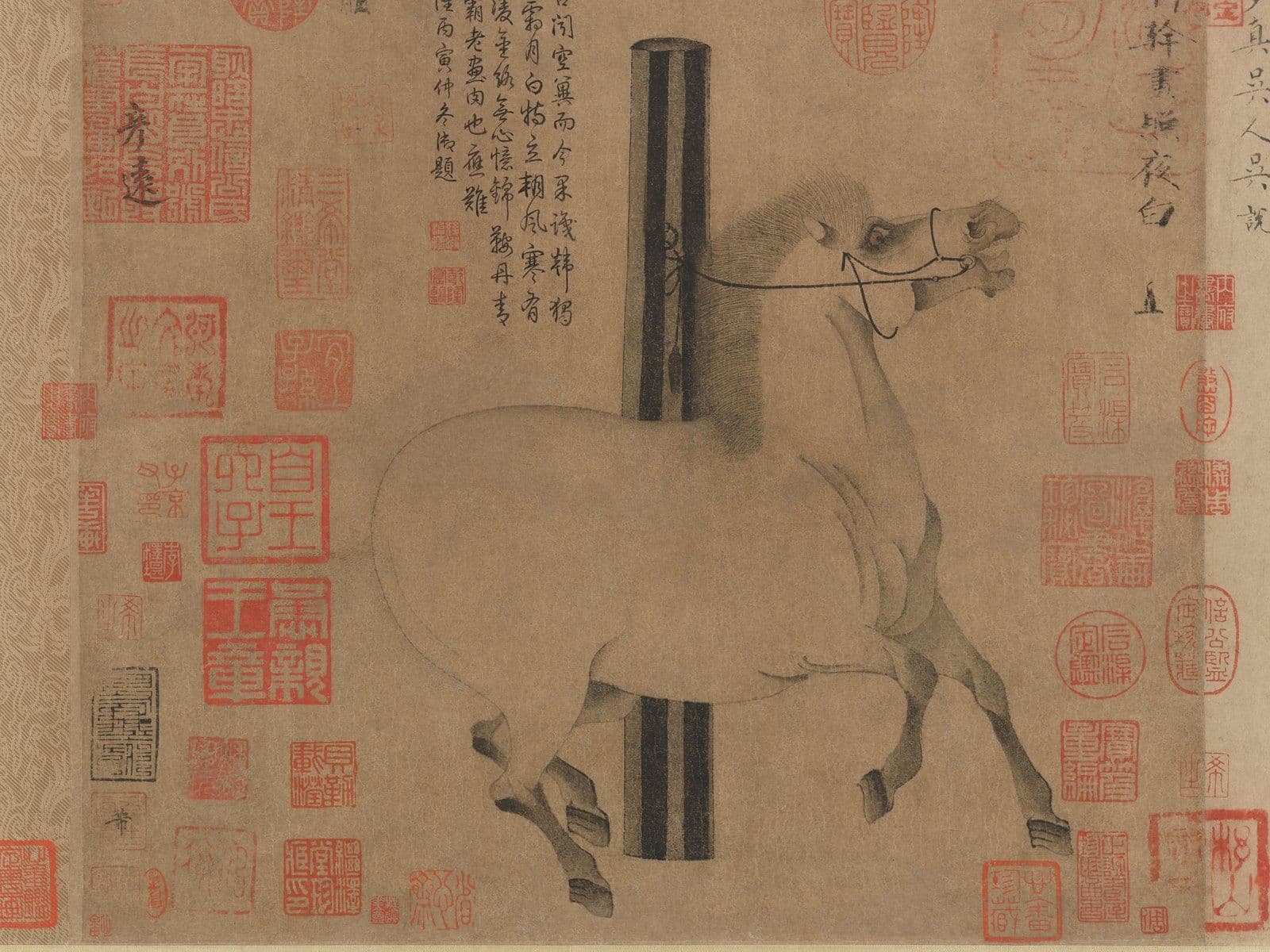
In the 1930s a famous Tang handscroll passed out of the hands of the painter and Qing imperial-clan aristocrat Pu Ru and out of China altogether. The painting was Night-Shining White, attributed to Han Gan and dated to around 750 — a tethered imperial stallion, ears back, rearing against a post, drawn with a line so economical that later Chinese critics used it as the standard for what brush description could do without colour.
It is now in the Metropolitan Museum of Art in New York, accession number 1977.78, acquired by purchase with a gift from the Dillon Fund in 1977. It is a superb painting, beautifully housed, and entirely outside China.
Zhang Boju drew a conclusion from that departure that shaped the rest of his life: if the great objects were going to be sold, someone inside China needed to be at the table with cash. The aristocratic collections were breaking up, the currency was unstable, and dealers with foreign buyers were paying better than anyone else. Understanding how ownership records travel with a Chinese painting helps explain why this period is so visible in modern provenance chains — a great many important scrolls changed hands in a fifteen-year window, and the paperwork from that window is what museums still lean on.
Pingfu Tie, 1937
The scroll Zhang Boju is most identified with is Pingfu Tie, a short letter in draft cursive attributed to Lu Ji, the Western Jin writer and official. It is a small, brown, worn thing. It is also, by common scholarly consent, the earliest surviving piece of Chinese calligraphy on paper that can be tied to a named individual — everything older survives as inscriptions cut in stone or bronze, or as anonymous manuscript fragments.
He acquired it in 1937, from Pu Ru — the same collection that had already let the Han Gan go. Pu Ru's position is worth stating without sneering: an imperial-clan household with no imperial income, holding objects of enormous value and facing bills, is going to sell. What Zhang Boju did was make sure that when it sold, it sold to him. Pu Ru's own painting career, and the strange position he occupied as a Qing prince who became a professional painter, is a useful companion to this story.
Zhang Boju bought it, and then he did the thing that separates him from most collectors: he did not resell it when the price rose.
Kidnapped, 1941
In 1941 Zhang Boju was seized in Shanghai and held for ransom. He was in captivity for roughly eight months.
The demand was for a sum his family could only have raised by selling paintings. The instruction he sent out — repeated in every Chinese account of his life, and the reason he is remembered as more than a rich man with taste — was that the collection was not to be touched. His wife, the painter Pan Su, was left to negotiate and to raise money by other means. He came out alive and the scrolls stayed where they were.
Pan Su (1915–1992) is not a footnote here. She was a serious painter in the blue-and-green landscape manner, she managed the household through the occupation years, and she is a co-signatory on the donations that came later. The collection is properly theirs, not his.
Youchun Tu, 1946, and the house
The second object that anchors his reputation is Youchun Tu, attributed to Zhan Ziqian and dated to the Sui dynasty, around 600. It is the earliest surviving Chinese landscape handscroll: a spring outing, blue and green mineral pigment on silk, figures riding and boating at a scale that finally makes sense against the hills behind them. Almost everything in the later landscape tradition can be argued back to it.
He bought it in 1946. To fund the purchase he sold his Beijing courtyard house.
That is the sentence that gets quoted, and it is worth pausing on rather than admiring. A courtyard house in Beijing in 1946 was the family's principal asset and its physical security in a period when neither the currency nor the government could be relied on. He converted it into a silk handscroll. The blue-and-green idiom that scroll founded ran all the way into the twentieth century — you can see the same mineral palette handled by a modern master in Zhang Daqian's work, and specifically in his blue-and-green landscape, where the pigment does the same job of making distance readable that it does in the Sui scroll.
1956: giving it away
In 1956 Zhang Boju and Pan Su donated eight major works to the state, Pingfu Tie and Du Mu's Zhang Haohao Shi among them. The Ministry of Culture issued a certificate of commendation. There was no commercial transaction of any consequence. Youchun Tu likewise passed into the Palace Museum's holdings in the early 1950s.
Set the numbers aside for a moment, because the numbers are the least interesting part. Zhang Boju spent roughly twenty years and most of a fortune acquiring objects on the explicit understanding that they belonged to a public that had never heard of him, and then he transferred them at the first moment there was a functioning institution to transfer them to.
The Cultural Revolution treated him badly, as it treated most people of his background. He was persecuted, lost his position, and was rehabilitated only late. He died in Beijing in 1982.
What a collector today can take from this
Three things, none of them sentimental.
- Buy the object, not the category. Zhang Boju did not assemble a survey collection. He went after a small number of works that occupied a defensible position — first of their kind, or last of their kind — and ignored the rest. A collection of six things that matter beats sixty that merely qualify.
- Provenance is made, not found. Every scroll he touched now carries his name in its ownership chain, which is part of why those chains are legible at all. When you buy, you are joining a record. The habits that make a record hold up are the same ones experts use when they authenticate a Chinese painting: documented transfer, consistent seals, no unexplained gaps.
- Liquidity is the enemy of a collection. The reason his collection survived intact is that he refused, repeatedly and at real cost, to treat it as an asset that could be sold under pressure. Most collections dissolve not because the owner changed their mind but because a bad year arrived and the paintings were the most saleable thing in the house.
Common questions
What exactly is Pingfu Tie, and why does it matter so much?
It is a short letter in zhangcao, or draft cursive, attributed to the Western Jin writer Lu Ji, written on paper. Its importance is structural rather than aesthetic: older Chinese writing survives as bronze inscription, stone carving, or anonymous manuscript, so Pingfu Tie functions as the earliest fixed point where a named scholar's hand on paper can be studied directly. Every argument about how brush technique developed before the Tang has to go through it.
Did Zhang Boju make money from collecting?
No, and that appears to have been deliberate. He bought at the top of the market, funded purchases by selling property, and then donated the most valuable works to the state in 1956 in exchange for a commendation certificate. Judged as an investor he was a disaster. Judged by his own stated aim — keeping specific objects inside China and in public hands — he succeeded completely.
Where can I see these works now?
Pingfu Tie and Youchun Tu are both in the Palace Museum in Beijing. Neither is on permanent display; works on paper and silk of that age are shown rarely and briefly. Night-Shining White, the Han Gan painting whose departure prompted his collecting, is in the Metropolitan Museum of Art in New York and is likewise rotated.
Was Pan Su a collector or a painter?
Both. She was a professional painter working in the blue-and-green landscape tradition, and she is named alongside her husband on the 1956 donation. Chinese accounts of the 1941 kidnapping credit her with holding the collection together while refusing to sell it, which makes her a custodian of the collection in the most literal sense.
Further reading
- How to Read a Chinese Handscroll — the physical format both Pingfu Tie and Youchun Tu take, and how it is meant to be unrolled.
- Collecting Chinese Calligraphy — how to approach the category Pingfu Tie sits at the head of.
- Chinese Painting Copies: Mo, Lin, Fang — why the tradition treats faithful copying as mastery rather than deception.
- How to Buy Chinese Art at Auction — the modern version of the table Zhang Boju kept sitting down at.
Browse the collection
Our limited-edition prints are made from works by the twentieth-century masters who inherited the tradition Zhang Boju spent his life protecting — browse the full collection.
Explore Further