Published August 3, 2026
A collector's guide to Xu Beihong: the Paris training, the galloping horses, what the market pays for, and how to check a work before you buy.
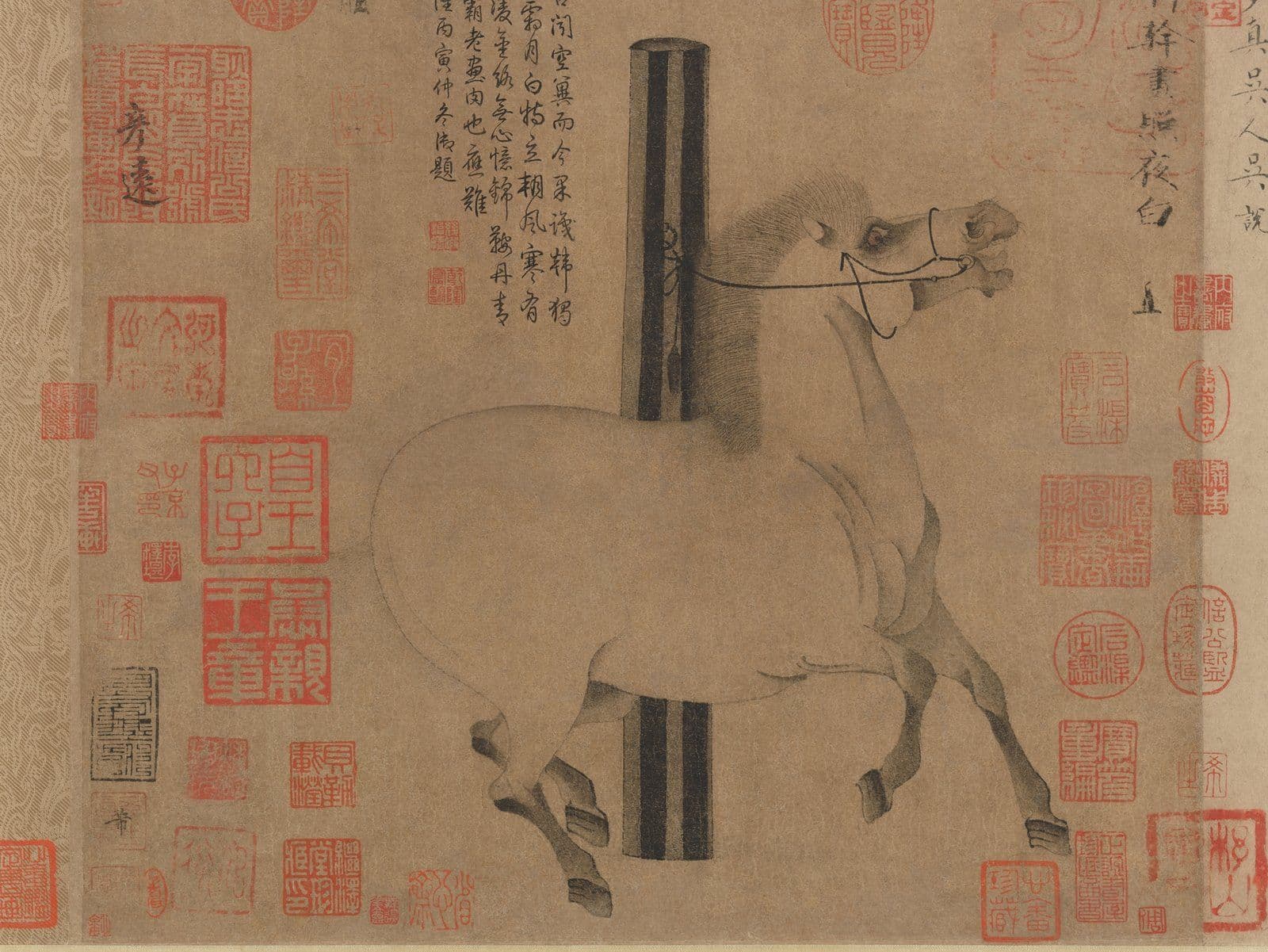
Look closely at the hind leg of one of the famous ink horses and you will see something that does not belong to classical Chinese painting. The muscle is in the right place. The hock bends the way a real hock bends, and the weight of the animal is distributed across the ground rather than floated on the paper. That anatomical correctness, carried by a brush loaded with wet ink, is the whole argument of the artist's career compressed into one limb.
This guide sets out who Xu Beihong was, why the horses became the signature and what else he painted, how the market grades his work, and what a buyer should actually examine on a sheet offered under his name.
Paris, and the argument he brought home
Xu Beihong (1895–1953) came from Yixing in Jiangsu, learned to paint from his father, and left for Europe as a young man. He spent much of the 1920s in Paris, studying at the École nationale supérieure des Beaux-Arts and drawing from casts and from the live model in the academic manner — years of anatomy, proportion and tonal modelling.
He came back with a position, not just a technique. Chinese painting, he argued, had drifted into the endless copying of earlier masters; what it needed was the discipline of drawing from life. He never proposed abandoning ink for oil. He proposed putting Western structural drawing underneath the Chinese brush, and he spent the rest of his life demonstrating that this could be done without the result looking like a hybrid.
That teaching position matters to collectors because it made him an institution builder as much as a painter. He taught widely, ran art departments, became the first president of the Central Academy of Fine Arts in Beijing after 1949, and headed the national artists' association until his death in 1953. Several generations of Chinese painters passed through the system he shaped, which is one reason works by his students and imitators circulate so freely.
The subjects, in order of how often you will meet them
| Subject | Why he painted it | What to look for ||---|---|---|| Horses | Freedom and, during the war years, national resilience | Anatomy under the ink; dry-brush mane and tail; one-pass tonal washes || Lions and eagles | Awakening, vigilance — read as wartime allegory | Structural drawing of the skull and shoulder || Oxen, roosters, cats, sparrows | Domestic subjects, often as gifts | Economy; correct weight and stance || Figures and history paintings | The formal ambition; large multi-figure compositions | Composition built from life studies |
The large narrative works — subjects drawn from Chinese history and legend, executed on a scale unusual for the period — are where his academic training is most visible. They are also almost entirely in institutional hands, which is why they rarely inform what a private collector sees on the market. Most of what circulates is animal subjects on paper, and among those, the horses dominate. We looked at the animal symbolism in more detail in Xu Beihong's lion paintings.
Why the horses became a national image
Xu Beihong drew horses obsessively, from life and from memory, and by the 1930s he had reduced them to a method: a few wet strokes for the neck and body, ink allowed to bleed at the edges to suggest muscle, the mane and tail dragged out with a splayed, half-dry brush, the legs drawn with quick, exact lines.
What makes the method hard to copy is that it is unforgiving. Absorbent paper takes ink instantly and gives nothing back; a stroke that lands in the wrong place cannot be lifted or painted over, only disguised. So a genuine horse tends to show a small number of decisions executed at speed, with the tonal range built into a single loaded brush rather than assembled afterwards. Copies are usually slower, and slowness leaves marks — patched edges, flat washes, hesitation at the point where a line changes direction.
Then the war gave the image a meaning. Through the late 1930s and 1940s he exhibited abroad and raised funds for relief, and a galloping horse — unbridled, straining forward, painted by an artist who had refused to sit out the period quietly — was read at the time as a picture of the country's will to keep going. That reading has stuck. It is also why so many horses were painted and, subsequently, forged. Our catalogue entry for Galloping Horses describes the composition and how the edition is made.
What a buyer should examine
Xu Beihong is copied more than almost any other twentieth-century Chinese painter, and the copies range from crude to genuinely difficult. Work through the object in this order:
- The drawing under the ink. This is the hardest thing to fake. Weak copies get the silhouette and lose the skeleton — legs that could not carry the body, a chest that does not connect to the shoulder.
- Ink behaviour. His washes were laid quickly on absorbent paper and left alone. Look for a single confident pass with tonal variation inside it, not a shape built up by patching and correcting.
- The dry-brush passages. Mane and tail should show separated hairs from a splayed brush, with the paper visible between them. Painted-in hair strokes are a bad sign.
- Signature, inscription and seals. Compare against published examples, and read the inscription for internal sense — a dedication to a named recipient, a cyclical date, wording consistent with the occasion. Seals and collector marks sets out how the impressions work.
- Paper and mounting. Sheet size, fibre and the history of the mount all carry information; heavy remounting can hide as much as it repairs.
- Provenance. Exhibition history, publication in a catalogue, or a chain back to a known collection is worth more than any single visual judgement.
If the seller cannot answer questions two through six, you are being asked to buy on the strength of the silhouette alone. The general sequence a specialist follows is set out in how experts authenticate Chinese paintings.
What the market pays for
Prices for Xu Beihong spread across an unusually wide range, because the name covers everything from a quick ink sketch given to a friend to a museum-grade wartime composition. Four things move the number:
- Subject. Horses lead, and among horses a single galloping animal or a group in motion outperforms a standing study. Lions and eagles follow. Domestic subjects — roosters, cats, sparrows — sit lower, which makes them the sensible place to start if you want an original rather than an edition.
- Date and circumstance. Works from the late 1930s and 1940s carry the wartime association that gives the horses their weight, and pictures with a documented exhibition or fundraising history are valued accordingly.
- Inscription. A long inscription naming a recipient and an occasion does two things at once: it adds biographical interest and it creates a checkable fact. A bare signature offers neither.
- Scale and condition. Large finished works on good paper, with intact margins and a sound mount, are a different market from small studies with foxing and trimmed edges.
There is also a category worth naming plainly: works by his students and by later painters trained in his method. Many are accomplished pictures. Some were signed in ways that later became convenient for the trade. If a horse painting is close to his manner but the price is far below the name, that gap is telling you something about what the seller believes.
Editions, prints and the honest middle ground
A large share of the Xu Beihong images in circulation are reproductions rather than paintings — published plates, posters, later print editions. That is not a problem in itself. It becomes a problem when the description is vague, when "after Xu Beihong" quietly becomes "by," or when a print is priced as if it were ink on paper.
Under magnification a printed image usually gives itself away: a regular dot structure, ink sitting on top of the sheet rather than sunk into it, an even edge where a brush would have left a ragged one. Buy prints as prints, at print prices, from sellers who say so plainly. It is a reasonable way to live with an image while you learn the market — and the discipline of only buying what is clearly described is the same discipline you will need later at a higher price point. The long-standing tradition of learning through copying, and where it shades into misrepresentation, is covered in the Chinese copying tradition.
Common questions
Are all Xu Beihong horses done in ink?
Most of the ones you will encounter are ink and light colour on paper, but he also painted horses in oil and made large numbers of preparatory drawings. Oils by him are far rarer on the market than ink works and belong in a different price and diligence category.
Why are there so many horse paintings attributed to him?
Three reasons compound: he genuinely painted a great many; the motif is nationally beloved, so demand never softens; and the method looks deceptively simple to imitate. Volume plus demand plus apparent simplicity is the standard recipe for a crowded field of fakes.
What did his Western training actually change?
The structure, not the surface. He kept Chinese materials, formats and brush conventions, and put life drawing and anatomy underneath them. The clearest test is to cover the ink effects and ask whether the animal beneath would stand up.
Where can his major works be seen?
The largest concentrations are in Chinese public collections, including the memorial museum in Beijing built around the works his widow preserved and donated. Seeing the major pictures in person is the cheapest authentication training available.
Further reading
- Literati painting versus court painting — the tradition he was arguing with.
- Silk versus paper in Chinese paintings — how the support changes what the brush can do.
- How to read a Chinese painting inscription — dates, dedications and what they commit the painter to.
- Ren Bonian and the Shanghai School — the generation of figure painting he inherited.
Browse our ink paintings
Modern hand-finished editions after the twentieth-century masters, each described for exactly what it is. See the collection.
Explore Further