Published August 18, 2026
A collector's guide to Wu Changshuo: the Stone Drum line behind his brushwork, the subjects he returned to, and what to check before buying a work.
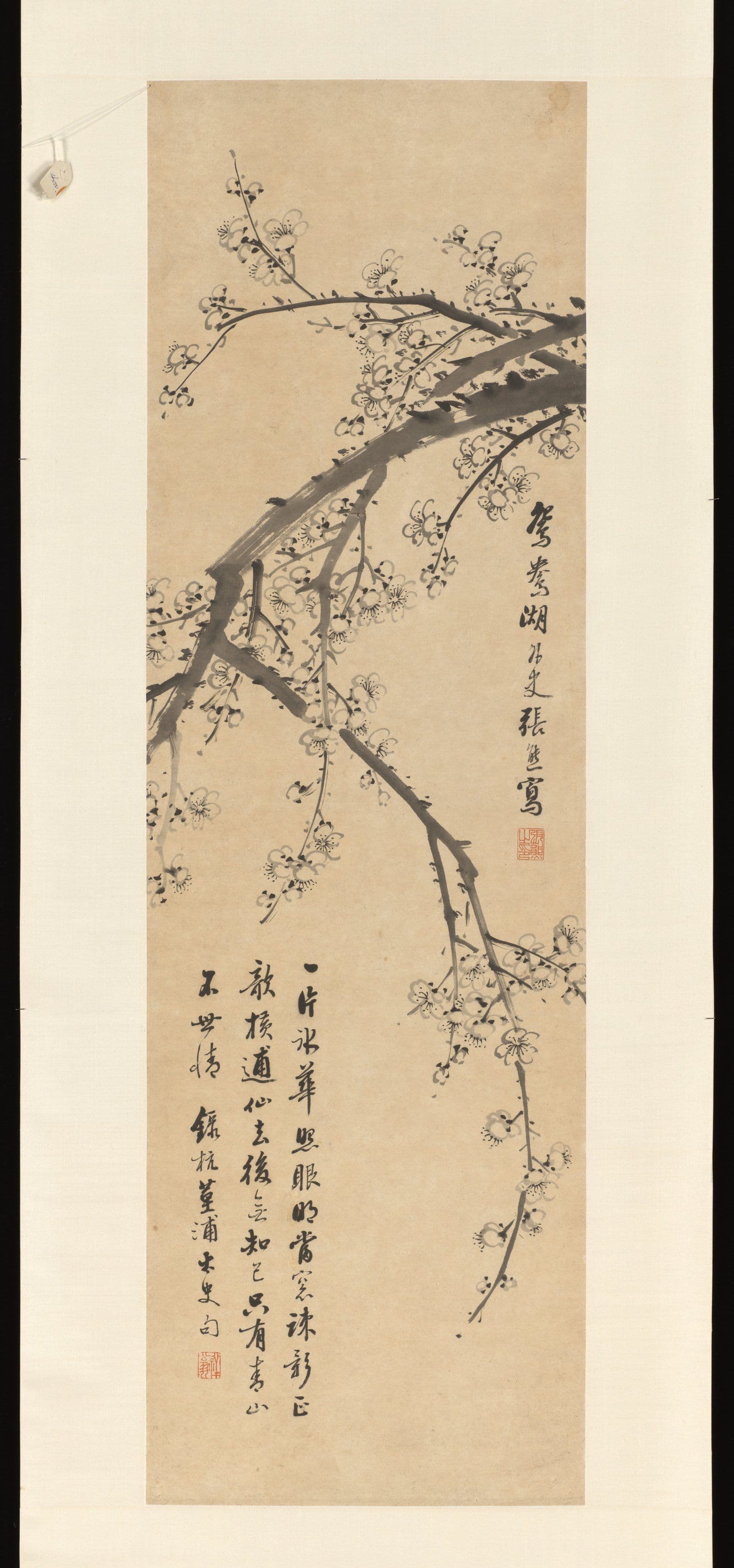
Look at a Wu Changshuo plum branch and the first thing to register is not the blossoms but the pressure. The line goes down wet and heavy, changes direction without lifting, and breaks into a dry, splintered edge where the brush ran out of ink halfway through the stroke. That stroke was not invented at the painting table. It came out of decades spent copying an archaic stone inscription, and it is the most useful single fact about him.
This guide sets out what Wu Changshuo actually did — seal carving first, calligraphy throughout, painting last — how those three practices resolved into one recognisable hand, and what to examine before buying anything that carries his name.
The order of the practices explains the pictures
Wu Changshuo (1844–1927) was born in Anji, in northern Zhejiang, and worked through the closing decades of the Qing into the early Republic. He is routinely called the last of the literati painters. That label is worth keeping only if you read it as a statement about training rather than sentiment.
He began as a seal carver and calligrapher. Painting came late, in middle age, after his standing in the other two disciplines was already secure; the Shanghai painter Ren Bonian is generally credited with pushing him into it. Nothing about that sequence is ordinary, and it accounts for most of what a collector sees.
A painter who arrives through the knife and the inscription does not assemble a picture the way an academy-trained painter does. He does not draw an outline and fill it. He writes the plant. Each stroke is a complete gesture with a beginning, a turn and an exit, and it cannot be corrected afterwards. The blossoms in his plum paintings are punctuation on a line that was already doing the work.
He also kept the literati habit of refusing the career. He held a minor official post briefly and abandoned it almost immediately, then supported himself by selling seals, calligraphy and eventually paintings — a professional artist with a scholar's training, which is precisely the position the Shanghai art market of his lifetime made possible.
Recognition arrived at the other end of his life. The Xiling Seal Society, founded in Hangzhou in 1904 and still the most serious institution in Chinese seal carving, made him its first president. He signed himself with studio names a collector meets constantly on his work — Fulu and Laofou among them, both built on the character for an earthenware jar.
Stone Drum script and the metal-and-stone brush
The technical centre of his art is a set of inscriptions carved on ten stone drums, in an archaic seal script older than the standardised writing of the Qin empire. He copied them for most of his adult life, not as an exercise but as a daily practice, and his versions became progressively less like careful reproductions and more like his own writing. That long apprenticeship to a single inscription is treated at length in our piece on Wu Changshuo and Stone Drum calligraphy.
What he took from it was a quality of line: even in width, slow, weighted, with a slight tremor that reads as stone rather than paper. Chinese criticism calls this the jinshi — metal-and-stone — manner, meaning brushwork carrying the character of bronze inscriptions and carved stone rather than the fluent, tapering line of classical calligraphy.
Carried into painting, that line does three things you can look for directly:
- Stems and branches are written, not drawn. A wisteria vine or plum branch is one continuous weighted stroke with visible speed changes, not a contour with shading inside it.
- Dry brush appears at the end of strokes, not as decoration. Because he loaded the brush heavily and did not reload mid-gesture, the split, streaked texture falls where the ink ran out. It should look consequential, not applied.
- Colour sits on top of structure. He used strong reds and mineral pigments freely, but they are laid over an ink armature that would still read as a picture if the colour were removed.
His seal carving belongs to the same project. He worked in an archaic register drawn from Han-dynasty seals and the same epigraphic sources, cutting characters that sit slightly irregularly in the field rather than filling it mechanically. If you want to see how one artist's line survives a change of tool, his seals and his branches are the clearest case in modern Chinese art.
The subjects, and why the compositions lean
He painted a narrow set of subjects repeatedly: plum, wisteria, peony, lotus, chrysanthemum, pine, gourds and loquats. This is the traditional flower-and-plant repertoire, and the narrowness is the point — the interest lies in the handling, not the inventory.
The compositions are what make them identifiable across a room. He tends to drive a major diagonal from one corner, let it cross most of the sheet, and stop it hard against an edge. Weight collects in one part of the picture and the rest is left open. Inscriptions are not captions tucked into a corner; they are structural, often a long column of his own calligraphy balancing a mass of ink on the opposite side.
That integration of text and image is the literati inheritance, and it has a practical consequence for buyers: on a genuine work the inscription and the painting should look like one performance. Where the writing feels like a different hand's afterthought, something is wrong.
His influence ran directly into the next generation. Qi Baishi was open about his debt, and Pan Tianshou built a monumental style on a comparable structural logic. Reading Wu Changshuo first makes both of them legible.
Market and authentication
He is among the most heavily reproduced and imitated Chinese artists, for the obvious reason that a bold single-branch composition looks easier to fake than a crowded landscape. It is not easier — but it looks it, and the market carries a great deal of weak material.
Before buying anything attributed to him, work through this:
- Read the line for pressure, not shape. Copyists reproduce the silhouette of a branch and lose the internal speed. Look for a stroke that changes weight along its length and exits dry. A uniformly wet, even branch is a warning.
- Check the inscription against the painting. Same ink tone, same brush character, same confidence. Hesitant or over-neat calligraphy attached to loose painting is the commonest tell.
- Treat seals as corroboration, not proof. His seals were cut by a master carver and carry his line quality; they were also copied extensively. A seal that is too crisp, too centred and too even is suspect. A seal alone never authenticates a painting.
- Ask what the paper and mounting have done. Genuine early twentieth-century works have aged, been remounted, and usually show it. Uniform, even toning across a sheet often means artificial ageing.
- Insist on provenance in writing. Publication history, exhibition record, or a documented chain of ownership carries more weight than any single visual judgement, and at this level it is a reasonable thing to ask for.
For original works, an opinion from a specialist in modern Chinese painting is not optional. The gap between a genuine work and a period copy is wide enough that the cost of a consultation is trivial against it.
If you are buying a reproduction rather than an original, the questions change entirely: what matters is that the edition is stated and limited, the sheet is numbered by hand, the paper is archival, and the seller documents what the object is. A print that is honest about being a print has nothing to hide.
Common questions
Why did Wu Changshuo start painting so late?
Because painting was, in his training, the last of the three disciplines rather than the first. He established himself as a seal carver and calligrapher and only took up painting seriously in middle age. Far from being a handicap, the sequence produced the thing he is valued for: a painter's image built entirely out of a calligrapher's line.
What is Stone Drum script, and why does it matter for his paintings?
It is an archaic form of seal script preserved on ten inscribed stone drums, older than the unified writing of the Qin. Wu Changshuo copied it for decades, and the weighted, slightly trembling line he developed there is the same line that appears in his branches and stems. Understanding this is the fastest way to separate his hand from an imitator's.
How do I tell a genuine work from a period copy?
Start with line quality rather than composition, since compositions are the easiest thing to copy. Look for pressure changes within a single stroke and dry-brush breakup at the end of gestures. Then check that the inscription looks like the same hand on the same day as the painting. Then look at provenance. Seals should confirm a conclusion you have already reached, never produce one.
What is the connection between Wu Changshuo and Qi Baishi?
Qi Baishi belonged to the following generation and openly acknowledged Wu Changshuo's influence on his development. Both built pictures from calligraphic strokes and worked a limited repertoire of plants, insects and everyday subjects hard rather than pursuing range. If you are collecting either, reading the other clarifies what you are looking at.
Is his work a reasonable place to start collecting modern Chinese painting?
His work is central to any account of the period, which is exactly why the market around him is difficult. For a first purchase, most collectors are better served by a well-documented limited-edition reproduction, or by an original bought through a specialist with the provenance written down. Neither route is a compromise; both are how careful collections actually get built.
Further reading
- Wu Changshuo's Flower Paintings and the Seal Carver's Line — the painting practice examined subject by subject.
- Wu Changshuo and Stone Drum Calligraphy — the inscription he copied for a lifetime, and what it did to his brush.
- Chinese Seal Carving: A Collector's Guide — the discipline he began in and later presided over.
- Qi Baishi: A Collector's Guide — the artist of the next generation who acknowledged his debt most directly.
Browse the collection
Wu Changshuo is one of the fifteen artists on the Kiln & Ink roster, and his lotus paintings show the weighted, epigraphic line described above about as clearly as anything he made. What we sell is paper: limited-edition archival giclée reproductions of the twentieth-century Chinese ink masters, each hand-numbered and issued with a Certificate of Authenticity.
Explore Further