Published August 15, 2026
Chinese seal carving explained: the four famous stones, how knife work is judged, which schools matter, and what to check before buying a seal.
Chinese Seal Carving: Stones, Schools and How to Collect
Turn a carved seal on its side before you look at its face. On the flanks, in characters sometimes only a couple of millimetres tall, the carver often left the paperwork: a signature, a date, occasionally the name of the friend the stone was cut for. Chinese seal carving is the rare art that documents itself — the face of a seal tells you who owned it, while the side tells you who made it, and connoisseurship starts with knowing which surface to trust.
This guide covers the art from the collector's side of the table: how carving stone became a scholar's own art in the Ming dynasty, the four famous stones and how they differ, the schools and knife manners you will hear invoked in catalogues, and what actually moves value when a seal comes up for sale.
When soft stone made a literati art
For most of Chinese history, seals were made for scholars, not by them. The materials of early sealmaking — jade, bronze, silver, ivory — are hard, and cutting them was artisan work: the owner might compose the text, but a professional executed it.
The change came in the Ming, when soft stones — workable with a hand-held knife and no special strength — entered the studio. The traditional founder figure is Wen Peng, son of the great painter Wen Zhengming, and tradition credits him with establishing Qingtian stone as the literati carver's material. Whatever the exact sequence, the consequence is not in doubt: from the sixteenth century onward, the designing hand and the cutting hand could belong to the same person. Seal carving became the "iron brush," and settled in beside poetry, calligraphy and painting as the fourth of the scholar's arts.
The script that carvers cut is, overwhelmingly, seal script — the archaic hand explained in the zhuanshu guide — which is why the art and the script share a name in English. Carving a seal means composing ancient character forms into a few square centimetres, then cutting that composition with conviction.
The four famous stones
Seal stones are named for where they come out of the ground, and each name covers a family of grades rather than a single look.
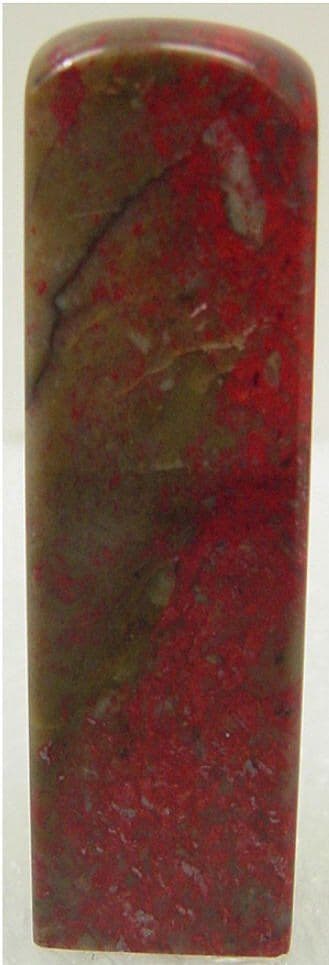
| Stone | Region | What collectors say ||---|---|---|| Shoushan | Fujian | A vast family of colours and textures; its yellow field-stone, tianhuang, is the most storied of all seal materials || Qingtian | Zhejiang | The carver's stone — crisp and clean under the knife; the translucent "light-penetrating" freeze grades are prized || Changhua | Zhejiang | Home of chicken-blood stone, streaked with cinnabar red; judged by the colour's intensity and distribution || Balin | Inner Mongolia | The twentieth-century arrival; a softer temperament and gentler prices |
Two cautions belong in the same breath. First, stone names are families, not guarantees — an ordinary Shoushan pebble and a fine tianhuang share a family name and almost nothing else. Second, treatments are everywhere: dyeing, oiling, waxing and resin repair all exist, and a stone that looks exactly like its most flattering photograph deserves a second look in the hand.
It also helps to know that two markets share this one object. Stone-first collectors buy material — colour, translucency, figure — and treat the carving as incidental. Carving-first collectors buy the knife, and treat the stone as the canvas. Prices make sense only once you know which market you are standing in.
Schools, knives and the masters you will hear named
Catalogue notes for seals lean on a genealogy of schools, and it is worth knowing the main branches.
The Zhe school, founded in Hangzhou by Ding Jing in the eighteenth century, cut with the qie manner — short, stacked, interrupted bites of the knife that leave an edge like weathered stone. Ding Jing and his followers are remembered as the Eight Masters of Xiling, and their deliberately archaic surfaces set the taste of a region.
The rival line runs through Deng Shiru of Anhui, who brought his own powerful seal-script calligraphy into the stone — the principle that the seal should come out of the writing, not out of other seals. Zhao Zhiqian, in the nineteenth century, widened the sources further, drawing character forms from coins, mirrors and stele capitals.
Then come the two names every collector knows. Wu Changshuo fed a lifetime of Stone Drum script practice into blunt, weathered, monumental cutting; the Xiling Seal Society, founded in Hangzhou in 1904 as the art's great institution, made him its first president. Qi Baishi, who had begun working life as a carpenter, cut with famous directness — long single-pass strokes, minimal retouching, an edge that keeps the speed of the hand that made it. In both cases the carving and the painting are one practice: the wrist that cut the stone is visible in Wu Changshuo's painted flowers, and the same is true in reverse.
Reading a carved seal
Start with the face. Characters cut in relief print red on paper and are called zhuwen; characters cut in intaglio reserve themselves in white against a red field and are called baiwen. Neither is better; carvers chose for balance, and paired seals often alternate the two. How those red and white squares behave once stamped on paintings is its own subject — the guide to reading painting seals covers it.
Then the knife. A push-cut line travels long and committed; a cut-cut line accumulates in short bites; a fine seal keeps one manner under control rather than wandering between them. Look at the edges of the stone face, too — carvers often deliberately bruise or break the border so the impression reads as aged and the composition breathes. That damage is design, not damage.
Then the sides. The biankuan — side inscription — is where the carver signs, dates and dedicates, in tiny regular, running or clerical script. Connoisseurs take ink rubbings of the sides exactly as they do of bronzes, and a seal's side inscription is its provenance document, subject to the same skepticism as any signature. The matching workflow — photograph the impression, orient it, compare against published references — is the one laid out in the step-by-step seal identification guide.
Finally, the impression record. Carvers' work was collected into yinpu — seal albums, stamped or printed compendia of impressions — and a published album is the reference set attribution lives or dies on. A seal whose impression matches a documented album entry has a biography; one that merely resembles a famous manner has a genre.
What moves value — and the traps
Observed across the market rather than decreed: the carver's identity usually outweighs the stone, the stone outweighs generic age, and documentation outweighs both. A plain Qingtian stone cut by a documented master will generally be chased harder than a handsome but anonymous tianhuang; a seal with a published impression and a credible side inscription stands apart from an identical-looking orphan. Dedications add history when the recipient is identifiable; condition matters at the corners, where chips gather, and on the face, where later re-polishing kills the crispness a knife once left.
The traps mirror the values. Old stones get re-cut with famous names added; genuine carvings acquire spurious side inscriptions; "chicken blood" gets manufactured with dye and resin; composite stones wear convincing skins. The discipline is the same as everywhere in this field: buy the impression, not the anecdote. Match against published references, treat undocumented attributions as decoration, and let the object outrank its story.
It is also worth saying plainly that this is a living art. The Xiling Seal Society still stands in Hangzhou, and contemporary carvers cut to a standard the tradition would recognize. At the entry level, a well-cut modern seal — judged on the quality of its cutting rather than a borrowed name — is one of the saner ways into the field.
Common questions
What script are most Chinese seals carved in?
Seal script — the archaic forms standardized before and during the Qin unification — remains the default, which is why reading a seal often requires a dictionary even for fluent readers of modern Chinese. Carvers also work in clerical and other hands, especially on side inscriptions, but the face of a classical seal usually speaks zhuanshu.
Which seal stone is the most valuable?
Tianhuang from Shoushan and fine chicken-blood from Changhua are the storied materials, and top grades of both are treated as treasures in their own right. But the carver usually outweighs the stone: a documented master's work on ordinary material tends to outrun anonymous work on precious material. Treatments and imitations cluster around exactly the famous stones, so material claims deserve the most skepticism where they promise the most.
How can I tell who carved a seal?
The side inscription is the first witness — carvers sign and date there — but it is a witness to be cross-examined, since inscriptions can be added later. The stronger evidence is the impression record: match the seal's impression and its cutting manner against published seal albums and documented works. No match, no documentation, no chain of ownership: then you have an attribution, and it should be priced as one.
Are seals by living carvers worth collecting?
Yes, on the merits of the cutting. The tradition is unbroken — the societies, the training and the scripts are all alive — and a contemporary seal is judged the way an old one should be: composition, knife control, edge quality, the fit of script to stone. It is also the corner of the field where what you pay for is most likely to be exactly what you get.
Further reading
- Collector Seals and Marks on Chinese Paintings — how generations of owners stamped a painting's biography onto it.
- Qi Baishi: A Collector's Guide to Subjects, Seals and Fakes — the painter whose knife manner reset the art.
- Collecting Chinese Calligraphy — the wider paper-and-ink discipline the seal world sits beside.
Browse the collection
Seal stones are a subject we write about rather than one we stock. What Kiln & Ink sells is paper: limited-edition archival giclée reproductions of the twentieth-century Chinese ink masters — the seal-carvers Wu Changshuo and Qi Baishi among them, including Wu Changshuo's Flowers — each hand-numbered and issued with a Certificate of Authenticity, at the collection.
Explore Further