Published August 26, 2026
Kesi silk tapestry explained: how the cut-silk weave is built bobbin by bobbin, why the court prized it above embroidery, and how to judge a panel.
Hold a piece of kesi up to a window and the first thing you notice is light leaking through in short, broken lines. The gaps run exactly along the boundaries between colors — the rim of a peony petal, the edge of a dragon's claw — as if the design had been incised into the silk with a blade. The name says as much: kesi is usually translated as "cut silk" or "carved silk," although nothing is ever cut. Those slits are a fingerprint of the loom, and they are the fastest way to separate true kesi from everything that imitates it.
This guide walks you through what kesi actually is, how a panel is woven bobbin by bobbin, how to tell it from embroidery and brocade in under a minute, where the great pieces sit in Chinese history from the Song court to the last dragon robes, and what to check — slits, fading, painted shortcuts — before you trust a textile offered under the name.
What kesi is
Kesi is silk tapestry. The loom carries plain, undyed silk warps, and the entire image is built from colored wefts — but unlike ordinary weaving, no weft thread ever travels the full width of the cloth. Each color is worked back and forth only inside its own patch of the design, wound on its own miniature bobbin. Chinese writers compress the whole method into four characters: tongjing duanwei, "the warp runs through, the weft is broken."
Because every color area is self-contained, a narrow vertical gap opens wherever two colors meet along a warp thread. Weavers managed these slits deliberately — leaving them open where they sharpen an outline, interlocking or dovetailing adjacent colors where strength matters, and sometimes stitching the longest ones closed after the panel came off the loom.
Two consequences of this structure matter to a collector. First, the image is structural: the design is the fabric itself, not decoration applied to a finished ground. Second, kesi is genuinely double-sided. Front and back carry the same image in mirror form, with no untidy reverse of knots and trailing threads. If a seller will not show you the back of a "kesi" panel, treat that as an answer in itself.
How a panel is woven
The weaver begins with a painted design — a cartoon — fixed beneath the stretched warps, and traces its outlines directly onto the threads in ink. Then the slow work starts. A panel of any complexity needs dozens of bobbins in play, one for each color, each filling in its own island of the pattern a few threads at a time. Fine passages — a face, a bird's eye, the gradations inside a flower — slow the pace further still.
That pace is the economic fact underneath everything else about kesi. A skilled weaver covers only a few square inches on a good day, and a complex panel represents months at the loom. The old trade saying — yi cun kesi yi cun jin, "an inch of kesi, an inch of gold" — was a price observation before it became a poetic one. Kesi was the most labor-expensive way to put an image on silk that China ever practiced, which is precisely why it belonged to the court and to collectors of serious means.
The materials follow the same logic. The silk itself is fine and tightly twisted; Ming and Qing workshops added gold-wrapped threads for grounds and dragons, and the most extravagant imperial robes even wove in thread twisted with peacock-feather filament, which still reads as a dark iridescent green where it survives.
Kesi, embroidery or brocade: three quick tests
Confusion among the three is the most common mistake in the market, and you can resolve most cases with three checks:
- The light test. Hold the textile toward a light source. Kesi shows small slits glowing along color boundaries. Embroidery and brocade show a continuous, unbroken ground.
- The back test. Kesi shows the same image on both faces, cleanly. Embroidery has a working back — knots, jumps, floating threads — because the design is stitched onto a woven ground you can see beneath the stitches. Brocade shows long floats or a mechanical-looking structure on the reverse.
- The repeat test. Brocade patterns are programmed into the loom and repeat at fixed intervals. Kesi follows a painted cartoon, so the image composes like a painting and does not repeat. Embroidery also composes freely, which is why the back test matters more than this one when choosing between those two.
One further trap deserves its own sentence: painted silk sold as kesi. From the nineteenth century onward, cheaper pieces substituted brushwork for weaving — sometimes a few details, sometimes most of the image. Magnification settles it. Woven detail resolves into discrete colored threads; painted detail sits on top of the threads and pools in the weave.
From the Silk Road to the Song loom
Tapestry weave came to China from the west. Wool tapestry has deep roots in Central Asia, and weavers along the Silk Road carried the discontinuous-weft idea eastward; Chinese workshops were producing silk versions by the Tang period. The decisive turn came under the Song, when kesi stopped being a way to decorate cloth and became a way to reproduce paintings. Southern Song workshops wove academy-style bird-and-flower compositions and even calligraphy, mounted and appreciated exactly as paintings were. Two Southern Song weavers, Zhu Kerou and Shen Zifan, are still the most honored names in the craft, and surviving works attributed to them are held in major museum collections in Shanghai, Beijing and Taipei. This is the point where kesi joins the broader copying tradition in Chinese art, in which a faithful reproduction of a revered image was a legitimate work in its own right rather than a lesser one.
The Yuan court favored kesi with gold grounds and used the technique for Buddhist imagery. The Ming revived court production on a large scale, and under the Qing the weaving bureaus of the lower Yangzi — Jiangning, Suzhou and Hangzhou — supplied the palace, with Suzhou the center of kesi work. The Qianlong reign drove production to its peak: robes, throne furnishings, fan cases, album covers, panoramic panels, and woven reproductions of paintings in the imperial collection. In the nineteenth century quality slid; more and more of the image was painted rather than woven, and the fineness of the weave itself declined.
What kesi was made for
Knowing the object types helps you read any piece you encounter:
- Paintings in silk. Reproductions of bird-and-flower subjects, landscapes and calligraphy, mounted as hanging scrolls, handscrolls or album leaves — formats worth understanding through the handscroll's own conventions.
- Dragon robes and court dress. Formal robes woven whole, often on grounds of imperial yellow — a color the Qing court regulated as tightly on silk as on porcelain.
- Rank badges. The square buzi worn on court dress, birds for civil officials and beasts for military ones, woven as separate panels.
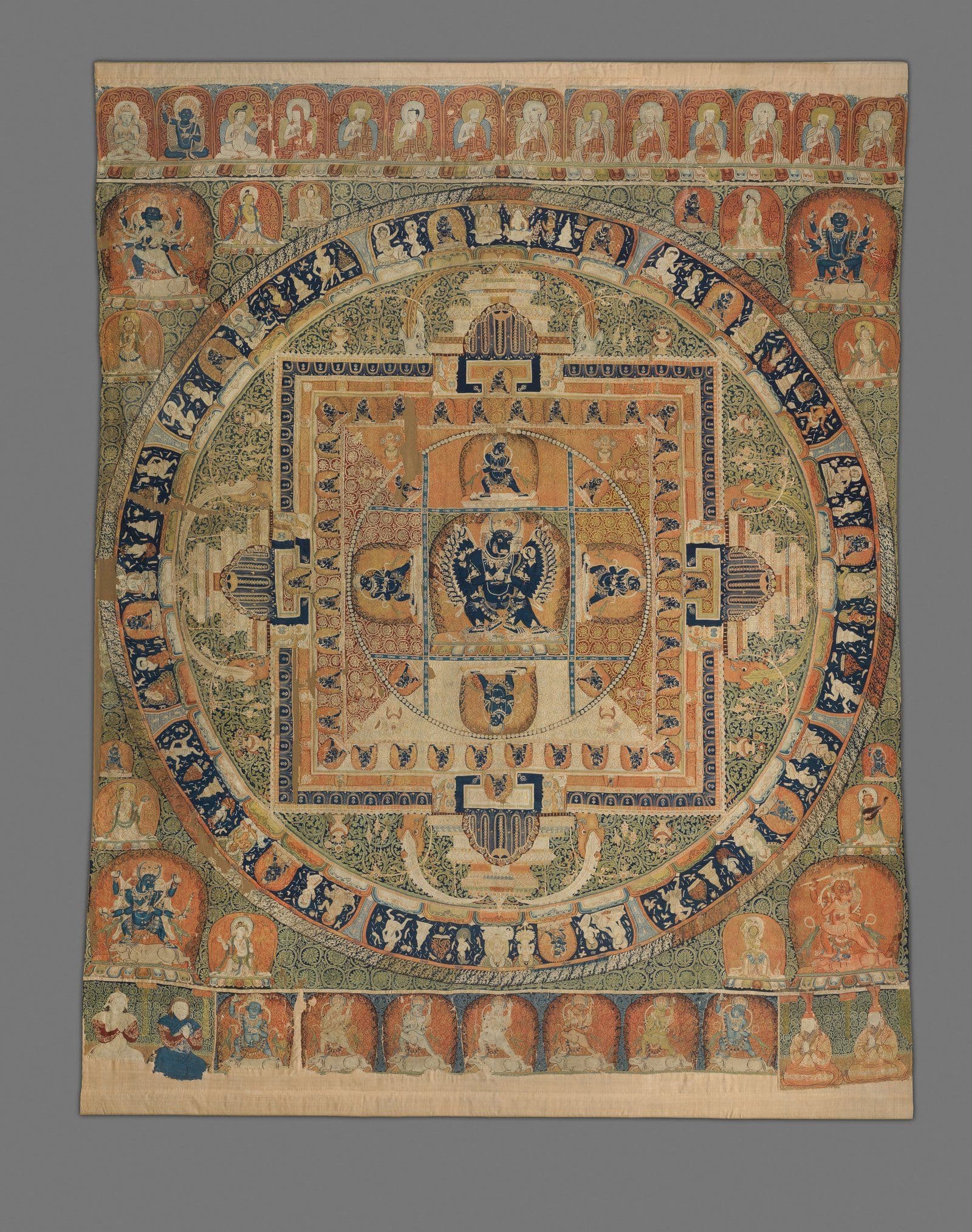
- Religious images. Buddhist icons and sutra covers, including large woven thangkas made for the court's Tibetan Buddhist practice.
- Furnishings and small formats. Throne cushions, table frontals, fan cases and the covers of fine albums — the places a collector today most often meets genuine Qing kesi at approachable scale.
Judging quality and condition
Quality in kesi is mostly a question of how much the loom was asked to do. Look for fineness and density of weave, complex color transitions worked in thread rather than paint, and woven detail that keeps its nerve in the hardest passages — faces, inscriptions, the inner gradations of petals. Brushwork is not automatically disqualifying: even fine Qianlong pieces combine weaving with deliberate painted accents. What should lower your estimate is weaving that stops exactly where difficulty begins, leaving eyes, outlines and shading to the brush. That is a cost decision, and it usually dates a piece late.
Condition has its own checklist. The slits are the structural weak point: check whether they have begun to split beyond their intended length, and whether old repairs have distorted the tension. Silk dyes fade, and the exposed face of a panel often reads several tones paler than the protected back — comparing the two tells you how much color has been lost, with blues and purples often the first to go. Creases matter more than on paper, because silk fibers break along fold lines. Like paintings, kesi panels have usually been remounted more than once, so treat mounting as evidence about the object's recent life rather than its age — silk supports age in their own characteristic ways, which is worth understanding through the comparison of silk and paper as painting supports.
Common questions
Is kesi the same as embroidery?
No, and the difference is structural rather than stylistic. Embroidery adds stitched thread on top of an existing woven ground; remove the stitches and a plain fabric remains. In kesi there is no ground and nothing is added — the colored wefts that form the image are the fabric. That is why kesi reads identically from both faces while embroidery has an unmistakable working back, and why the two age differently as objects.
Why does kesi have slits?
The slits are a byproduct of the discontinuous weft. Each color is woven only within its own area, so where two color fields meet along a vertical warp line, neither weft crosses over and a narrow gap remains. Weavers exploited this: an open slit draws a sharper contour than any interlock can. Long structural slits were often sewn closed after weaving, and finding those old closure stitches is a reassuring sign of age rather than a defect.
How long does a kesi panel take to weave?
There is no single figure, but the honest order of magnitude is months rather than days for a panel of any ambition. A weaver advances a few square inches on a good day, and dense passages slow that further. The proverb "an inch of kesi, an inch of gold" survives because it summarized a real cost structure — which is also why genuine kesi was never a cheap or casual product in any period.
How can I tell kesi from a printed or painted imitation?
Use magnification and the light. A printed image sits uniformly on the surface and shows halftone dots or ink pooling under a loupe; it has no slits and a wrong-looking back. A painted imitation shows pigment lying on top of the threads. Genuine kesi resolves into discrete colored wefts, boundary slits glow against the light, and the reverse repeats the image cleanly. Of the four tests, the back is the hardest for an imitation to fake.
Further reading
- How Experts Authenticate Chinese Paintings — the same evidentiary habits apply when a kesi panel claims a Song or Ming date.
- Chinese Art Provenance Documents — what ownership records look like and why they matter for court textiles.
- Famille Rose and Fencai Enamels — the parallel story of Qing court taste worked out in another medium.
Browse the collection
Kesi is a subject we write about rather than one we stock. What Kiln & Ink sells is paper: limited-edition archival giclée reproductions of the twentieth-century Chinese ink masters, each hand-numbered and issued with a Certificate of Authenticity.
Explore Further