Published July 29, 2026
Fencai, the famille rose palette: opaque pink overglaze enamels developed under the Qing, fired at low temperature in several firings, and how to spot them.
Look closely at a piece of famille rose porcelain and you will see something that no earlier Chinese enamel could do: a petal that shades from deep rose at the edge to almost white at the center, the color graded smoothly across a single brushstroke. Older overglaze palettes laid down flat, transparent washes bounded by an outline. Famille rose paints. That shift — from filling shapes to modeling them — is the whole story of the palette, and it reshaped Chinese porcelain decoration in the eighteenth century.
This article explains what famille rose actually is, the two technical innovations that made it possible, the Chinese terms behind the French label, and how to tell it apart from the earlier wucai and famille verte palettes it replaced.
What "famille rose" means — and what the Chinese called it
"Famille rose" is a French collector's term, coined in the nineteenth century to group Qing porcelain whose decoration is dominated by a distinctive opaque pink. It sits alongside "famille verte" (green-dominated) and the black- and yellow-ground famille noire and famille jaune wares in a naming system the West invented for its own convenience. The Chinese vocabulary is more precise and worth learning:
- Fencai (粉彩) — literally "pale" or "soft colors," the standard term for the opaque-enamel palette produced at Jingdezhen in quantity.
- Yangcai (洋彩) — "foreign colors," a court term acknowledging the European origin of some of the materials and effects.
- Falangcai (珐琅彩) — painted enamels, the finest imperial version decorated in the palace workshops in Beijing on porcelain blanks sent up from Jingdezhen.
For a working collector, the key distinction is that falangcai is a small, imperial, palace-decorated category, while fencai covers the vast bulk of the pink-enamel production. The English "famille rose" flattens all of these into one bin, which is why the underlying terms matter.
The two innovations that made it possible
Famille rose is not just a new color added to an old set. It rests on two specific technical breakthroughs, both arriving around the turn of the eighteenth century.
The first is opaque white enamel, often called "glass white" (玻璃白), an arsenic-opacified lead glass. Earlier overglaze enamels were transparent, so a color was whatever the pigment dictated, applied flat. By mixing colors with this opaque white — or laying them over a white ground — potters could lighten any enamel and, more importantly, blend tones within a single area. That is what enables the graded petal and the softly modeled face.
The second is the pink itself, derived from colloidal gold — the same "purple of Cassius" technology developed in Europe. Suspended gold particles produce a range from pale pink to deep ruby depending on concentration and firing. This rose is the palette's signature and the reason for its Western name.
Put together, opaque white plus gold-pink gave decorators a full painterly toolkit for the first time on Chinese porcelain: highlights, shadows, and smooth transitions, all fired as overglaze enamels. The effect is closer to painting on paper than to the graphic, outlined decoration that came before.
A short chronology
The palette developed in the late Kangxi period, roughly the 1720s, when the new enamels first appear on porcelain. It was perfected under the Yongzheng emperor (1723–1735), whose reign produced some of the most restrained and delicate famille rose — sparse floral sprays on a white ground, exploiting the new ability to shade. Under the Qianlong emperor (1736–1795) it became the dominant decorative mode, denser and more elaborate, and it drove an enormous export trade.
That export stream is a category of its own. The Canton workshops enameled porcelain to Western taste in famille rose, producing the dense, gold-heavy rose medallion wares that filled European and American homes through the nineteenth century. Imperial fencai and export famille rose share the same core technology but serve very different markets, and they are priced and judged separately.
Famille rose versus the palettes it replaced
The quickest way to understand famille rose is by contrast. Here is how it differs from the two overglaze systems that came before it.
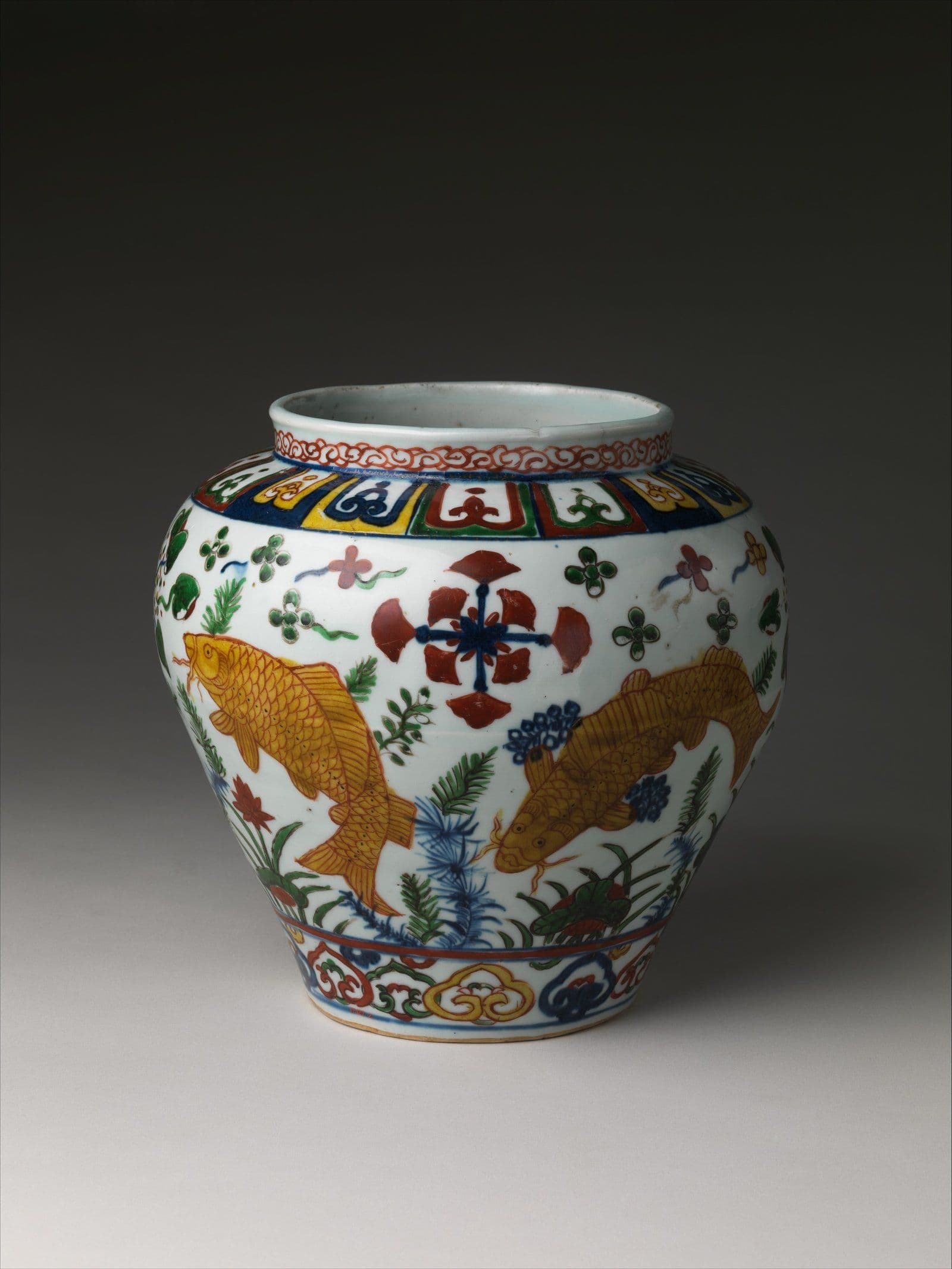
| Palette | Period | Key trait | How it reads ||---|---|---|---|| Wucai (五彩) | Ming into early Qing | "Five colors," transparent overglaze enamels usually combined with underglaze blue | Bold, flat, graphic; colors outlined and filled || Famille verte | Kangxi | Transparent overglaze enamels dominated by a bright apple green | Jewel-like and translucent, still largely flat || Famille rose / fencai | Late Kangxi onward | Opaque enamels including glass-white and gold-pink; tonal shading | Soft, painterly, modeled with highlights and gradients |
The line between famille verte and famille rose is exactly the arrival of opacity. If the enamels are transparent and the green leads, you are looking at famille verte, and the comparison is worth reading in full. If the pink is opaque and the decoration is shaded, it is famille rose. It also helps to know the earlier five-color system on its own terms; the wucai palette is the flat, transparent world that opacity left behind.
One more comparison prevents a common confusion. Doucai, the celebrated Chenghua technique, also combines underglaze blue with overglaze enamels — but there the blue is an outline drawn under the glaze and the enamels fill within it. Famille rose is a purely overglaze, opaque, painterly system. Different centuries, different logic.
How the enamels were fired
Famille rose is an overglaze technique, and the firing sequence is what separates overglaze enamels from underglaze decoration like cobalt blue. The porcelain body is first thrown, glazed, and fired at high temperature — well over 1,200°C — to produce the finished white vessel. Only then are the enamels painted on top of the already-fired glaze.
Because the gold-pink and the arsenic-opacified white cannot survive a high-temperature firing, the decorated piece goes back into a low-temperature muffle kiln, fired at roughly 700–800°C, which fuses the enamels to the glaze without melting the body. Complex pieces might be fired more than once, adding and firing colors in stages so that pigments needing different temperatures each set correctly.
This second, gentler firing has two consequences a collector can see. First, the enamels sit slightly above the glaze surface rather than melting into it, which is why famille rose often has a faint relief you can feel. Second, the overglaze colors are more vulnerable than underglaze blue — they can wear, scratch, or flake with heavy handling over centuries, so surface condition on the enameled areas is worth checking closely.
What to look for on the piece
When you handle a piece of famille rose, a few features confirm the palette and hint at quality and date:
- Opacity and shading. Genuine famille rose enamels are opaque and often stand slightly proud of the surface; run a fingertip lightly across a petal and you may feel the raised enamel. Look for real tonal gradation, not flat fills.
- The pink. The gold-derived rose ranges from pale to ruby. Muddy or chalky pink can indicate later, cheaper production.
- Density and market. Sparse, delicately shaded sprays on white point toward earlier imperial taste; dense, gold-outlined panels crowded edge to edge point toward export production.
- Ground color. Some fine wares use colored grounds — including the imperial yellow-ground pieces — which sit at the top of the market and demand careful authentication.
As with any Qing porcelain, the reign mark on the base is a starting point, not proof — the Qianlong mark in particular is the most copied in ceramics. Judge the enamels, the drawing, and the potting together, and let condition and provenance carry the weight the mark cannot.
Common questions
What is the difference between famille rose and fencai?
They describe the same thing from two directions. "Famille rose" is a nineteenth-century French collector's label for Qing porcelain dominated by opaque pink enamels. "Fencai" (粉彩) is the Chinese term for that palette, meaning "pale colors." Fencai is the more precise word and the one used in Chinese scholarship; famille rose is the Western trade name. A related term, falangcai, refers specifically to the finest imperial enamels painted in the Beijing palace workshops.
Why is famille rose porcelain pink?
The pink comes from colloidal gold — microscopic gold particles suspended in the enamel, a technology known in Europe as "purple of Cassius." Depending on concentration and firing, the same material yields anything from a pale rose to a deep ruby. This gold-based pink was new to Chinese porcelain in the early eighteenth century and is the feature that gave the palette its Western name.
How can I tell famille rose from famille verte?
Opacity and shading. Famille verte, the Kangxi palette, uses transparent overglaze enamels dominated by bright green, applied largely as flat, jewel-like washes. Famille rose uses opaque enamels — including an opaque white and the gold-pink — that can be blended to create highlights, shadows, and smooth gradation. If the colors are translucent and green leads, it is famille verte; if the pink is opaque and the decoration looks modeled and painterly, it is famille rose.
When was famille rose first made?
The palette appears in the late Kangxi period, around the 1720s, was perfected under the Yongzheng emperor (1723–1735), and became the dominant decorative style under the Qianlong emperor (1736–1795). Yongzheng wares are prized for their restraint and delicate shading; Qianlong production is denser and includes the large export trade.
Further reading
- Famille rose vs. famille verte explained — the transparent-to-opaque shift in full.
- Wucai five-color porcelain — the flat, transparent palette famille rose replaced.
- Famille noire and famille jaune — the black- and yellow-ground relatives.
- Rose medallion Canton export porcelain — famille rose made for the Western market.
Browse the collection
If the marks and glazes here have you looking at Chinese art more widely, our own catalogue runs to paper rather than clay — archival giclée reproductions of the modern ink masters, hand-numbered on rice paper and supplied with a Certificate of Authenticity.
Explore Further