Published July 18, 2026
Imperial yellow explained: how the glaze was fired, which ranks at the Qing court were allowed it, and the checks that date an unmarked yellow piece.
Most colors on Chinese porcelain tell you about taste. Yellow tells you about law. At the Qing court, a fully yellow-glazed dish was not a decorating choice — it was a statement of rank, governed by written regulation, and using the wrong grade of yellow at the wrong table was a punishable presumption. No other glaze color carries this much institutional meaning, which is exactly why collectors and auction catalogs treat imperial yellow as a category of its own.
This guide covers what the yellow glaze actually is, why the color belonged to the emperor, the court rules that rationed it by rank, and the practical signals — tone, wear, incised decoration, marks — that help you place a yellow-glazed piece.
Why yellow belonged to the emperor
Yellow's imperial status is older than porcelain glazes. In the traditional five-element scheme, yellow is the color of earth and of the center — the position the emperor occupies among the directions. The association was reinforced by language: huang meaning "yellow" and huang meaning "emperor" are pronounced alike, a pun no court needed explained. By the Ming and Qing dynasties, yellow was woven into the architecture of rule itself — the glazed roof tiles of the palace precincts were yellow, and the emperor's ritual and household objects followed.
Under Qing ritual regulation, color even organized worship: altar vessels were made in color-matched porcelain, with yellow serving the Altar of Earth as blue served the Altar of Heaven. A yellow-glazed dish, in other words, sat inside a complete symbolic system — which is why the court took its distribution so seriously.
What the glaze is and how it was made
Classic imperial yellow is a low-temperature glaze colored with iron and fluxed with lead. It could not survive the full heat that fires porcelain, so it was applied in a second step: either directly onto fired, unglazed biscuit, or over an already glazed white piece, and then fixed in a second, cooler firing. The two routes look different — yellow over biscuit tends to be deeper and warmer, showing any incised decoration crisply; yellow over glaze sits brighter and glassier.
The low-fired chemistry has a practical consequence collectors learn quickly: the surface is softer than a high-fired glaze. Genuine table-used pieces almost always show fine scratching and utensil wear, and that wear pattern is itself a dating and authenticity signal — the same logic that makes the whole family of Chinese monochrome glazes such a connoisseurship field. A centuries-old "yellow" dish with a flawless mirror surface deserves a second look.
In the eighteenth century a second yellow arrived. Alongside the traditional iron yellow, the court workshops adopted an opaque, paler lemon yellow based on antimony — chemistry that came into Chinese enameling through contact with European practice in the Kangxi and Yongzheng periods. Yongzheng lemon-yellow wares, thin-potted and perfectly even, are among the most admired monochromes of the dynasty. Tone therefore carries information: deep egg-yolk warmth and pale lemon opacity are different technologies, not just different moods.
Who was allowed which yellow
The Qing household regulations rationed yellow porcelain down the ladder of the imperial family. The scheme, recorded in the dynasty's administrative codes, ran in descending grades:
- The emperor, the empress dowager, and the empress used vessels fully glazed yellow, inside and out.
- The highest-ranking consorts used yellow on the exterior with white interiors.
- Lower consort ranks descended through combinations — yellow grounds with green dragons, blue grounds with yellow dragons, and so on — each pairing tied to a specific rank.
- Below the imperial household, plain yellow tablewares were simply not permitted.
The details of the middle grades varied over time and are the territory of specialists, but the principle is what matters for reading objects: the more completely yellow the piece, the closer to the throne its intended user. A dish yellow inside and out is making the largest possible claim — which is also why that configuration is the most copied.
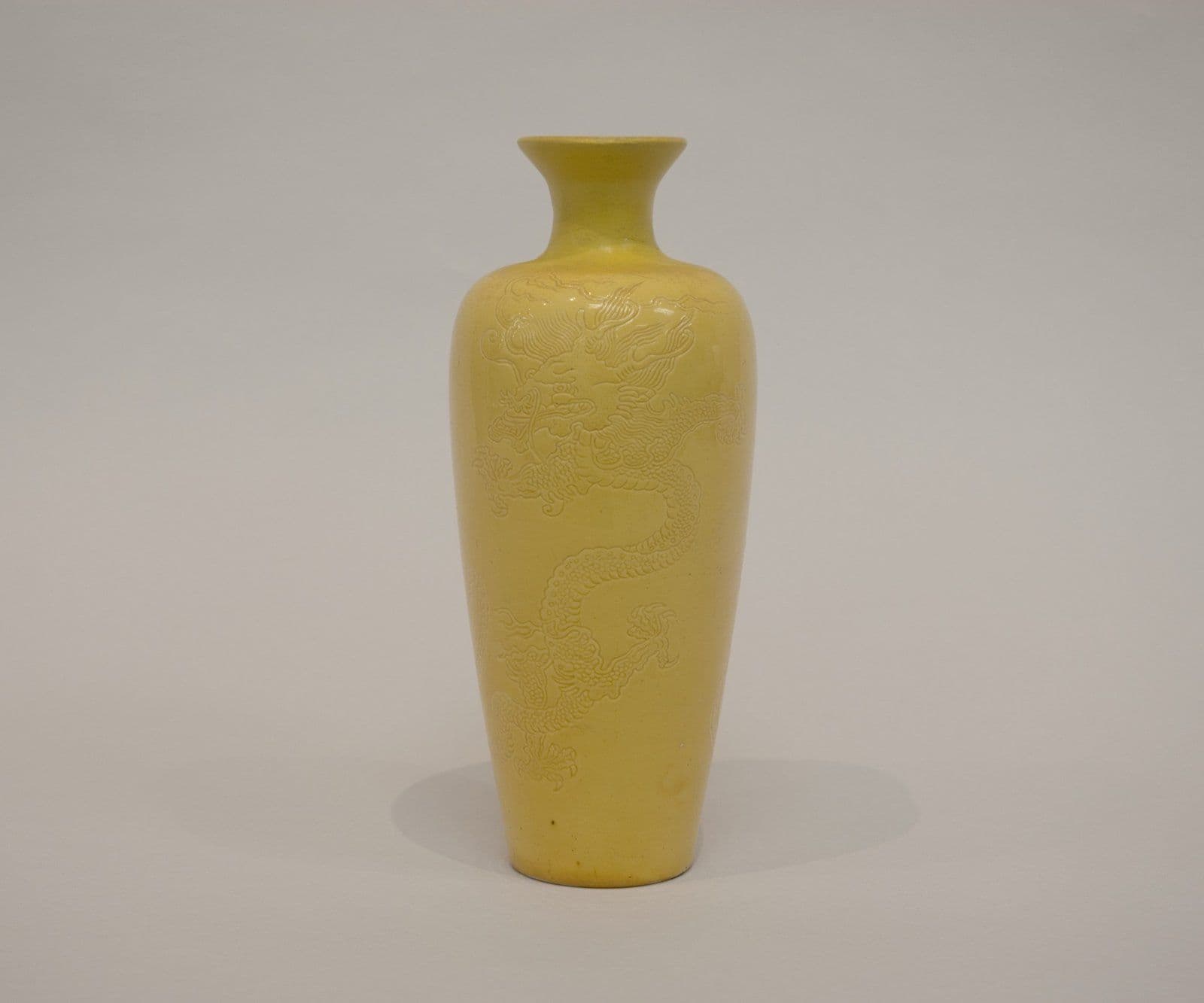
Imperial yellow wares were produced at Jingdezhen under court order, most commonly as sacrificial and household dishes and bowls, frequently with dragons incised into the body under the glaze — decoration you find with raking light and a fingertip as much as with the eye.
The Ming benchmark: Hongzhi and after
Yellow monochromes appear through the Ming dynasty, but one reign owns the benchmark. The yellow glaze of the Hongzhi period (late fifteenth to early sixteenth century) is traditionally ranked the finest ever achieved — a soft, saturated, perfectly even tone that Chinese connoisseurs named "chicken-fat yellow." Hongzhi yellow dishes are the reference point against which the whole category is judged, and genuine examples are correspondingly serious objects at auction.
The reigns around it have their own profiles: Zhengde continued the tradition strongly, and Jiajing yellows tend toward a deeper amber cast. The Qing dynasty then systematized production — Kangxi, Yongzheng, and Qianlong yellows are technically superb and survive in larger numbers, with the antimony lemon yellow joining the palette as described above. Later Qing production continued the forms for court use through the nineteenth century, generally with less refinement, though the category remained genuinely imperial to the end.
Yellow also worked as a stage rather than a soloist: yellow-ground famille rose, with enameled decoration over the imperial color, became a standard Qing court taste. Those wares belong to the enamel story — the palette distinctions in our guide to famille rose and famille verte — but they borrow the same rank-laden ground color.
Reading a yellow-glazed piece
Tone first. Set your expectation by claimed period: soft saturated depth for Hongzhi, amber warmth for Jiajing, strong even yolk for Kangxi, pale opaque lemon for a Yongzheng antimony glaze. A tone that fights the claimed reign is the fastest red flag in the category.
Then the surface. Look for honest, fine, directionless wear on pieces that claim age and court use; look for incised dragon decoration under the glaze and judge its drawing quality — imperial incising is confident and anatomically fluent. Check how the yellow stops at the foot: the glaze line at the rim and foot is typically neat on court wares.
Then the mark. Imperial yellow wares normally carry reign marks, and mark-reading here follows the same rules as everywhere in Jingdezhen production — calligraphy quality, layout, and period consistency, as covered in our guide to Chinese porcelain marks. The Kangxi mark conventions apply directly, since so much surviving yellow ware claims that reign. Remember the standing rule: the mark is the beginning of the argument, not the end. Yellow monochromes have been copied continuously — late Qing copies of Hongzhi, Republic copies of Kangxi, modern copies of everything — precisely because the color's imperial claim adds value.
Condition last, and honestly. Because the glaze is soft, some wear is expected and forgivable; chips, hairlines, and re-firing repairs are not. And because plain surfaces hide nothing, run the same disciplines you would on any monochrome — rim, foot, weight, and glaze texture in the hand.
Common questions
Was it actually illegal for ordinary people to own yellow porcelain?
Fully yellow vessels were restricted to the top of the imperial household by court regulation — this was sumptuary law, and using above your station was an offense within the system that the rules governed. In practice the restriction applied to use at court and official life; the regulation's reach over ordinary subjects mattered less because plain yellow wares were made under court order at Jingdezhen rather than sold on the open market. After the dynasty fell in 1912, the restriction died with it — which is one reason Republic-period copies of imperial yellow wares exist in quantity.
How can I tell iron yellow from antimony lemon yellow?
By eye, mostly: iron yellow is warmer, deeper, and slightly transparent, showing tone variation where it pools; antimony yellow is paler, cooler, opaque, and remarkably even. The antimony glaze only enters the repertoire in the early eighteenth century, so a pale opaque lemon glaze on a piece claiming to be Ming is contradicting itself.
Do all imperial yellow pieces have dragons?
No. Many of the classic sacrificial and household dishes are entirely plain, relying on the color alone. Incised dragons under the glaze are common on Qing court wares but their absence proves nothing. Painted decoration over or alongside the yellow — green dragons, enamel scenes on yellow grounds — belongs to the graded rank combinations and to the famille-rose court taste rather than to the plain monochrome tradition.
Why do auction catalogs care so much about which reign a yellow glaze is?
Because the category's value structure is a reign hierarchy. Hongzhi sits at the summit by tradition; early Qing imperial production is the strong middle; late Qing and Republic wares are the accessible base. With tone, potting, mark, and wear all shifting by period, the reign attribution effectively is the price — which is why the dating disciplines matter more here than in almost any painted category.
Further reading
- Dehua Blanc de Chine: A Collector's Guide to Chinese White Porcelain — the white end of the monochrome spectrum, with its own dating logic.
- Ge Ware and Crackle Glazes: Reading the Cracks in Chinese Ceramics — another glaze family where the surface itself carries the value.
- How to Spot Fake Chinese Porcelain Marks — the counterfeit patterns that follow value into every imperial category.
- Dating Chinese Porcelain from the Foot Rim — the under-side evidence that plain glazes make especially important.
Browse the collection
Porcelain is a subject we write about rather than one we stock. What Kiln & Ink sells is paper: limited-edition archival giclée reproductions of the twentieth-century Chinese ink masters, each one hand-numbered and issued with a Certificate of Authenticity.
Explore Further