Published August 6, 2026
A collector's guide to Fu Baoshi: the baoshi texture stroke, his rain landscapes and Chu ci figures, how the market grades his periods, and what to check.
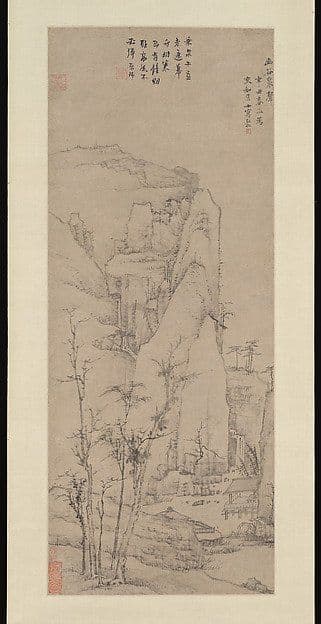
Look closely at the mountain face in a Fu Baoshi landscape and you will not find the neat, repeatable texture strokes that generations of Chinese painting manuals taught. You find something closer to a tangle — dozens of splayed hairline strokes laid down fast, at speed and at angle, so densely interwoven that the rock reads as weather rather than geology. He got the effect by working with a brush most painters would have thrown away: worn, split at the tip, dragged rather than drawn.
That stroke is the reason his name is worth knowing before you buy anything attributed to him. This guide covers who Fu Baoshi was, what the baoshi cun texture stroke actually is, which subjects he returned to, and what a collector should look at when a work — or, far more often, a reproduction of one — is put in front of them.
The scholar who became a painter
Fu Baoshi was born in Jiangxi in 1904 into modest circumstances, and the name by which he is known was one he chose. Baoshi means, roughly, "embracing stone," and the reference is to Shitao — the Ming-loyalist monk-painter of the seventeenth century whose work and writing Fu studied for most of his life. Choosing a name as a declaration of lineage is an old habit among Chinese painters. It tells you, before you have seen a single brushstroke, what tradition he considered himself accountable to.
He trained in Japan in the late 1920s and early 1930s, and this matters more than it is usually given credit for. Tokyo at the time was where Chinese art history was being systematised as a modern academic discipline, with the tools of Western scholarship applied to Chinese material. Fu came back not only as a painter but as a historian: he wrote extensively on Shitao and on the development of Chinese painting, and he taught. Among the twentieth-century masters he is the one whose theoretical writing is genuinely substantial, and it shows in the work — his innovations read as arguments about what a landscape is for, not as stylistic restlessness.
He appears on the Kiln & Ink roster: Fu Baoshi.
The wartime years and the birth of the baoshi cun
The decisive period came during the war against Japan, when Fu was living outside Chongqing in the hills at Jingangpo. Conditions were poor, materials were poor, and the landscape was permanently wet — the Sichuan basin's mist and rain became the subject he is now most identified with.
What he developed there is the baoshi cun, the "Baoshi texture stroke." Conventional cun — the texture strokes used to give a rock its surface — are discrete, named, and teachable: axe-cut, hemp-fibre, raindrop. Fu's is closer to a continuous scribble. Held sideways and moved quickly, a splayed brush leaves a fan of parallel hairlines in a single pass; layered in different directions and different ink densities, they build a mountain surface with no visible individual strokes, only accumulated texture.
Two consequences matter to a viewer:
- Rain and mist become structural, not atmospheric. In much traditional landscape, mist is the blank paper left between forms. In Fu's rain landscapes, sheeting diagonals are drawn across the whole composition, over rock and tree alike, so the weather is the top layer of the picture rather than a gap in it.
- Speed is visible. The stroke cannot be executed slowly; a slow split brush deposits blots rather than lines. Genuine passages carry the evidence of pace — tapering, skipping where the brush ran dry, variation in the fan's spread. The technique is set out at greater length in our study of his rain landscape method.
His best-known collaboration is with Guan Shanyue: the two painted a monumental landscape for the Great Hall of the People in 1959, a commission that placed Fu's brush in the most public setting available to a Chinese artist of his generation. We cover that project separately in the Great Hall painting.
The figures, and why they look archaic
The other half of Fu Baoshi's reputation rests on figure painting, and it surprises people who know him only as a landscapist. His figures are deliberately antique — high-antiquity scholars, poets, and above all the women of the Chu ci, the ancient southern anthology of poems whose imagery he returned to throughout his career. The Lady of the Xiang, the river goddess of those poems, is his signature figure subject.
The drawing is loose where the landscape is dense: faces built from a handful of fine, unhurried lines, drapery in long sweeping strokes, hair in wet black ink. He was not attempting historical costume reconstruction. He was painting figures as a literatus would have imagined them — remote, quiet, thin on detail and heavy on mood. The contrast with the storming energy of the mountains is the reason his figure works function as a distinct collecting category rather than a sideline.
Both threads are represented in our reproduction catalogue; the tonal range is easiest to see in The Lady of the Xiang, where the figure is carried almost entirely by line while the ground is left to atmosphere.
How the market reads his periods, and what to check
Fu Baoshi died in 1965, at sixty-one. The working life is therefore short by the standards of his contemporaries — Qi Baishi painted into his nineties — and the supply of authentic work is correspondingly limited. He is consistently ranked among the most sought-after modern Chinese painters at auction, and his prices have climbed steadily since the mid-2000s alongside the broader modern-and-contemporary Chinese ink market.
Collectors and specialists generally grade the work by period:
| Period | Character | Market view ||---|---|---|| Pre-war, before Sichuan | Formative; less of it, and less distinctive | Of scholarly interest || Jingangpo / wartime years | The baoshi cun at full strength; rain landscapes; Chu ci figures | The celebrated period || Post-1949 | Travel landscapes, public commissions, brighter palette | Strong, more variable |
Where that leaves a buyer:
- The stroke is the hardest thing to fake and the first thing to look at. Copyists reproduce the composition and the silhouette. What they struggle with is the fan of a split brush moving at speed — imitations tend toward evenly spaced, deliberate lines, because they are being drawn rather than dragged.
- Check the inscription against the picture. Fu inscribed and dated much of his work, and the calligraphy is part of the object, not a caption. Reading it is a skill in itself; our guide to reading a Chinese painting inscription covers what the components are.
- Treat seals as evidence, not proof. He used a number of seals, including one often translated as "often done after drinking." Seals are carved, and carvings are copied. They corroborate; they do not certify. See painting seals and collector marks.
- Ask what the paperwork actually says. Provenance for twentieth-century Chinese painting is frequently thin, and the market has an active problem with confident attributions resting on nothing. How specialists authenticate Chinese paintings sets out the process an original ought to survive.
Common questions
Is a Fu Baoshi original realistically obtainable?
For most collectors, no. The output is small, the reputation is high, and genuine works move through major auction houses at levels that put them out of ordinary reach. That is precisely why the reproduction market around him is so busy, and why it pays to be clear with yourself about which market you are in before money moves.
How do I tell a reproduction from an original?
Look at the surface rather than the image. An original is ink and colour sitting in paper or silk — the fibres have absorbed it, tone varies within a single stroke, and the sheet has responded to wetting. A printed reproduction has an even ink film, no absorption gradient, and under magnification often shows a regular dot or screen structure. Reputable reproductions say what they are on the certificate. Anything sold as an original with no provenance, no exhibition history, and a price that seems achievable deserves suspicion on the price alone.
What do edition numbers mean on a print?
On a limited-edition reproduction, a hand-written number such as 12/200 states the size of the run and this impression's place in it. It is a statement about scarcity within that edition and nothing else — it does not make the sheet an original, it is not a valuation, and a low number is not a mark of quality. What it should come with is a certificate identifying the paper, the process, and the edition size.
Which subject should a first-time buyer look for?
If you want the technique, take a rain landscape — the baoshi cun is the whole point of the picture and there is nowhere for it to hide. If you want the mood, take a Chu ci figure: quieter on a wall, easier to live with at close range, and more forgiving of a small room than a full mountain composition.
Further reading
- Zhang Daqian: A Collector's Guide — Fu's most-collected contemporary, and a useful comparison of how two reputations were built.
- Silk versus Paper in Chinese Painting — what the support does to ink, and why it matters for judging a surface.
- Mounting: Zhuangbiao — how a scroll is assembled, and what remounting does to value.
- Album Leaves and Fan Paintings — the small formats, and a gentler entry point than a hanging scroll.
Browse the collection
Kiln & Ink sells limited-edition archival giclée reproductions of the twentieth-century Chinese ink masters, Fu Baoshi among them — printed on rice (xuan) paper or museum-grade cotton rag, hand-numbered, and issued with a Certificate of Authenticity.
Explore Further