Published August 10, 2026
A collector's guide to Li Keran: his accumulated-ink landscapes, the buffalo and red-mountain subjects, how the market sorts his periods, and how his work is checked.
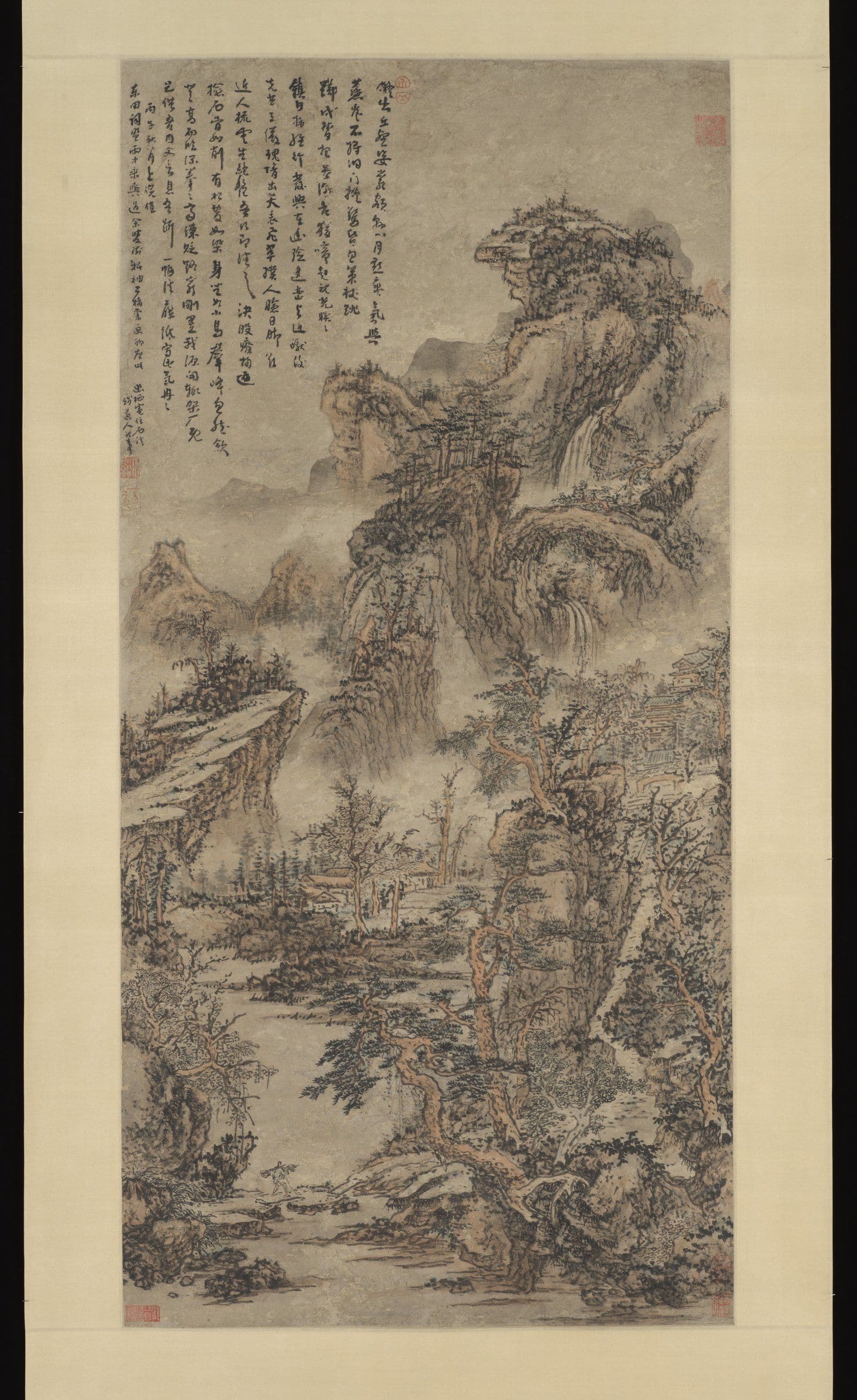
In the late paintings the mountain is almost black. Ink has been laid down, allowed to dry, and laid down again — six times, ten times, until the paper carries a density that ought to read as mud and instead reads as light. A thin road of untouched white winds up through it, a few roofs catch the sun, and the whole dark mass resolves into depth. Photographs of these paintings rarely survive the reproduction; they flatten into a grey smear. In front of the sheet, they open.
This guide covers what Li Keran actually did, which parts of his output the market separates and why, and what a buyer looks at before committing — including the forgery problem, which in his case is substantial.
From oil painting to the ink tradition
Li Keran was born in Xuzhou, Jiangsu, in 1907, and died in Beijing in 1989. That span put him inside every argument twentieth-century Chinese painting had with itself, and his answer to those arguments is what the work is about.
He came up through both systems. He began studying landscape with a local painter as a boy, entered the Shanghai Art College in 1923, and later took a postgraduate place at the National Academy of Art in Hangzhou, where Lin Fengmian was his mentor. That is a Western-trained pedigree — oil painting, drawing from the model, chiaroscuro as a working assumption about how form is described.
The second half arrived in 1946, when Xu Beihong invited him onto the faculty of the Beijing National Art College and he became a student of Qi Baishi and Huang Binhong. He was nearly forty. From Qi Baishi he took a discipline of brushwork; from Huang Binhong, the layered ink that would become the centre of his own manner.
What makes Li Keran interesting rather than merely eclectic is that he never resolved the tension. His mountains are built from orthodox ink strokes and lit like oil paintings. Light falls from a direction. Masses recede because they are darker, not because they are higher on the page. That is not how the classical tradition described space, and it is the reason his landscapes look immediately different from Huang Binhong's late black landscapes even though the ink method is closely related.
The accumulated-ink method, and why it matters commercially
The technique the market cares about is accumulated ink — repeated layers of wash and stroke, each allowed to dry before the next, building tonal density without turning the paper to pulp.
It is unforgiving. Each layer must respect what is underneath; too much water lifts the previous coat, too little kills the luminosity that makes the darkness read as air rather than dirt. Reserved white — the road, the waterfall, the lit roof — has to be planned from the first layer, because it cannot be recovered once covered.
For a buyer this has two direct consequences. First, it is the hardest part of his work to fake convincingly: a forger can copy composition and signature far more easily than the specific transparency of ten correctly-managed layers. Second, it separates his periods. Earlier work is lighter, wetter and closer to conventional literati landscape; the dense, structural mountains belong to his mature and late years, and that is where the money is.
The subjects: mountains, buffalo, and the red landscapes
Three bodies of work account for most of what a collector will encounter.
The travel landscapes. From the mid-1950s Li Keran made extended sketching journeys and built a practice of painting from direct observation — a deliberate break with copying old masters, and the source of the specific, locatable feel of his scenery.
The buffalo and herdboy pictures. He painted the water buffalo his whole working life, usually with a small boy on its back, in a register completely unlike the landscapes: wet, quick, affectionate, often funny. Collectors sometimes treat these as minor works. The market does not agree — good examples are strongly sought, partly because they are approachable and partly because the brush economy in them is genuinely virtuoso. The buffalo-and-herdboy subject is the best entry point into his hand for anyone learning to read it.
The red mountains. Between 1961 and 1964 he painted seven versions of Ten Thousand Mountains Bathed in Red, taking the title from a line in a 1925 poem by Mao Zedong. Cinnabar is laid over the accumulated ink so that the forest reads as burning red against black rock. These are the paintings that made his auction record: the largest of the seven sold at Poly in Beijing on 3 June 2012 for RMB 293.25 million, and another 1964 version sold at China Guardian in November 2015 for RMB 184 million. The red-mountain subject sits at an awkward intersection of politics and landscape that Western collectors often skip past — worth understanding before you buy into it or dismiss it.
His dark manner drew political criticism during the Cultural Revolution, and his output slowed sharply in those years. The strongest late landscapes come after that period, when he returned to the mountains with the method fully formed.
How the market sorts him
Li Keran is one of the most expensive twentieth-century Chinese painters at auction, and the price spread within his own work is enormous. What drives it:
| Factor | What lifts value | What depresses it ||---|---|---|| Period | Mature and late landscapes (1960s–1980s) | Early, derivative work || Subject | Red mountains; major structural landscapes | Repetitive small buffalo studies || Scale | Large hanging scrolls | Album leaves, small fans || Inscription | Long, dated, circumstantial | Bare signature only || Provenance | Published, exhibited, or family-sourced | None |
Buying is concentrated in the mainland Chinese market, and the strongest prices are set in Beijing rather than Hong Kong or New York. That matters practically: catalogues, comparables and scholarship for his work are disproportionately in Chinese, and a Western buyer working only in English is reading a thin slice of the record.
The forgery problem
This needs stating plainly. Li Keran is among the most heavily forged of the modern masters. High prices, a recognisable manner, and a large body of legitimate variation within his own output combine into ideal conditions for fakes, and a great deal of material carrying his name is not his.
What experienced buyers check:
- The ink layers. Hold the work at an angle to raking light. Genuine accumulated ink shows discrete, coherent layers with reserved lights that were planned. Fakes tend to show a single loaded application worked while wet, producing flat darkness with muddy, hesitant edges where white should be crisp.
- The white. Untouched paper in a Li Keran landscape does work — it describes a road, a waterfall, mist between ranges. If the reserved areas are arbitrary shapes that describe nothing, that is a serious signal.
- The calligraphy. His inscriptions have a distinctive blunt, weighty hand. Forgers reproduce the picture more successfully than the writing, and the inscription is often where a copy first fails.
- Provenance and publication. For work at this price level, an unpublished piece with no ownership history is a very difficult proposition regardless of how good it looks.
- The seals. Useful, but never on their own. A seal is one strand among several rather than a verdict, and a genuine impression can sit on a painting the artist never touched.
Anyone considering a Li Keran at serious money should be reading the condition report closely and treating a specialist opinion as a cost of entry, not an optional extra.
Common questions
Where should a new collector start with Li Keran?
With the buffalo pictures rather than the landscapes. They are smaller, more available, less exposed to the top of the forgery market, and they teach you his brush at a scale you can actually read. Spend time with the way a single wet stroke describes the animal's back. Once that hand is familiar, the density of the mountains becomes legible as brushwork rather than as a dark mass.
Why are his paintings so dark?
Because darkness was the point. He was after the weight and enclosure of real mountains — the feeling of standing inside a range at dusk rather than surveying it from above, which is how classical landscape usually positions the viewer. The Western training in tonal modelling gave him a way to build that with ink, and the accumulated-ink method gave him the means. The best of them are dark the way a forest is dark: full of information, not empty.
Is his work available outside China?
Occasionally, at the major houses in Hong Kong and sometimes New York and London. But the depth of the market, the scholarship and the price discovery are all in mainland China, and a Western collector will see a limited and not necessarily representative selection. Museum holdings and good reproductions are the realistic route to knowing the work well.
How does he compare with his contemporaries?
He sits alongside Fu Baoshi and Wu Guanzhong as one of the painters who found a workable answer to the century's central question — what to do with the ink tradition once Western picture-making is in the room. Where Wu Guanzhong went toward abstraction and line, and Fu Baoshi toward atmosphere and a reinvented texture stroke, Li Keran went toward mass, structure and light.
Further reading
- Li Keran: Ten Thousand Mountains Bathed in Red — the red-mountain series in detail.
- Li Keran's Buffalo and Herdboy Paintings — the other half of his output.
- Huang Binhong's Late Black Landscapes — the teacher whose ink method Li Keran rebuilt.
- How Experts Authenticate Chinese Paintings — the framework behind the checks above.
Browse the collection
If you want to live with the ink mountains rather than only read about them, Ten Thousand Mountains Bathed in Red and Playing with the Ox show the two sides of his hand; more is on Li Keran's artist page. These are limited-edition archival giclée reproductions on rice paper or museum-grade cotton rag, hand-numbered and issued with a Certificate of Authenticity.
Explore Further