Published August 16, 2026
How to frame Chinese art on paper: hinges, rag mats and UV glazing, float mounts versus window mats, and when a scroll mount is the better choice.
The sheet arrives rolled in a tube or flat between two boards, and then it sits on a table for a week while you decide what to do with it. That week is when most of the damage happens — a corner catches, a coffee ring lands two inches from the edge, someone flattens the curl under a stack of books and leaves a crease that will never come out. Paper is the most forgiving support in Chinese art right up until the moment it isn't.
This guide covers what to ask a framer, what to refuse, and how to judge the result, for flat works on paper: ink paintings, calligraphy sheets, rubbings, and limited-edition prints. It assumes you are not doing conservation work yourself, only commissioning it well.
First, identify what your paper actually is
Framing decisions follow from the sheet, so start there. Most Chinese works on paper sit in one of three families.
Xuan paper (宣纸), often sold in the West as "rice paper," is the classic support for ink painting and calligraphy. It is soft, highly absorbent, and thin enough that light passes through it. It has almost no dimensional stiffness — it will cockle and ripple with humidity swings far more visibly than Western papers. If you are unsure what you have, how to judge xuan paper quality before you buy covers the tells.
Cotton-rag paper is a heavier, stiffer Western-style sheet used for archival printing. It holds its shape better, takes hinges more predictably, and tolerates handling.
Silk is a different problem entirely and mostly belongs in a traditional mount rather than a frame — what the support tells you about a Chinese painting sets out why the two behave so differently.
The practical difference: the thinner and more absorbent the sheet, the more the frame package has to do the work of holding it flat without ever gripping it.
The conservation frame, layer by layer
A properly built frame is a stack. Every layer has a job, and the failures collectors bring to framers are almost always a missing layer rather than a bad frame.
- Glazing — blocks UV, dust and fingers. Avoid ordinary glass with no UV filter.
- Spacer or mat — holds the glazing off the surface. Avoid any build where glazing rests on the sheet.
- Window mat or float board — presents the work and buffers the edges. Avoid wood-pulp board and coloured cores.
- Hinges — attach the sheet, and give way before it does. Avoid every kind of pressure-sensitive tape.
- Backing board — rigid support behind the work. Avoid cardboard or foamcore in direct contact.
- Dust seal — closes the package at the back. Avoid an open back with exposed gaps.
Three of those rows carry nearly all the risk.
Nothing may touch the front of the sheet. Glazing pressed flat against paper will, over years in a humid room, stick to the surface. Ink can transfer. The remedy is either a window mat with enough thickness to hold the glass off, or purpose-made spacers hidden behind the rebate.
Board must be acid-free and lignin-free through the whole thickness. Cheap "acid-free" mats are only surface-treated: the bevel you cut exposes a wood-pulp core that browns and leaves a permanent burn line along the window edge. Ask for museum rag board or a genuine alpha-cellulose conservation board, and check the bevel colour.
Hinges must be weaker than the paper. The standard is a Japanese tissue hinge set with wheat starch paste, which is reversible with moisture and tears before the artwork does. Two hinges along the top edge only, so the sheet can expand and contract freely below. What to refuse: masking tape, framer's tape, linen tape, "archival" self-adhesive tape, and above all dry mounting, which bonds the sheet permanently to a board with heat and glue. Dry mounting is not reversible and it is the single most common way a good sheet is quietly destroyed.
Window mat or float mount
Two presentations, and the choice is aesthetic as much as technical.
A window mat lays a bevelled opening over the sheet, covering perhaps three to five millimetres of the edge all round. It is the safer option, hides slightly ragged edges, and gives a crisp rectangle.
A float mount attaches the sheet to a backing board and leaves the whole sheet visible, edges included, with a shadow gap around it. Use it when the edges are part of the object: deckle edges, a torn xuan edge, a visible plate mark, or a hand-written edition number in the lower margin.
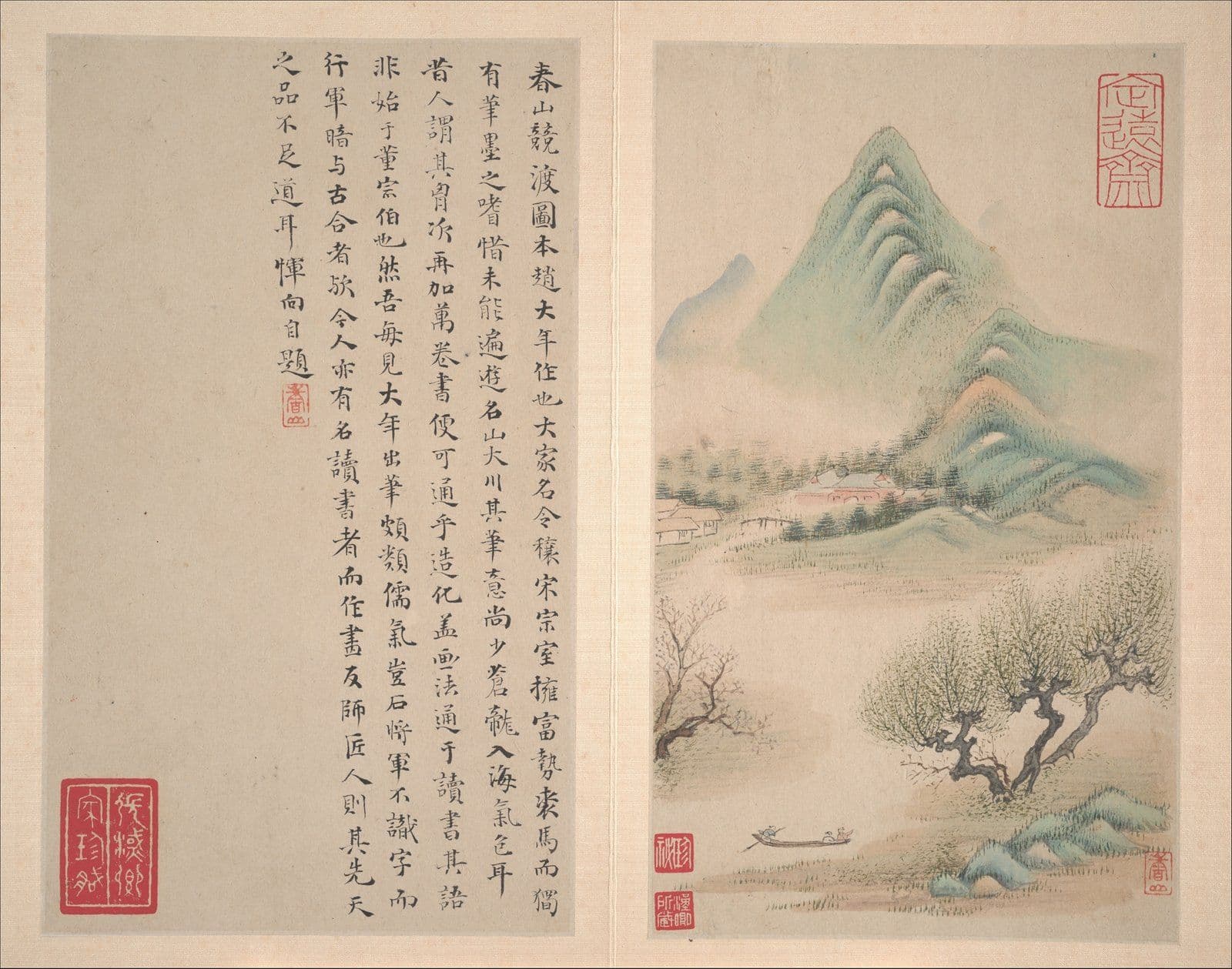
Float mounting matters more in Chinese art than in Western work because of what sits in the margins. Seals, dedications, and dated inscriptions frequently run close to the edge, and a window mat sized by eye will crop them. Sheets after ink masters such as Wu Guanzhong often carry deliberate expanses of empty paper that are compositionally load-bearing — mat them tight and the picture stops breathing. Before anyone cuts board, put the sheet down and mark where every seal and character falls. Reading collector seals on Chinese paintings explains why those small red marks in the margin are worth protecting.
Glazing: glass, acrylic, and light
- Weight — glass is heavy; acrylic is roughly half.
- Breakage — glass shatters; acrylic is effectively unbreakable.
- Static — glass carries none; acrylic carries a significant charge.
- Scratching — glass resists it; acrylic scratches easily.
- Best for — glass suits most framed sheets; acrylic suits large pieces, shipping, and high or awkward spaces.
The material matters less than the coating. Specify UV-filtering glazing; it removes most of the ultraviolet component that fades ink and pigment, and the price difference over plain glass is small relative to what it protects. Anti-reflective museum glazing costs considerably more and is worth it only where glare genuinely defeats the work — dark ink grounds under a window, for instance.
One caution on acrylic: its static charge lifts loose particles. For a printed or fully bound ink surface this is not a problem, but for charcoal, pastel, unfixed pigment, or a rubbing with powdery ink, use glass.
Ultraviolet filtering is not a licence to hang anything anywhere. It slows fading; it does not stop it. No work on paper should face direct sun at any hour.
The wall matters as much as the frame
A conservation frame in a bad location will still lose. The environment rules are simple and mostly free.
- Stable humidity, roughly 45–55%. The stability matters more than the number. Paper swells and contracts with every swing, and cockling that comes and goes will eventually set.
- Interior walls only. Exterior walls run colder, and condensation forms inside the frame package where you cannot see it.
- Away from heat sources. Not above a radiator, not over a working fireplace, not opposite a west-facing window in summer.
- No bathrooms or unheated rooms, whatever the ventilation.
- Rotate what is on show. The most effective preservation measure available to a private collector is simply not leaving the same sheet on the same wall for a decade. Plan a rotation of three or four works through one good wall position rather than hanging everything at once.
When to mount as a scroll instead
Framing is not the only answer, and for some works it is the wrong one. A traditional mount — silk borders, paper backing layers, a wooden roller — is the format a hanging scroll was designed for, and it lets the work be rolled, stored flat in a box, and brought out seasonally. Chinese painting mounting (装裱) explains what the process involves and why the quality of the mount affects value.
Choose a scroll mount when the work already has a mount worth preserving, when it is tall and narrow enough that a frame would be unwieldy, or when you want to rotate a group of works through one wall position. Choose a frame when the sheet is a flat modern edition, when it will hang permanently, or when the household includes people who will inevitably touch it. How to display a Chinese scroll painting at home covers the hanging side of that decision.
One rule holds in both directions: never cut down a sheet to fit a frame, and never trim an existing mount to fit a wall.
Common questions
Can I dry mount a print to keep it perfectly flat?
No. Dry mounting bonds the sheet to a substrate with heat-activated adhesive, and it cannot be undone without damaging the paper. It permanently removes any possibility of remounting, conservation treatment, or resale to a buyer who cares about condition. Slight cockling in an absorbent sheet is normal and expected; it is not a flaw to be engineered away. If flatness genuinely bothers you, the correct approaches are a float mount with a well-chosen hinge placement, or a period of controlled humidification and flattening by a paper conservator before framing.
Does a work on paper have to be behind glazing at all?
For anything you intend to keep, yes. Unglazed paper collects airborne grease and soot, absorbs pollutants, and is exposed to fingers. The traditional alternative is not an unglazed frame but a scroll mount that spends most of its life rolled and boxed — protection through storage rather than through glass. What you should not do is frame a sheet openly and leave it on a wall indefinitely.
Will framing hide the artist's seal or inscription?
It can, and this is the most common avoidable error. Red seals and dated inscriptions often sit within a centimetre or two of the edge. Measure their positions before the mat is cut, and choose a float mount if anything important runs close to the margin. If you are unsure what the marks in the margin are saying, resolve that question before framing rather than after — a mat is cheap to recut only while the frame is still open.
Can I frame it myself with a shop-bought frame?
You can, provided you replace what comes in the box. Ready-made frames ship with wood-pulp backing, no spacers, and sometimes a card mat that will burn a line into the sheet within a few years. Buy the frame if you like it, then have conservation board cut to size, use starch-paste tissue hinges, and specify UV glazing. The frame itself is the least critical component in the stack.
How much should conservation framing cost relative to the work?
There is no fixed ratio, but it is normal for a properly built frame to cost a meaningful fraction of a modestly priced print, and that is not a sign of being overcharged. The materials that matter — rag board, UV glazing, correct hinges — are a small part of the total; most of the cost is skilled labour. Where the ratio starts to look absurd is on very inexpensive sheets, in which case a simple, well-built frame with good board and plain UV glass is entirely sufficient.
Further reading
- What Is Xuan Paper? How to Judge Quality Before You Buy — identifying the support before you commit to a mount.
- Chinese Painting Mounting (装裱): Why It Matters for Collectors — the traditional alternative to framing, and how to judge one.
- How to Display a Chinese Scroll Painting at Home — hanging, rotation, and light for mounted works.
- Chinese Painting on Silk vs Paper: What the Support Tells You — why silk and paper need different handling.
Browse the collection
Everything Kiln & Ink sells is flat work on paper, which means every piece we ship faces exactly the decisions above: limited-edition archival giclée reproductions of the twentieth-century Chinese ink masters, printed on rice (xuan) paper or museum-grade cotton-rag, hand-numbered, and issued with a Certificate of Authenticity. Editions run from about $300 to $1,200, and they arrive unframed on purpose — so that the framing decision is yours to make properly.
Explore Further