Published October 28, 2026
How momei reduces plum painting to ink alone: branch structure, the five-petal flower, the Song and Yuan masters, seals and the copies that fill the market.
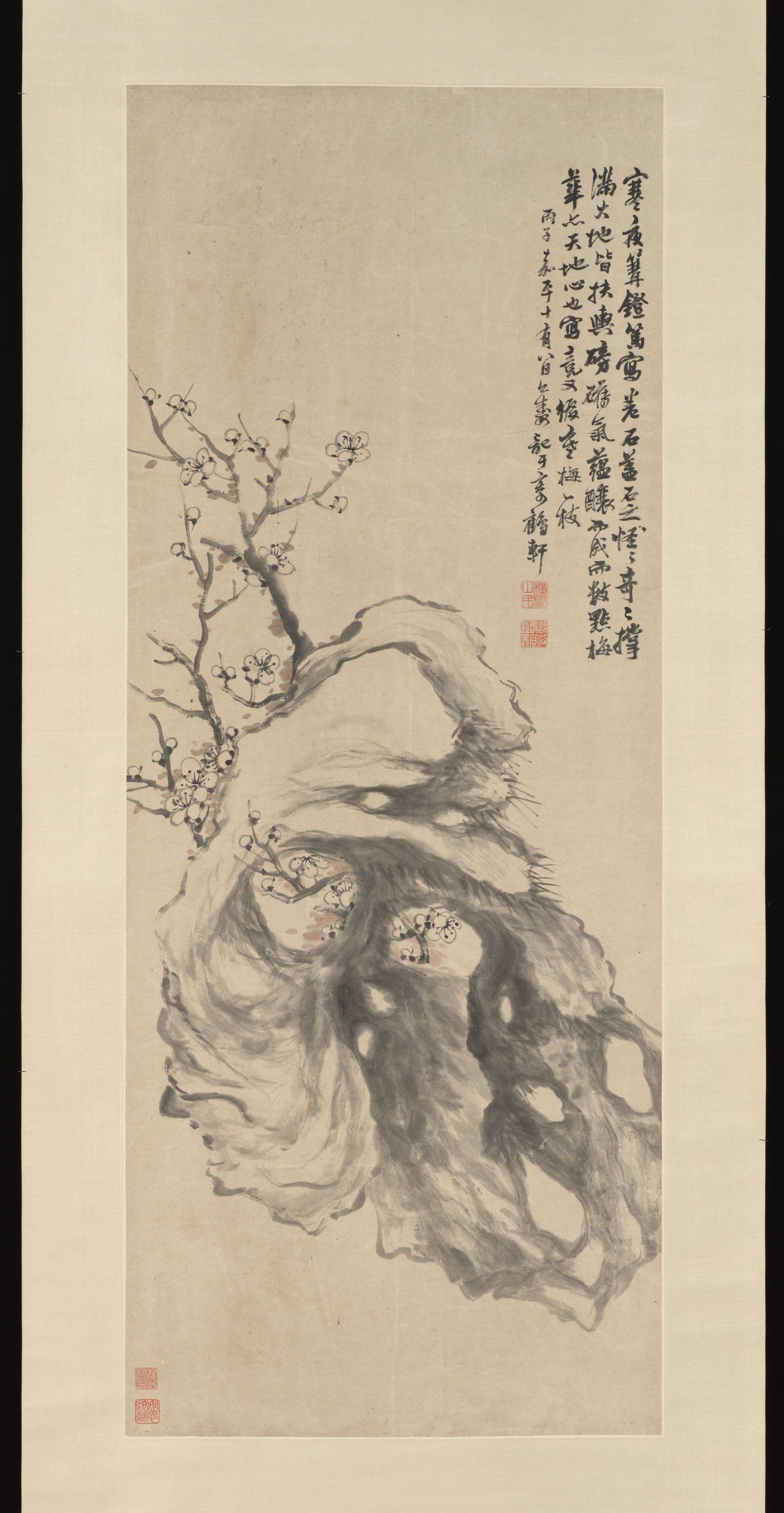
The scroll is open on the table and the first thing that holds you is not the flowers but the branches: black, angular, turning at the joints as though the brush had been stopped by something harder than the painter's hand. Then the blossoms, five pale petals each, a few in ink outline, a few laid in as a single wet dot, and two bare calyxes where the flower has already gone. Nothing else. No ground, no sky, no inscription to explain the mood.
That economy is the whole argument. Ink plum — momei (墨梅), literally "ink plum" — is the most reductive of the Chinese painting genres, and the one that most rewards close reading. Strip out colour and background and what is left is brushwork and decision.
This guide walks you through what momei is and how it differs from the coloured plum, why the subject carried such weight for scholar-painters, how branch structure encodes technique and date, how to read a blossom petal by petal, the four periods that matter, and what to check before you buy a scroll that claims to be old.
What momei is, and what it is not
Plum painting divides into two families, and the division is not merely technical. Hongmei uses colour, usually a red or rose wash for the petals, and sits closer to the decorative and popular tradition. Momei uses ink alone, and it is the branch of the genre the literati claimed as their own.
Colour describes; ink judges. A painter working in ink has only tone and pressure to work with, so every shift in the density of the wash becomes a statement about control. The same is true of the paper: because nothing is hidden under pigment, a hesitating line cannot be corrected, only abandoned and painted again on a fresh sheet.
This is why momei is the genre collectors use to test a painter's reputation. Anyone can make a plum look agreeable in rouge. Very few can make an empty branch look inevitable.
Why the plum, of all flowers
The plum blossoms in the cold, before the leaves, often while snow is still on the ground. For a culture that read plants as moral biography, that fact alone was enough: the flower that opens in hardship and asks for nothing was the scholar out of office, the official in exile, the man who kept his handwriting when keeping his position was easier.
The subject also carried a specific historical charge. After the fall of the Song, plum painting became a way of declining to serve — a private vocabulary of loyalty that could be displayed in a friend's studio without ever being stated. Painters who took office under the Yuan painted plum too, but the association stuck to the genre rather than to individuals.
Add the practical appeal and you have a subject that never went out of fashion. Plum needs no garden, no model and no expensive pigment. A brush, a stick of ink and a sheet of paper are sufficient, which is why the genre attracted amateurs as well as professionals — and why the surviving corpus is so uneven.
The branch is the argument
In momei, the trunk and branches carry more meaning than the flowers, and this is where a forgery usually fails. The structure has a logic borrowed from the tree: an old trunk, gnarled and often broken into segments, from which newer shoots rise at sharp angles.
- Iron-wire line. The main branches are drawn with a slow, pressured line that turns without softening, so the joint reads as a hinge rather than a curve. Look for the pause at each change of direction; a copied branch usually turns in one continuous sweep.
- Dry brush and flying white. Where the brush runs out of ink, the paper shows through in streaks — feibai, "flying white". This should occur where the painter moved fast, not at random, and it should thin as the branch extends.
- The direction of growth. Shoots rise and reach outward; they do not droop like willow. A branch that sags under its own flowers is a late, decorative habit, and a useful dating signal.
- The crossing. Where two branches cross, the nearer one must be visibly darker. Painters who worked from memory rather than observation often get this wrong.
Stand back and ask whether the branch could support the flowers. Then step close and ask whether the brush ever hesitated. Those two questions eliminate most of what is offered as old plum.
Five petals, and what each one costs
The plum flower has five petals, and the count is not negotiable. Two ways of drawing it dominate. In the outlined method the petals are drawn as fine loops and the interior left empty or lightly washed. In the dotted method each petal is a single press of a loaded brush, the shape decided in one movement.
The dotted method is harder and later in prestige. A dot that is too round looks like a bead; too pointed and it becomes a leaf. The best examples are slightly irregular, thinner at the tip, and they overlap without merging.
Then come the details that separate a competent painting from a good one:
- The calyx. Under each flower, five small sepals, usually darker than the petals. Amateurs forget them or draw three.
- The stamens. Fine lines radiating from the centre, each ending in a dot of pollen. They should be sparse and confident; a dense scribble of stamens is a sign of a painter filling space.
- The bud. A closed bud is drawn as a small dark calyx with a sliver of petal showing. It is the most reliable test of a painter's touch, because there is nowhere to hide.
Count the petals on the largest flower first. If the count wanders, put the scroll down.
The high point: Song and Yuan
Ink plum emerges as a recognised subject in the Song. The tradition credits an eleventh-century monk, Zhongren, with the first ink versions, and the anecdote that later painters told — that he learned the flower from its shadow on a window — explains the genre's premise better than any treatise: the plum reduced to silhouette.
By the Southern Song the subject had its masters and, more importantly, its manuals. Song Boren's thirteenth-century woodblock handbook, the Meihua Xishen Pu, fixed the flower into named positions and codified the branch into a grammar that could be taught. Once a subject has a manual, it has a market.
The Yuan is the summit. Wang Mian (1287–1359), a painter from Zhejiang who refused office, produced ink plums in which the branch is drawn with an almost aggressive clarity and the flowers are sparse, dry and placed with great care. His work set the pattern that later painters either followed or deliberately broke, and it is his compositions that the eighteenth-century forgers most often recycled.
Ming and Qing: from statement to specialism
The Ming widened the subject. Xu Wei (1521–1593) painted plum as part of a looser, faster repertoire in which ink is allowed to puddle and run, and the flower becomes an occasion for expressive accident rather than structural display. The change is visible in the paper: Ming plum uses more water.
In the Qing the genre split again. The orthodox painters kept to the Yuan grammar and made it stricter. The Yangzhou group, working for a wealthy salt-merchant market, made it larger, wetter and more theatrical — Jin Nong (1687–1763) painting plum on a scale that assumed a hall rather than a study.
This is the period most collectors actually buy. An eighteenth or nineteenth-century plum scroll by a named but minor painter is obtainable; a Yuan attribution is a museum conversation, and should be treated as one.
Modern plum, and why it still sells
The twentieth century kept the subject and changed its purpose. Wu Changshuo (1844–1927) brought seal-carving stone into the brush and painted plum with a weight that reads almost as sculpture. Qi Baishi (1864–1957) made it popular and deceptively simple. Guan Shanyue (1912–2000) painted plum late in life at monumental scale, and those late works are now the version of the genre most often seen in reproduction.
Modern plum is where the market is deepest and the forgery problem is worst. The demand is genuine, the printing is good, and the difference between a good reproduction and a weak original is often smaller than buyers expect. Read the paper, then read the seals, and treat any signature you cannot compare against a published example as decoration rather than evidence.
What to check before you buy
Work through these in order, and stop at the first one that fails.
- The paper. Old paper cockles at the edges and goes warm; new paper is flat and cold. Hold the scroll at an angle to a window and look for the weave.
- The mounting. A remounted scroll loses its original borders, and with them a dating signal. Silk borders that have been replaced with paper usually mean the piece was repaired in the twentieth century.
- The ink. Age dulls ink and drives it slightly brown at the edges of a stroke. Photocopies and modern prints show a hard, even edge with no bleed.
- The seals. Compare every seal against a published impression, not against your memory. A seal that is crisp on a three-hundred-year-old painting is a warning, not a bonus.
- The inscription. Read the dedication. A poem dated to a year the painter is known to have died is the commonest failure in the market, and the easiest to check.
Condition matters less than you think and provenance more. A repaired scroll with a clean line of ownership is a better purchase than a perfect one with no history, because the repair can be lived with and the history cannot be invented.
Common questions
Is momei always black?
No. Momei means ink plum, but many ink plums carry a faint wash of dilute ink over the petals, and some use a very light blue-grey to suggest shadow. The defining constraint is that the image is built from ink tone rather than from a separate pigment.
How can I tell a print from a painting?
Look at the edge of a stroke under a loupe. A brush leaves a slightly ragged, bleeding edge where the ink meets the paper fibre; a print leaves a hard edge with a visible dot pattern. Paper texture is the second test — a print sits on top of the sheet, a painting sits in it.
Do plum paintings need to be hung?
A hanging scroll is designed to be hung, but not permanently. Three months at a time, out of direct light, is the usual compromise: long enough to be lived with, short enough that the paper is not asked to carry its own weight year after year.
Why are there so many unsigned plum paintings?
Because the subject was a scholar's exercise, and many were painted as gifts, album leaves or practice pieces rather than for sale. An unsigned plum is often a better painting than a signed one, and almost always a worse investment.
Further reading
- The Four Gentlemen in Chinese Painting — how plum sits with orchid, bamboo and chrysanthemum as a single moral programme.
- Bamboo in Chinese Ink — the sibling subject, and the same test of brush control applied to leaves rather than petals.
- Guan Shanyue's Plum Blossoms — the twentieth-century version of the genre at monumental scale.
- Chinese Painting Seals and Collector Marks — how to read the red squares before you trust the signature.
Browse the collection
Ink plum is a subject we write about rather than one we stock in depth, but the same discipline — ink, paper, a single loaded brush — runs through the twentieth-century masters whose archival giclée reproductions we publish. Each is hand-numbered and issued with a Certificate of Authenticity. If you want to see how a dry branch behaves on a modern sheet, start with the collection.
Explore Further