Published August 12, 2026
Cizhou ware explained: the white slip ground, sgraffito and iron-brown painting, workshop-marked pillows, and what separates period pieces from copies.
Turn a Cizhou jar on its side and look at the foot. The clay there is grey or buff, coarse, faintly gritty — nothing like the sugary white body of a Jingdezhen porcelain. Then look at the shoulder of the same pot, where the surface is chalk-white under a glassy clear glaze, with a peony drawn across it in iron-brown. That contrast between what the body is and what the surface pretends to be is the whole idea of Cizhou ware in a single object: an ordinary northern stoneware clay, dressed in white so that it could carry a picture.
This guide covers what Cizhou ware actually is, the decorating techniques you will meet in the market, the forms that dominate surviving material, the stamped family marks found on pillows, and the condition and reproduction problems that decide whether a piece is worth owning.
Cizhou is a family of kilns, not a single kiln
The name misleads almost every new collector. Cizhou (磁州) is a place — the Ci county area of southern Hebei — but Cizhou ware is not the output of one workshop or even one town. It is a decorating tradition shared across dozens of kiln complexes spread through Hebei, Henan and Shanxi, all working the same coarse northern stoneware clays in broadly the same way.
Because production was dispersed, museums and dealers use the hedged term Cizhou-type. That phrasing is not evasion; it is accuracy. Outside of pieces recovered from a documented kiln site, attributing a Cizhou-type jar to one specific kiln is usually more confidence than the evidence supports. A seller who names a precise kiln without excavation evidence is telling you something about their sales patter rather than about the pot.
The tradition ran from the Northern Song through the Jin and Yuan periods, its most inventive stretch, and continued through the Ming and later in simplified form. Crucially, this was commercial ware, not imperial ware. Cizhou pots were made for households, inns, markets and temples. Nobody at court was ordering them. That commercial character explains almost everything else about the ware — the robust potting, the cheerful subject matter, the writing, and the fact that so much of it survives.
If your reference points so far are the refined Song imperial and semi-imperial wares, it is worth reading Cizhou against them. The porcelain-white restraint of Ding ware and the opalescent blue of Jun ware belong to a culture of monochrome surfaces and quiet form. Cizhou belongs to the opposite instinct: draw on it.
The white slip, and what it made possible
The technical heart of Cizhou is slip — liquid clay, here a fine white one, brushed or dipped over the raw grey body before firing. The slip solved a problem. Northern potters had abundant refractory stoneware clay but not the white porcelain stone of the south. Coating the pot in white gave them, cheaply, the pale ground that decoration needs.
Once a white ground existed, several decorating methods followed, and you should learn to tell them apart by touch as much as by eye.
- Painted iron-brown or black slip under a clear glaze. The most familiar Cizhou look: brushed decoration in dark brown-black on white, sealed under a transparent glaze. Run a finger over it and the surface is smooth and continuous — the drawing sits under glass.
- Sgraffito, or carved-through decoration. The potter coats the pot in white slip, then cuts through it so the darker body shows as the line or the ground. You can feel the step where slip has been removed. Backgrounds are often combed or ring-punched to create texture, throwing the reserved white motif forward.
- Cut-glaze (black slip carved away). A dark slip is applied over the white, then carved back so the design appears white against black. High-contrast, graphic, and the hardest of the techniques to fake convincingly, because the carving must be confident and the two slip layers must behave correctly in the fire.
- Overglaze red and green enamels. Developed in the Jin period, these are painted on top of the fired glaze in a second, lower-temperature firing. They matter historically: this is one of the ancestral lines of Chinese overglaze enamel painting, which later flowers at Jingdezhen.
There is one more reason Cizhou matters out of proportion to its humble status. Painting a picture on a white ceramic ground and sealing it under clear glaze is, in technique and in mentality, the direct rehearsal for underglaze blue-and-white. Cizhou potters worked out how a brush behaves on a slip-coated pot centuries before cobalt made the idea famous. Set beside the monochrome glaze tradition, where the glaze itself is the entire event, Cizhou represents the other great line in Chinese ceramics — the pot as a surface for drawing.
The forms you will actually meet
Survival is uneven, and the market reflects it.
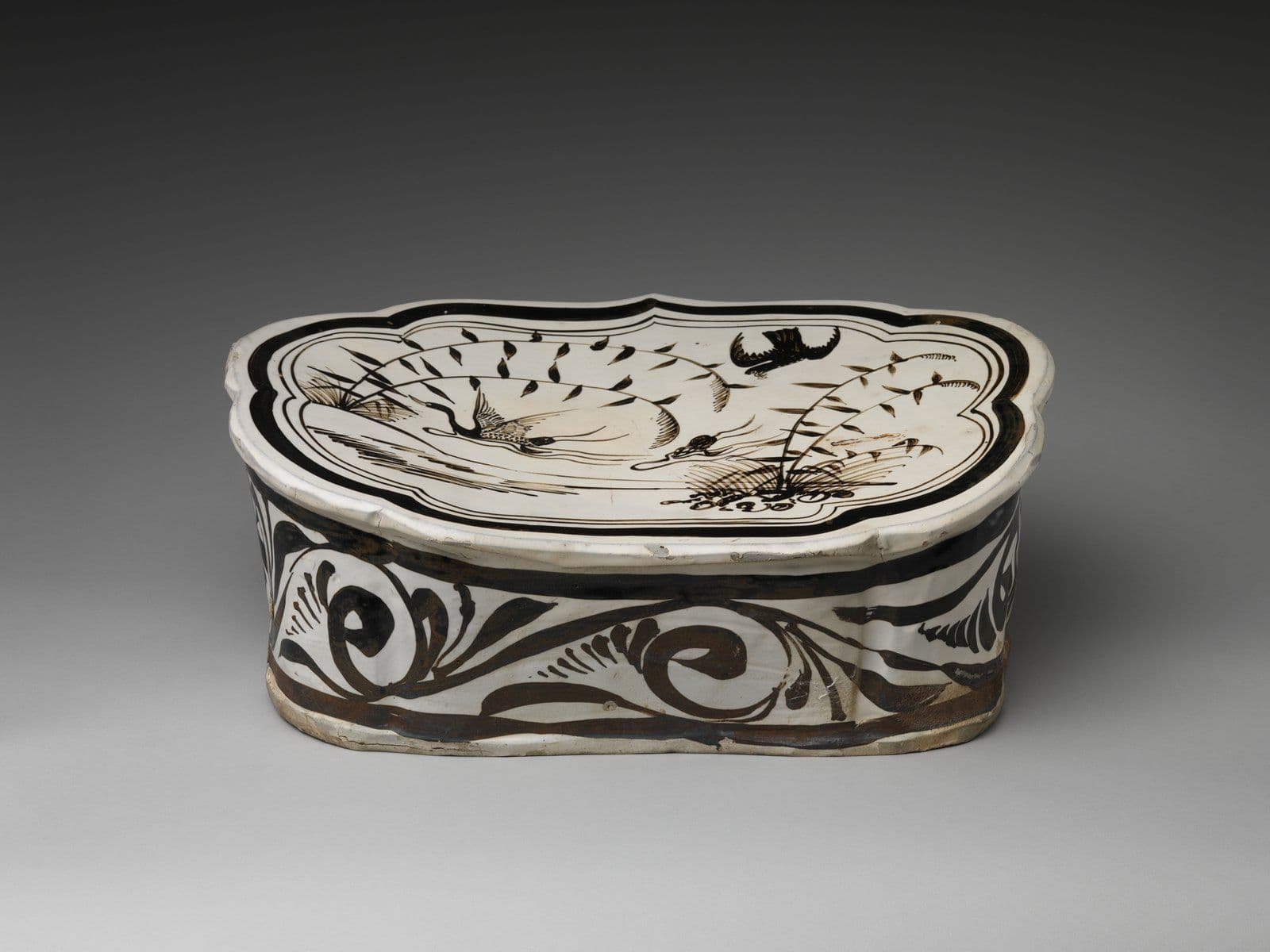
- Pillows. The signature Cizhou form and the one most collectors encounter first. These are ceramic headrests — leaf-shaped, bean-shaped, rectangular boxes, and moulded shapes including recumbent tigers and children. The flat top is a natural picture field, and the best carry lively painted scenes.
- Meiping vases. Tall, high-shouldered, small-mouthed. On a Cizhou meiping the decoration is usually organised in horizontal registers, with a broad main band across the shoulder and belly.
- Storage and wine jars. Robust, wide-bodied, often with bold sgraffito peony scrolls.
- Bowls, basins and ewers. Utilitarian, frequently with a simplified splash or a few brushed strokes rather than a full composition.
The decorative repertoire is worth knowing because it is a dating and authenticity signal in itself. Peony and lotus scrolls, fish among waterweed, birds on branches, boys at play, and — distinctively — writing. Cizhou is one of very few Chinese ceramic traditions that regularly carries text as primary decoration: poems, drinking couplets, proverbs, shop slogans. A pot that tells you to enjoy your wine is doing something no imperial vessel would ever do.
Marks: family workshops, not reigns
This is where Cizhou departs most sharply from the porcelain habits most collectors bring with them. A Cizhou mark is not a reign mark. It is usually a stamped or impressed workshop name, most often on the base of a pillow, and it names a family firm — formulations of the type "made by the Zhang family" being the best known, with other surnames appearing in the same pattern.
Two consequences follow. First, the mark is an attribution of maker, not of date: a family workshop could operate across generations. Second, because these are impressed rather than painted, they behave physically like seals — you read them by raking light across the base, not by looking straight down.
If you are used to working through six-character painted reign marks, the shift in method is worth rehearsing properly; the reading order, the tooling and the fakes are all different for impressed potter's marks than for painted imperial ones, which is the subject of our guide to pottery marks on stoneware.
Dating, condition and copies
Most Cizhou ware on the market has been in the ground. Expect that, and read condition accordingly.
What honest age looks like. Glaze crazing that runs continuously across the surface, with the crackle lines stained evenly by burial rather than only in convenient places. Slip that has flaked at rims and high points where a pot rubs. Foot rims worn smooth in a way that follows how the object actually stood. Iron-brown pigment that has bled very slightly into the glaze rather than sitting on it like ink on paper.
What should slow you down.
- Painting that is too even in tone and pressure. Period brushwork accelerates and thins; a copyist's line is uniform because it was drawn carefully rather than quickly.
- Crackle that is dark everywhere, as though the piece had been soaked in stain — real burial staining is uneven because contact with soil was uneven.
- A body that is too clean, too pale, or too uniformly fine at the foot. The coarse grey-buff clay is the ware's fingerprint, and it is the part most reproductions get wrong.
- Sgraffito with rounded, timid edges. Carving through wet slip leaves crisp shoulders; a mould-made imitation of carving does not.
- Restoration under the rim and at the neck. Sprayed overpaint fluoresces differently under a UV torch, and a torch costs less than a mistake.
Reproduction has been continuous rather than occasional. Cizhou-type wares have been made in the same regions, sometimes by the same methods, for a very long time, and twentieth-century output is abundant. This is not a ware where you can rely on rarity to protect you. Buy from sellers who will state condition in writing, and treat an unconditional "Song dynasty" attribution on an unprovenanced pillow as a claim to be tested rather than a fact to be accepted.
Common questions
Is Cizhou ware porcelain or stoneware?
Stoneware. The body is fired high enough to be hard and largely non-porous, but it is not the white, translucent, kaolin-rich porcelain body of Jingdezhen. This is exactly why the white slip exists — it supplies the pale ground the clay itself could not provide. In practice you can often confirm this at the foot rim, where the unglazed body is visible and reads grey, buff or brownish rather than white.
Why does so much Cizhou ware have writing on it?
Because it was made to be sold to ordinary buyers rather than presented to a court. Inscriptions on Cizhou pieces include poems, popular sayings and convivial phrases, and they served the same purpose as decoration — they made the object appealing on a market stall. It is one of the few places in Chinese ceramics where the pot talks to you in sentences, and it is a large part of the ware's charm for modern collectors.
Were the pillows genuinely used for sleeping?
Yes, though not quite as a Western pillow is used. Ceramic headrests supported the neck rather than cushioning the head, and they were valued in hot weather because the glazed surface stays cool. Some were also made for burial. A pillow with a genuinely worn, slightly polished top and honest chips at the corners is behaving like an object that was used.
Does a stamped family name make a piece more valuable?
Usually somewhat, because it is evidence of origin in a class of material where evidence is scarce, and because marked pillows are a defined collecting category. But a mark is not a guarantee. Impressed marks are straightforward to copy, so the mark should be assessed after you are satisfied with the body, the slip, the brushwork and the wear — never as a substitute for that assessment.
Further reading
- Ru Ware: Imperial Song Ceramics — the courtly opposite of a market ware, and the standard Cizhou was never trying to meet.
- Ge Ware and Crackle Glaze — how deliberate crackle differs from the burial crazing described above.
- Longquan Celadon: A Collector's Guide — the southern green-glazed tradition, and a useful contrast in ambition.
- Jian Ware and Tenmoku Tea Bowls — another Song stoneware where the body does the work.
Browse the collection
Cizhou is a subject we write about rather than one we stock. What Kiln & Ink sells is paper: limited-edition archival giclée reproductions of the twentieth-century Chinese ink masters, printed on xuan paper or museum-grade cotton rag, hand-numbered, and issued with a Certificate of Authenticity.
Explore Further