Published July 15, 2026
Ge ware made cracks the decoration. What crackle glaze is, how the gold-thread-and-iron-wire surface works, and how to tell intentional crackle from damage.
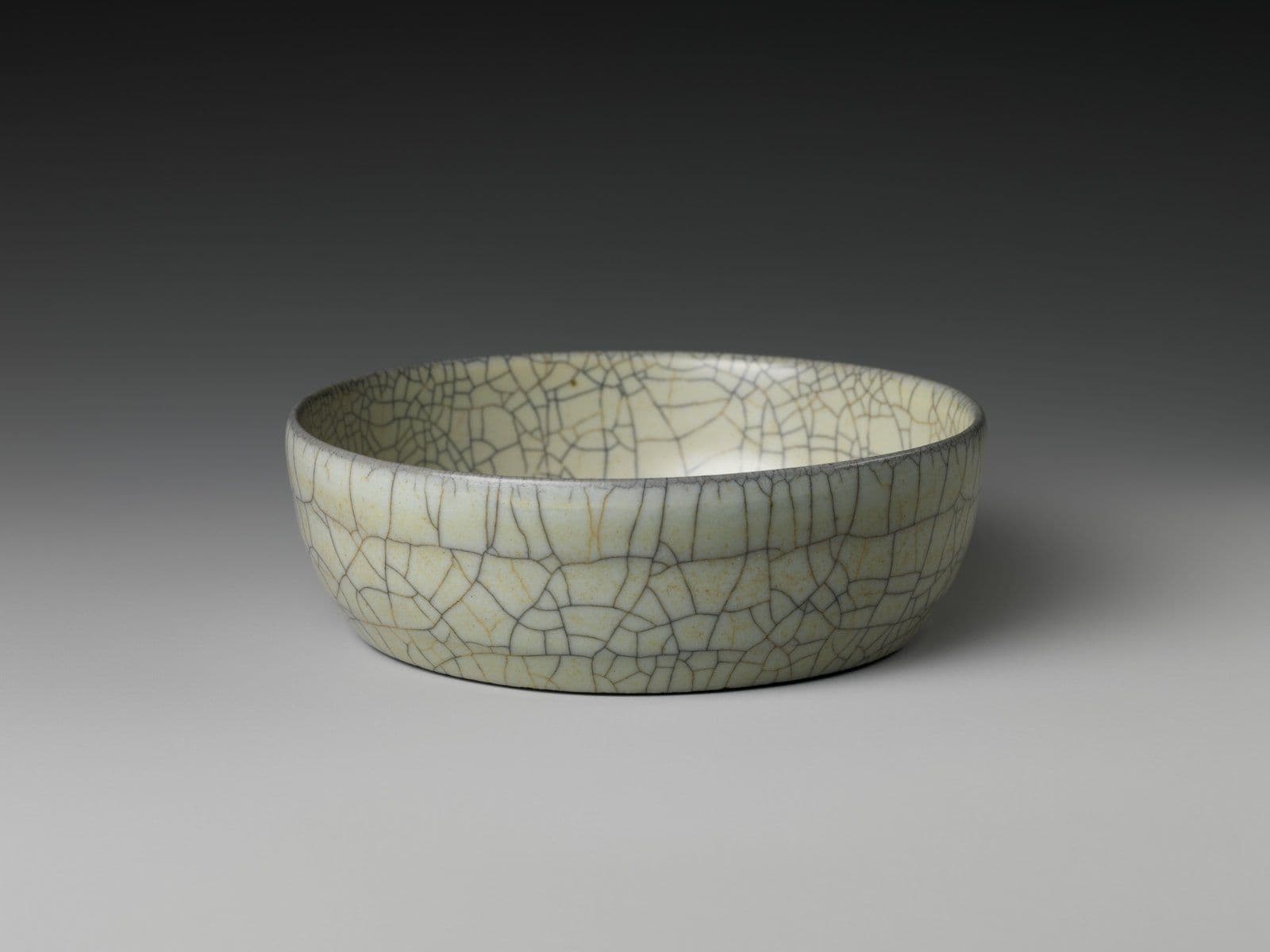
Pick up a Ge-type brush washer and the first thing you notice is that the glaze is shattered — a web of dark lines crossing the whole surface, with a second, finer net of amber threads running between them. On almost any other ceramic, this would be damage. Here it is the entire point: the crackle was induced deliberately, stained deliberately, and has been prized for centuries as one of the most sophisticated surfaces in Chinese ceramics.
This article explains what crackle glaze actually is, what makes Ge ware the most famous expression of it, how to tell intentional crackle from genuine damage, and how the market treats the many later pieces made in the Ge manner.
What crackle is, mechanically
Crackle — also called crazing when unwanted — is a network of fine fractures in the glaze layer only, not in the clay body beneath. It happens when glaze and body contract at different rates as a fired pot cools: if the glaze shrinks more than the body it sits on, it ends up under tension and relieves that tension by cracking, the way drying mud does. Kiln masters who understood the effect could provoke it on purpose by adjusting glaze chemistry and cooling, turning a defect into a decorative language.
Two features of the process matter for collectors:
- Crackle develops over time. The primary network forms as the piece cools — the fine "ping" of new crackle opening is audible for a while after a kiln is unloaded — but glazes under tension can continue to open new, finer lines for years afterward. An old crackle ware surface is a slow event, not a single moment.
- The lines take color. A fresh crackle line is a clean fissure that reads as faint. Potters learned to rub or steep coloring agents — inks, teas, ochres — into the fresh network so the pattern would declare itself. Age and use then darken the lines further as the piece lives its life.
Because the fractures live in the glaze alone, a crackled pot is structurally sound. That distinction — glaze-deep versus body-deep — is the single most useful thing to hold onto when examining a piece, and we will come back to it.
Ge ware: the crackle that defines the category
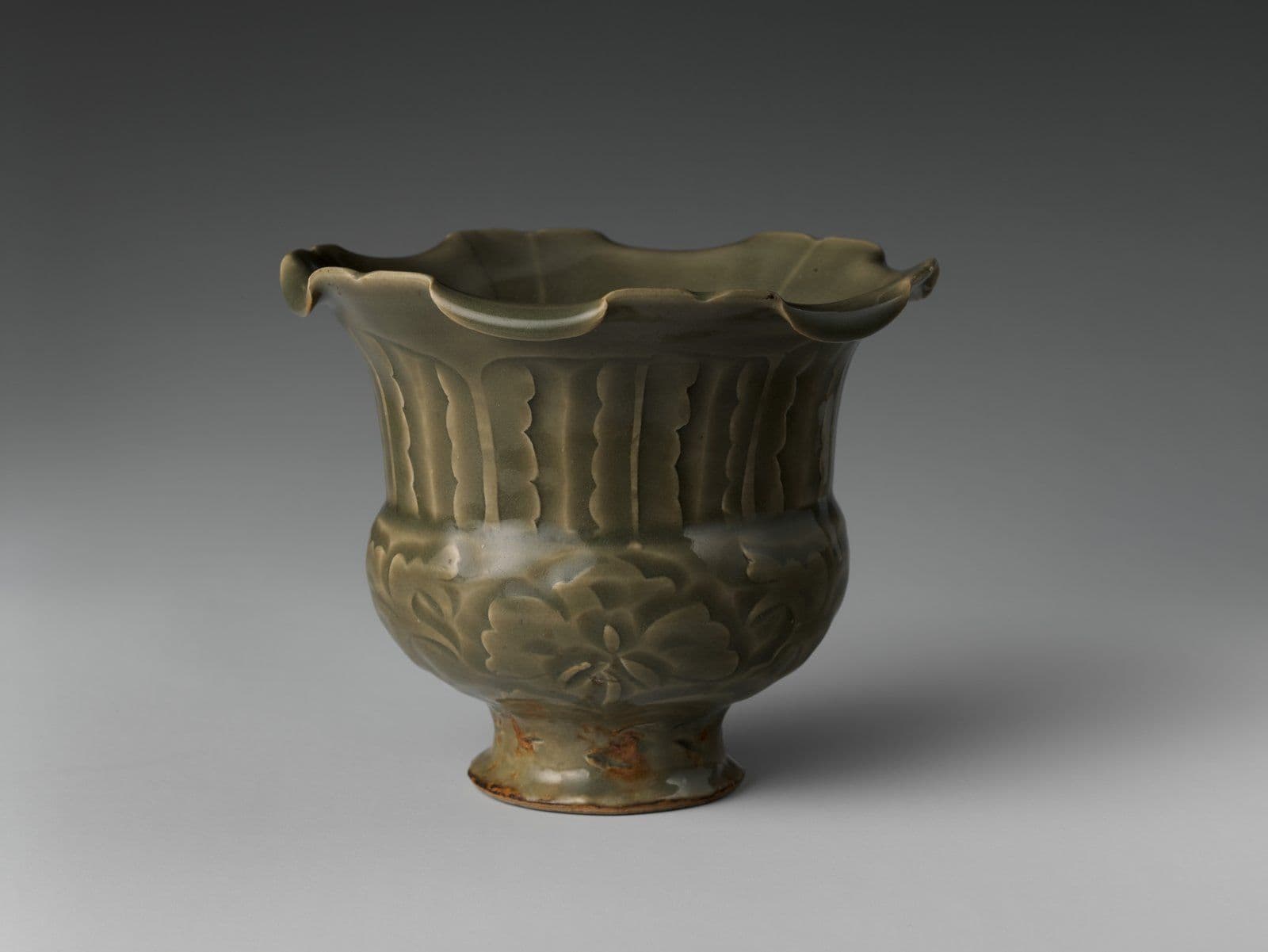
Ge ware (哥窑, "elder brother ware") is counted among the celebrated Five Great Kilns of the Song dynasty — Ru, Guan, Ge, Ding, and Jun — and it is the one whose identity remains genuinely unsettled. No kiln site securely identified as "the" Ge kiln has ever been confirmed, and specialists continue to debate whether the classic heirloom pieces are Southern Song or later. The name itself comes from a story recorded in Ming-period texts: two brothers surnamed Zhang potted in the Longquan region, and the elder brother's kiln — ge means elder brother — produced the crackled ware. The tale is best treated as legend, but it preserves a real association: Ge ware belongs to the same broad tradition as Longquan celadon, the thick-glazed green ware of the same region, minus the crackle.
What makes a classic Ge-type surface recognizable is a set of conventions connoisseurs have named:
| Feature | Chinese term | What you see ||---|---|---|| Double crackle | jinsi tiexian — "gold thread and iron wire" | A bold network of dark, almost black lines (the iron wire) with a secondary net of much finer amber-brown lines (the gold thread) between them || Dark rim | zikou — "purple mouth" | The glaze thins over the rim, letting the dark body tone show through as a brownish line || Iron foot | tiezu — "iron foot" | The unglazed foot ring fires to a dark iron-brown, exposing the dark-bodied stoneware || Subdued glaze | — | An opaque, softly lustrous surface in grey-blue to buff tones, closer to polished stone than glass |
The "gold thread and iron wire" effect is the heart of it: two crackle networks of different scales, stained to two different colors. However it was achieved in each case, the double network against a quiet, thick, opaque glaze produces a surface of extraordinary depth — decoration generated entirely by physics, with no painting at all. In that sense Ge ware belongs with the monochrome glaze tradition: nothing on the surface but the surface itself, and nowhere for quality to hide.
Guan ware — the official Southern Song court ware of Hangzhou, and Ge's closest relative among the Five Kilns — is also characteristically crackled, with a thick, lush glaze over a dark body and often a sparser, bolder network. The two categories shade into each other at the edges, and "Guan-type" versus "Ge-type" is, for heirloom pieces, sometimes a judgment call the auction house makes rather than a fact of manufacture.
Crackle after the Song: imitation as homage
Classic Ge ware was already being treasured, collected, and imitated centuries ago, and the imitations are a collecting category of their own.
The most important are the Jingdezhen Ge-type wares of the Qing dynasty, above all from the Yongzheng and Qianlong reigns, when the imperial kilns set out to reproduce the celebrated Song surfaces in porcelain. These are not fakes in any meaningful sense: they are open homages, frequently bearing their own six-character reign marks on the base, and the best of them are superb objects that command serious prices in their own right. A neat underglaze-blue seal mark on a crackle-glazed piece is telling you plainly that you are looking at a Qing (or later) tribute to the Ge taste, made at Jingdezhen — a different thing from heirloom Ge ware, and honestly labeled as such.
Crackle glazes also spread far beyond the Ge idiom: apple-green crackles over other glazes, large-scale "crab-claw" crackle on later decorative wares, and modern studio and revival pieces from Longquan and Jingdezhen alike. Crackle remained in the potter's repertoire continuously, which is exactly why the surface alone can never date a piece.
Reading a crackled piece in the hand
When you examine a crackle-glazed ceramic — at auction preview, in a dealer's cabinet, or in the family attic — the questions run in this order:
Is the crackle in the glaze or through the body? Intentional crackle lives in the glaze layer only. Run a fingernail across the surface: crackle lines are barely perceptible or invisible to touch, and the interior wall opposite them shows nothing. A structural crack, by contrast, typically registers on both faces of the wall, can often be felt as a step, and may show at the rim as a start point. On the foot rim, where the body is exposed, damage shows as body cracks; crackle stops where the glaze stops.
Is the staining consistent with age? On old pieces the crackle color is settled, uneven in the way accumulated grime is uneven, and denser where handling was densest. Freshly stained crackle on a piece sold as old — uniform, chemical-looking color sitting identically in every line — is a warning sign. So is a "double network" where the gold threads and iron wires are suspiciously tidy: on the classic surfaces the two networks interpenetrate irregularly.
Does the whole object agree? Rim tone, foot color, glaze texture, weight, and form must all tell the same story. A bright white porcelain body showing at the foot of a piece offered as heirloom Ge-type stoneware is a contradiction; dark-dressed feet exist, and dressing is itself worth noticing. Marks, where present, should be read against the usual references — a reign mark makes a piece a candidate for the Jingdezhen homage tradition, and the master guide to Chinese porcelain marks is the place to start.
What is the honest ceiling? Heirloom-quality Ge and Guan pieces with old provenance are museum-grade rarities; the overwhelming majority of crackle-glazed objects in circulation are Qing homages, later decorative wares, or modern pieces. That is not a reason to avoid the category — Qing Ge-type is a rewarding field with real connoisseurship in it — but it is a reason to price surfaces, not stories.
Common questions
Is crackle glaze a defect or a decoration?
Both, depending on intent. As an accident (crazing), it is a glaze-fit fault that potters worldwide try to eliminate. In the Chinese tradition descending from Guan and Ge ware, it was provoked, controlled, and stained deliberately as the entire decorative program of the piece. The mechanics are identical — glaze under tension cracking as it cools — the difference is whether the kiln wanted it.
Does crackle weaken a piece?
Not structurally. The fracture network is confined to the glaze layer; the clay body beneath is intact, which is why crackled wares have survived centuries of use. The practical caveat is liquid: an unsealed crackle network can absorb what it touches and stain unpredictably, so crackled vessels should not be soaked or used to hold liquids — treat them as display porcelain, with the usual care rules.
How do I tell Ge ware from Guan ware?
For heirloom pieces, sometimes only tentatively — the categories overlap and specialists disagree at the margins. The conventional handles: Ge-type shows the double "gold thread and iron wire" crackle in a greyer, more opaque glaze, while Guan-type tends to a lusher, thicker glaze with a sparser, bolder network. Both share the dark rim and iron-toned foot. For pieces at auction, read the catalogue attribution carefully — "Ge-type" is a description of manner, not a warranty of Song date.
Are Qing dynasty Ge-type pieces worth collecting?
Yes, on their own terms. Yongzheng and Qianlong Jingdezhen recreations of the Ge surface are accomplished imperial porcelain, honestly marked, and firmly established in the market. They are the realistic way to own the Ge aesthetic, since heirloom Song-attributed pieces essentially never circulate. Judge them as Qing imperial ware: mark quality, glaze quality, form, condition, and provenance.
Why would anyone stain the cracks?
Visibility. An unstained crackle line is nearly invisible — a hairline of refraction. Rubbing ink, tea, or mineral color into the fresh network turns an invisible fault into a drawn pattern, and using two colors at two scales (the gold thread and iron wire) turns it into a composition. It is decoration by controlled accident, then made legible by hand.
Further reading
- Yongzheng Reign Marks: Identification Guide — reading the marks on the finest Qing Ge-type homages.
- How to Care for Chinese Porcelain — handling and display rules that protect a crackled surface.
- How to Spot Fake Chinese Porcelain Marks — the mark-side checks for crackle pieces carrying reign marks.
- How to Photograph a Porcelain Mark for Authentication — building the record a specialist needs for an opinion.
Browse the collection
Porcelain is a subject we write about rather than one we stock. What Kiln & Ink sells is paper: limited-edition archival giclée reproductions of the twentieth-century Chinese ink masters, each one hand-numbered and issued with a Certificate of Authenticity.
Explore Further