Published July 12, 2026
A collector's guide to Chinese monochrome porcelain glazes: sang-de-boeuf, peachbloom, celadon, imperial yellow, tea-dust and more — eras, tells, evaluation.
Chinese Monochrome Glazes: Sang-de-Boeuf, Celadon & Beyond
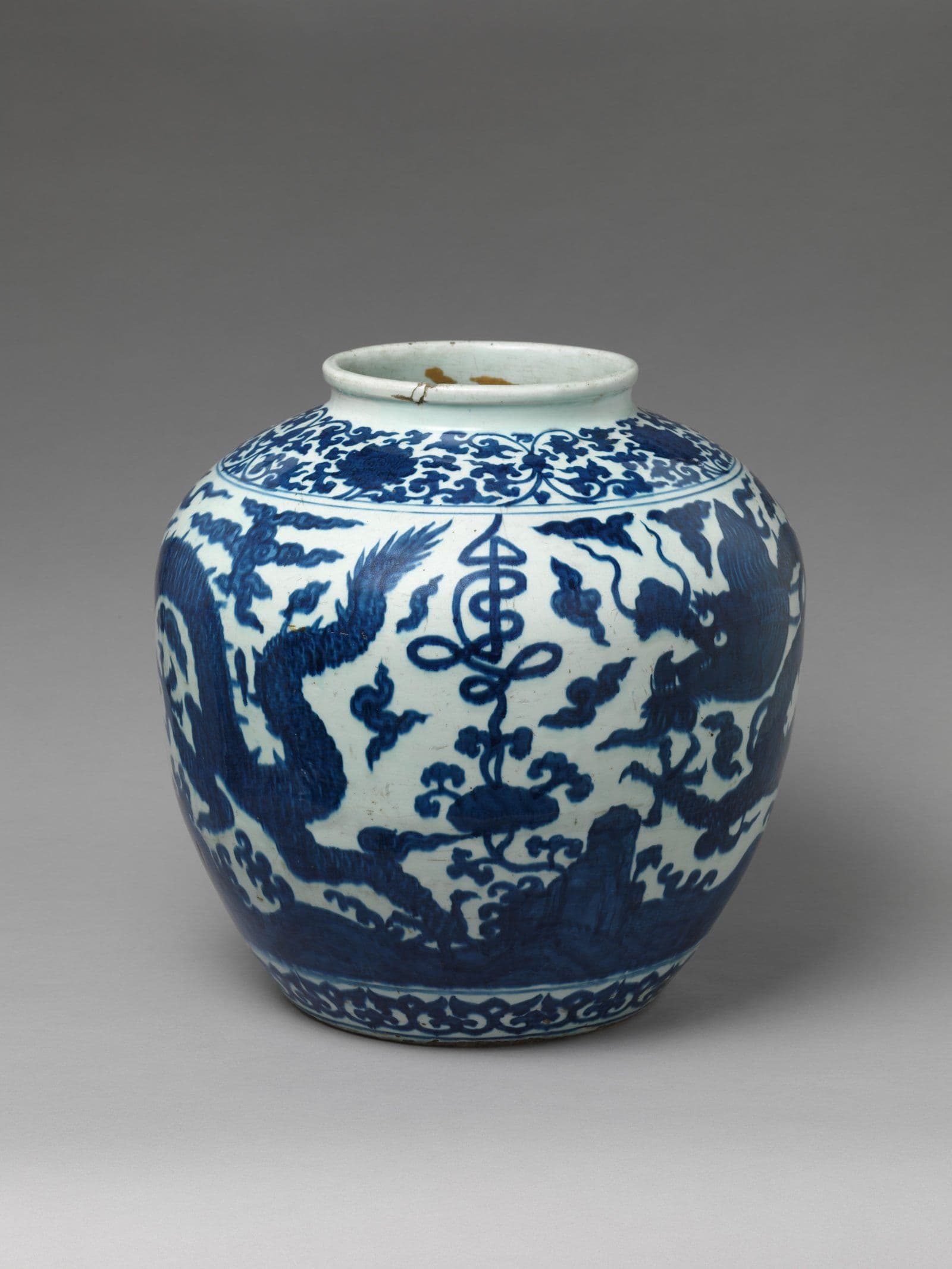
Put two Qing vases side by side in an auction preview: one covered edge to edge in painted figures and flowers, the other a single unbroken sheet of deep red glaze. Newcomers assume the painted vase is the prize. Quite often the estimate says otherwise — and the plain red one carries it.
Monochrome porcelain is where Chinese ceramics is at its most technically exposed. With no decoration to carry the eye, everything depends on body, glaze chemistry, and firing control, and every flaw shows. This guide walks through the major monochrome glaze families a collector will actually meet — what they look like, when they were made, and how to evaluate a piece on its own terms.
Why a plain vase can outrank a painted one
Three forces put monochromes at the top of the hierarchy.
First, difficulty. A painted vase can hide a mediocre glaze under decoration; a monochrome cannot. Colors derived from copper in particular are notoriously sensitive to kiln atmosphere — a few degrees or a shift in oxygen and the red fires grey, liver-brown, or vanishes entirely. Success rates for the great copper-red glazes were low, and the surviving successes were treasured accordingly.
Second, ritual. At the Qing court single colors were not a taste, they were a regulation: altar vessels were color-coded to the ceremony, with blue associated with the Altar of Heaven, yellow with the Altar of Earth, red with the Sun, and white with the Moon. Yellow, the imperial color, was restricted at court by rank. A monochrome was often not a decorative choice but a statement of function and privilege.
Third, taste. The scholar-official tradition prized restraint — the same sensibility that ranked an ink landscape above a gold-and-green one. A perfect single glaze, like a perfect line of calligraphy, shows cultivation precisely because it declines to impress by quantity. That said, connoisseurs treat monochromes and the great painted palettes as parallel achievements, not rivals — for the painted side of the story, see our guide to famille rose versus famille verte enamels.
The Song foundation: celadon and the crackle wares
Chinese monochrome taste was codified in the Song dynasty (960–1279), and every later dynasty measured itself against it.
Celadon is the family every collector meets first: iron-tinted glazes fired in reduction to greens ranging from olive to a soft blue-green. The Longquan kilns of Zhejiang made the classic thick, jade-like celadons of the Southern Song, with unctuous glazes that pool deeper in carved recesses. Celadon was continuously imitated and revived for the next seven centuries, so period judgment leans heavily on body material and foot finishing rather than color alone.
Ru ware sits at the apex of the canon — a soft, agate-inflected blue-grey glaze made for the Northern Song court over a famously short span. Complete surviving pieces are counted in the dozens worldwide, which is why Ru ware functions more as a benchmark than a collecting category; what the market actually trades are the later imitations, especially the excellent Yongzheng ones.
Guan and Ge wares turned a defect into an aesthetic: deliberate crackle, the network of fine glaze fractures produced by mismatched shrinkage between glaze and body, often emphasized with dark staining. The best pieces layer large and small crackle networks together. Song originals are museum territory, but the crackle aesthetic became a permanent part of the monochrome vocabulary, imitated with real sophistication under the Qing.
The copper-red family: sacrificial red, sang-de-boeuf, peachbloom
Copper red is the drama queen of Chinese glazes — the hardest classical color to fire, lost and recovered more than once, and the source of three glazes every collector should be able to tell apart.
Sacrificial red (祭红) is the early Ming achievement: a deep, even, matte-leaning red associated with the Xuande period, made for altar use. The Ming formula was subsequently lost — court records complain about failed red wares for generations — which set the stage for the most famous revival in ceramic history.
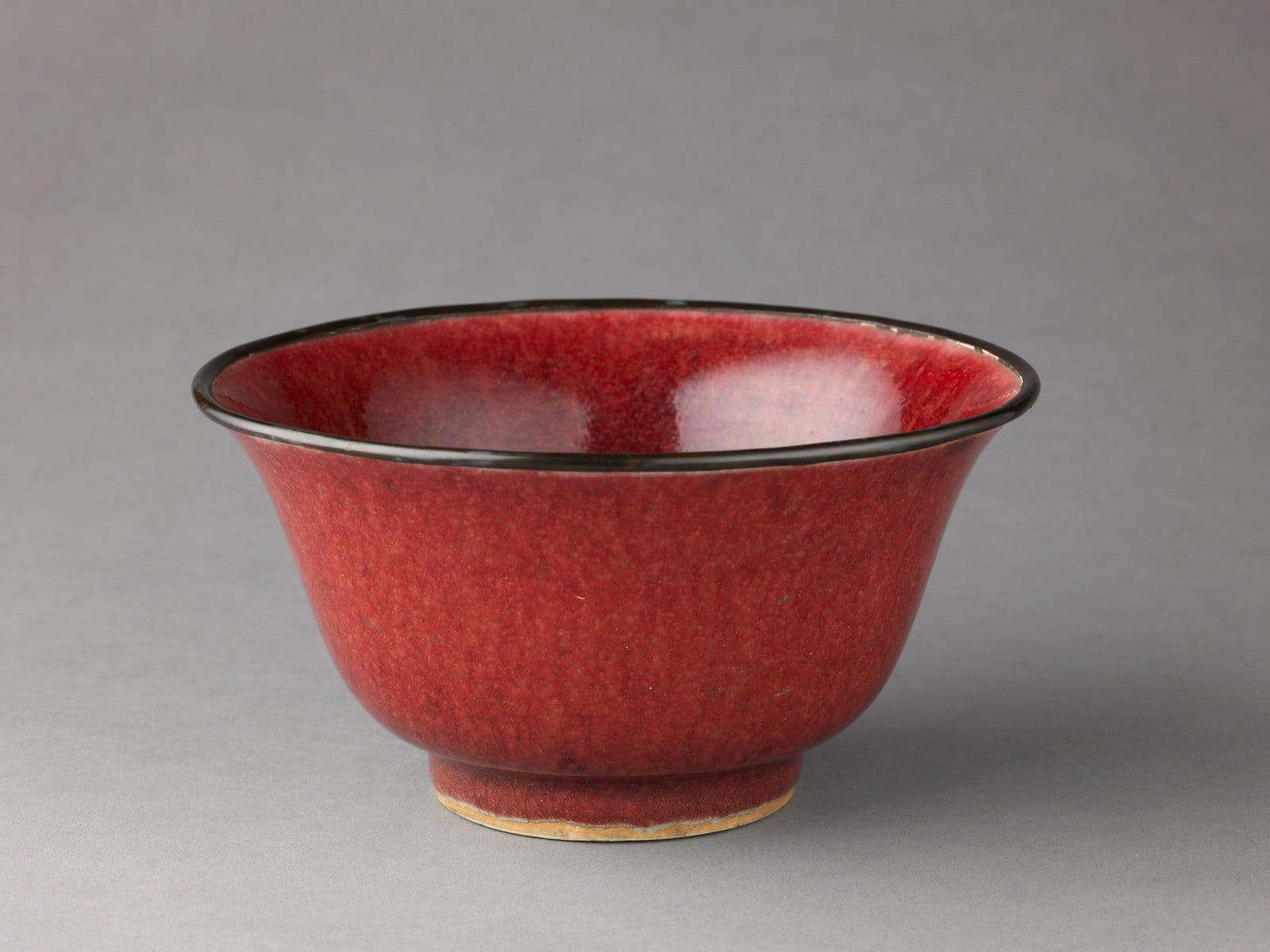
Sang-de-boeuf, or langyao red (郎窑红), is the Kangxi-era recovery, traditionally associated with the imperial kiln directorship of Lang Tingji in the early eighteenth century. The glaze is glassy, deep, and mobile: it thins to a pale line at the lip, deepens down the body like pooled oxblood — the French name means exactly that — and stops just short of the foot in a controlled roll. That "stopped at the foot" behavior is a quality test in itself: on the best pieces the glaze halts as if commanded; on lesser and later ones it is ground back or runs onto the foot rim. The base often fires to a crackled pale "apple green" or buff tone.
Peachbloom (豇豆红) is copper red domesticated — a soft pink-red suffused with green and russet mottling, produced by blowing the copper pigment onto the glaze in layers. It was reserved almost exclusively for a small canonical set of scholar's-desk objects: water pots, brush washers, seal-paste boxes and the like, in sizes that fit the hand. The charm is in the mottling — "beauty's blush" passages against moss-green flecks — and the market has prized peachbloom continuously since the nineteenth century.
The wider Qing palette: a field guide
The Kangxi, Yongzheng, and Qianlong reigns (1662–1795) turned the monochrome tradition into a systematic research program, reviving lost glazes and inventing new ones. The table below covers the colors a collector is most likely to encounter, and our master guide to Chinese porcelain marks covers the reign marks that usually accompany them.
| Glaze | Appearance | Classic period | Collector's note ||---|---|---|---|| Sweet white (甜白) | Warm, sugary white, often with faint incised decor | Yongle (early Ming) | The Ming benchmark for white; later Dehua "blanc de Chine" is a separate southern tradition || Imperial yellow (娇黄) | Clear lemon-to-egg yellow | Hongzhi (Ming) apex; Qing continuations | Restricted color; Hongzhi examples are the connoisseur's gold standard || Clair-de-lune (天蓝) | Pale moonlit blue | Kangxi | Mostly small scholar's objects; prized for quiet perfection || Mirror black (乌金) | Deep glossy black, sometimes with gilt traces | Kangxi | Gilding often worn away — check for ghost patterns || Tea-dust (茶叶末) | Matte olive-brown with crystalline speckle | Yongzheng–Qianlong | Iron crystalline glaze; often bears incised seal marks || Robin's-egg (炉钧) | Mottled turquoise-and-blue suffusion | Yongzheng onward | A low-fire second glaze; look for even, lively mottling || Celadon revivals | Even sea-green over carved decor | Yongzheng–Qianlong | Qing celadons are thinner and more uniform than Song Longquan |
Two reigns deserve special mention. Yongzheng monochromes are generally considered the most refined of the Qing — the emperor's taste ran to archaism and quiet perfection, and the imitations of Song Ru, Guan, and Ge wares made under his kilns can be superb objects in their own right (the reign's marks are covered in our Yongzheng reign marks guide). The Qianlong kilns, under the celebrated supervisor Tang Ying, pushed technical range further still, though connoisseurs often find the results more virtuosic than moving.
How to evaluate a monochrome in the hand
Because there is no decoration to distract, evaluation concentrates on a short list of physical tells:
- Glaze quality first. Look for depth, evenness, and life. Tilt the piece in raking light: the best glazes have optical depth — color that seems to sit in the glaze rather than on it. Dead, uniform, spray-flat color is a modern signature.
- Read the lip and the foot. Mobile glazes like sang-de-boeuf thin at the rim and gather low on the body; how the glaze terminates at the foot separates great from ordinary. The unglazed foot rim itself is a dating document — body color, finishing style, and wear are covered in our guide to reading the foot rim.
- Check the base and mark together. Many Qing monochromes carry reign marks, and apocryphal marks are everywhere; the mark's calligraphy, layout, and glaze must agree with the body they sit on.
- Expect honest wear. Scholar's objects were handled daily. Soft, consistent wear on high points and foot rim is reassuring; either razor-fresh perfection or theatrical, uniform "antiquing" deserves suspicion.
- Beware of ground-down rims and refired repairs. A monochrome surface makes restoration easier to hide than on painted wares; run a fingertip around lip and foot for suspicious smoothness, and use UV light where possible.
Common questions
What does "sang-de-boeuf" mean, and is it the same as oxblood?
Yes — sang-de-boeuf is simply French for "ox blood," the name nineteenth-century Western collectors gave the deep copper-red glaze the Chinese call langyao red (郎窑红). The glaze was a Kangxi-period recovery of the lost Ming sacrificial red, and its signature behavior is tonal movement: pale at the lip, deepening down the body, stopping neatly above the foot. "Oxblood" and "sang-de-boeuf" are interchangeable in dealer usage.
Why are peachbloom pieces so small?
Peachbloom glaze was applied by blowing copper pigment onto the surface in multiple thin layers, a fussy process that suited small objects and produced its best effects at desk scale. The glaze was reserved essentially for scholar's-desk wares — water pots, brush washers, small vases — made for the Kangxi court. The intimacy is the point: these were objects to be handled at arm's length, not displayed across a hall.
Are monochromes safer to buy than painted porcelain?
They remove one class of risk and concentrate another. There is no painted decoration to fake badly — but glaze, body, and foot must carry the entire attribution, and later copies of famous monochromes have been made continuously for centuries, including excellent ones. Judge the glaze's depth and behavior, the foot finishing, and the mark as a single consistent package, and weigh provenance heavily for high-value pieces.
Which monochrome is the best entry point for a new collector?
Later Qing and Republic-period monochromes — celadons, tea-dust, sang-de-boeuf descendants — offer honest, well-made glazes at accessible prices, and they teach the eye the same lessons as their imperial ancestors: how glaze pools, how feet are cut, how wear accumulates. Learning on them costs little, and the knowledge transfers directly upmarket.
Further reading
- Why Some Chinese Porcelain Marks Have a Double Circle Around Them — a Kangxi-era convention you'll meet on monochrome bases.
- Tongzhi & Guangxu Marks: Late Qing Imperial Output — where many affordable monochromes actually date from.
- How to Photograph a Porcelain Mark for Authentication — glaze and base shots that experts can actually use.
- How to Care for Chinese Porcelain: Cleaning, Display, and Storage — monochrome surfaces show every scratch; handle accordingly.
Browse the collection
We do not sell ceramics. The Kiln & Ink collection is limited-edition archival giclée reproductions of Qi Baishi, Xu Beihong, Wu Guanzhong, Zhang Daqian and their contemporaries — hand-numbered, printed on rice paper, and supplied with a Certificate of Authenticity.
Explore Further