Published August 5, 2026
Jun ware explained: how the sky-blue glaze gets its colour, the copper-red splashes, numbered flowerpots, and what is realistic to buy today.
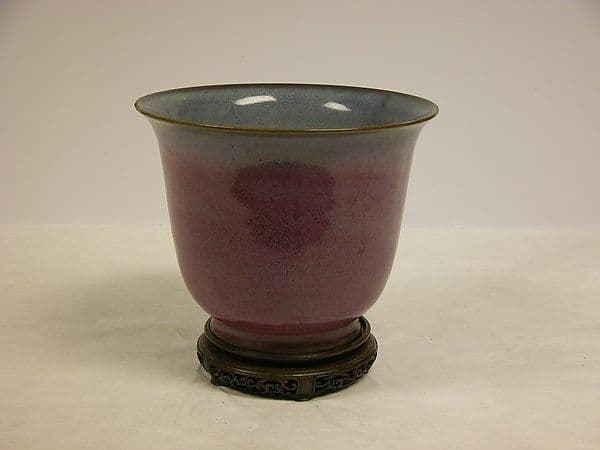
Line up the classic Song glazes and Jun is the one that looks like weather. Ru is a quiet grey-green, Ding an ivory white, Ge a net of crackle — and then a Jun bowl arrives looking like sky after rain, an opalescent blue that seems lit from within, sometimes struck through with a cloud of plum purple or a single splash of crimson. No other ware in the Chinese tradition puts colour to work this way, which is why Jun has been imitated for eight centuries and why learning to read the real thing repays the effort.
This guide covers what Jun ware is, how the glaze actually gets its colour, what the numerals under the famous flowerpots mean, and what a collector can realistically expect to find and afford.
What Jun ware is
Jun is a high-fired stoneware from northern Henan province, made at kiln complexes centred on Juntai in present-day Yuzhou, with related kilns spread across the surrounding counties. Tradition counts it among the Five Great Wares of the Song — alongside Ru, Guan, Ge and Ding — and production ran from the Song through the Jin and Yuan periods, with the glaze type revived repeatedly ever since.
The ware splits into two families that the market treats very differently. Ordinary Jun — bowls, dishes, jars and censers — carries the thick sky-blue glaze, with or without purple markings, and was made in quantity over a long period. So-called "numbered Jun" or official Jun is a small, grand group: flowerpots, pot stands and bulb bowls in sculptural shapes, glazed in richer blues and purples, each incised on the base with a Chinese numeral from one to ten. These were palace objects — the numbers are a size register, with one the largest and ten the smallest — and nearly all known examples sit in museum collections.
The glaze: how the blue happens
The first thing to understand about Jun blue is that it is not a pigment. There is no cobalt in the glaze. The colour is optical: during firing and cooling, the thick glaze separates into microscopic droplets of glass within glass, and that emulsion scatters short-wavelength light — the same physics that makes the sky blue. Depending on thickness, firing and cooling, the result runs from a milky "moon white" through sky blue to deep lavender, and the glaze has a depth and softness that a painted colour cannot fake.
The purples and reds are a second invention layered on the first. Potters at the Jun kilns learned to apply copper to the glaze and fire it in reduction, producing splashes that flare from rose to crimson to aubergine — the earliest sustained, deliberate use of copper red in Chinese ceramics, centuries before the technique was tamed into the even monochrome reds covered in our guide to Chinese monochrome glazes. On ordinary wares the splash sits like a cloud on the blue; on numbered pieces the copper can flood whole surfaces in rose-purple.
Connoisseurship has its own vocabulary for all this, worth knowing because dealers and auction catalogues still use it:
| Term | Meaning || --- | --- || Tianlan ("sky blue") | The classic mid-tone opalescent blue || Yuebai ("moon white") | The palest, milkiest end of the range || Meiguizi ("rose purple") | The rich copper purple seen on numbered flowerpots || Haitang red | A redder flare, named after the crab-apple blossom || Earthworm tracks | Wandering lines in the glaze where early cracks healed in the kiln, prized on numbered Jun |
Numbered Jun and the dating question
The numbered flowerpots are where Jun scholarship gets genuinely contentious, and a collector should know the argument exists. The traditional account makes them Northern Song imperial commissions, linked by lore to the garden-building ambitions of the Huizong court. Much modern scholarship disagrees: excavation evidence from the kiln sites and laboratory dating of sherds have pushed many specialists toward an early Ming date for the numbered group, tying the shapes to Ming palace furnishing rather than Song garden fantasy. Museums currently label these pieces both ways, and the literature is honest about the impasse.
For the market the practical effect is smaller than you might expect — the objects are so rare that authenticity matters far more than which century of imperial patronage they belong to. But the debate is a useful reminder of something broader: Jun was made, and remade, across many centuries, and "Song Jun" as a blanket label deserves the same scepticism as any reign mark. Ordinary wares are more safely thought of as Song-to-Yuan, with Yuan pieces tending coarser, heavier and more sparsely splashed.
How to read a Jun piece in the hand
Weight first. Jun is stoneware under a very thick glaze, and a genuine bowl has a dense, settled heft. The body, where you can see it at the foot, fires grey to olive-brown, and the foot is typically dressed with a brown wash. The glaze stops short of the foot in a thick, rolled edge — run a fingertip under the pooled rim and you feel how much glass is actually there.
Then the rim. Where the glaze thins over the lip, the blue gives way to a band of olive, mushroom or brown — one of the most reliable tells of the type, and something imitations often get wrong by keeping the blue uniform to the edge. Look into the glaze rather than at it: real Jun has depth, with faint bubbles, drifts and unevenness suspended in the thickness, and on some pieces the wandering "earthworm track" lines where the glaze healed itself in the kiln.
Finally, place the piece in its family tree, because Jun's admirers are part of the identification problem. Guangdong's Shiwan kilns built a whole tradition — sometimes called Guangjun — on thick, streaked Jun-style glazes, discussed in our guide to Shiwan pottery; Yixing potters made their own "Yijun" versions; and the modern revival centred on Shenhou town in Yuzhou keeps the glaze alive today, in workshops whose best output is honest craft and whose worst is aged, dirtied and sold as Song. Modern copies tend to give themselves away with even, glassy glazes, tidy feet, wrong weight and surfaces that have been chemically dulled rather than worn.
What is realistic to buy
Numbered Jun is effectively out of reach — the pieces are rare, tightly held, and when one does surface at auction it competes at the level of important imperial porcelain. That is not where a private collector starts.
The realistic market is ordinary Jun: bowls, dishes, small jars and censers of the Song, Jin and Yuan periods. Plain sky-blue pieces are the most affordable entry into any of the Five Great Wares; a well-formed bowl with a good purple splash costs meaningfully more, with price tracking the beauty of the splash, the quality of the glaze, and condition. The usual condition vocabulary applies — hairlines, rim frits, star cracks and restoration, all covered in our porcelain condition guide — and because the glaze is so thick, restoration can hide well; a UV lamp is worth using on any candidate piece.
Buy for the glaze above all. Two bowls of the same date and shape can differ enormously in the life of their blue and the grace of their splash, and the better glaze will always have been the better purchase. A modest dish with real depth of colour is a finer object than a bigger piece with a flat, tired surface.
Common questions
Is Jun ware porcelain?
Strictly, no — it is high-fired stoneware. The body is dense and grey rather than white and translucent, and everything Jun does, it does with glaze rather than body. In practice the ware is discussed, sold and collected alongside Chinese porcelain, and auction houses catalogue it within Chinese ceramics. The distinction matters mainly for understanding the object: the thick opalescent glaze over a dark body is the whole aesthetic.
Why do some Jun pieces have numbers on the base?
The numerals one to ten appear on the "official" group of flowerpots, stands and bulb bowls, and they record size — one is the largest of a shape, ten the smallest, which allowed pots and stands to be matched in the palace. Whether these numbered pieces are Northern Song or early Ming is a live scholarly argument, but the numbering system itself is well understood.
How can I tell Jun from Shiwan or modern imitations?
Look at the body, the rim and the depth of the glaze. Jun fires grey-olive with a brown-washed foot and a thick rolled glaze edge; Shiwan Guangjun sits on a darker Guangdong stoneware and its streaked glazes behave differently from Jun's suspended opalescence. Modern Shenhou copies are often too even — uniform blue to the rim, glassy surface, tidy foot — and lack the internal drift and bubbles of the old glaze. When in doubt, weight and rim colour are the fastest checks.
What should a first Jun purchase be?
A Song-to-Yuan bowl or dish with an honest glaze and no ambitions to be more than it is — ideally from a seller who states condition plainly and welcomes a UV check. Choose the piece with the most alive blue you can afford, with or without a splash, and treat any grand attribution (palace, numbered, "imperial Song") as a claim requiring an entirely different level of proof.
Further reading
- Ding Ware: The White Porcelain of the Song — the ivory-glazed member of the Five Great Wares.
- Jian Ware and Tenmoku Tea Bowls — the black-glazed Song tea bowls and their effects.
- Ge Ware and the Crackle Glaze — the deliberately crazed glaze and its double crackle.
- Longquan Celadon: A Collector's Guide — the green-glazed counterpart from the southern kilns.
Browse the collection
Ceramics are a subject we write about rather than one we stock. What Kiln & Ink sells is paper: limited-edition archival giclée reproductions of the twentieth-century Chinese ink masters, each hand-numbered and issued with a Certificate of Authenticity.
Explore Further