Published August 11, 2026
Chinese pottery marks explained: impressed potter's seals on Yixing teapots, Shiwan figures and Cizhou stoneware, and what a pottery mark can prove.
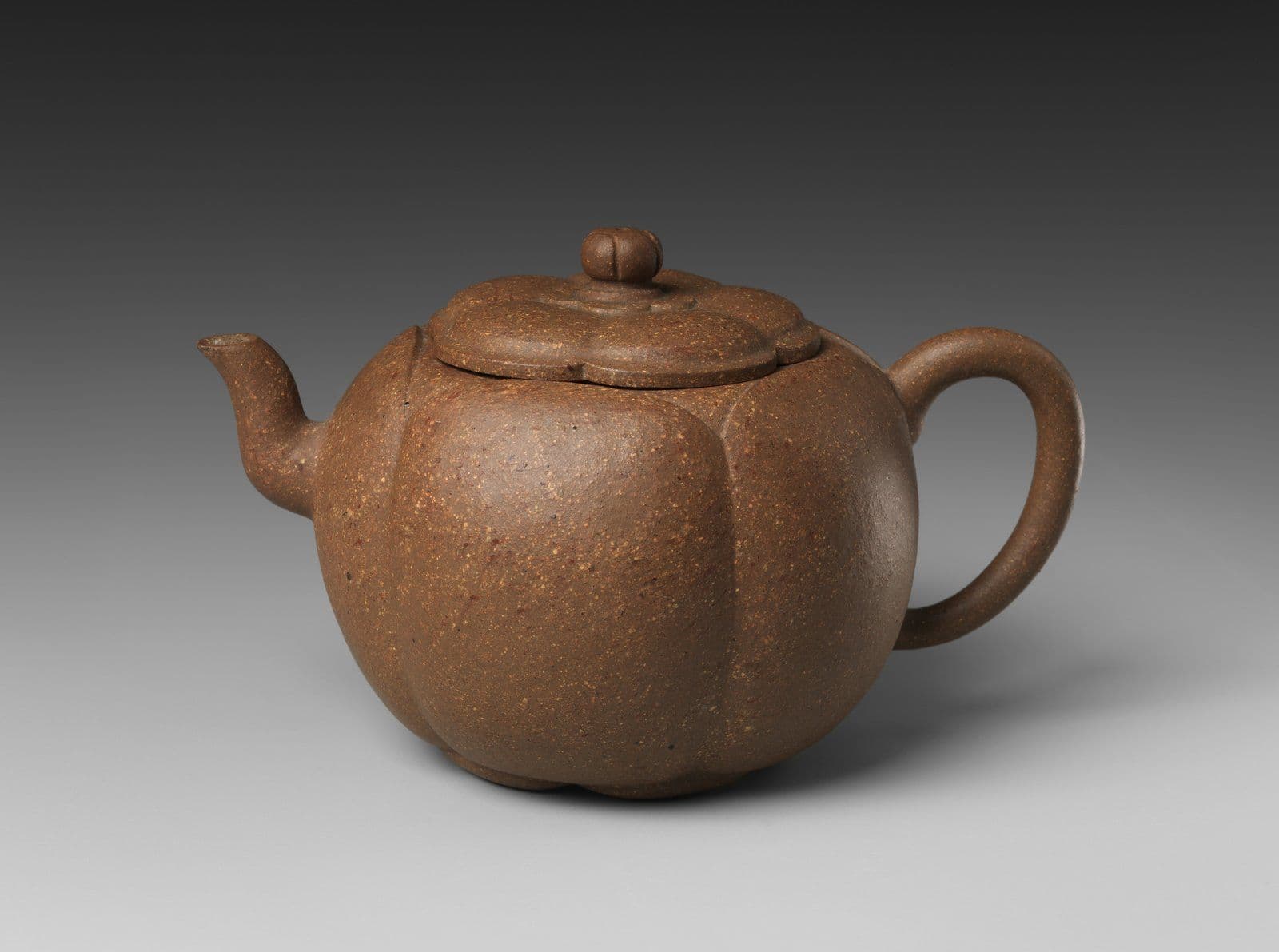
Turn over a small unglazed reddish-brown teapot and you will not find a reign mark painted in cobalt. You will find a square seal pressed into the clay while it was still soft, its characters standing in slight relief, sometimes crisp and sometimes half-collapsed where the potter pressed unevenly. It names a person or a workshop. It does not name an emperor, and it was never intended to.
Almost everything written in English about Chinese ceramic marks is really about porcelain reign marks — six characters, painted, naming a Ming or Qing emperor. Pottery and stoneware run on a different system entirely, and applying the porcelain framework to a Yixing teapot or a Shiwan figure produces immediate nonsense. This guide covers what the other system is, where to look on each of the main wares, and what the mark can and cannot settle.
Why pottery marks work differently
The difference is not decorative. It follows from how the objects were made and who made them.
Imperial porcelain was a court-supervised industry. The mark was applied in cobalt or enamel over the finished body and it recorded the reign under which the piece was made for the throne — the system set out in the Chinese porcelain marks guide. Yixing, Shiwan and the northern stoneware kilns were craft industries organised around named individual potters and family workshops selling to a domestic market. Their marks record the maker, and they are impressed into the raw clay with a carved seal — the same technology as a scholar's seal on paper.
- How it is applied. Porcelain reign marks are painted, under or over the glaze. Pottery marks are impressed into the raw clay before firing.
- What it names. A reign mark names an emperor and a reign. A pottery mark names a potter, a workshop or a studio.
- Where it sits. A reign mark is almost always on the base. A pottery mark may be on the base, under the lid flange, inside the handle end, or on the back of a figure.
- What script it uses. Reign marks use formal regular or seal script. Pottery seals use seal script, often idiosyncratically cut.
- What it tells you. A reign mark tells you the reign claimed for the piece. A pottery mark tells you the hand or the shop claimed for it.
One convention does cross over. The studio or hall name — a two-, three- or four-character name of a real or notional studio — appears on both porcelain and pottery, and functions the same way in each: it is a workshop signature rather than a dynastic date. If you have read our studio marks and hall marks guide, that framework transfers directly to stoneware.
Yixing: three places to look, not one
Yixing zisha ware — the unglazed purple-clay teapots of Jiangsu — is the most heavily marked and most heavily faked of the stonewares, so it repays a systematic look.
There are three conventional mark positions on a Yixing pot, and a serious maker often used all three:
- The base. The principal seal, usually square, giving the potter's name or studio.
- Under the lid flange. A small seal, often just the given name or a two-character abbreviation, visible only when the lid is lifted out.
- Inside the end of the handle. A tiny impressed seal, easily missed, sometimes the only original mark on a pot whose base has been reground.
A pot with a fine base seal and nothing under the lid is not automatically wrong — plenty of ordinary production carries a base mark only. But a pot claiming to be by a documented master should be internally consistent, and inconsistency between the three positions is a standard reason to walk away.
Two things are worth knowing about the names themselves. First, the great Ming and early Qing potters — Shi Dabin above all — have been copied continuously for centuries, and a seal bearing a famous early name on a pot that shows no other sign of age tells you about the copyist's ambition rather than the pot's date. Second, the early nineteenth century produced a well-known collaborative tradition in which scholars designed forms and inscriptions and professional potters executed them; on those pots you may find the potter's seal in the conventional positions and a separate carved inscription and seal from the literary collaborator on the body.
For twentieth-century pots, the vocabulary changes again. State-organised production from the 1950s onward commonly used workshop marks naming Yixing itself rather than an individual, and these are a genuine and collectable category rather than a substitute for a name — they simply record a different production system.
Shiwan: seals on figures, not on bases
Shiwan ware, from the kilns near Foshan in Guangdong, is best known for glazed stoneware figures — immortals, scholars, fishermen — with unglazed or partly unglazed faces and hands. The marking convention follows the object type.
On a Shiwan figure, look at the back, usually between the shoulder blades or low near the base of the robe, and at the underside if the figure is hollow and open beneath. Marks are impressed rectangles or squares carrying a potter's name or, more often, a studio or shop name. Some figures carry two: a maker and a retailer.
A large amount of Shiwan output was never marked at all, particularly ordinary architectural and utilitarian ware. Absence of a mark on a Shiwan figure is normal and says little. What matters more for a figure is the modelling of the face and hands, the quality of the glaze pooling, and the treatment of the drapery — the Shiwan pottery figures guide goes through those judgements in detail.
Cizhou and the northern stoneware kilns
Cizhou ware — the slip-decorated northern stoneware of the Song, Jin and Yuan periods — is the case where a collector must adjust expectations most sharply. The overwhelming majority of Cizhou pieces carry no mark at all.
Where marks do appear, they take two forms. Pillows in particular sometimes carry an impressed workshop stamp naming a family workshop, and these are a recognised and studied group. Separately, some pieces carry inscriptions painted or incised as part of the decoration — poems, auspicious phrases, occasionally dates — which are decorative and documentary rather than marks in the trade sense.
The practical consequence: on Song and Yuan stoneware, marks are so rare that they cannot be the basis of your judgement. Body, slip, glaze, and the character of the brushwork carry the weight. The same is true of the classic tea wares — Jian ware tea bowls of the same broad period are effectively unmarked, and are assessed entirely on body, glaze and form, as our Jian ware tea bowls guide sets out.
What a pottery mark can and cannot prove
Three limits are worth stating plainly, because they are where money is lost.
An impressed seal is easy to copy. Carving a seal and pressing it into clay is a modest technical exercise. Impressed marks carry no more authority than painted ones, and arguably less, because they leave fewer diagnostic traces of hand and hesitation.
A mark dates the seal, not the pot. Seals were inherited, sold, borrowed within workshops and reused for decades. A genuine period seal can appear on a pot made long after the person named on it stopped working.
Absence of a mark proves nothing either way. Large categories of genuine, good pottery were never marked. Treating unmarked as suspect will steer you away from most of the field.
What the mark does give you is a hypothesis, and a starting point for the comparison that matters: this impression against a published impression of the same seal, at the same scale, with attention to the exact proportions and the breaks in the border line. Photographing it properly is the precondition for that comparison — the method in our photographing a mark guide applies to impressed seals as much as to painted ones, with one adjustment: impressed marks need raking light from one side to throw the relief into shadow, where painted marks need flat, even light.
Common questions
My teapot's base seal is illegible. Is that bad?
Not necessarily. Impressed seals blur when the clay was slightly too wet, when the potter pressed at an angle, or when the seal itself was worn from long use. Partial legibility is very common on genuine working pots. What is more concerning is a seal that is perfectly crisp and perfectly centred on a pot whose body, spout and lid fit show none of the corresponding care — a mismatch between the quality of the mark and the quality of the potting.
Do Yixing teapots ever carry reign marks?
You will occasionally see an apparent reign mark on zisha ware, but it sits outside the normal convention and should raise your attention rather than settle it. The default expectation for Yixing is a maker's or studio seal. If a pot presented to you as eighteenth century carries a painted reign mark in the porcelain style, ask why.
How do I tell a modern Shiwan figure from an older one?
Marks will rarely settle it, since studio names were reused across generations and modern workshops still use traditional forms. The more informative evidence is the glaze — older Shiwan glazes tend to pool and break with more variation and depth — along with the modelling of the unglazed face, wear at the base, and the weight and ring of the body. Treat any figure whose only claim to age is its seal as undated.
Is unmarked Chinese pottery worth collecting?
Yes, and much of the best of it is unmarked by nature. Song and Yuan stoneware, most Cizhou, most utilitarian Shiwan and a great deal of ordinary Yixing carry nothing at all. In those fields the market prices form, glaze and condition, not signatures — which is one reason they remain more approachable than the marked porcelain categories.
Further reading
- Reading Chinese Porcelain Marks: A Tutorial — the porcelain system worked through step by step, for contrast.
- Chinese Porcelain Mark Shape Decoder — what the frame around a mark tells you.
- Shiwan Pottery: Guangdong Figures — the ware itself, beyond its marks.
- Republic Period Porcelain Marks — how marking conventions shift once the reigns end.
Browse the collection
Stoneware is a subject we write about rather than one we stock. Kiln & Ink deals in paper: limited-edition archival giclée reproductions of the twentieth-century Chinese ink masters, printed on rice paper or museum-grade cotton rag, hand-numbered, and supplied with a Certificate of Authenticity.
Explore Further