Published August 3, 2026
Ding ware explained: the ivory glaze, carved and moulded decoration, the unglazed mangkou rim, and how to tell Ding from Ding-type white wares.
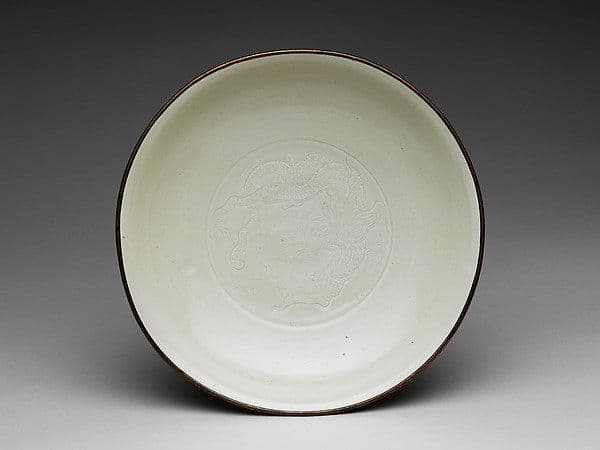
Run a finger around the rim of a Ding bowl and you will find bare, slightly rough clay where you expected glaze — and, very often, a thin band of metal fitted over it. That unglazed rim is not damage and not a shortcut. It is the fingerprint of how the bowl was fired, and it is the single most useful thing to know about the ware.
This guide covers what Ding ware is, where and when it was made, how the glaze, body, decoration and firing marks identify it, how it compares with the other famous Song kilns, and what is realistic to buy.
Where Ding was made, and when
Ding ware takes its name from Dingzhou in Hebei province, in north China, though the kilns themselves were concentrated around Quyang County nearby. Production ran from the Tang dynasty through to the Yuan, with the finest wares generally assigned to the Northern Song and the Jin periods that followed.
The kilns worked in white. Northern China had a longer white-ware tradition than the south — the earlier Xing kilns had already established a market for high-fired white ceramics — and Ding refined it: a fine, dense, pale body, thinly potted, covered in a warm ivory glaze rather than a cold blue-white one. Held to a strong light, thin walls on good pieces show a faint translucency at the edge.
Ding was made in enormous quantity. It served the court at points in its history, and it was also traded widely as high-quality tableware. That combination — imperial-grade at the top, commercial below — is worth remembering when you see a modest bowl described simply as "Ding."
Reading the glaze, the body and the firing marks
Four features do most of the identification work:
- Ivory glaze. Warm rather than blue-toned, thin, and closely fitted to the body. It pools slightly in carved lines, which is how incised decoration reads at all.
- Tear marks. On the exterior of many pieces the glaze has run into drips that stopped mid-flow, often described as tears. They are considered characteristic, though not universal.
- The unglazed rim. Better pieces were fired upside down, resting on the mouth rim, which let potters stack more into the kiln and helped prevent warping in thin-walled forms. The rim could not be glazed, so it was left bare — the mangkou, or "rough mouth."
- Metal binding. That bare rim was often finished with a band of copper, silver, or occasionally gold. A period metal band, worn and slightly loose, is a good sign. A crisp modern band is a question.
Later writers report that the unglazed rims eventually counted against Ding at court, and that imperial taste moved on to other wares. Whether that account explains the historical record or merely tidies it, the physical evidence is not in doubt: upside-down firing is visible on the object.
The forms follow the function. Bowls and dishes dominate, because those are what upside-down firing suits: an open shape rests stably on its rim, and the technique was developed for volume production of exactly this kind of vessel. Beyond them you will meet ewers, small jars and boxes, pillows, and stem cups, along with the occasional figure. Anything unusually large or elaborately sculptural in a supposedly Ding body deserves a second look, simply because the kiln's technical strengths were thin walls and clean cut lines rather than monumental forming.
Decoration falls into two broad families. Earlier work tends to be carved and incised — lotus, peony and duck designs cut freehand into the damp body with a bevelled tool, then combed with fine parallel lines to give texture. Later, and especially in the Jin period, moulded decoration became common: the piece was formed over a carved mould so that dense, symmetrical patterns appeared in low relief. Moulded designs are more crowded and more regular; carved lines have the speed and the small irregularities of a hand.
Ding against the other great kilns
The "five great kilns" of the Song — Ru, Guan, Ge, Jun and Ding — is a grouping made by later connoisseurs rather than by Song potters, but it remains the frame most collectors first learn. Ding is the odd one out in it: the other four are celadon-family or opalescent wares, judged largely on glaze colour and crackle, while Ding is judged on whiteness, thinness and the quality of its cut decoration.
| Ware | Colour family | Judged mainly on ||---|---|---|| Ding | Ivory white | Body thinness, glaze warmth, carved or moulded design || Ru | Pale blue-green | Glaze tone, spur marks, extreme rarity || Ge | Greyish, crackled | The crackle pattern itself || Jun | Opalescent blue, purple splashes | Glaze effects || Jian | Iron black | Hare's-fur and oil-spot effects |
White wares similar to Ding were also produced at other northern kilns and in Sichuan, and the trade name "Ding-type" covers them. The distinction matters commercially: a Ding-type bowl from a secondary kiln is a real Song ceramic and often a good object, but it is not priced like Quyang work.
How Ding has been copied
Ding has been imitated for a very long time, and the copies fall into layers that a buyer should be able to name.
The first layer is contemporary: other northern kilns making white wares in the same idiom while Ding was at its height, for customers who wanted the look at a lower price. These are period ceramics in their own right and are usually catalogued as Ding-type.
The second layer is Ming and Qing revivalism. Later potters admired Song wares and reproduced them deliberately, sometimes with great skill, as homage rather than deception. Jingdezhen made white and ivory-glazed wares that quote Ding forms directly. Their bodies are typically whiter and more vitrified, the glaze sits differently, and the potting rarely reproduces the specific thinness of the originals.
The third layer is modern reproduction for the tourist and decorative markets, which is easy to spot once you have handled a real piece: the glaze is too even, the incised lines are too regular, the weight is wrong, and the unglazed rim — when it is present at all — has been made rather than left.
The fourth layer is deliberate forgery aimed at collectors, and it is the only one that requires real caution. Here the giveaways are usually in the firing evidence and the wear: manufactured "tear marks" that are too uniform and too well placed, artificial abrasion that runs across surfaces a hand would never touch, and metal rim bands that are new inside even when they look old outside.
Buying: what is realistic
Genuine Northern Song and Jin Ding survives in reasonable numbers compared with Ru, but the good pieces have long been in institutional and established private collections, and the ware has been copied since the Ming. Realistic advice:
- Look at the foot and the rim first. Firing evidence is harder to fake convincingly than glaze colour. An unglazed mouth rim with wear consistent with centuries of handling, and a foot ring showing the right tool marks, is where confidence starts. The general method is set out in dating porcelain by the foot rim.
- Weigh it. Fine Ding is thin and lighter in the hand than it looks. Heavy, dull-glazed pieces marketed as Ding are usually later or from another kiln.
- Expect condition issues, and price them. Thin rims chip; metal bands hide chips. Ask what is under the band.
- Distrust marks. Ding is not a reign-mark ware. Incised character marks do exist on some pieces, but a tidy underglaze-blue mark on a supposed Song white bowl is an immediate problem, for reasons covered in apocryphal marks on Chinese porcelain.
- Buy the object, not the attribution. If the piece only makes sense at the price with the best-case dating attached, walk.
For collectors who want the aesthetic rather than the archaeology, later white and monochrome wares reward attention at a fraction of the cost, and a good Ming or Qing white bowl teaches the eye as usefully as a Song one you cannot afford to handle.
Common questions
Why do so many Ding bowls have metal rims?
Because they were fired mouth-down, which left the rim unglazed and slightly rough. A copper or silver band covered the bare clay, made the rim comfortable to drink from, and protected it from chipping. The band was a finishing step, not a repair — though later bands were sometimes added to hide damage.
What are the "tear marks" people mention?
Runs of glaze on the outside of a piece that thickened and stopped before reaching the foot, leaving drop-shaped accumulations. They occur because the glaze was fluid at temperature and the walls were near-vertical. Collectors treat them as a supporting indicator rather than proof.
Is Ding always white?
The classic ware is ivory white, but historical sources describe black and purple-brown Ding as well. Those are rare, and pieces offered under those names deserve considerably more scrutiny than an ordinary white bowl.
How can I tell carved from moulded decoration?
Look at the line ends and the symmetry. Carved lines start and stop with a visible tool angle, vary in depth, and are rarely perfectly symmetrical. Moulded designs repeat exactly, sit in low relief across the whole surface, and often fill the field densely, sometimes with a slightly soft, rounded quality where the mould was worn.
Further reading
- Longquan celadon — the southern green-ware tradition running alongside Ding.
- Dehua blanc de chine — the later white ware most collectors start with.
- Chinese monochrome glazes — how single-colour wares are graded.
- Chinese porcelain condition and damage — how chips, hairlines and restoration are priced.
Browse our collection
Hand-finished works in the Chinese ceramic and ink traditions, each faithfully described. See the collection.
Explore Further